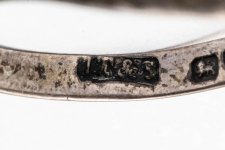
Silver Hallmarks - any knowledgeable folks?

cymruchris

Suspended / Banned
Messages
2,921
Name
Chris
Edit My Images
Yes
I've come across my great grandmothers silver ring - not sure if it was a wedding ring or a betrothal ring or something completely different. I know being silver the value isn't much, but a bit more interested in the history. I've had the macro lens out - and think it's got a Chester hallmark of 1914 - but the stamp of the maker is confusing me a little. Although there's a very clear 'T & S' visible - the size of the stamp seems to indicate that there might have been a third letter at the beginning. I've looked at TT&S - but that doesn't bring up anything - does anyone think I'm seeing more than I should and it's just T&S? I do find a T&S entry for W H Tandy & Sons in Birmingham - but thought I'd rund it past a fresh set of eyes to see if anyone can see something that I'm missing? Do we have any hallmark experts amongst us?
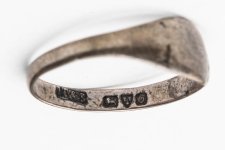
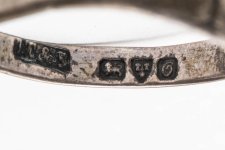
A78I7670.jpg

A78I7673.jpgA78I7672.jpg
 
I have had a dig here

Lion Passant AFAIK= .925 silver
The Wheatsheeves symbol is the Chester Assay Office
The date letter appears to be for the Chester date mark 1739

HTH ?
 
Last edited:
I also found an alphabetical list of Chester silversmiths including two T&S but none/neither that would tally with 1739 assay date.

 
Last edited:
Yes - I'm sure it's 1914 and Chester - due to the slanting O (there's an alternative image if you happen to look at 1914 on some sites).

Was interested in the name of the maker - T&S as I say comes up with a Birmingham company - but the mark looks like it might be more than just T&S - that's where I'm a little unsure as to what I'm looking at....
 
Last edited:
Possibly J.T&S - John Troupe & Sons variant from 1880?
But that would point towards a 1914 date whereas the mark does look more like the 1739 one...

Or perhaps John Thompson & Sons
But again, not compatible with the 1739 date.
 
Found this site that suggest John Thompson and sons

J.T & S
John Thompson & Sons,
Business established in tha late 1860s in London by John Shield Thompson. The style was changed to John Thompson & Son and then to John Thompson & Sons. They are listed as wholesale jewellers at 31 Clerkenwell Road, London until 1916
Sheffield 1913 hallmark

 
Re: 1739 vs 1914

The "O" for 1739 has cut lower corners on the surrounding edge as per in the pictures above but the one for 1914 has a wavy/rippled base on the surrounding edges.

My observation is still for 1739

Copied the date ranges here that zoomed in to the years you can see the difference(s) that I describe.


I was leaning towards the earlier date until I saw the footnote

"NOTE: in most cases the actual date letter contour of the period 1901-1925 is a chamfered corners square (similar to the series 1884-1900)"​


As for the maker, I would see if Chester museum can help. I know that our local museum has a silver expert who specialises in local silver.
 
Found this site that suggest John Thompson and sons

J.T & S

John Thompson & Sons,

Business established in tha late 1860s in London by John Shield Thompson. The style was changed to John Thompson & Son and then to John Thompson & Sons. They are listed as wholesale jewellers at 31 Clerkenwell Road, London until 1916

Sheffield 1913 hallmark

:thinking: when it comes to makers mark(s) I thought they would be more strongly geographically linked to where the assay office mark was located.....in the case of @cymruchris ring the assay office mark is Chester not London.
I was leaning towards the earlier date until I saw the footnote

"NOTE: in most cases the actual date letter contour of the period 1901-1925 is a chamfered corners square (similar to the series 1884-1900)"​


As for the maker, I would see if Chester museum can help. I know that our local museum has a silver expert who specialises in local silver.
As we have both spotted the shape of the letter and the surrounding chamfer shape have a bearing but when I look at both only 1739 seems to match both 'attributes' of letter script shape & corners/chamfer.

As noted by others, I hope Chris can get some meaningful insights from Chester Museum and 100% solve the mystery of the Maker.......I abhor a mystery and would look forward to the clarity on this one :)
 
The makers stamp looks like an over-stamp to me on top of an earlier stamp, looking at the left edge of it. If so, it would explain the possible mismatch between assay date etc. It's not unknown for a piece of jewellery to be "re-manufactured" for resale, eg a wedding band flattened on one side to become a signet ring.
 
The makers stamp looks like an over-stamp to me on top of an earlier stamp, looking at the left edge of it. If so, it would explain the possible mismatch between assay date etc. It's not unknown for a piece of jewellery to be "re-manufactured" for resale, eg a wedding band flattened on one side to become a signet ring.

That’s something I hadn’t considered - so it could be that it’s been through more than one process as two different jewellery types…
 
:thinking: when it comes to makers mark(s) I thought they would be more strongly geographically linked to where the assay office mark was located.....in the case of @cymruchris ring the assay office mark is Chester not London.

As we have both spotted the shape of the letter and the surrounding chamfer shape have a bearing but when I look at both only 1739 seems to match both 'attributes' of letter script shape & corners/chamfer.

As noted by others, I hope Chris can get some meaningful insights from Chester Museum and 100% solve the mystery of the Maker.......I abhor a mystery and would look forward to the clarity on this one :)
In my mind I would have expected the maker to be geographically similar to the assay mark - but I imagine it was possible for a dealer in London to buy a batch of jewellery from another area, and then sell locally in a different part of the Uk…
 
when it comes to makers mark(s) I thought they would be more strongly geographically linked to where the assay office mark was located.....in the case of @cymruchris ring the assay office mark is Chester not London.

I have no idea whether they only sold to locals or whoever wanted to buy regardless of where theycame from, just had some rare spare time and thought the link might be useful
 
I have no idea whether they only sold to locals or whoever wanted to buy regardless of where theycame from, just had some rare spare time and thought the link might be useful
It’s all very useful - and an ongoing learning process :) it’s an interesting question though as to whether it was usual for jewellery manufacturers bought only from their local office - or whether they travelled further afield for better deals (a bit like we do to get cheaper camera equipment!)
 
I have no idea whether they only sold to locals or whoever wanted to buy regardless of where theycame from, just had some rare spare time and thought the link might be useful
When on the hunt for things all inputs can bring extra insights :)
It’s all very useful - and an ongoing learning process :) it’s an interesting question though as to whether it was usual for jewellery manufacturers bought only from their local office - or whether they travelled further afield for better deals (a bit like we do to get cheaper camera equipment!)
For sure and as @lindsay says there can be changes to the suppliers mark to reflect that but one thing AFAIK is that the assay marks don't get changed unless perhaps for nefarious reasons?
 
Found this site that suggest John Thompson and sons

J.T & S

John Thompson & Sons,

Business established in tha late 1860s in London by John Shield Thompson. The style was changed to John Thompson & Son and then to John Thompson & Sons. They are listed as wholesale jewellers at 31 Clerkenwell Road, London until 1916

Sheffield 1913 hallmark


You may find this site of some help, it is a bit of a rabbit hole mind: https://www.silvercollection.it/englishsilvermarksXA3.html

Same one I linked to post 8

Ha!

Totally missed that, sorry.


*Heads off to Specsavers*

Or even in post #2 above ;)
 
Back
Top