

Shooting Table (Infinity Curve) Any tips ? Lighting etc (Lighting from underneath pointers please?)

gothgirl

Suspended / Banned
Messages
1,589
Edit My Images
Yes
Just invested in one of these bad boys,

https://www.calumetphoto.co.uk/product/calumet-desktop-shooting-table/RM1017/
320x320


Here is the ultimate in portability and convenience when it comes to small-product tabletop photography. The Tabletop Studio is a lightweight and compact shooting surface that is perfect for small objects such as jewelry, models, flowers and much more. Consisting of no more than a folding metal frame and a single piece of 24 1/8 x 36 1/8" (61 x 92cm) diffused Plexiglas, the Tabletop Studio sets up in seconds to provide a professional-quality, seamless shooting surface which can be lit from any direction, including below the subject.

It can be placed either on the ground or on any smooth flat surface.
The lightweight metal frame freatures hinged front and rear legs and a hinged back, allowing it to be folded flat, taking up minimum storage or transport space.

Definetly going to be an upgrade from my old piece of it
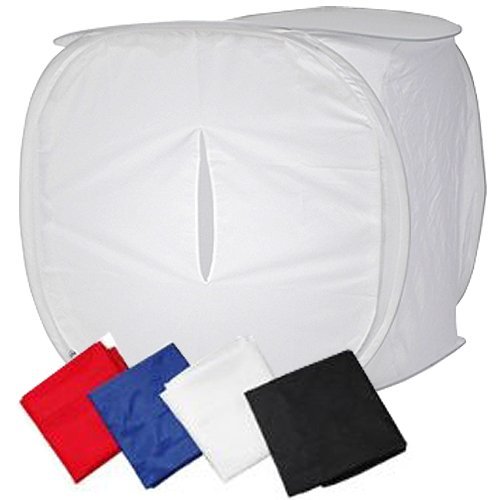
41q6Elim46L.jpg

Which has served me well so far.......

Splinter by Morro Fenrir, on Flickr


but is rather cumbersome and flimsy...

I especially enjoy the idea of the lighting possibilities, including lighting from underneath

Can anyone share any examples, or any tips on using this type of setup, I am very excited to get it :)
 
Light tables were popular with film, as it's the only way to get a pure white background with no shadows. But not easy to use - the under-lighting has to be very carefully balanced and it can be tricky to get it perfectly even.

I bought one a few years ago, used it once, and it's now hanging in the garage. Much easier to do these things in post-processing these days.
 
Light tables were popular with film, as it's the only way to get a pure white background with no shadows. But not easy to use - the under-lighting has to be very carefully balanced and it can be tricky to get it perfectly even.

I bought one a few years ago, used it once, and it's now hanging in the garage. Much easier to do these things in post-processing these days.

I don't expect perfect results, but will be a lot easier to light than the china tent, and wipe clean too!


Sent from my iPhone using Talk Photography Forums
 
I use (a much larger) one a lot, but I agree with Richard that it's best to use it as a product base rather than to underlight it, it's easier to cut out in PP, add reflections and drop shadows in PP too, if required. So, I tend to light the products on it and to use the shape and reflective surface of the table without underlighting it, as in these examples.

The problem with underlighting a large product shooting table is that it's difficult to avoid edge degradation and flare, simply because the product is much too close to the light source.
With a small table, you have the same problem but also have nowhere to put the under lights.
 
Can you suggest your favoured method of lighting ?

Thank you all for your replies :)


Sent from my iPhone using Talk Photography Forums
 
Can you suggest your favoured method of lighting ?

Thank you all for your replies :)


Sent from my iPhone using Talk Photography Forums
That depends on the subject, including its level of reflectivity and texture, and the result that I need to achieve.
But a common starting point is a large softbox, mounted ovehead on a boom arm and angled forwards as well as down.

But, that's just a starting point
 
Can you suggest your favoured method of lighting ?

Thank you all for your replies :)


Sent from my iPhone using Talk Photography Forums

From above, as Garry says.

With under-lighting, you'll find it very difficult to achieve much control. For under-lighting you need as much distance as possible between the table and light, like 3ft minimum, and then the black bar at the back will still cast a shadow. Proper product lighting tables do not have anything running across the back for this reason.

Give it a try, but you may end up just using it as a handy surface with a nice curve behind.
 
Let's see if I can expand on my last answer a bit and be more helpful...

What you've bought is a tool, to be used alongside other tools, it isn't some kind of magic elixier that will somehow produce perfect lighting.
And the most important tool you can use is your own understanding of light. This is an ongoing process, you've made a good start by realising that your light tent is a bit of a waste of time, but now you need to learn how to use light - not so much to use the light that is already there, but to actually create the light and shadows that show your subject at its best.

Youtube is full of videos on lighting, most of them are worse than useless, but you will be able to learn the principles from some of them.
The best book on the subject that I've seen is Light: Science and Magic. I have the 3rd edition, I haven't seen the current (4th) edition but it's probably even better
I've written a tuturial on still life lighting, it will cost you £5.99, other people give their versions away for free, all over the web.
I've written a serious of quick tutorials on the Lencarta Lighting blog, the vast majority were shot on a larger version of your own table. Other people have writtten tutorials there too, but mind are probably more relevant to your question.

What you need to learn is the way that the size, direction and position of the light affects the way the subject ends up looking - it isn't about having enough light, it's about having the right light.

This is your starting sequence.
1. Position your subject on the shooting table
2. Position your camera, fixed to a tripod, to find out the distance that gives you the best viewpoint (the greater the distance, the less perspective distortion there will be, there is an optimum distance for everything)
3. Position your camera at the right height. Try every kind of height variety to see which works best
4. Get a torch or a table lamp, move it around (get someone else to do it for you if you can while you look through the camera viewfinder) and note the enormous difference that different positions make to how your subject looks.

Then, just replace the torch/table lamp with a flash head or similar, this becomes your main light. Then add others as needed.

It's a start, and a logical process.
 
My plan is to have the shooting table on a large table to bring it up to about chest height

Have camera on tripod, an overhead light above the subject, than flash with a diffuser to fill in.

I'll have a search for some more tutorials, appreciate your input :)
 
Back
Top