Shooting people indoors with a 430EX II

ST Colin

Suspended / Banned
Messages
252
Edit My Images
Yes
Hi everyone,

I spend a lot of time taking photos of friends and family indoors, just informal shots, candid stuff.

I don't have any examples to hand but I can't seem to find a good balance of exposure with my 30D and 430EX II. Fill flash leaves a dark background and harsh shadows which is unpleasant (ETTL metering usually) and bouncing from the ceiling of wall leaves faces dull and dark around the facial features (eyes etc).

What other techniques can I use? I've tried manual mode on the flash, but more often than not, it blows highlights out on me.

Hopefully I can get some tips here

Thanks

Colin
 
have you tried bouncing it off the wall and ceiling behind you at a 45 degree angle ? that way you get light hitting the front of the face, plus subtle shadows.

i read it in a magazine a couple of weeks ago :P
 
I've tried various angles of bounces. Some more successful than others.

The white balance is also pretty poor out of the camera too, but that's not a major concern.
 
Hi everyone,

I spend a lot of time taking photos of friends and family indoors, just informal shots, candid stuff.

I don't have any examples to hand but I can't seem to find a good balance of exposure with my 30D and 430EX II. Fill flash leaves a dark background and harsh shadows which is unpleasant (ETTL metering usually) and bouncing from the ceiling of wall leaves faces dull and dark around the facial features (eyes etc).

What other techniques can I use? I've tried manual mode on the flash, but more often than not, it blows highlights out on me.

Hopefully I can get some tips here

Thanks

Colin

try putting the camera on manual and bringing in the background light with a longer exposure, if the bg is about a stop or two below the subjects it makes them pop and the shadows aren't too deep
 
Thanks David,

I shoot in manual, forgot to mention that. I have got into a habit of shooting on ISO400, and sticking around 1/80, f8 or so. I was keeping the shutter speed high enough to stop unwanted blur, and f8 to help give me a decent dof. I usually shoot with a 50mm f1.8 prime of my 10-22 WA lens.
 
Stick the flash on manual and full power. 1/200 and F11 on the camera and work from there. Since I have started using the flash and camera together in "M" my shots have really improved. It may take a bit of tinkering but give it a go. Bounce the flash and use a diffuser too.
 
if it's candid there isn't time to muck about
P mode and then get a 6x4 card, fold in two put it on the vertical head of the camera using a rubber band.
you only need about 1" showing at close-ish range

you'll get the bounce flash, some light to fill in the face and a catch light

p.s I read the title of this thread and immediately thought of the film Goodfellas...
my suggestion was going to be that you put a lot of plastic sheeting down

a bit like this..I used to do this all the time with my 430ex. I've seen wedding pros do it too with manual flash units.
00EbNh-27106484.jpg
 
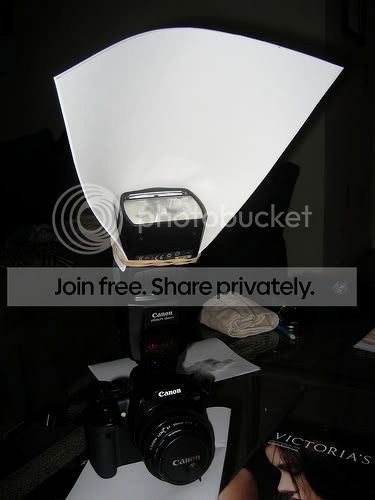
like the post above suggests, bounce cards are very useful. When indoors I use a piece of that white foam card/paper stuff you can get from art shops for around 40p a sheet, and then elastic band it to my flash, kind of looks like this...

bouncecard.jpg


However I dont use one so big... bit overkill, and I also position it so the flash head is positioned length ways rather than how it is in this pic, and the foam wraps around the narrow side of the flash, rather than the broadside (if you follow me). That way its easy to switch from landscape to portrait. Simply aim the flash vertically, and the foam will provide some fill :) - works for me.
 
The reason you are getting a dark background is because your f/number and shutter speed are too high for the ambient light to have a chance to show. And the light is hard because of the direct flash.

You can use manual, but it's not making best use of the E-TTL exposure capability. I would use Av, which will balance the shutter speed to the ambient light automatically. Set f/4 which will still give you a decent enough shutter speed to control background blur. The main subject lit by the flash will always be sharp as the flash duration is extremely short, probably 1/1000sec or less, varying with distance.

Balance the flash and ambient light levels to taste with +/- compensation on the gun to lighten/darken the flash exposure (moderates flash power); change the +/- compensation on the camera to lighten/darken the background (moderates the shutter speed).

To soften the light, use the bounce card method described above. If the ceiling is anything like typical, it gives really nice light. You only need a small card and point the flash directly upwards to the ceiling. Have a look at some of the videos here www.abetterbouncecard.com - I think that guy's a hoot, but he talks a lot of sense.

Using a Stofen diffuser works on the same basic principle. Flash In The Pan sells something similar on here for just £2! See post #3 http://www.talkphotography.co.uk/forums/showthread.php?t=157807 n

Edit: check the handbook for how and when to use the Flash Exposure Lock button with off-centre subjects which is just about the only thing that fools E-TTL.
 
Some great ideas and advice, thanks very much.

Colin
 
Hi Colin (there is surely only one Colin from belfast with an ST?!) :wave:

I can highly recommend a Lambency diffuser which you'll find in the for sale section, look for a post by Flash In The Pan selling strobist gear. They're not expensive and they are well worth it, I don't use flash without it now as it helps reduce (even eliminate sometimes) the shadows on walls and provides a really nice soft even light.

If your background is too dark, increase the iso to let more ambient in.

Also try 2nd curtain sync on the flash, that allows you to drop the shutter speed to say 1/30th which lets more ambient in, and the flash at the end of the exposure will freeze everything (unless the subject is moving fast or dancing) in which case go a little faster, but 2nd curtain allows you to drop the speed more than you might think possible (unless you've already tried it!).
 
Thanks Dave!

I've tried 2nd curtain sync a few times, but I can never seem to get the subject (people) sharp enough. I always end up with too much ambient, light trails etc.
 
Hi Colin (there is surely only one Colin from belfast with an ST?!) :wave:

I can highly recommend a Lambency diffuser which you'll find in the for sale section, look for a post by Flash In The Pan selling strobist gear. They're not expensive and they are well worth it, I don't use flash without it now as it helps reduce (even eliminate sometimes) the shadows on walls and provides a really nice soft even light.

Diffusers like the Lambency, the Fong and little Stofen work on the same principle as a bounce card. They sent most of the light upwards to the ceiling, which is what gives the softness as it's spread over a large area, and part of the flash fowards for some fill light which lifts faces and adds sparkle. They all work extremely well, with very similar final result.

If your background is too dark, increase the iso to let more ambient in.

Raising ISO increases the brightness of the background ambient exposure but will do the same to the flash, so you end up with exactly the same result. You need to alter the ratio between the flash and ambient light and the only way to do that is by using a longer shutter speed.

Also try 2nd curtain sync on the flash, that allows you to drop the shutter speed to say 1/30th which lets more ambient in, and the flash at the end of the exposure will freeze everything (unless the subject is moving fast or dancing) in which case go a little faster, but 2nd curtain allows you to drop the speed more than you might think possible (unless you've already tried it!).

Second curtain sync just fires the flash at the end of the exposure instead of the beginning. It has no effect unless the subject is moving, when it puts the flash at end end of the blur rather than the beginning. You can reduce the shutter speed with first curtain sync in just the same way ('dragging the shutter') which is the technique used when shooting on Av as described above.
 
Back
Top