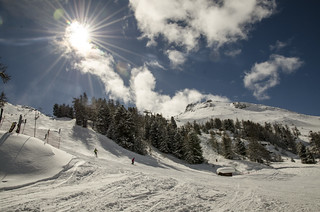
Shooting into the sun.

metroman

Suspended / Banned
Messages
1,298
Name
Brian
Edit My Images
Yes
I actually like shooting into the sun if the subject suits but is it detrimental to the camera's sensor? I ask this as a family friend cautioned me on doing so.

This was shot when we went on holiday last month, I took several others as well but my frind's comment has got me thinking.

8589248245_ea1d4e15f5_n.jpg
 
Sounds like urban myth territory. I have always liked taking into the sun shots. Never had a problem.
Camera makers would be giving product use warnings if damage was likely.
Ask your friend where he got his information.
 
Sounds like urban myth territory. I have always liked taking into the sun shots. Never had a problem.
Camera makers would be giving product use warnings if damage was likely.
Ask your friend where he got his information.

When I used to use my Fuji s9600 bridge camera, a number of other users wrote that they had seen black dots on their images after shooting into the sun, they also cautioned about leaving the aperture open for extended shots as the sensor got hot! Maybe I'm worrying about nothing.
 
If you shoot into the sun, have a think about how long your sensor is exposed to direct sunlight for....thousands of a second?

Your mate is pulling your leg (I hope so anyway)
 
Last edited:
Maybe your friend was thinking about film cameras or thinking you meant to be pointing your camera right at the sun with telephoto lens? There could be any reasons why your friend warned you against doing it. But over the years in the history of photography, people have took photos where the sun had been in front of the camera, and many turned out to be fine.

If you and your friend are worried, then you can cut down the lenght of time you spend pointing your camera towards the sun by doing the following...

Use your hands to frame the subject, picture in your mind how you would like to frame the photo.

Use a light meter if you have one so you don't have to use camera's TTL metering.

If you do not have a light meter, then just point your camera in the general direction, don't waste time fine-tuning your framing, just get a rough frame, use camera's TTL metering to get settings, and take test photos.

When you are happy with your ideas of where to frame the picture and your choice of settings and options, then frame the scene the way you want it, and take photos.

That way, you just try to miniumise the amount of time you keep pointing your camera at the sun. If your friend warns you again, just tell your friend that you're only spending a few seconds pointing your camera towards the sun to take the photos, and that it's not like you're taking minutes and minutes, trying to get the best view, and still trying to get metering right.

 
Maybe your friend was thinking about film cameras or thinking you meant to be pointing your camera right at the sun with telephoto lens? There could be any reasons why your friend warned you against doing it. But over the years in the history of photography, people have took photos where the sun had been in front of the camera, and many turned out to be fine.

If you and your friend are worried, then you can cut down the lenght of time you spend pointing your camera towards the sun by doing the following...

Use your hands to frame the subject, picture in your mind how you would like to frame the photo.

Use a light meter if you have one so you don't have to use camera's TTL metering.

If you do not have a light meter, then just point your camera in the general direction, don't waste time fine-tuning your framing, just get a rough frame, use camera's TTL metering to get settings, and take test photos.

When you are happy with your ideas of where to frame the picture and your choice of settings and options, then frame the scene the way you want it, and take photos.

That way, you just try to miniumise the amount of time you keep pointing your camera at the sun. If your friend warns you again, just tell your friend that you're only spending a few seconds pointing your camera towards the sun to take the photos, and that it's not like you're taking minutes and minutes, trying to get the best view, and still trying to get metering right.


But, unless I'm being really dense, the sensor isn't exposed unless you fire the shutter as it's protected by the mirror (if it has one)
 
The Nikon manual says:
"Do not leave the lens pointed at the sun or other strong light source for an extended period. Intense light may cause the image sensor to detoriate or produce a white blur effect in photographs."

I've never experienced anything bad happened though - other than to self with seing sunspots everywhere! Especially when blinking! :lol:


Guess the "extended" period also may cause quite a heat building up inside camera...

I would be much more worried for the eyes, especially with lenses above 50mm. Permanent damage is a real danger!

Nikon has another warning about protecting you eyes:
... "when operating the diopter control with your eye to the viewfinder, be careful not to put your finger in your eye"! :D
 
Nikon has another warning about protecting you eyes:
... "when operating the diopter control with your eye to the viewfinder, be careful not to put your finger in your eye"! :D

:lol:
 
Use your hands to frame the subject, picture in your mind how you would like to frame the photo.
Use a light meter if you have one so you don't have to use camera's TTL metering.

If you do not have a light meter, then just point your camera in the general direction, don't waste time fine-tuning your framing, just get a rough frame, use camera's TTL metering to get settings, and take test photos.

When you are happy with your ideas of where to frame the picture and your choice of settings and options, then frame the scene the way you want it, and take photos.

That way, you just try to miniumise the amount of time you keep pointing your camera at the sun. If your friend warns you again, just tell your friend that you're only spending a few seconds pointing your camera towards the sun to take the photos, and that it's not like you're taking minutes and minutes, trying to get the best view, and still trying to get metering right.

Such simple advice but it makes perfect sense, thank you, in fact I will adopt the "framing" idea more frequently anyway so as to better compose my shots.
 
Remember reading an article a few years ago where a guy had left his camera on the whole day taking a time-lapse sequence of the sun. Since it was a compact camera, which didn't have a physical shutter, it burned an arc across the sensor (every subsequent image had it).

I think it totally depends on the focal length used, if you are using a 500mm lens pointed directly at the sun, not only can it destroy your shutter, it can also destroy your eyes...permanently.
Here's a similar experience:
http://www.the-digital-picture.com/Help/Flare.aspx

At wide angles I don't think it really matters too much as in the first image.
 
I think there have been cases of mirror box damage where people have left their cameras facing the sun and the lens has acted as a magnifying glass and burned a hole in the internal parts of the camera.

But I think none of us would leave a camera lens up to the sun, would we?

David
 
Think about it....
Boy-Scout lighting fire with a magnifying glass, school-boy burning mates neck with a watch glass, or forrest fires started by disguarded milk-bottles....
Let direct sun fall on & be concentrated by any lens.... stuff gonna get HOT, isn't it?
So, if you leave a Nikon DSLR with the lens cap off sat on a table, pointing up?
You are going to collect them solar rays and concentrate them inside the camera....
With the mirror down and shutter closed the sensor might be quite safe, but who knows what may happen inside the view-finder? And so much of a modern camera is plastic, that doesn't take much heat to start to go bendy or melt, does it?
So the 'care' advice makes sense.
As for the sensor? Well, it is turning light into electrical energy, and them little receptors are not very big... there has to be a point where they will burn out.....
I would hope they wouldn't from the sort of exposure times the camera offers, up to about a minute, without using 'Bulb'... and it has time to dissapate a bit of heat between exposures.... but on Bulb... why you would use such a long exposure, unfiltered direct into the sun beats me, but.... or firing in quick succession, or prolonged pre-view or vid?
I suppose possible that you could put a lot of light on the sensor without chance for it to dissipate.....
Depends what the tolerences are, I suppose.
 
Maybe a warning derived from the old days of cloth shutters?

It wasn't unknown for a pin holes to form on the shutter due to focused light burning a hole.
 
Last edited:
It all depends on the focal length of the lens. With a wide-angle it's not going to be too much of a problem, although I wouldn't leave it pointing at the sun for an extended period. With a tele lens, 400mm or thereabouts, it will fry your sensor in a fraction of a second, your retina in about the same time, your shutter curtains in minutes.
 
Maybe a warning derived from the old days of cloth shutters?

It wasn't unknown for a pin holes to form on the shutter due to focused light burning a hole.

It was, allegedly, a problem occasionally suffered with rangefinder type cameras, eg Leicas. With SLRs and DSLRs, the mirror reflects everything into the pentaprism.
 
Make sure you squat down as close as you can to the floor when taking pictures directly into the sun. That way you are increasing the distance between the sensor and the sun which should help reduce the problem.
 
Make sure you squat down as close as you can to the floor when taking pictures directly into the sun. That way you are increasing the distance between the sensor and the sun which should help reduce the problem.

And get as close to sea level as possible to help even further.
 
Back
Top