

Sensor cleaning after full spectrum conversion

apodo

Suspended / Banned
Messages
600
Edit My Images
Yes
I bought a second-hand full spectrum converted camera, yay! However it has some noticeable dust, boo. And I think both filters have been removed from the sensor, rather than just the UV/IR one or anything else put in place.

Am I correct about this? And if so is it still safe to use a SensorKlear pen as I would normally, or is it just a case of accepting that the spots will need editing out?
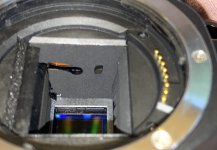
IMG_1965.jpg

Thank you.
 
It should be safe to clean it. The removal of the OEM IR/AA filter causes the focal plane to shift forward, so something has to be installed in its place... it can be a tuned IR pass filter, or clear glass for full spectrum, and that's what you will be cleaning.
 
Last edited:
It should be safe to clean it. The removal of the OEM IR/AA filter causes the focal plane to shift forward, so something has to be installed in its place... it can be a tuned IR pass filter, or clear glass for full spectrum, and that's what you will be cleaning.
Sometimes the position of the sensor is adjusted to compensate for the lack of the filters. The lack of filters also makes each spot more noticeable (as they're closer to the sensor).
I've always been very nervous of cleaning my converted cameras, so I've now have a major cloning job for each shot...
There are non contact cleaning methods like the 'artic buterfly' Which should be perfectly safe.
Sadly I can't find mine currently so may end up trying a sensor pen...
 
Because I bought it from a dealer rather then whoever converted it I have no idea how it was originally done. But the contacts at the edge of the sensor look like they are uncovered, which is what made me think both filters were removed without replacement. Obviously the sensor still has its own layer of glass protecting the actual sensor, I am just worried it may be more sensitive that the front filter which I assume is designed to be cleaned.

I have not tried the camera through the viewfinder to see what the focus is like that way, only a quick test with an IR filter, so I had to use live view which is obviously unaffected. But that was mainly why I bought it so as much as I prefer a viewfinder, if it was not adjusted to focus properly then it will be disappointing but something I could live with.
 
Sometimes the position of the sensor is adjusted to compensate for the lack of the filters.
I have never heard of that... I wouldn't think there would be that much depth of focus adjustment possible.
And without some filtration you would get both UV and long IR which can't usually be focused simultaneously.
 
I have never heard of that... I wouldn't think there would be that much depth of focus adjustment possible.
And without some filtration you would get both UV and long IR which can't usually be focused simultaneously.
Those focus issues are equally true if Quartz is used for the hot mirror replacement, so applies to all Full Spectrum conversions. NB. If glass is used it SHOULD be called a two spectrum conversion, to indicate the UV is lost.

Where sensor movement is employed I believe it is usual to use shims, and it may be necessary to replace the original screws. I didn't compensate on the compact I tried converting myself, and found focus was impossible at any usual distance - that's £3 down the drain unless I do it all again! :)

Filtration in front of the lens allows selection of which wavelengths you photograph, but how different wavelengths focus depends very much on the lens, there are some super expensive 'Ultra Apochromatic' lenses which have very nearly the same focus position for all wavelengths from ~250nm to 1100nm. Sadly I can't even play with one of those they're not just expensive but also rather rare.

The images below were taken through a U330 filter on a full spectrum body, it is formed from UV & NIR only & while not brilliantly sharp is quite usable (both at f/5.6 using a normal lens):
Crocuses by IR2 by Mike Kanssen, on Flickr

Dovercourt park IR by Mike Kanssen, on Flickr

Schott U330 glass is a UV pass filter which leaks considerable IR. It transmits over 70% from 260nm to 390nm (UV), almost no visual light, and up to 45% in the Infra red. These images will be mainly IR due to the glass of the lens reducing the UV.
 
Last edited:
And without some filtration you would get both UV and long IR which can't usually be focused simultaneously.

That is surely the point of a full spectrum conversion over simply having the camera converted to a particular wavelength? You always have to use a filter, but get to choose what sort of light to shoot. While it was infrared I wanted to play with, having previously not enjoyed the long exposure approach, it was the versatility of a full spectrum camera which made it attractive to buy. Which included being able to use it with normal light if appropriate.

Anyway, I have done some quick test shots of the infamous row of batteries and the focusing seems to be fine, so I guess now I just need to overcome my fear of cleaning the dust from the sensor. Eek. Though to be on the safe side I will buy a new pen first.
 
That is surely the point of a full spectrum conversion over simply having the camera converted to a particular wavelength? You always have to use a filter, but get to choose what sort of light to shoot. While it was infrared I wanted to play with, having previously not enjoyed the long exposure approach, it was the versatility of a full spectrum camera which made it attractive to buy. Which included being able to use it with normal light if appropriate.

Due to the lack of UV availability/sensitivity the loss of that end isn't really an issue... even Mike's images taken using a UV pass filter are mainly IR. You can't really make a digital sensor "full spectrum;" the max is ~ 266 - 1350 nm, UV is 100-400 nm and IR is 780 to 1M nm. I've always understood "full spectrum" to mean Visible + IR as opposed to an IR only conversion.
 
Due to the lack of UV availability/sensitivity the loss of that end isn't really an issue... even Mike's images taken using a UV pass filter are mainly IR. You can't really make a digital sensor "full spectrum;" the max is ~ 266 - 1350 nm, UV is 100-400 nm and IR is 780 to 1M nm. I've always understood "full spectrum" to mean Visible + IR as opposed to an IR only conversion.
Full spectrum refers to the full capabilities of the unfiltered sensor which is roughly 250-1050nm for normal cameras (precise sensitivity actually depends on the thickness of the sensor).
There are quite a few converters who misleadingly use the term 'full spectrum' for visible & IR two spectrum sensitivity, but this is not the full sensor sensitivity.
My UV pass filter transmits roughly twice as much UV as it does NIR for much of each region. Pared with a lens that doesn't block UV so heavily it will show far more UV. If you have the funds you can get a Baader U2 filter which is coated to block the IR overtone transmissions seen with U330 & other affordable UV pass filters. Couple that with a quartz (or other special UV transmitting) lens & digital UV photography becomes practical. Dr Klauss Schmidt has a great website exploring imaging at these wavelengths.

You are quite right there is NO sensor in the world that can detect the full range you are referring to, silicon becomes transparent to IR above ~1100nm so other detectors are needed for medium/long IR bands. IIRC Gallium Arsenide sensors are common for mid IR (just one of at least half a dozen used for IR spectroscopy) but these typically can't see much of the near IR let alone visual.

UV below 190nm is classed as vacuum ultraviolet as it is blocked by air in relatively short distances (under 1m). I believe optimised silicon sensors can detect these wavelengths but only in a vacuum which rules out convenient photography for those of us who breathe oxygen :(
 
Due to the lack of UV availability/sensitivity the loss of that end isn't really an issue... even Mike's images taken using a UV pass filter are mainly IR. You can't really make a digital sensor "full spectrum;" the max is ~ 266 - 1350 nm, UV is 100-400 nm and IR is 780 to 1M nm. I've always understood "full spectrum" to mean Visible + IR as opposed to an IR only conversion.

For me full spectrum means having access to the full spectrum of the sensor too, not all wavelengths of light. It is as opposed to being limited to a specific part of the sensor's range and specific sensitivities. Whether that is visible light, as with the OEM filters, or converted to replace the UV/IR filter with another for capturing IR light or for astrophotography.

You can even get DSLR cameras converted to just capture the range of a sensor under 400nm, with all the caveats that come with it. A limited range should not limit your creativity. Though for me it is things like lacking the right lenses and ability which do that!
 
Back
Top