

mike weeks
Suspended / Banned
- Messages
- 4,881
- Name
- mike
- Edit My Images
- No
What about reviewers that don't know their fact from their fiction, or as we say in my world, there are engineers and there are salesmen
Here is an example
Now Elinchrom are using Tail Sync (They call it HiSync), what is really nice is that the transmitter is tuned to the heads so no work required from the photographer to get the best performance but wait
So if you just read that blurb you might think that you were getting all the power still at faster shutter speeds, BUT YOU ARE NOT because as you go above X-Sync the light is captured between the traveling slit formed by the 2 curtains and the faster you go the smaller the slit. When I went to school a smaller slit lets through less light than a wider slit. What this means that along with a reduction in Ambient as the shutter speed increases there is also a linear reduction in the flash light.
Elinchroms own info says
Thing is that would be true if the effective power (light captured) went up as the shutter speed goes up, but the reality is that it may stay proportionately the same (depending on technology it usually goes down) however I am happy to be proven wrong on this as I have not personally tested the HS head and ELB400
So does this combo have a much greater Sun killing effect above X-Sync? I for one would love to see a side by side test against the same setup at or below X-Sync
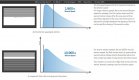
Elinchrom demonstrate on their own info the size of slit gets smaller as the shutter speed goes up, and a smaller shutter speed lets through less light i.e. the power of the flash light is effectively reduced as the shutter speed increases as in you cant suddenly better overpower the sun
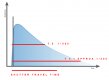
The HS head is variously quoted as 1/550 or 1/600 t.5 which is an issue as the travelling curtain starts just above X-Sync so you need a light source as long as X-Sync so in the Elinchrom situaton it needs to read much longer than t.5 time and much closer to t.1 time and as we can see the power of the flash diminishes over that time which will lead to graduated power across the frame just as the Photo Professional review states
Me, I trust the article written by @HoppyUK in this months Photo Professional and from that I draw the following conclusions
To overpower the sun you need as much power as possible so;
Simplest answer is to Shoot at X-Sync at full flash power
If you need a larger aperture then ND filters affect ambient and flash equally
If you need to stop action then there are 2 choices at the expense of power loss;
If you need Max power and can live with light fall off across the image (depending on subject this may not be or may bevery noticeable) use a variant of long tail sync such as Elinchrom's HS head
If even light across the frame is the priority then you need good HSS (the pulsed light)
Mike
Here is an example
or did he just copy it from the sales blurb?The ELB400 is a 400W/s pack, but because you can shoot at a much faster shutter speed, you can crush your ambient light levels by much more then you’d otherwise be able to, and the overall effect will be akin to shooting with a much larger and more powerful flash at a longer standard flash sync speed like 1/250 of a second
Now Elinchrom are using Tail Sync (They call it HiSync), what is really nice is that the transmitter is tuned to the heads so no work required from the photographer to get the best performance but wait
So if you just read that blurb you might think that you were getting all the power still at faster shutter speeds, BUT YOU ARE NOT because as you go above X-Sync the light is captured between the traveling slit formed by the 2 curtains and the faster you go the smaller the slit. When I went to school a smaller slit lets through less light than a wider slit. What this means that along with a reduction in Ambient as the shutter speed increases there is also a linear reduction in the flash light.
Elinchroms own info says
"When shooting outdoors, in broad daylight, being restricted to a shutter speed or 1/200th or 1/250th second means that quite a bit of flash output (Watt-seconds) is required to overpower daylight.
By accessing higher shutter speeds, we can overpower daylight with less power output (or from farther away)"
Thing is that would be true if the effective power (light captured) went up as the shutter speed goes up, but the reality is that it may stay proportionately the same (depending on technology it usually goes down) however I am happy to be proven wrong on this as I have not personally tested the HS head and ELB400
So does this combo have a much greater Sun killing effect above X-Sync? I for one would love to see a side by side test against the same setup at or below X-Sync
Elinchrom demonstrate on their own info the size of slit gets smaller as the shutter speed goes up, and a smaller shutter speed lets through less light i.e. the power of the flash light is effectively reduced as the shutter speed increases as in you cant suddenly better overpower the sun
The HS head is variously quoted as 1/550 or 1/600 t.5 which is an issue as the travelling curtain starts just above X-Sync so you need a light source as long as X-Sync so in the Elinchrom situaton it needs to read much longer than t.5 time and much closer to t.1 time and as we can see the power of the flash diminishes over that time which will lead to graduated power across the frame just as the Photo Professional review states
Me, I trust the article written by @HoppyUK in this months Photo Professional and from that I draw the following conclusions
To overpower the sun you need as much power as possible so;
Simplest answer is to Shoot at X-Sync at full flash power
If you need a larger aperture then ND filters affect ambient and flash equally
If you need to stop action then there are 2 choices at the expense of power loss;
If you need Max power and can live with light fall off across the image (depending on subject this may not be or may bevery noticeable) use a variant of long tail sync such as Elinchrom's HS head
If even light across the frame is the priority then you need good HSS (the pulsed light)
Mike


