Rollei Infrared advise ?

BADGER.BRAD

Suspended / Banned
Messages
4,252
Edit My Images
Yes
Hello all,

I have just ordered a batch of Rollei RPX400 as a bit of a trial as I did I saw the Rollei Infra red and thought I've got to try a roll. So I'm looking for as much advise as I can get. What are the best subjects ? I know I maybe too late for leaves so am I best keeping it till summer ? What sort of light does it like ? Which filter do I need to use the infra red side of it ? How much should I compinsate for exposure using one of these filters ( I'm likely to use it in an unmetered camera) .Any other info will be much appreciated.

Thanks all.
 
I'm not sure what RPX400 is, is it just extended red sensitivity so not a true IR film, I dunno.
I shot Rollei IR, you could shoot it at box 400 speed and get straight b/w negs or you could shoot it with an R72 filter @ iso12 for true IR negs.
Mileage may vary on the speed but 12 seemed to be good for me.
Blues will be dark so black skys, greens will be very light in the sun light and portraits will be of vampires... :D
 
Last edited:
Stone is a bit light too with sun on it, you can blow stone if you're not careful..:)
 
I seem to remember some proper IR films had issues with the light trap on the cannister and needed to be loaded in the dark, and the film cameras with a "window" in the back showing film model had to be covered, I also remember some changing bags let IR through. But that was a long time ago.
 
In the past I removed and loaded Rollei IR film into my C220 in subdued shade and it was OK. A TLR is ideal too, as the IR filter can stay on the taking lens, makes focusing and composition easy. Also best to bracket exposures. Now I would wait until next summer for shooting in the UK.
 
Thanks everyone, as suggested I'll keep it for next summer and get on with trialing the RPX400 various cameras.
 
I shot some Rollei IR over the past year, see https://www.talkphotography.co.uk/t...res-of-dundee-on-rollei-infrared-film.741558/ for some examples. It does need a lot of light as the film itself is really more around ISO 200 than 400 and the required R72 filter absorbs about 4-5 stops. For the best IR effect, you need to shoot around midday when the sun is right overhead and maximal IR is being reflected, so I would keep it until May or so. I do describe in the thread about how I shot it, which should give you an idea of what you need to do. It does also work very nicely as normal film as well and I had a mix of IR and non-IR pictures on the same roll.
 
Lenses work by bending light to a focus; different optical materials have different bending powers - it's called refraction and the amount of bending is the refractive index. Unfortunately, the refractive index varies with the wavelength of the light (which determines what colour we see). This means that a single element lens (one piece of glass) can't focus all colours to the same point. There are ways around this; with more than one element, you can juggle curvatures and positions, and also use materials with different dispersions (the difference between how much the blue and red ends of the spectrum are refracted).

Lenses were called achromatic when two colours could be brought go to common focus, and apochromatic when all three could.

In the early days of photography, only blue light registered on film, then green was added to give ortho film, and finally red to give panchromatic film. And hence why lens designers were playing catch up.

IR wasn't part of the game, and comes to a focus at a different point to visible light. Many lenses on 35mm cameras had an IR focusing mark so that you could adjust the focus. On view cameras with no such mark, you can calculate the compensation, but you don't need to know that (yet :)).

And if we really want to be pedantic, visible light covers a range of wavelengths from about 4000 to 7000 Angstroms (modern physicists don't use Angstroms, but a different unit 1/10th the size) and what lens designers do is pick three specific wavelengths to bring to a common focus.

More than you probably wanted to know, but I hope I wasn't too confusing in the explanation.
 
IR wasn't part of the game, and comes to a focus at a different point to visible light. Many lenses on 35mm cameras had an IR focusing mark so that you could adjust the focus. On view cameras with no such mark, you can calculate the compensation, but you don't need to know that (yet :)).

A good explanation from Stephen. My two-pennorth is that I've shot quite a lot of IR and have never adjusted the focus to account for the wavelength difference. My subjects have usually been landscapes with the point of focus at least 12 feet away, and I embrace softness in my IR images.
 
Thank you for your explanation Stephen simple, easy to understand and informative !
 
My notes from the last year or so show that it's about 6 stops for a 720nm filter. That's about ISO 6. I don't tend to mind going a bit over. I think it's a really well priced film for what it can deliver. Works really nicely with the R72 filter, but also quite well with a standard red filter (which will likely mean you can shoot at 50 which is far more manageable!)

It's not so bad for shooting at other times than the summer. A blue sky and lots of green often help make the images dramatic.

Similar to Kevin, I've shot quite a bit of IR film, and with the Rollei stock, I've never had an issue with mis-focus. I wonder if that's much to do with the landscapers "f/11 at 24mm" = massive depth of field so "minor" issues are just not noticed. Also, with it not being a true IR film and just having very extended red sensetivity, a degree of non-IR light in the image will still need to be focused. I don't know. One for the clever people that one.

If your exposure times get over 1 second (which they can at ISO 3), you also need to consider reciprocity failure and adjust the exposure times even further. I wrote an article on it here: https://www.ianturpin.co.uk/post/rollei-400-infrared-reciprocity-testing if you're interested. Rule of thumb is to add a stop if your exposure is over 1 second, and it's quite a flat scene, and add 2 stops if it's contrasty, or you really want shadow detail.

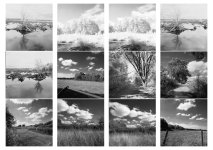
This from January, no filters, just straight B&W. Stands up nicely as a good all purpose B&W film.
2022-01-14-rollei400ir-hassy.jpg


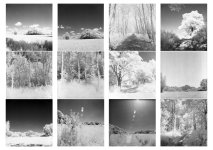
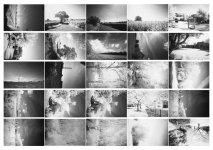
This from September. The first 5 frames are with an R72 where I cocked up the exposure. The Last 7 are with a standard red filter. You can get some nice dark skies, but the greens just don't pop.
2022-09-02-ir400-503cw.jpg

Finally, this from June with an R72 on a sunny day. You can see there's far more IR light to reflect off the greenery giving lovely fluffy whiteness. I think I was using about a 6 stop estimate for the R72 which I reckon is spot on. Frame 4 looks perfect whilst frame 7 is over-done so my metering is clearly suspect.
2022-06-23-ir400-503cw.jpg
 
Thanks for you information Ian. I take it that with proper IR film no filter is needed ?
 
Last edited:
On focus issues, if you have a lens with an IR focusing mark, you can verify that in most cases the depth of field will cover the focus shift.

If a film is sensitive to IR only, then no filter would be needed. I know of no such film, as without some extra treatment (basically adding dyes to the emulsion) the silver salts are sensitive only to the blue end of the spectrum.

Disclaimer: I've only ever used 1 black and white IR film, a Kodak one back inthe 1960s. I have used a fair amount of High Speed Ektachrome IR film, which gives interesting co,our slides.
 
Thanks for you information Ian. I take it that with proper IR film no filter is needed ?
I've only ever used Kodak HIE and Konica 750 which I believed to be "true" IR. In both cases I've only tried them with a red filter - mainly because I was after the Simon Marsden look which I believe was HIE with a red filter. The problem is that as neither film is made any more, it's "expensive" to practise with, and all the rolls are out of date & eBay bought, so there is no true idea of how they have been stored. One thing's for sure - they don't give great results if the light is poor....

Kodak HIE
2021-06-06-kodakhie-f1n.jpg

Konica 750
2021-08-28-konica750-t90.jpg
 
Hello,
If need is only for some technical reason such as aerial surveying then use a R72 filter. However if it is an ir "look" you want a red filter works well, sdd a polariser and it gets you quite close to true ir without having to buy an R72.
Focus adjustments need to be made for near distance subjects especially if using an R72.
IR light cuts through haze so is good for marine observation if you want to identify ships etc. It can also show disturbed earth so it can be used for archaeological surveying finding buried infrastructure and some "forensic" applications. In spring and summer a buried wall foundation in a field or the site of an old pit or ditch can show up as these areas hold more or less water than the surrounding land.
IR film is not sensitive enough to record heat loss.
 
Back
Top