Reverse lens photography

Pembrokeshire Photography

Suspended / Banned
Messages
61
Name
Anthony
Edit My Images
No
Hi all, I am interested in macro photography and currently trying to choose and save up for a true macro lens. I have heard that reverse lens macro photography is a very good alternative method, until i can afford the real thing.

does anybody have any experience of this method?

as much help and advice will be greatly appreciated

I have tried searching but couldnt find anything on this subject.....so apologies if this has been asked before!
 
I've used a reversed lens for macro and you can get pretty decent results, if you're patient and don't get easily frustrated :)


Zebra Spider juvenile by Michael B O'Brien, on Flickr
I used a Pentax 50mm, reversed onto M42 tubes and an M42-EOS plain adapter.
The downside is stopped-down metering and more importantly for me, focussing. The viewfinder image is very, very dark at f11 up!


Now I use auto-tubes with a non-reversed Canon EF 50mm. Focus wide-open and the camera stops down :) With a full set of tubes, I can get 1:1.

Segestria Senoculata by Michael B O'Brien, on Flickr
There's another way, which I've personally not tried, and that is to reverse one lens onto another. So for example, stick your kit zoom normally onto the camera and using the filter threads with the right adapter ring, reverse another lens onto it. I've seen good results on Flickr this way.

The cost of tubes is a little higher than a reversing ring but for me, I felt it was worth it. I have cheapo-plastic tubes but no probs for my light use.
 
Last edited:
great pic Mike, I only have one lens at the moment, i will do some digging into the ext tubes. many thanks
 
another cheap way into macro is to get a raynox dcr 250, it clips onto lens,
i paid £50 for it on amazon, got some half decent pics with it, all you need is technique and patience :lol:
 
I've tried reversing one lens on the front of another using a reversing ring, which seems to work well, giving results like this:

IMG_4507 by m.rodgers1, on Flickr
Even if you only have one lens at the moment it might be worth picking up a cheap FD mount (the mount that old canon film cameras used) 50mm lens from ebay to reverse on the front of the kit lens (that's what I use, already had the old 50mm lying around though).
 
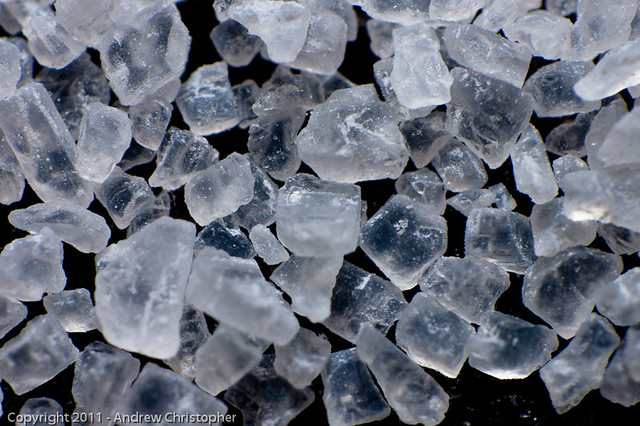
The biggest problem at this level magnification is getting a usable depth of field, even set at f10 I could only get a grain of table salt in focus (see below.)
There are no electrical connections to controll the lens so aperture and focus will need to be set manually. There is a trick to doing this on auto lenses.
Higher apertures are needed to get a reasonable DoF and as Mike said it makes the viewfinder (and exposure) very dark as the aperture needs to be set before taking the shot so high iso may be needed.
I'd also recomend off camera lighting as, getting this close, the lens will block the light from a standard flash. Although DIY modifications with milk cartons and pringles tubes to bounce the light do work.
Overall it can be tricky but using a £3 adaptor has saved me £600 on a lens :)

I do also have some cheap extention tubes which work well but have the same problems as the reversing ring, plus moving the lens further away from the body, with long lenses, will unbalance the camera and make it awkward to hold one handed.
A set of Auto-focus tubes with electrical connections is on my shopping list :)

My favourite shot with a reversed lens (EF20-35mm @ 20mm)


Wasp by Andy_S_C, on Flickr

And standard table salt:

Salt Crystal Macro by Andy_S_C, on Flickr
 
Back
Top