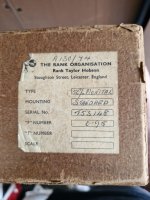
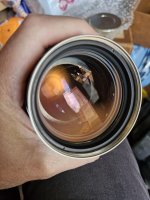
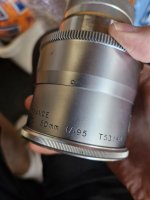
This is a thread to find a bit more about this lens and to record it's existence since I was not able to dig anything on it on Google.
I've came across this lens on eBay last weekend and unfortunatly was not able to acquire it, it appears to be sold off the auction in the end and I was unsuccessful to top the offered price (as much as I'd like to have it). But the seller (Chris Davies, a photographer as well) kindly gave me his permission to use the photos of this lens to preserve information about it. Some of the infomation below comes from his descriptions as well.
The lens is made by Sopelem of France for Taylor Hobson, when T.T.H. were owned by the Rank Organization, it is a 50mm F/0.95 lens. The lenses were apparently made for UK specifically (this is as much as I could find on the internet).
It has a large number of elements, which look to be of rare earth glass. It has a C mount, probably Bolex.
The lens were designed to be used on 16mm cinematic cameras but it appears to be adaptable for photographic use (and appears to be enough to cover 35mm frame). Unlike other ultra fast lenses used on TV or X-Ray equipment, this lens have a larger back register - standard for 16 mm cine cameras and is around 17mm. Although it is still lower than Nikon or Canon lens register it makes it much more usable than those other ultra fast lenses and makes a portrait photography possible. Furthermore, it seems that it may be possible to use it for a full potential and infinity focusing with new micro four thirds mount (due to their small lens register and no mirror).
The lens weighs a staggering 1.35 kilos.
It is 130 mm in length, including the original lens hood. Diameter of the front element is 61 mm.The aperture of the rear mount is 22.5 mm.The distance from outside of rear protrusion to lens surface is 19.1 mm.
What sets this apart from other ultra fast lenses (like Rodenstocks, Fujinons etc) is that it does have a build in iris. The diaphragm itself has 5 blades. The iris is a smooth one and does not have a predefined clickable positions. It stops down to nothing, as do many cine lenses.
There is no focusing mount, but it looks as though the black part of the barrel, at the rear, could be removed. This would reveal a large rear element, which might mean it could cover more than the 16mm format it was used for, and a clever technician might be able then to attach a focusing mount.
If anyone knows more details or history about these lenses, please do share it here. I'd be very interested to find out more about it.
The photos (with permission of Chris Davies):


I've came across this lens on eBay last weekend and unfortunatly was not able to acquire it, it appears to be sold off the auction in the end and I was unsuccessful to top the offered price (as much as I'd like to have it). But the seller (Chris Davies, a photographer as well) kindly gave me his permission to use the photos of this lens to preserve information about it. Some of the infomation below comes from his descriptions as well.
The lens is made by Sopelem of France for Taylor Hobson, when T.T.H. were owned by the Rank Organization, it is a 50mm F/0.95 lens. The lenses were apparently made for UK specifically (this is as much as I could find on the internet).
It has a large number of elements, which look to be of rare earth glass. It has a C mount, probably Bolex.
The lens were designed to be used on 16mm cinematic cameras but it appears to be adaptable for photographic use (and appears to be enough to cover 35mm frame). Unlike other ultra fast lenses used on TV or X-Ray equipment, this lens have a larger back register - standard for 16 mm cine cameras and is around 17mm. Although it is still lower than Nikon or Canon lens register it makes it much more usable than those other ultra fast lenses and makes a portrait photography possible. Furthermore, it seems that it may be possible to use it for a full potential and infinity focusing with new micro four thirds mount (due to their small lens register and no mirror).
The lens weighs a staggering 1.35 kilos.
It is 130 mm in length, including the original lens hood. Diameter of the front element is 61 mm.The aperture of the rear mount is 22.5 mm.The distance from outside of rear protrusion to lens surface is 19.1 mm.
What sets this apart from other ultra fast lenses (like Rodenstocks, Fujinons etc) is that it does have a build in iris. The diaphragm itself has 5 blades. The iris is a smooth one and does not have a predefined clickable positions. It stops down to nothing, as do many cine lenses.
There is no focusing mount, but it looks as though the black part of the barrel, at the rear, could be removed. This would reveal a large rear element, which might mean it could cover more than the 16mm format it was used for, and a clever technician might be able then to attach a focusing mount.
If anyone knows more details or history about these lenses, please do share it here. I'd be very interested to find out more about it.
The photos (with permission of Chris Davies):