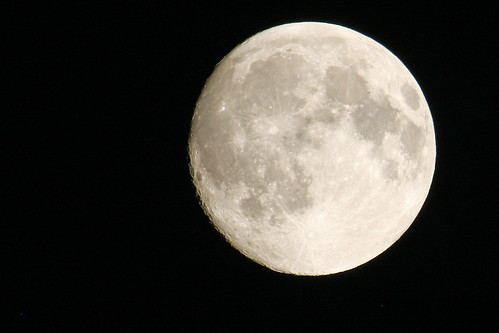
quick question, what lens to for closeshots of moon?

jjcool

Suspended / Banned
Messages
9
Edit My Images
Yes
hi just a quick question,

i currenty have a good telescope,however would like to start takeing pictures of the moon and stars.

however im pretty new to all this and my first camera has a 18-55mm lens and is no where getting close to take very close pictures of the moon.


what sort of lens am i going to have to buy to get real close pictures of the moon etc.;)

thankyou
 
You'll get useable shots from a 300mm, much better from a 500mm, really good from a 1000mm but an empty wallet to go with it.
 
hi just a quick question,

i currenty have a good telescope,however would like to start takeing pictures of the moon and stars.

however im pretty new to all this and my first camera has a 18-55mm lens and is no where getting close to take very close pictures of the moon.


what sort of lens am i going to have to buy to get real close pictures of the moon etc.;)

thankyou

There are some attachments available that allow you to connect a DSLR to a telescope like - these
 
You'll get some great shots @ 300 when cropped (not resized). I've recently been fiddling with a william optics 60mm refreactor and my DSLR through a t-ring and tbh, it's so fiddly that the results I got with a 300mm lens were better. But I probably just need more practice with the scope :)
 
I think vibration is the big problem with using a scope and adaptor. The telescope is so long the vibration of the mirror slapping up and down can ruin the shot. I've tried it myself on a cheap scope but the results were not good partly through vibration and partly through poor optics.
 
hi just a quick question,

i currenty have a good telescope,however would like to start takeing pictures of the moon and stars.

however im pretty new to all this and my first camera has a 18-55mm lens and is no where getting close to take very close pictures of the moon.


what sort of lens am i going to have to buy to get real close pictures of the moon etc.;)

thankyou

What scope do you have? If as you say it's a good scope that is most definitely the thing to use :) also what camera are you using?
 
my camera is a canon d300 mate only a cheap scope.

how would a 400mm perform?
 
This is a view that I took at about 400mm.
You need to watch your exposure carefully as the moon is a very bright object (bracket around 1/250).
1659086487_37e98fb481_o.jpg
 
Wow that's pretty damn good! Hmm.. I may have to expand my lens range...
 
cool thats great picture.

question i seen a cheaper lens

400mm telephoto telephoto lens T2 or M42, chap said i would need a adaptor which are avalible to fit a canon dslr.

M42 or T2 fit (will fit most digital or film slr with adapter)

Focal length 400mm (use a 2x converter to get 800mm)

F6.3 to F32 aperture range

Filter diameter 72mm

useing a 2x converter to get 800mm are these any good?
 
my camera is a canon d300 mate only a cheap scope.

how would a 400mm perform?

400mm would be adequate for the moon, but if you wanted a full frame image you would need to crop, which isn't a problem. TBH even cheap scopes (if it gives decent views through the eyepiece? you should be able to get decent shots attaching the camera :) it takes a bit of trial and error but well worth the effort.

This was taken with a S/H £100 scope no tracking the camera was an Eos 30D

moon8.jpg


Steve
 
This is a view that I took at about 400mm.
You need to watch your exposure carefully as the moon is a very bright object (bracket around 1/250).
1659086487_37e98fb481_o.jpg

Wow really nice pictures im amazed! How much cropping was needed for the above. 400mm! Could you do similiar with a 300mm? Or would too much cropping loose detail and quality?
 
If i was you i would pm j.palmer. Here is a thread he did a while ago using a 600mm scope i think and some other bits but i don't think he spend to much money on his gear (i could be wrong mind you) and his pics are stunning
http://www.talkphotography.co.uk/forums/showthread.php?t=50058

Mind you i havn't seen him on here for i while i hope everything is ok with him :thinking:
 
I would try and use the telescope if its a good one as you say. But how close do you want to get?

This was with a 2000mm f10 lens (my 8" telescope) and a relatively cheap ccd camera. A lot of cheap webcams can be used too ( especially those with a Sony chip in them) Or you could get an adapter and mount your dslr on the back.

2649273854_9b4002e8e1.jpg


Allan
 
I would try and use the telescope if its a good one as you say. But how close do you want to get?

This was with a 2000mm f10 lens (my 8" telescope) and a relatively cheap ccd camera. A lot of cheap webcams can be used too ( especially those with a Sony chip in them) Or you could get an adapter and mount your dslr on the back.

2649273854_9b4002e8e1.jpg


Allan

That is a stunning shot.
 
I think vibration is the big problem with using a scope and adaptor. The telescope is so long the vibration of the mirror slapping up and down can ruin the shot. I've tried it myself on a cheap scope but the results were not good partly through vibration and partly through poor optics.

Could always shoot in liveview, then the mirror won't move at all :)
 
Another way to get over vibration caused by mirror slap is to set a long exposure and use a piece of dark card over the lens. Release the shutter with the card over the lens, remove the card, count the correct exposure, either put the card back over the lens and wait for the shutter to close or just wait till the exposure is complete.
May need a bit of trial and error, but thats how they took photos in the early days of cameras.
Allan
 
Here's a quick visualisation of what size image you'll get with a 1200mm lens.

I took this shot of the moon with a Canon 350D and 100-400L at 400mm, with a 2x Extender, hence 800mm. But it was slightly cropped during post processing, so what you're looking at here is roughly what the moon would look like through a 1200mm lens (on a camera with a 1.6x crop factor: hence roughly 1800mm full-frame equivalent).

256500110_nT4AU-L.jpg
 
@400mm on a 40D, uncropped....

20080618_012613_5799_LR.jpg


100% crop....

20080618_012613_5799_LR-2.jpg
 
Another way to get over vibration caused by mirror slap is to set a long exposure and use a piece of dark card over the lens. Release the shutter with the card over the lens, remove the card, count the correct exposure, either put the card back over the lens and wait for the shutter to close or just wait till the exposure is complete.
May need a bit of trial and error, but thats how they took photos in the early days of cameras.
Allan

I expect the D300 has mirror lockup which would do that, another tip would be to lay a bean bag on top of the scope to dampen vibration.
 
I expect the D300 has mirror lockup which would do that
It does. Rotate the shooting mode dial all the way anti-clockwise, press the shutter all the way to put the mirror up, give a suitable amount of time for everything to settle (3-4 seconds does it for my 300mm f/4.5 on a good tripod) and then press the shutter again to take the photo.

Pressing the shutter on the camera will just reintroduce shake though, so it's best to use a remote cable like the MC-36.
 
Any pics i took of the moon i set camera to mirror lock up and used the self timer, press the shuter button then by the time the camera takes the pic it should have settled down after you pressing the button (seems to work for me might be wrong ) :D
 
I have a hoooj Meade 10" LX200 GPS scope (think R2D2) And I keep meaning to get an adaptor for my camera. Now I have a 40D to do it justice I may well get one now. That site with the adaptors looks very appealing. A setup like that and you would see the Clangers waving at us!
 
Hey, your right. Taken with my Meade 10" LX200 gps

mjrckn.jpg


Allan
 
400mm would be adequate for the moon, but if you wanted a full frame image you would need to crop, which isn't a problem. TBH even cheap scopes (if it gives decent views through the eyepiece? you should be able to get decent shots attaching the camera :) it takes a bit of trial and error but well worth the effort.

This was taken with a S/H £100 scope no tracking the camera was an Eos 30D

moon8.jpg


Steve


That's a stunning shot! :clap:
 
Thats certainly a very impressive shot. A lot of people have to do a mosaic of shots and join them together to get that sort of detail, mind you, I wouldnt fancy hand holding that lot!

Of course, when you start getting that sort of detail, the next thing to start photographing are the planets.

Allan
 
How come it is so sharp? Surely with that sort of magnification and going through 2 TCs, there would be some sort of image degredation?
 
Wow, the examples here make my efforts look like complete cack. I already knew they were cack, but you guys are doing a great job of rubbing it in :)
 
Hi Tim,
there is nothing wrong with your pictures, settings or technique.
The Full Moon is extremely difficult to photograph and I would suggest that if you took photos of it in two different months using the same settings, the results will be different.
My suggestion is to persevere with your settings (maybe bracket exposures), try a non-full moon which increases contrast and take lots of shots using a tripod and remote release.
You will get pleasing photographs with practice and good seeing (atmospherics).
 
I'm surprised at the stacked TC shot too. Tried yesterday with 100-400 + 1.4x + 2x and it was really soft. Just the 1.4x was ok though. Here's one that came out ok


As you don't get a huge amount of contrast except at the terminator (is that the right term for the edge bit in shadow?), could you do a series of shots from new to full moon and post process it so that all the high contrast crater bits are put together?
 
Hi JJCool

I took this with a Tamron 200-500mm last night (its for sale if you want to have a look here Tamron 200-500mm F5-6.3 (Nikon Fit) , (sorry don't know how to link) in the for sale section.

The-Moon.jpg


Its a crop but I'm quite happy with it.

Cheers

Andy

Sorry just noticed you use Canon, this is Nikon. Note to self... read all of the post. :bonk:
 
Thats looking nice, lots of contrast and detail.
Taking a picture of a full moon is difficult, more detail ( and IMHO more interesting shots) are shown when the moon is showing as a crescent.

Allan
 
Hi Tim,
there is nothing wrong with your pictures, settings or technique.
The Full Moon is extremely difficult to photograph and I would suggest that if you took photos of it in two different months using the same settings, the results will be different.
My suggestion is to persevere with your settings (maybe bracket exposures), try a non-full moon which increases contrast and take lots of shots using a tripod and remote release.
You will get pleasing photographs with practice and good seeing (atmospherics).

Thanks, mbscad :) I tried again tonight - cropped and reproduced at 50% size. 40D, 100-400 at 400mm and Kenko 1.4X teleconverter. I think the lighting has improved a bit compared with my previous effort and I also think the atmosphere is a bit clearer tonight as well.

EXIF will show 400 ISO, 1/200, 400mm and f/8 because I have taped the teleconverter to maintain autofocus function (not used for this shot). Correct EXIF is 400 ISO, 1/200, 560mm and f/11.

2868109407_2348b47329_o.jpg
 
Tried again tonight - cropped and reproduced at 50% size. 40D, 100-400 at 400mm and Kenko 1.4X teleconverter. I think the lighting has improved a bit compared with my previous effort and I also think the atmosphere is a bit clearer tonight as well.

Tim
That shot is excellent, really well capured and loads of detail :thumbs:

Steve
 
Thanks, Steve. I think conditions may still not be perfect because this was shot 1 stop brighter than the recommended "moony 11" exposure, and it is far from bright according to the histogram. I focused manually, using 10X Live View and a 10 second self timer to avoid shake. The camera was on a tripod, with legs fully extended and (shock horror) the centre column up by a few inches as well. This has given me new hope to try again when, hopefully, the sky might be even clearer.
 
Thanks, Steve. I think conditions may still not be perfect because this was shot 1 stop brighter than the recommended "moony 11" exposure, and it is far from bright according to the histogram. I focused manually, using 10X Live View and a 10 second self timer to avoid shake. The camera was on a tripod, with legs fully extended and (shock horror) the centre column up by a few inches as well. This has given me new hope to try again when, hopefully, the sky might be even clearer.

Tim
I doubt that you could have got that shot much better and from what you say you have used all the best methods i.e. tripod, self timer, manual focusing etc :clap: Rules are OK, but a just a guide :) You've nailed focus and got the exposure right and that's spot on IMHO so well done and take as many as you can and keep sharing :thumbs:

Steve
 
Back
Top