Quick aperture question...

simonmoran

Suspended / Banned
Messages
401
Edit My Images
No
So I understand that the lower the f number, the bigger the aperture, the more light comes in (ignoring the shutter speed for now). I also understand that the bigger the aperture, the shallower the dof.

But can someone explain exactly why this happens? Why does increased light obtained through a bigger aperture lead to a shallower dof?

Thanks

Si
 
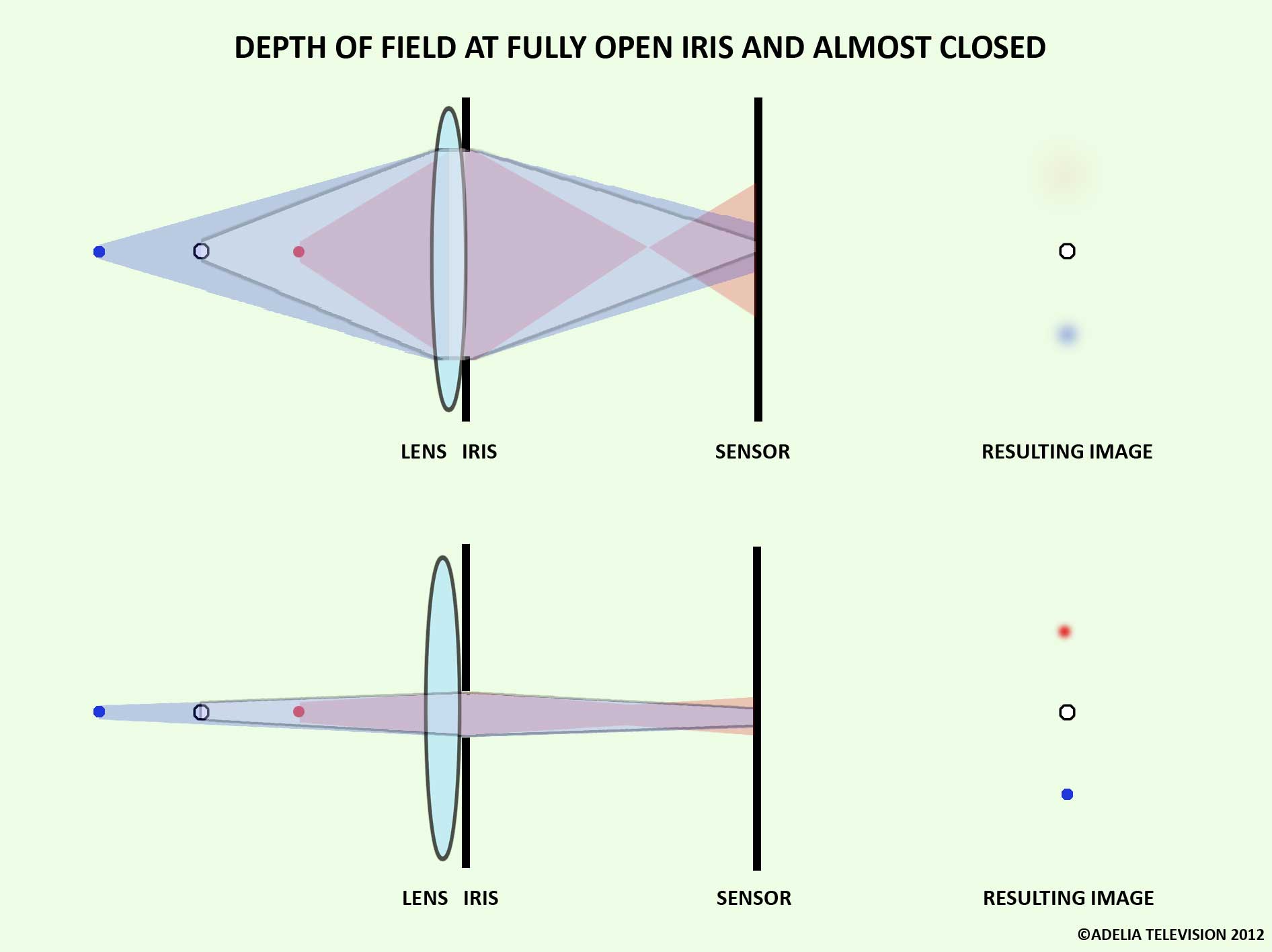
This type of diagram helped me get it in the beginning.

Notice the three points to the left and how the 'light cones' enter the lens and then converge or focus on the sensor (or focus just before or just behind) depending on the aperture being wider or otherwise. Sorry I don't know enough of the optical/technical terms to describe. Hopefully one of the experts will chip in:thumbs:


Source: http://www.adelia.co.uk/depth-field-creative-filmmaking/
DOF-diagram.jpg
 
Last edited:
Depth of field is all about magnification, ie physical dimensions. The diameter of the aperture, focal length, shooting distance, sensor format, output size (print), and viewing distance. They all affect DoF.

Depth of field is an illusion. In theory, it doesn't exist and there is only one point of sharpest focus in the image. However, the concept of DoF relies on the fact that the human eye cannot detect any detail smaller than 0.2mm wide when a print 10in long is viewed from a distance equal to the diagonal, ie 12in (though it also works for larger sizes, provided the viewing distance is increased accordingly). Therefore, any detail in the image that is smaller than that size is seen as perfectly sharp, and falls within the depth of field zone.
 
Last edited:
This type of diagram helped me get it in the beginning.

Notice the three points to the left and how the 'light cones' enter the lens and then converge or focus on the sensor (or focus just before or just behind) depending on the aperture being wider or otherwise. Sorry I don't know enough of the optical/technical terms to describe. Hopefully one of the experts will chip in:thumbs:


Source: http://www.adelia.co.uk/depth-field-creative-filmmaking/
DOF-diagram.jpg

Actually that diagram really helps, thanks!
 
That image has prevented a whole load of arguing and fighting by everyone trying to explain their own interpretation of it :exit:
 
That image has prevented a whole load of arguing and fighting by everyone trying to explain their own interpretation of it :exit:

It mentions how sensor size affects it on the link. Still time for arguing and fighting about that :naughty:
 
Thanks guys

Another question...

Why does aperture change when focal distance increases? My 18-55 kit lens will shoot f3.5 at 18mm whilst only f5.6 at 55mm.

And is this always the case, or can some lenses keep a particular aperture across the whole range.

Forgive me if these seem like stupid questions, it's just if I am going to start getting into photography, I would like to understand the 'inner workings' as much as possible!
 
All down to price.

And yes a number of lenses will give 2.8 across the whole range but they are more expensive. A larger physical aperture is required to provide an aperture of 2.8 at 55 than at 18 which means more complexity.

I know there are books on exposure, composition etc,. but anyone know of a book that goes through all the technical aspects of the camera itself?
 
Thanks guys

Another question...

Why does aperture change when focal distance increases? My 18-55 kit lens will shoot f3.5 at 18mm whilst only f5.6 at 55mm.

And is this always the case, or can some lenses keep a particular aperture across the whole range.

The lens designation will tell you which lenses change aperture as you zoom and which have a fixed aperture. Your kit lens will have a designation something like EF-S 18-55 f.3.5-f/5.6. This tells you that the maximum aperture at 18mm is f/3.5 which closes down to f/5.6 at 55mm.

One of the many 70-200 lenses that Canon produce will have a designation like EF 70-200 f/2.8. The fact that there is only one figure for aperture in that designation shows that it is constant across the zoom range.

As has already been mentioned, constant aperture lenses tend to be quite a bit more expensive.
 
Back
Top