Professional Standards in Documentary and Fine Art (Staged)

DanielleBN

Suspended / Banned
Messages
4
Name
Danielle
Edit My Images
No
Hello everyone,

I'm a photography student currently working on an assignment in which I juxtapose two contrasting photography practices: Documentary Photography vs Fine Art Photography, focusing on Staged Photography.

As part of the assignment, I'm researching and discussing the professional standards for both practices within the professional photography world, and thought this is an excellent platform to engage in this kind of discussion!

Documentary Photography

In Documentary Photography, the professional standards are mostly well defined:
  • The image must show a truthful depiction of the captured subject(s)
  • Aim to provide context for displayed photos and avoid misleading images
  • Photos must not be altered in post-production except for minor or subtle edits which do not harm the integrity of the image (known as "traditional darkroom practices" necessary to guarantee accurate display or reproduction)
  • Avoid staging of photos
  • Do not interfere or influence the event
  • Always treat all subjects with respect, dignity and compassion
I would also argue that should the Documentary photographer want to bring their subject(s) or their situation into the public eye, they must also research the topic thoroughly, have a good understanding of it, and engage with their subject(s) on a long enough period to be able to capture as much of a complete and truthful story as they can within the constraints of the medium.
  • Do you agree with the standards listed above?
  • Are there any standards that you disagree with?
  • Are there other standards you think are missing?
  • If you practice Documentary Photography, do you have your own set of standards you adhere to in your professional work?

Fine Art (Staged) Photography

As for Fine Art Photography, and primarily focusing on Staged Photography, the professional standards seem to be more flexible.

Fine Art Photography, just like Fine Art itself, is not as easily defined due to its mere art nature.
Indeed, Fine Art Photography is a creation of the photographer/artist's vision and has no commercial element. Therefore, the artist does not have to conform to an external set of standards – they're free to make their own.

However, as a work of art, and specifically photography, must their basic standards be the same as the primary professional photography standards (good composition, accurate exposure, etc.) or does Fine Art Photography allow the artist to break these to match their own vision?

Do you think that something as abstract as Fine Art has fundamental professional standards which must be observed?
  • Will these be universal or, like art itself, dependent on the eye of the beholder?
  • Are the professional standards just the current standard that the professional art world (galleries, museums, etc.) holds itself to as the elite, or are they inherent to the practice?
  • If you practice Fine Art Photography, do you have your own set of standards you adhere to in your professional work?
Keen to hear your thoughts on either one or both of these practices!

Many thanks,
Danielle
 
Welcome to TP Danielle. We fairly regularly get "do my homework for me" posts on here from students but your post doesn't seem like one of those and it does seem that you have put some thought into what you are asking so I hope people will contribute to this.

I'm wondering if you need to define "documentary" a bit more. It's a pretty broad area and whilst I think your standards apply to things like photojournalism and natural history, I suspect people like Martin Parr and Chris Killip might have influenced their subjects to get a shot to some extent.

The fine art photos that I see are just open to anything, what is "accurate exposure" in terms of a fine art photo? I might want dark and moody or very high key. I would think that professional standards for fine art photos, particularly commercial ones, are more around printing and presentation, e.g. using archival materials and inks
 
Photographing staged things is not much different from documentation, I think.
The main work is to create situations or installations that are then photographed. Documented art, one might say. And if you really need standards for photography, at least for a start, you can also apply them to this situation. ;)
 
In Documentary Photography, the professional standards are mostly well defined:
I would suggest otherwise.

I take the view that the term "professional" is inappropriately applied to most photography and especially to journalistic photography. Photographers are more akin to tradesmen, who tend to take a practical approach to earning their living. The market is paradoxically increasing in size while contracting economically. This is due to the increase in digital distribution and the decrease in hard copy distribution, which has led to lower payments. This has been excacerbated by increased competition from part time non-specialists, who are often happy to donate their work for free.

Your list of "standards" is, I think, likely to be honoured more in the breach than in reality. Virtually none of these demands will be met in practice for a variety of reasons, mostly economic but often also practical. Images will often be "staged" because the camera is there, whether the photographer wishes it or not. Again, the presence of the photographer in itself will influence events. As to the manner in which subjects will be treated has little to do with the photographer, unless s/he is also the editor and publisher of the final output.

At the end of the day, economics will always win out against arbitrary moral considerations and photographers who want their work published will have to compromise.

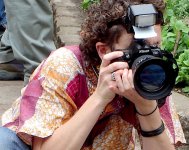
Photographer at Swinon Mela.jpg
 
I am not a professional photographer but a club photographer who enters club, national and international salons so have to adhere to rules. There are documentary sections which are restricted more or less as you describe. The same rules apply to nature photography and Travel. For almost all other genres, the only real limitation is that it must be all your own work including capturing the images and any editing. You may combine images or parts of images but they must be your own. Often there are other sections such as Open where almost anything goes within the above constraint but there are also often a Creative section. Often those producing complex "manufactured images" are encouraged to enter Creative rather than Open. My clubs liaises with the Art/Photography dept. of our local university.

Dave
 
Welcome to TP Danielle. Hope you stick around!

First, I'd suggest getting hold of a copy of Andreas Fenninger's "The Complete Photographer". In the first chapter he "defines" genres of photography by defining the photographer and the intent rather than the actual subject. A photographer can drift across different genres, mixing them to suit their own purpose/vision.

Documentary photography can range from Erwitt's humorous and sometimes whimsical depictions of life, through someone like Clive Limpkin's "Battle of the Bogside" Northern Ireland work in the 70s/80s to Robert Frank's travel style "Americans". Then there are the photographers who do stage things to reinforce their message. I saw a video once of photographers paying local Afghan kids to throw petrol bombs in the background to make it look like a war zone. A friend of mine who was in Iraq said that the reporters all ended up having a party on the roof of the hotel, with canapes and champagne, all the while making sure their "war footage" was shot at the edge of the roof with the war torn burning vista of Baghdad in the background. It's not to say everyone does this, but it would be foolish to assume it doesn't take place.

In terms of respect - there are photographers like Bruce Gilden who - in his interview with Ben Smith almost convinced me he does have respect for the people he photographs, but I'm still not entirely sure. Parr's work in New Brighton was almost certainly not seen as respectful by those living there at the time, but personally, I do see a degree of respect to that work. I think he cares, but he shows it in his own way that's not to everyone's taste.

Fine Art Photography is a creation of the photographer/artist's vision and has no commercial element
I'd disagree with this. I would say that the majority of fine art has a commercial element. What would be the point of doing it otherwise? Moreso than documentary where the primary driver is "telling the story", one has to ask "what is the point?" of Fine Art other than to have something pretty to look at? And whilst I can count off many documentary, portrait, fashion, and landscape photographers, I can't think of a single "fine art" one that isn't driven 100% by financial reasons. Indeed, the word "professional" alongside "standards" heavily implies financial reward. It's a definition of what a professional is. If you're talking about amateurs (the ones who aren't professional) then they don't need to adhere to "professional standards"

When I read your OP, I initially thought of someone like Gregory Crewdson, who has highly staged work. And whilst I'm not sure I would class it as fine art, and I wouldn't class it as documentary (unless "fictional documentary" is a thing? :)) it would be the closest sort of thing I could think of that would relate to both areas.
 
Parr's work in New Brighton was almost certainly not seen as respectful by those living there at the time
I thought it was, and it was the chattering classes who thought it disrespectful. :thinking:

Anyway...

Documentary Photography

In Documentary Photography, the professional standards are mostly well defined:
  • The image must show a truthful depiction of the captured subject(s)
  • Aim to provide context for displayed photos and avoid misleading images
  • Photos must not be altered in post-production except for minor or subtle edits which do not harm the integrity of the image (known as "traditional darkroom practices" necessary to guarantee accurate display or reproduction)
  • Avoid staging of photos
  • Do not interfere or influence the event
  • Always treat all subjects with respect, dignity and compassion
I would also argue that should the Documentary photographer want to bring their subject(s) or their situation into the public eye, they must also research the topic thoroughly, have a good understanding of it, and engage with their subject(s) on a long enough period to be able to capture as much of a complete and truthful story as they can within the constraints of the medium.
  • Do you agree with the standards listed above?
  • Are there any standards that you disagree with?
  • Are there other standards you think are missing?
  • If you practice Documentary Photography, do you have your own set of standards you adhere to in your professional work?

Fine Art (Staged) Photography

As for Fine Art Photography, and primarily focusing on Staged Photography, the professional standards seem to be more flexible.

Fine Art Photography, just like Fine Art itself, is not as easily defined due to its mere art nature.
Indeed, Fine Art Photography is a creation of the photographer/artist's vision and has no commercial element. Therefore, the artist does not have to conform to an external set of standards – they're free to make their own.

However, as a work of art, and specifically photography, must their basic standards be the same as the primary professional photography standards (good composition, accurate exposure, etc.) or does Fine Art Photography allow the artist to break these to match their own vision?

Do you think that something as abstract as Fine Art has fundamental professional standards which must be observed?
  • Will these be universal or, like art itself, dependent on the eye of the beholder?
  • Are the professional standards just the current standard that the professional art world (galleries, museums, etc.) holds itself to as the elite, or are they inherent to the practice?
  • If you practice Fine Art Photography, do you have your own set of standards you adhere to in your professional work?
Keen to hear your thoughts on either one or both of these practices!

Many thanks,
Danielle
My thoughts on documentary.

All photographs are subjective. Documentary is better viewed as a body of work than single images as that provides more context. Photo manipulation beyond the exposure and colour correction and cropping is to be avoided. Staging needs to be defined - it's OK to ask someone to pose holding a relevant object, or for a portrait, but not to stage an event. The very presence of a photographer influences events. If you are wanting to make a subject in a specific way that can be OK (as before, all photos are subjective - everyone has a point of view on a subject) - see Arnold Newman's portrait of Krupp - https://www.artsy.net/artwork/arnold-newman-alfred-krupp-essen-germany

On Fine Art.

This depends on how you define 'Fine Art'. These days in photography it seems to mean something quite different to what it means in an academic setting. A 'Fine Art' degree would not be a good way in to the 'Fine Art' photography business. In photography 'Fine Art' seems to me to be all about making pictures to serve as interior decor - Peter Lik et al.

In the academic sense of 'Fine Art' photography is simply one possible medium for the expression of a concept/idea which can be used in any way, traditional or unconventional.

I could write a dissertation on this. Oh, wait, I did that already. Forty years ago! :LOL:
 
I would rather just take the photos than worrying about fine art v documentry etc. The point has been entirely missed. A photograph is something one likes and if others like it as well it is a bonus
Ask yourself "what is the difference between a professional photographer and an amature photographer?" the only difference is one gets paid and the other doesn't. It has nothing to do with how good a photo is or not no matter which catagory it is in.

The only reason why photographic classes of any standard are held is because they can screw a lot of money from the students. You either have a natural talant or you don't. All this BS going on about" how to" is crap.
My advise is just go out there and take photos ,you can't get a better learning method , spot the mistakes in the photos so you don't make them again

Did all the great painters go to classes to learn to paint? NO and their pictures are worth £m. Those that go to classes to learn you never hear of

Just my opinion of course
 
Last edited:
Hi Danielle, and welcome to TP.

I have no direct professional experience in either of these areas, but would agree with much of the above posting that runs counter to your 'arguments'.

For example:

Documentary photography - if the photographer has educated themselves about a particular event or group, it is highly likely that they will take pictures based on their personal views and feelings about the events and the people taking part, and will therefore produce pictures that spin reality according to those views.

Fine art photography - as mentioned, this is likely to be biased quite strongly toward commercial value if the photographer is a professional - thay have to eat and pay the mortgage! This also used to be a euphemism for nude images, though distinctly less so these days with the social embrace of pornography.
 
Last edited:
On Fine Art.

This depends on how you define 'Fine Art'. These days in photography it seems to mean something quite different to what it means in an academic setting. A 'Fine Art' degree would not be a good way in to the 'Fine Art' photography business. In photography 'Fine Art' seems to me to be all about making pictures to serve as interior decor ...

In the academic sense of 'Fine Art' photography is simply one possible medium for the expression of a concept/idea which can be used in any way, traditional or unconventional.
Very pertinent. Fine art is a term with a variable definition, and if discussing anything one must define one's terms. But the above nails the field pretty well.
 
Very pertinent. Fine art is a term with a variable definition, and if discussing anything one must define one's terms. But the above nails the field pretty well.

I'll second that, Dave has summed it up pretty well, there is a broadly accepted commercial definition of fine art photography which seems to be basically photos that are sold in galleries and intended to be hung for display in homes and hotels. Some people make a good living from it - e.g. https://www.tomway.co.uk/gallery/
 
My advise is just go out there and take photos ,you can't get a better learning method , spot the mistakes in the photos so you don't make them again
How do you know what the 'mistakes' are if you don't take on board other people's views on what makes a good photograph?

One person's mistake is another's creative breakthrough. :D
 
How do you know what the 'mistakes' are if you don't take on board other people's views on what makes a good photograph?

One person's mistake is another's creative breakthrough. :D
I make creative breakthroughs every time I pick up a camera :LOL:
 
An example of staged photography is Can Dağarslani


also on Flickr (flickr: https://www.flickr.com/photos/candagarslani) and Instagram, still maintained: https://www.instagram.com/candagarslani/

Great work and really needs no additional classification, except perhaps artful photographic documentation of artfully staged performers. ;)
 
"The real world is infinitely more interesting than anything you try to invent in a studio."
Paul Reas

:)
Of course this assumes a particular limited range of photography. My interests are almost everything; I have not yet tackled astrophotography and my Nature photography is limited by travel etc. I am happy to cover landscapes, sport, studio all in the same day. I visited Highgate Cemetery on Sunday but I doubt that many shots will be suitable on their own but I will add a studio model to a few. I took some of a lady dressed in Edwardian clothes recently which may well suit. It is the final image that matters. I had planned for some time to capture Highgate shots for backgrounds. It can be tricky to combine such shots if the lighting looks wrong but the Edwardian lady was outside (not in a studio) which should make it easier.

Dave
 
Hello everyone,

I'm a photography student currently working on an assignment in which I juxtapose two contrasting photography practices: Documentary Photography vs Fine Art Photography, focusing on Staged Photography.

As part of the assignment, I'm researching and discussing the professional standards for both practices within the professional photography world, and thought this is an excellent platform to engage in this kind of discussion!

Documentary Photography

In Documentary Photography, the professional standards are mostly well defined:
  • The image must show a truthful depiction of the captured subject(s)
  • Aim to provide context for displayed photos and avoid misleading images
  • Photos must not be altered in post-production except for minor or subtle edits which do not harm the integrity of the image (known as "traditional darkroom practices" necessary to guarantee accurate display or reproduction)
  • Avoid staging of photos
  • Do not interfere or influence the event
  • Always treat all subjects with respect, dignity and compassion
I would also argue that should the Documentary photographer want to bring their subject(s) or their situation into the public eye, they must also research the topic thoroughly, have a good understanding of it, and engage with their subject(s) on a long enough period to be able to capture as much of a complete and truthful story as they can within the constraints of the medium.
  • Do you agree with the standards listed above?
  • Are there any standards that you disagree with?
  • Are there other standards you think are missing?
  • If you practice Documentary Photography, do you have your own set of standards you adhere to in your professional work?

Fine Art (Staged) Photography

As for Fine Art Photography, and primarily focusing on Staged Photography, the professional standards seem to be more flexible.

Fine Art Photography, just like Fine Art itself, is not as easily defined due to its mere art nature.
Indeed, Fine Art Photography is a creation of the photographer/artist's vision and has no commercial element. Therefore, the artist does not have to conform to an external set of standards – they're free to make their own.

However, as a work of art, and specifically photography, must their basic standards be the same as the primary professional photography standards (good composition, accurate exposure, etc.) or does Fine Art Photography allow the artist to break these to match their own vision?

Do you think that something as abstract as Fine Art has fundamental professional standards which must be observed?
  • Will these be universal or, like art itself, dependent on the eye of the beholder?
  • Are the professional standards just the current standard that the professional art world (galleries, museums, etc.) holds itself to as the elite, or are they inherent to the practice?
  • If you practice Fine Art Photography, do you have your own set of standards you adhere to in your professional work?
Keen to hear your thoughts on either one or both of these practices!

Many thanks,
Danielle
OK, I'm going to be a pedant here. I think you're using the term documentary photography interchangeably with news photography / photojournalism. The two can be the same but not always. I'd certainly agree with the standards you define for spot news photography, but for documentary - yes but not necessarily. A documentary project is there to tell a story - not necessarily a news story - and that will often have an angle or agenda depending on the photographers (or commissioning editors) preferences and prejudices. To that end, an element of staging of photographs may happen to one degree or another. For instance, Zed Nelson's Gun Nation - yes, the studio portraits are obviously posed, but I do wonder if some of the other ones were maybe arranged so as to add a different perspective of the story, such as this one https://www.zednelson.com/?GunNation:2. If you haven't already seen it, I'd recommend The Documentary Impulse by Stuart Franklin, Chapter 8 has a whole subject on Manipulation and Staging.

As for fine art photography, trying to define and categorise what that is, is akin to trying to plait fog. It can be anything you want it to be, and I think it's more a question of ethics than standards e.g. David Hamilton's 'controversial' photographs of teenage girls, or Sally Mann's pictures of her children.

But I may be wrong!!
 
Hi Everyone,

Firstly, thank you all for taking the time to answer my post and to create such an interesting and lively discussion.
I appreciate the time each of you took to reply and the welcoming environment you created in this forum.

Secondly, before I reply to your comments, I feel like I should clarify a few things that I think were too vague on my post and might've caused some confusion:
  1. When I mentioned Documentary Photography I meant to refer to documentary series more than to individual images, as some of you have correctly identified.
    Examples can be Jessica Earnshaw's Aging in Prison, Aline Deschamps's I Am Not Your Animal and Ross Taylor's Last Moments.

  2. What is Fine Art (photography)? I don't want to add to what seems to be a heated historic discussion on this platform, but the way I see it, Fine Art Photography is a photographic work, envisioned and executed by the photographer (/artist) on their own accord (meaning = not commercially commissioned), and is not intended to be a true depiction of reality.
    It also doesn't have to be highbrow, displayed in a gallery or a museum. I see 'Fine Art' as an umbrella term for creative and aesthetic photographs. Within it, can be various sub-practices, like Staged photography.
    Though some iconic photojournalism shots can sometimes be sold in galleries or shown in museums, and even considered Fine Art due to their status, I think they are few and far between and their iconic status in our society is what blurs the line between their Documentary original nature and their value as a work of art in modern times.

  3. Talking about Fine Art (Staged) photography, I said it has no commercial element. I need to clarify - I didn't mean that there was no remuneration for the work (as a few of you mentioned, people need to be paid for their work after all!), but that the essence of the work is not commercial by nature; it is not commissioned by another business to be used by them for commercial reasons (like a selection of Annie Leibovitz's work is) but is created by the photographer (/artist) from their own vision, even if it is to be later sold in a gallery or displayed in a museum.
    A good example is Gregory Crewdson, who creates such intricate and perfect settings - nearing perfection - in each of his series, with a production resembling cinematography more than photography. Another is Jeff Wall, who uses real-life situations to inspire him to recreate them later in a documentary aesthetic, albeit completely reposed and developed with his own artistic modifications. Cindy Sherman's Untitled Film Stills series is also a good representation of this.
    As you can probably tell from my examples, I do focus more on the Staged photography element of Fine Art Photography.
With that in mind, I'd like to reply to a few of your responses:
All photographs are subjective. Documentary is better viewed as a body of work than single images as that provides more context.
Documentary photography - if the photographer has educated themselves about a particular event or group, it is highly likely that they will take pictures based on their personal views and feelings about the events and the people taking part, and will therefore produce pictures that spin reality according to those views.
A documentary project is there to tell a story - not necessarily a news story - and that will often have an angle or agenda depending on the photographers (or commissioning editors) preferences and prejudices. To that end, an element of staging of photographs may happen to one degree or another.

I agree - Documentary photography's aim is to shed light on otherwise unknown stories, injustices or members of society in the hopes that the public will notice them, ideally also becoming a call to action or swaying public opinion.
It can achieve this aim by showing a more rounded and complex depiction of the subject(s) and their story. The photographer has a good understanding of the project and spends considerable time with the subject to ensure the story is they're telling is more complete than what would've been conveyed by a single image out of context.

This naturally means that the photographer has an agenda in mind - to tell the story they think is appropriate in the situation - and will be biased, as will the subject(s), the publication and the viewers.
One can also say that nothing is truly objective, every photograph omits something and none can capture everything and give a full objective capture of reality. If we go even further, it's easy to expand this to everything, as no two people will experience anything the same way; their own opinions, culture, upbringing and life experiences will create a biased prism through which they experience the world around them, camera or not.

While the professional standards I listed for Documentary Photography are more reflective of Documentary Photojournalism work I do find similarities between Documentary and Photojournalism in the sense that both are aiming to expose the viewer to truthful events, even if they do so in different ways, and as mentioned above - with bias.
Similarly to Photojournalism, for Documentary projects to be as impactful as possible, their creators must strive to be as close to the truth as possible, within the limitations of the medium and practice. If the photographs in these projects are overly fake it negates the validity of the series' message.

Your list of "standards" is, I think, likely to be honoured more in the breach than in reality. Virtually none of these demands will be met in practice for a variety of reasons, mostly economic but often also practical. Images will often be "staged" because the camera is there, whether the photographer wishes it or not. Again, the presence of the photographer in itself will influence events
Professional standards for photojournalism do exist; I did not make up the standards I listed in my original post, these are based on standards that professional journalism and photojournalism bodies use, such as The British Press Photographers’ Association, National Press Photographers Association, Editors' Code of Practice and others.
Now, I know that even within the realm of pure Photojournalism there are and have always been staged photographs, misleadingly presented as genuine for greed or fame. I still hope that most of the work published as Documentary and/or Photojournalism is adhering to these standards, with only a few that disregard them.

I suspect people like Martin Parr and Chris Killip might have influenced their subjects to get a shot to some extent.
Documentary photography can range from Erwitt's humorous and sometimes whimsical depictions of life, through someone like Clive Limpkin's "Battle of the Bogside" Northern Ireland work in the 70s/80s to Robert Frank's travel style "Americans". Then there are the photographers who do stage things to reinforce their message.
[...]
It's not to say everyone does this, but it would be foolish to assume it doesn't take place.
Staging needs to be defined - it's OK to ask someone to pose holding a relevant object, or for a portrait, but not to stage an event.
With that said, I do agree with you, staging in Documentary projects does need to be better defined.
I believe that the nature of Documentary series, the collaboration between the photographer and the subject(s) and the length of the project can allow for certain staging freedoms, as long as these remain true to the subject(s).
For example, the photographer can't be directing and staging subject(s) to appear a different way, they can't use makeup fx to mislead the viewer (e.g. causing an individual to look injured), and they can't shoot the subject in staged situations that they were never in.

As to the manner in which subjects will be treated has little to do with the photographer, unless s/he is also the editor and publisher of the final output.
I have to disagree, the treatment of the subject(s) starts with the photographer that interacts or captures them. It's true that any other journalists, editors and/or publishers have a role to play in the treatment of the subject(s), but it all starts with the photographer.

I initially thought of someone like Gregory Crewdson, who has highly staged work. And whilst I'm not sure I would class it as fine art, and I wouldn't class it as documentary
I would definitely classify Crewdson's work as Fine Art Photography within the Staged Photography practice. He creates fully-staged works of art that are based on his own vision and convey his message or a certain emotion to the viewer.

In photography 'Fine Art' seems to me to be all about making pictures to serve as interior decor
Not sure I agree with this notion. yes, Fine Art photography does have a strong element of being aesthetic and is aimed to be viewed. However, that is not to say that any Fine Art pieces can't have a message or an agenda. Talking about Cindy Sherman's work again, her Staged photography works are meant to challenge the public perception about topics from women's portrayal and expected roles in our culture to gender norms and identity.

As for fine art photography, trying to define and categorise what that is, is akin to trying to plait fog. It can be anything you want it to be, and I think it's more a question of ethics than standards e.g. David Hamilton's 'controversial' photographs of teenage girls, or Sally Mann's pictures of her children.
That's an interesting perspective, that the professional standards are irrelevant in this case as art is art and can't be clearly defined. Therefore, our societal morals and culture codes come into effect when judging the ethics of the message or how the work itself was created.
Thank you, I didn't think of it this way.
 
Not sure I agree with this notion. yes, Fine Art photography does have a strong element of being aesthetic and is aimed to be viewed. However, that is not to say that any Fine Art pieces can't have a message or an agenda. Talking about Cindy Sherman's work again, her Staged photography works are meant to challenge the public perception about topics from women's portrayal and expected roles in our culture to gender norms and identity.
You're conflating my definition of 'Fine Art Photography' with what I might term as 'Photography as Art' or, more simply, 'Art Photography'.

There is a huge gap between commercial decor photography which appears in provincial commercial galleries (and more upmarket versions of the same) and photography which appears in Tate, MOMA etc.

Hence why it is essential to define the meaning of 'Fine Art Photography' in this context.

An example of a photographer who has crossed from journalism to (my definition of) Fine Art, which might be of interest, is Robin Layton. - https://www.robinlayton.com/about
 
However, as a work of art, and specifically photography, must their basic standards be the same as the primary professional photography standards (good composition, accurate exposure, etc.) or does Fine Art Photography allow the artist to break these to match their own vision?

Do you think that something as abstract as Fine Art has fundamental professional standards which must be observed?
Thanks for such a detailed reply Danielle. You got me thinking!

I think my answer to both your questions is "no". It's fine if the photographer makes a decision to follow those rules (whatever they are!), but also fine if they don't. The "must" in your question makes the answer quite easy. If they aren't being commercially commissioned, then the can do what they want, and the results are what will determine their remuneration. I don't know whether buyers of their work are judging it based on some ruleset, or whether they are buying it because a) it's an investment or b) because they just like it. I suspect the latter.

"Staged fine art photography" is all about the vision of the photographer and their intent. They have a very clear message they want to convey and go to a lot of trouble to try and convey it. I was thinking of photographers like Joshua Hoffine (I'll leave you to Google him as some of the images can be disturbing) and Tyler Shields (probably more fashion than fine art). Both very different, but both go to huge lengths to "get" their image. And I really like the work that they produce. Both also have "behind the scenes" information kicking around which shows how much care goes into the composition, lighting, makeup and staging. The very nature that so much effort is expended on this is enough for me to know that it really doesn't matter whether they conform to rules. What matters is - do I like it?

The problem with putting people in boxes is that there will always be people who straddle the lines that are created.
 
It's fine if the photographer makes a decision to follow those rules (whatever they are!), but also fine if they don't.
This is the key point that the OP appears have missed.

In practice, there are no rules around photography other than those the photographer and/or the "customer" choose to impose. The idea that groups such as British Press Photographers’ Association, National Press Photographers Association or Editors' Code of Practice affect more than a minority of photographers, these days, strikes me as naive.

Most journalism has moved on line, where the cost of entry is minimal and only the most authoritarian of countries have any say over what can be published.
 
This is the key point that the OP appears have missed.

In practice, there are no rules around photography other than those the photographer and/or the "customer" choose to impose. The idea that groups such as British Press Photographers’ Association, National Press Photographers Association or Editors' Code of Practice affect more than a minority of photographers, these days, strikes me as naive.

Most journalism has moved on line, where the cost of entry is minimal and only the most authoritarian of countries have any say over what can be published.


[cough] [PLEASE DON'T TRY TO BYPASS THE SWEAR FILTER] [/cough]
 
Thanks for taking the time to reply in such a considered way Danielle.

What is Fine Art (photography)? I don't want to add to what seems to be a heated historic discussion
:LOL: If only you knew and if only a few other people on here were are perceptive as you.
 
Rules of Photography Engagement from the wonderful British documentarian Daniel Meadows. Someone always worth listening to.

Pay particular attention to Rule 9. ;)

Screen-Shot-2020-08-12-at-13.56.54.png


[cough] b****x [/cough]


No I have an issue with the content of your posts.

Despite claiming an illustrious career as some form of picture editor a freelance photographer, almost everything that you post shows a complete lack of knowledge of the industry.

As for the quality of the photographs that you occasionally post.....


I can only assume that your knowledge comes from something akin to a very local town newspaper which wasn't connected to the wider world of photojournalism.
 
No I have an issue with the content of your posts.

Despite claiming an illustrious career as some form of picture editor a freelance photographer, almost everything that you post shows a complete lack of knowledge of the industry.

As for the quality of the photographs that you occasionally post.....


I can only assume that your knowledge comes from something akin to a very local town newspaper which wasn't connected to the wider world of photojournalism.
Please can both of you continue this elsewhere.
 
Please can both of you continue this elsewhere.


I do apologise, but as a board member of the British Press Photographers' Association, I feel the need to both object and point of how ill informed this poster is.
 
You're conflating my definition of 'Fine Art Photography' with what I might term as 'Photography as Art' or, more simply, 'Art Photography'.

There is a huge gap between commercial decor photography which appears in provincial commercial galleries (and more upmarket versions of the same) and photography which appears in Tate, MOMA etc.

Hence why it is essential to define the meaning of 'Fine Art Photography' in this context.
Thanks Ed, I agree that it is essential to define meanings of terms, and I find that it gets complicated when discussing terms which are not clearly defined in a universally acknowledged way. Such is the nature of art and other abstract fields, but it does make it harder to discuss terms which their definitions can change and fluctuate depending on the people who use them.
I can agree with your two terms or sub-genres, even if just for the purpose of this discussion. Sharing the same term or not, the two types of photography you mentioned are different as you mentioned.

I don't see the purely commercial part of Fine Art Photography as a complex or interesting side of photography. There's a lot of value in aesthetics and visually beautiful photos, but personally, I don't see much value in them for myself. Not to say they are not art or that they don't have a place in the art or decor world, but though I acknowledge the work and technique involved in creating them, I don't feel a strong connection to the pieces and they leave no lingering impact on me.

What you call 'Photography is Art' is the side of Fine Art Photography I find more interesting and compelling. If I'm going to a museum or photography exhibition I want my mind to be engaged, my perception(s) challenged and/or to be made to feel something because of it. If I don't spend the time I'm there thinking about the pieces on display, what is the point of going?
There's beauty in a lot of things and many other types of photography, but I'm looking for an extra value in this type of works.


Thanks for such a detailed reply Danielle. You got me thinking!
[...]
It's fine if the photographer makes a decision to follow those rules (whatever they are!), but also fine if they don't [...] If they aren't being commercially commissioned, then the can do what they want.
[...]
The problem with putting people in boxes is that there will always be people who straddle the lines that are created.
Thanks Ian, glad you're enjoying the discussion!

I generally agree with your approach and don'y necessarily think that a photo needs to be technically correct in order to be accepted as a work of art or as a professional photograph.
Consider for example Julia Margaret Cameron who had famously published photos that were intentionally soft-focused because she thought it best matched her artistic vision (and got laughed at for this by other photographers at the time). She was well aware they were not sharp or “correct” but didn’t let this notion stop her from making a "technically incorrect” decision which she believed benefited her work. I think that limiting Fine Art photographs to the “correct” photography rules limits the photographer’s artistic vision and harms their creation.

Also agree with your closing statement; art is a humanly made abstract concept and it's imprudent to assume all artists or individual works will fall neatly into only one box.

Thanks for sharing your views on this!

The idea that groups such as British Press Photographers’ Association, National Press Photographers Association or Editors' Code of Practice affect more than a minority of photographers, these days, strikes me as naive.

Most journalism has moved on line, where the cost of entry is minimal and only the most authoritarian of countries have any say over what can be published.
Naive or not, I have to consider professional standards in the industry.

I'm not sure that your statement that journalism has moved online means there are no longer professional standards. I find it hard to believe publications which are exposed to certain standards, rules and regulations are just going to disregard these because they now share them online and not on a piece of paper or on national TV.
Other than adhering to certain rules and regulations concerning the press, journalists and/or photojournalists are dependent on their reputation to be able to report the truth. Their livelihood is literally depended on it. People who want to follow news reports will turn to reliable sources. Any professional publication - traditional or digital - that knowingly misleads the public is taking a huge risk that their reputation will be harmed, their audience losing their trust in them and moving somewhere else.

If self appointed journalists want to publish their articles and photographs on a personal blog or website, or share them on social media, they're can of course do so without consulting anyone (obviously within the constrains of the law, etc., etc.), but they are not professional journalists or photojournalists and therefore can choose whether or not they want to follow these standards (truthful depiction, etc.).

You are full within your right to agree or disagree with the professional bodies' standards, but I think that claiming everyone disregards them is incorrect.

With that said, I do think that focusing on photojournalism and the professional standards in the press is a tad removed from what I originally wanted to discuss, so for the sake of the time and efforts of all involved I will leave this part of the discussion.


Pay particular attention to Rule 9. ;)
Thanks for sharing these rules, Ed!
I personally don't agree with this particular statement, but I have a feeling this goes back to the heated 'what is Fine Art' discussion or is similar enough, so let's agree to disagree on this one and leave it at that ;)


Thanks for taking the time to reply in such a considered way Danielle.
Thanks Chris for supporting this discussion, and everyone who took time to reply. It's definitely been interesting, and for the most part pleasant.
I might stick around for other discussions :giggle:
 
Thanks Ed, I agree that it is essential to define meanings of terms, and I find that it gets complicated when discussing terms which are not clearly defined in a universally acknowledged way. Such is the nature of art and other abstract fields, but it does make it harder to discuss terms which their definitions can change and fluctuate depending on the people who use them.
I can agree with your two terms or sub-genres, even if just for the purpose of this discussion. Sharing the same term or not, the two types of photography you mentioned are different as you mentioned.

I don't see the purely commercial part of Fine Art Photography as a complex or interesting side of photography. There's a lot of value in aesthetics and visually beautiful photos, but personally, I don't see much value in them for myself. Not to say they are not art or that they don't have a place in the art or decor world, but though I acknowledge the work and technique involved in creating them, I don't feel a strong connection to the pieces and they leave no lingering impact on me.

What you call 'Photography is Art' is the side of Fine Art Photography I find more interesting and compelling. If I'm going to a museum or photography exhibition I want my mind to be engaged, my perception(s) challenged and/or to be made to feel something because of it. If I don't spend the time I'm there thinking about the pieces on display, what is the point of going?
There's beauty in a lot of things and many other types of photography, but I'm looking for an extra value in this type of works.
(y)

It's worth bearing in mind that Rule 9 is intended to apply to documentary photography. And my stressing it was (mostly) in jest. ;)

Good luck with your course, and future career.
 
(y)

It's worth bearing in mind that Rule 9 is intended to apply to documentary photography. And my stressing it was (mostly) in jest. ;)

Good luck with your course, and future career.

Fair enough, I think it makes sense!
Though I think a good photo will fundamentally have some artistic qualities, I also think that the purpose of creating a Documentary photo series is not to create art but to bring exposure to the subjects(s) and the topic documented.

Thanks Ed, appreciate your comments!
 
whereas in fact there is a broad spectrum of approaches which meld into each other in all sorts of ways.
This is the case, in my opinion. (y)
 
Talking about Fine Art (Staged) photography, I said it has no commercial element. I need to clarify - I didn't mean that there was no remuneration for the work (as a few of you mentioned, people need to be paid for their work after all!), but that the essence of the work is not commercial by nature; it is not commissioned by another business to be used by them for commercial reasons (like a selection of Annie Leibovitz's work is) but is created by the photographer (/artist) from their own vision, even if it is to be later sold in a gallery or displayed in a museum.
This depends on how you define 'Fine Art'. These days in photography it seems to mean something quite different to what it means in an academic setting. A 'Fine Art' degree would not be a good way in to the 'Fine Art' photography business. In photography 'Fine Art' seems to me to be all about making pictures to serve as interior decor - Peter Lik et al.
Personally, I wouldn't conflate Fine Art with Staged. For me, it's much more about artistic vs commercial intent. Documentary photography can in some cases be Fine Art. But as Ed suggests, definitions can be slippery things. Outside the art world, 'fine art' has come to mean commercial work with an 'arty' veneer, which is pretty much a reversal of its academic meaning - see the website of every other wedding photographer, or for that matter of Peter Lik, who has made a career of marketing largely decorative commercial pictures, with all the artistic depth of a nice postcard, as 'fine art'. This is Martin Parr on Peter Lik supposedly selling a picture for £4m:

“I’ve never even heard of him,” Martin Parr, the renowned British photographer, says. “It’s pretty astonishing. I’ve looked at his work today and though he’s a very good commercial photographer who can take pictures people like, he has no standing whatever in the fine-art world that I belong to.”


Note that Parr, who many would think of as a documentary photographer (albeit with a rather jaundiced eye), regards himself as part of the Fine Art world (some other documentary photographers may reject this definition of their own work, of course). I don't think this is just snobbery. Parr's work, though it has sometimes been divisive, is clearly done with real artistic intent and has a depth to it that's missing from most largely commercial work. While he's obviously a savvy marketer himself, I'm pretty sure he'd continue to do serious work even if he wasn't. It pays his bills, but that's not why he does it. He is, by Danielle's definition, a Fine Artist with his own vision, except that (or even though) most of his work is not staged.
 
Back
Top