Problems spooling 35mm film

fstorm

Suspended / Banned
Messages
278
Edit My Images
Yes


I've just wound a 35mm and 120mm on their respective spools. The 120 was fairly straightforward, the 35 took me many, many attempts, as I could feel the film not winding on properly, despite this it's FUBARd again. It's happened several times now.

Do you think there is a problem with the spool?
Or am I doing it wrong?

I'm doing it inside a changing bag, clipping at the centre and winding out. Using my right hand to curve/pinch the film gently. Left hand aiding and feeding the film.

The spools were purchased secondhand.

It's very annoying.
 
Do you have a roll of 35mm that you can sacrifice by practicing in daylight with your eyes closed? It'll give you the feel of loading the reel in a changing bag but with the benefit of being able to see what's happening if you feel it going awry.

I've never used the stainless steel reels so can't comment on their use otherwise (or if they are interchangeable with the Paterson reels), sorry.
 
The problem is probably not with the stainless steel centre load spool, they are all difficult to load until you get the hang of it then they are a breeze to use. Says he who remembers with horror finding out the college darkroom only had SS reels and deep tank lines back in 1984. :)

They (SS reels) are easier to use in a totally blacked out dark room where you have more freedom that when using a changing bag so don't feel that you have missed something obvious. You can get bench mounted loading devises for SS reels but again not something I would try in a changing bag, as others have said a Paterson or Jobo plastic reel and developing tank will be easier for 35mm processing unfortunately you can not mix plastic spirals in SS tanks or visa versa.

Another option is one of the daylight loading tanks which some here use but I have no experience of recent models to advise.
 
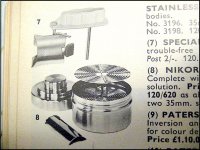
Long, long ago, in a galaxy not too far from here, there were loading guides on the market for stainless steel reels. Here are two as shown in the 1968 Wallace Heaton catalogue....

Wallace Heaton catalogue stainless steel tank Ixus 70 IMG_4492.JPG

The top one (7) is a "univeral" version and the bottom one (8) is specific to the Nikor (not to be confused with "Nikon" or "Nikkor") developing tank shown next to it.
 
That's a a bit of history there - I'm thinking there may be a physical issue with the 35mm spirals.
I've ordered a new Paterson tank, comes with a pair of 35/120 spools.
Let's see if I can get decent results with these. I've ruined 3 rolls of films so far and am getting fed-up.
 
The problem is probably not with the stainless steel centre load spool, they are all difficult to load until you get the hang of it then they are a breeze to use. Says he who remembers with horror finding out the college darkroom only had SS reels and deep tank lines back in 1984. :)

They (SS reels) are easier to use in a totally blacked out dark room where you have more freedom that when using a changing bag so don't feel that you have missed something obvious. You can get bench mounted loading devises for SS reels but again not something I would try in a changing bag, as others have said a Paterson or Jobo plastic reel and developing tank will be easier for 35mm processing unfortunately you can not mix plastic spirals in SS tanks or visa versa.

Another option is one of the daylight loading tanks which some here use but I have no experience of recent models to advise.

I don't use film enough to justify another piece of kit to load the film.
Though that may change if I use it more often, especially if it can be used was a bulk loader too.
 
Another option is one of the daylight loading tanks which some here use but I have no experience of recent models to advise.
I use both a Rondinax 35 and a Lab-box, both daylight loading tanks. Loading the Rondinax is completely dead easy. Same is true for the Lab-box for 135, but I leave it set up for 120. It's a slightly more complicated procedure because of the backing paper. I don't use 120 very often, so I have to check every time. Nevertheless there is no problem getting the film on the spool.

A disadvantage is that they are all single film tanks. The Rondinax only needs 200 ml of chems, and the Lab-box 300 ml, so both are pretty parsimonious per film, but you can't get away from the extra time, nor the business of (intermittent but continuous) winding. My feeling is, a conventional tank is likely better if you can crack the technique (and don't have some physical issue making it impossible).
 
I ordered a new Paterson tank, takes 2 x 35mm or 1 x 120.
I'll see how I get on with this.
I'll stick with the SS reels for 120.

I think you'll get on better with this. Have a practice with a piece of scrap film first.
 
I'd agree with Terry, I always found the SS spirals a PITA to load, I used the patterson white plastic ones, as long as they are dtry they load way easier IMHO.
Keep one of the spoiled rolls and practice so you can see whats going wrong with the SS ones otherwise.
 
When Wayne says "dry", he means "DRY"!!!
 
When Wayne says "dry", he means "DRY"!!!
The v rare occasions I use a plastic spiral straight after washing it I shake off excess water, towel dry and then thoroughly dry the spiral, paying particular attention to the spiral grooves, with a hair dryer.

For natural drying of spirals and dev tanks I shake off excess water and leave to dry in the open for at least 24 hours, with intermittent turning of components. I only re-assemble when it's a 100% dry. Of course bits of dev equipment drying in the house doesn't always go down well domestically :)
 
Last edited:
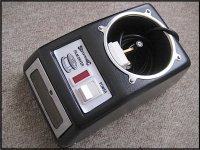
The best way I've found to dry plastic reels, with or without films, is a blower device like this Silvertronic ...

Silvertronic film dryer Ixus 70 IMG_4342.JPG

Two reels, with 35mm films, dry completely in much less than 30 minutes.

Because the air is filtered, blows up through the reels and is at room temperature, I don't have problems with dust, film sticking to the reels or excessive curving. Unfortunately, this version is hard to find these days but there were several similar devices that work in the same way, so a bit of effort may be rewarded with a lucky find.
 
Last edited:
I only use SS now. I have had many instances with plastic reels on hot summer days when the hands get sweaty in the changing bag and the film sticks.

The essential start is that the film is in the clip perfectly square to the spiral otherwise it will try to feed at an angle and get out of line.

120 reels can be prone to this. Once the first half turn is in place, relese the clip momentarily to allow the film to square up.

35mm reels are best when they don't have clips but prongs to catch the perforations. In my experience these load easily every time.

There's no substitute for practising in daylight with a scrap film, then in the bag until it becomes second nature.

Once you've got it it becomes second nature and you'll wonder why you ever found it so hard. (We've all been there.)
 
I spent the last hour playing with bits of cardboard to help start the loading process with my new Paterson tank and reel.
Did it for real with a roll of Kodak Tri-X 400 120, will put the chems in the morning.
Found it easier than the SS reels.
I think I have a roll of exposed Agfa APX 100 35mm - I'll try that tomorrow.
Let's see how it turns out.
 
Last edited:
I have always struggled with the Patterson reels for 35mm. AP reels are the easiest to load for me they have a wider leader to help getting the film started. Never had a problem since i swapped a couple of years ago.
 
I have always struggled with the Patterson reels for 35mm. AP reels are the easiest to load for me they have a wider leader to help getting the film started. Never had a problem since i swapped a couple of years ago.

I always begin the loading process with Patterson reels in daylight for 35mm.

Extract a bit of the leader, cut it straight and curve the corners with scissors, and then load the first few inches onto the reel in daylight. Then transfer it to the changing bag to load the reel fully in the dark. The first few inches of film won't have any photographs on them anyway as they'll have been exposed to light when the camera was loaded. It makes it a lot easier. :)
 
Update

Used the Paterson tank and reels today.
For me a total game changer. Developed 2 x 120, 1 x 35.
Worked almost flawlessly.
No damage to the 120 or 35 at all. No overlaps, no undeveloped sections.
I've just ordered a larger one so I can do more than a single 120 roll at a time.

ID11 has turned a dirty, dark brown. Not much left and I'm not sure if it's too oxidised.


Decided to use the new developer.
The negs are nice, turned out really well in the HC110 dilution B, with 600ml of developer at 21c.
Used the dev 3 times, 2 x 120 and 1 x 35. No issues, Added 30 seconds to the 35mm (600ml).


The Fuji looks a bit too contrasty.


Pre-wound the 35mm


But it meant I lost half of my first frame. I'll need to wind on more or do the initial spooling in the changing bag.


The 35mm is Agfa APX 100


Very happy with these negs.
 
I didn't even have to warm up the water as it was already at 20.8c
Need to remember not to loop the dry negs though, as it caused a watermark on one of the frames.
 
  • Like
Reactions: zx9
Pre-wound the 35mm


But it meant I lost half of my first frame. I'll need to wind on more or do the initial spooling in the changing bag.
Cut the film straight immediately after the narrow part of the film leader. I've never lost any frames that way - I usually get a few frames worth of blank film where it was exposed when loading the camera, and sometimes a "burn frame", but all my proper shots are there.
 
To add to Nige's comment...

I counted the sprocket holes between the start of the wide bit of the leader and the light trap on the cassette when the film was properly loaded into the camera so I knew that that part of the film had no photos on it then allowed that much of the film out of the cassette when I was winding it onto the Patterson reel.

Good to hear a success story!
 
Thanks for the good advice from all.
It gives me the confidence to take more 35mm and do my own dev.
It's also made 120 easier too. I've been looking at scanning my negs, I have an old Epson 4490 scanner, it's slow and the film holders infuriate me.
Looking to use a digital cam and a macro lens and see how well that works.

On the wet dev side of things, I'm looking to process Ilford XP2 Super in B&W chemistry. I know people have tried it with varying levels of success.
I make good use of the variable sensitivity/latitude of XP2, rating at between ISO 50-800. I wonder if that still stands in B&W dev instead of C41?
I'll try it with HC110.
 
Used to do XP1 in B&W chems about 45 years ago. Worked well but was grainy compared to the C41 souped rolls. IIRC, back then, the chems were available as a kit with the films but if times were a bit tight, the "naked" films were cheaper!
 
I use the Patterson plastic reels and I occasionally run into trouble and I believe it is because of humidity from sweating in the change bag. It happens more frequently when the outside temperature is higher. I may invest in a change tent in the hope of avoiding too much humidity.
 
Scanning update
I need to modify my LED light source to accommodate new leg supports. I used hex spacers, they look like a cross-section of a BIC biro.

Film developing - Ilford XP2 Super in HC110
Took me all of 2 mins to successfully wind a 35mm spool on to the Paterson spiral.
Ilford XP2 Super - rated between ISO 100-800 throughout the roll.
I used HC110 at 49:1, 23c. 5 mins agitation every 60s.

Yes XP2 is a C41 chromogenic film, but it works in B&W chems too ;-)
 
  • Like
Reactions: Nod
hmm, there was an interesting reply from bandeau_rouge, gone now?
there were several "interesting" posts scattered across the forum, often of a fairly antagonistic nature, made in rapid succession between his joining around 3am today, and being shown the door early this morning. This post is for information, not discussion.
 
Back
Top