Post-processing v straight from the camera

ab2012

Suspended / Banned
Messages
667
Name
alan
Edit My Images
Yes
Most photos put up for display/critique here have been post processed in PS or suchlike...or so it seems to me.And most are stunning.Can a stunning photo be produced wuthout PS,filters etc?Or is post processing just part of it all?
If so, please post some.I'm very intersted.
Apologies if this debate has been done before.
 
The end result is what matters. Why worry about how it happened, as long as it's `stunning`?
 
Because it's not me and the camera that's done the work?
 
Because it's not me and the camera that's done the work?

and?

I'm more of a digital retoucher than I am a photographer, I can produce 'stunning' images from quite mediocre shots, so in that case it's all me and my computer that's done the work. Of course I see (and have take myself) great images straight out of camera, but every image requires processing of some sort- whether it's extreme manipulation, minor contrast/exposure tweaking, or just the conversion from a raw file (or piece of film) into something visible.
Digital cameras are set to capture a flat image (as digital doesn't respond well to being clipped, think about how your stereo sounds when you put the volume up too high), so this flat image has to be 'processed' for it to even look like the scene you were originally trying to capture- whether you then chose to alter reality, or go hyper-real is a decision for the user. When I photograph I usually have an idea of what I want the final image to look like, I think about it like I would a painting; what I see through the viewfinder is merely a reference for how I would like to render the scene in my mind

my final images are a combination of my skills with the camera, my skills in the editing suite, and my artistic sensibilities as a creative arts graduate


I don't see how photoshopping something is any different to 'editing' in camera- example- you're shooting a landscape and you set the camera on a tripod, you move the camera to exclude a bin from the frame, you run over and pick up a stray coke can on the floor- that to me is the exact same 'editing' as getting home and thinking 'oh I wish i'd have moved that- maybe i'll just clone it out'

A lot of my photography is for clients- if i'm shooting an image for a hotel I don't have the luxury of waiting years (a la ansel adams) for the right sky, I have to take the shot and then change the sky to reflect what is needed to sell the picture


I must stress that I was a 'proper'/film photographer for 8 years before I started to retouch my own work and work digitally- so I learnt how to shoot without the digital safety net.

I think shooting for pleasure and shooting professionally are 2 different worlds, and in the commercial world I think it's a necessity to have a 'style' which is yours, that you've perfected, and clients will want you to replicate for them (whether that's through in-camera tricks or in post production), look at photographers like dave hill, or tim tadder
 
What Mr Canon, Mr Nikon, Mr Sony or Mr Pentax think our image should be isn't always what we actually see with our eyes when we shoot a scene or the final creation we let enter our minds.

For that reason PP work will always be done by Most people. Ultimately though you are still the brain child behind the idea from composing the shot to tweaking it in PP.
 
Last edited by a moderator:
Many of the tools in photoshop are derived from techniques developed (pardon the pun) in the darkroom by the greats film photographers.
 
What Mr Canon, Mr Nikon, Mr Sony or Mr Pentax think our image should be isn't always what we actually see with our eyes when we shoot a scene or the final creation we let enter our minds.

For that reason PP work will always be done by Most people. Ultimately though you are still the brain child behind the idea from composing the shot to tweaking it in PP.

even on film (and then you either did your own processing, or you let someone else do it) you have the ability to adjust and play around with an image. Want to selectively edit- you have to expose different areas separately with neutral gray filters, want to clone out; you have to use a tiny brush and some actual paint

Film was a lot more difficult to make local edits, and because most people didn't do their own processing the prints they got from the lab were how the photos stayed- with digital it makes it much easier to do THE EXACT SAME THING that was capable on film, although much more difficult to carry out


editing is not a new thing, it's just become a lot more democratic in that it's now something nearly anyone can do fairly easily
 
We start editing and processing as soon as we choose which lens to put on our camera, which aperture to use, how to frame the picture, whether to bump the Ev, etc, etc. If we want our photos to look good we continue the job after we take them, too.
 
The creative process doesn't necessarily end as soon as you press the shutter. It begins with a vision in your head and ends in an image. If you can achieve your vision straight from the camera, then fine. There's nothing wrong with that and it's perfectly doable. Photoshop is just another tool in the photographer's arsenal that can be used to help them achieve their vision.

Photo manipulation has been around since the days of analog, it's just easier and more accessible now. Just because you have retouched your photo, it doesn't devalue you as a photographer (unless we're considering pure photojournalism). It's true that a lot of people view Photoshop as a safety net and use it to "save" a bad image but I think it's greatest strength is that it allows for an excellent photograph to be made even better. What I always try to remember is that in order to create that excellent photo, you need to have excellent photographic skills, something which is acquired through experience and learning.
 
I'm a much better photoshopper than I am a photographer.

I think that they're two different skills and if you can combine them for even better images then why not. Surely it's the result that's important - the method for getting there is up to the individual!
 
I went to an event the other day and it was teaming with rain. The pictures would have went straight in the bin but for post processing my RAW images. At least now I have a good record of the event even if not magazine quality.:shrug:
 
Most photos put up for display/critique here have been post processed in PS or suchlike...or so it seems to me.And most are stunning.Can a stunning photo be produced wuthout PS,filters etc?Or is post processing just part of it all?
If so, please post some.I'm very intersted.
Apologies if this debate has been done before.


It's in the eye of the beholder, if you're happy with your image straight out of the camera, then there's your answer.

I've got loads of photo's hung around my house that haven't been touched at all, some have red eye removed, some have horizons straightened, some have been extensively processed.

Don't be pressured by people who think every picture needs 'tweeking' to make it 'perfect'
 
Don't be pressured by people who think every picture needs 'tweeking' to make it 'perfect'

I think there are more 'you should get it all right in camera' as opposed to any 'you should post process' posts. ;)

You do as much or as little post processing as you're comfortable with. :shrug:

It's obviously preferable to get an image as best you can 'in camera', but don't be fooled that you're not doing any processing should you print straight from your camera. ;)

If you shoot Jpeg, you, or your camera, has decided on a picture style, Landscape, Portrait, Vivid or whatever, that has altered reality. There has been contrast and sharpening applied. If you have shot B&W, you've already altered reality. We don't see in B&W after all. ;) If you have used filters, you have altered reality. That some of these changes were done before the light entered the lens make a difference? :shrug: It does to some.

Even with film you made decisions which affected the image to a greater or lesser degree. You chose the type of film, which affected the colour reproduction, or you used B&W, which has again altered reality. Processing the film was subject to changes during the developing process because of strength of chemicals and time of development. If you did that yourself, then you had control of that, if you sent the film away, you had no control over that.

If you received the prints back, then the company altered the images during printing. The machines used averaged out the exposures during printing to print 'correctly'. I know I had the odd print that was grainy because the image had been taken underexposed, and the exposure altered when printing to give a better print, at the expense of grain, just like the 'noise' now.

If you printed yourself from the negatives, by printing lighter or darker prints, dodging, burning and whatever else you did you were changing the image further and further from 'reality'.

Slide was the most pure and unforgiving medium, but obviously filters affected the recorded scene as before. (and now)

Unless you're Journalist, or are claiming that the final image was as it was straight out of the camera with no post processing, then the final image is what counts and how happy you are with the final image and how it was achieved.

 
Unless you're Journalist, or are claiming that the final image was as it was straight out of the camera with no post processing, then the final image is what counts and how happy you are with the final image and how it was achieved.

I'm no Journo, I'm what I think you'd call a 'prosumer' (more assumed talent & ability than actual)

I think I'm a fan of SOOC as I'm a bit lazy. I have 'shopped' lots of images for a whole lot of different reasons over the years, & have become quite proficient in certain areas.

I'm also the official 'togger (if I may assumer the title)for my nippers football teams & post some pics on their team website, so editing lots of pics for editing sake can be very time consuming (usually just cropped & re-sized to comply with posting image size rules of the website.

However, I work with a bloke who is obsessed with adjusting curves, temperatures, layers with different masks, etc & sometimes he can spend hours on a picture & I don't think there's much improvement or difference over the original. Perhaps it's just my lack of 'artistic eye' ( I have dabbled in the 'arty' stuff, but I know it's not one of my strong points) or one of my veiws that photography is (not always though) a moment frozen in time that evokes a memory of a certain peson/event/place/time etc.
 
redhed17 said:
I think there are more 'you should get it all right in camera' as opposed to any 'you should post process' posts. ;)...

Definitely, but it fed (especially on forums) by many people mistakenly believing that good photographers don't enhance their images, or at the least, that its a badge of honour to get everything right sooc, a bit like shooting in manual means you're somehow better than eveyone else because the camera had no hand in the decision making process...
 
My (unsubstantiated) suspicion is that many of the people who claim not to edit their photos are incapable of doing so.
 
So am I to understand that those who don't edit, bin unrepeatable shots that were out of their control and didn't quite make the grade?:shrug:
 
My (unsubstantiated) suspicion is that many of the people who claim not to edit their photos are incapable of doing so.
I'm a relative beginner and wouldn't know where to start with PS or whichever.I can adjust lighting where I store images, but that's about it.So I suppose I am one of those "people". I would dearly love to get some of the photos I've seen on here, but at the same time I'm not one for over doing it.
The responses to my OP have been informative, and I'm still getting to grips with some of them. What made me smile most was the idea of being a better photoshopper than photographer :) Perhaps I ask too much of the camera itself, putting to one side my lack of skills :)
Cheers.
And I'm also one of those who bins the vast majority of shots BECAUSE they don't come out of the camera as I had hoped.This may be a mistake.
 
Last edited:
Think of post processing as just one of many aspects of photography.

It has to be learned, naturally - and post processing is a huge subject. You can use auto solutions by setting saturation, sharpening and so forth in camera: `P` or any of the various `scenic` settings. In post, you can use auto-levels, auto sharpening and the rest in the same way. The result of which is that the computer or the camera is making many of the decisions, not you.

A lot of people are quite happy to do this, and good luck to them.

But, if you want to get the best possible pictures, ignoring an aspect as important as post processing will put you at a disadvantage. It's about being in control of the final picture, the one you frame and put on the wall or send around the world for all your friends to see. The more you know about how to bring the best out of a latent image, the better it is likely to be.

The camera is less than half of what is involved in photography. If you are willing to take the time and effort to learn camera technique, why not go the whole way and learn how to process? It takes time and application, but that is true of every aspect of photography.
 
Depending when you started your photography you may have experienced the disappointment of receiving back a set of slides that didn't live up to your expectations. Well, shooting to JPG straight in the camera is very much like shooting slide film of old...you have to be very very good to get it right (or possibly bracket a lot and shoot a lots of frames).

If you want to make life easier for yourself, shoot like you used to shoot negative film, where the printing process gave a large tolerance but learn to "develop" your own pictures. I think it's a misconception that when we shot film we got more reliable results for some reason, the reality is that a lot of the exposure was corrected automatically in the printing stage.

I think most people will find their photography will take a leap forward if they post-process their images. You've just got to find a friendly tool to make the process fast, and Photoshop generally isn't that tool.

So, I am on the 'post-processing is a must' side of this fence. You can get great shots straight out of the camera, but it is much easier to get great shots with simple post-processing as the norm in your workflow. (and yes, shooting RAW is now the norm for me as a result)

Andy
 
Post processing can be daunting to a newb, try and find a photographer that does his/her own PP and ask to watch - there are also lots of videos on various aspects of PP.
A GOOD piece of PP software can make all the difference.
CS3/4/5 are VERY good but VERY expensive, with a HUGE learning curve.
Lightroom is superb and not too costly for what you get, relatively easy to use, although there are hidden depths - a very powerful program.
an example - my son came to me to have a look at some of his pics and see if there was any way to give them more life/pop (he was shooting raw).
Now, raw tends to be pretty bland before PPing, it took just 2 minutes to show him in LR, the difference was like chalk and cheese.
You could hear his jaw hitting the desk from 10 feet away.
Guess what he uses now????
Getting it right SOOC seems to be a mantra for those who can't be a***d to put the effort into learning PP.
For me, it is all part of photograhy
 
Definitely, but it fed (especially on forums) by many people mistakenly believing that good photographers don't enhance their images

I think most, if not all magazine and advertising images are enhanced after they come out the camera, either by the Photographer, their assistants, or by a professional retoucher, always have, always will. :shrug:

Here are a few retoucher's sites, Amy Dresser and Glenn Feron. Some of the images are OTT, but on some of the images you can see the before and after images. You can also see how the images were straight out of the camera.

I don't think Landscape photographer's go to such extremes, though some do enhance, with most advertising and Portrait images it's anything goes.

People not disclosing that processing has been done leads people to try and get the same kind of images straight out of the camera, and when that is not possible, because it was never possible, people can become discouraged with their images, even with all the gear when they don't match what the pro's produce. :shrug:

Here is a very brave Brittany Spears showing before and after images. After seeing how some of these celebs look in paparazzi images, it is not possible, even with the top make up and stylists, to get them looking how they do in some promotional and advertising images without digital enhancement. They used to do it all in the darkroom too. ;) :lol:

The first image here blew my mind when I saw it, as a pre Photoshop case of image manipulation. :eek:
 
There's no such thing as unprocessed, whether film or digital. You can spend a long time setting all of the camera's processing options beforre you press the shutter, or spend time afterwards choosing your processing options. One could argue that relying on the jpg that comes out of the camera is a more "unskilled" effort than post-processing, because you're relying on whatever Canon / Panasonic / whoever thinks is the best option, rather than using your own skill and experience to customise the settings to suit your own individual photo.

I very much take the view that (excluding things like forensic photography which is supposed to record a scene exactly as it was) the best photo is the one that looks nicest on my wall - and I have zero interest in how it was processed.

David
 
I'm a relative beginner and wouldn't know where to start with PS or whichever.I can adjust lighting where I store images, but that's about it.So I suppose I am one of those "people". I would dearly love to get some of the photos I've seen on here, but at the same time I'm not one for over doing it.
The responses to my OP have been informative, and I'm still getting to grips with some of them. What made me smile most was the idea of being a better photoshopper than photographer :) Perhaps I ask too much of the camera itself, putting to one side my lack of skills :)
Cheers.
And I'm also one of those who bins the vast majority of shots BECAUSE they don't come out of the camera as I had hoped.This may be a mistake.

It's all new skills to learn. And each to their own what they want to do.

Yes there's always been some amount of 'processing', whether it be in the shop selecting the film you want to use for a particular shoot, or manipulating the end product. However, there's no reason you can't get great pictures straight out of the camera. And the better they are in the first place, the easier job you will have post-processing.

However, even after started photography in the age of film, and initially disliking digital manipulation, I have to say I now love the post processing. And it's difficult not to, when you know you have an image there that kinda looks good. But you can make it look great! Then when you're done with it, you look back at the original and wonder why you chose to process it. Because it looks so horrible in comparison. Flat and lifeless.

What I do enjoy more than anything though. And it's already been mentioned. Is the fact I have full control. I will often have a picture in my head from the start. And to create that picture in camera is something of genius. Something I don't currently possess. But I can get home and I can work on. Towards the picture that sits there tapping on my skull. And to create that visualisation....that's art.

I still have huge admiration for the guys that can do this straight out of the box. That is something special indeed. But you also have to admire the guys doing some amazing PP. And if you can mix both together...then you're really on to something.
 
Why doesn't anyone just try things?
 
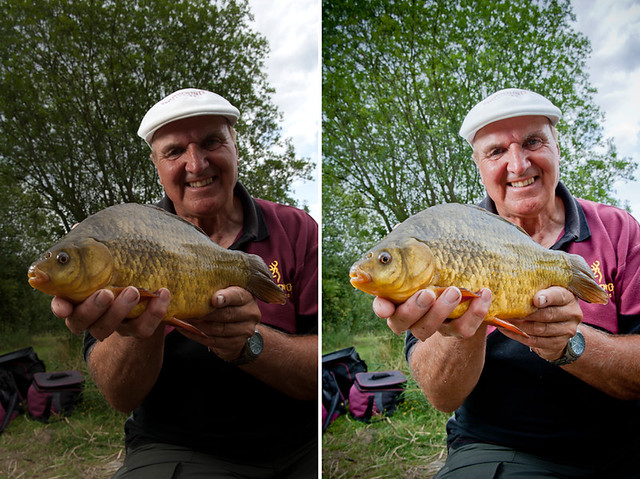
This is the kind of PPing I do on a general, day-to-day basis....


Demonstration of before/after edit by Pat MacInnes, on Flickr


Shooting for magazines I come across many situations where the light is just extreme to control without spending loads of time on lighting, so I often have to rely on getting a cautionary exposure (i.e. one that's a bit underexposed) and then lifting it in PP.

This is a typical example of the quick edits I can make in Lightroom 3 to basic raw files; the pic on the right has fill adjustment, increased black and contrast, plus a slight tweak to WB and some luminance tweaks to lift specific colours in the shot. there's also a vibrancy increase, and a saturation decrease, only slightly mind.

It's by no means a finished edit but it's along the lines of how i work when I don't have the luxury of too much time, the main reason to get the fish back healthily. Ii generally have a minute or two to set up lights, get an ambient exposure reading and think about how to frame up for a cover shot (of which this is, hence the space for straplines and headers).

This was lit basically with a 40x40cm softbox up high, powered by a single SB-800 triggered via a Phottix Strato - flash power was 1/4th. I'm a big fan of single lights, especially to help counter the hard sunlight I'm often having to work in through the middle of the day.

*Nikon D2x
*Nikon 17-55mm f/2.8 AF-S
*ISO 100
*1/125th @ f/8
*SB-800 set to 1/4th through softbox high camera left
*Processed in Lightroom 3
 
You've done a great job on the fishing photo Pat:thumbs:
But i can spot instantly that it has been rescued. I know its WIP, but the point is, PP does give you a lot of flexability, creative options, and more margin for error. But at the end the day, the better job you do with the camera the more potential the image has. So photographic skills are always gonna vary in people and so its always going to be important, PS isnt going to negate camera skill.

And like other people have mentioned, there is no such thing as an unprocessed image. As a film photographer, your choice of camera, lens, focal length, film brand/speed, the development process you choose. Plus all the other tricks people use to enhance or fantasize a scene, long exposure, bokeh, trails. So the point of all this is, we dont just need photos to document how things really look, photography is an art form, and as such is open to any manipulation the artist sees fit.

Im also better at PP that photography, but im getting there.
 
If you are happy with the final image your camera produces without any tweaking then there's no point tweaking it for the sake of it is there? I'm sure I can spend many hours moving sliders around or I could just go out and take more photos which is the bit I actually enjoy :)

Most photo sharing sites also sharpen and tweak images anyway so if you have already done that to a jpg and they do it again they'll potentially make it look over sharpened and generally awful.

I also want the option of uploading to Alamy so if I can get the image how I want it without having to process then there is a much, much better chance of it being accepted as the more you process the more chance there is they'll reject it. Sharpening shouldn't be done twice so that's something I'd definitely want right in camera so I may as well get the rest right while I'm there.
 
I rarely ever process any image that comes out of the gf1, but every image that I take with the d700 is processed. Different tool for different jobs though. Commercially I process, but for personal and family shots I never bother as I don't want every image of my family to have my "look" to them.
 
I think people get too worked up with this

Photography always has been a process

capture-----------something happens ----------output

It is a garbage in garbage out scenario too

However, I bet if you look at the best photographs from the last 100 years, you will see they all start with a great capture, and nearly all have great processing. Only the truly emotive images (girl running naked in Vietnam after Napalm attack shot springs to mind) can bypass the great processing step and still do the job

While we think about these images, we remember that our cameras are utterly superb in comparison
 
I work it out, if I take half the shots in the same time span and use that extra time to get them as right in camera it saves me double the time again at a computer.

Less time at a computer, more time drinking wine and chasing nurses for me! (until they jab a needle in me and stick me back in my padded room).

The best processing and processed images I see starts with an already great image at the time of capture that was also shot with the PP in mind so that all that is left to do is enhance not correct.
 
It's great to get a good image straight out of the camera, but almost always I look at my snaps and think 'oh that's a little dark' or 'it's a shame that sign was there'. A quick PP can correct these. I doubt I've ever seen a prize winning photo that hasn't been PPd and there's a reason for that.
 
I work it out, if I take half the shots in the same time span and use that extra time to get them as right in camera it saves me double the time again at a computer.

Less time at a computer, more time drinking wine and chasing nurses for me! (until they jab a needle in me and stick me back in my padded room).

The best processing and processed images I see starts with an already great image at the time of capture that was also shot with the PP in mind so that all that is left to do is enhance not correct.

I completely agree with this! Couldn't have put it better myself. I think the question isn't "should people rely on PP more?" but I believe it's about making the most efficient use of your time more than anything. If you know that a shot is going to take a long time to set up (decluttering a very cluttered background), then it's logical to do it in PP if that would be quicker - and vica versa.

I love to post-process, so I'm in no way against that, and I believe anyone should post-process for however long they want to. It's all about the end result.

But, I have noticed that by concentrating on my camera technique a bit better, framing, composition, thinking about what I want to convey; it saves me double the time than if I had to do it on the computer in post processing. Post-processing (detailed) takes me MUCH more time than if I was to wait for a car in the background to drive off, for example. Obviously I'm referring to detailed PP, correction and not enhancement. I love 'enhancing' my images, even if they are great SOOC, even just a slight adjustment in contrast can work wonders.
 
Last edited:
Back
Top