Post processing preferences?

FishyFish

Suspended / Banned
Messages
8,792
Name
Nige
Edit My Images
No
I always post process my film scans, but for the most part I tend to go for a relatively natural approach, rather than something more overtly "artistic".. Out of interest, I did a quick and dirty (it took less than 5 minutes) edit to one of my recent pictures to add a lot more drama.

I think the new edit is much more striking, but I also feel slightly dirty about having changed reality so much. :D

What do you think? Which approach do you prefer?

1 - My usual processing. Looks close to how the scene was on the day (apart from it being in B&W, of course).


Tree beyond a wall by fishyfish_arcade, on Flickr

2 - A much heavier edit to add a vignette and add drama to the sky. I also added a linear gradient and some contrast enhancement to the grass at lower right. The scene didn't look like this on the day. :)


Tree beyond a wall (pp) by fishyfish_arcade, on Flickr
 
I think it depends on the scene and for what it is going to used. In the image above the edit is more eye catching and I dare say would get more likes on the socials.

Quite often the image formed by our brains is not what the camera captures and that is most likely why I would do heavy edits, i.e. to get something close to what moved me to take the photo.
 
First one for me Nige, as the processing on the second one makes the sky look less natural and makes the grain more prominent.
 
Number one for me. It looks more real - unless you deliberately want an 'interpretation' of the scene.

At the end of the day, it's your photograph, make it what you want.
 
I don't think that there is anything there that could not be achieved in the darkroom, not from experience but from what I read.

The second is far more dramatic, but obviously artistically so, as there is no sun.

The fence post near the tree is annoying and if your going to edit that should come out, the ones on this side cause me to wonder where the fencer is and is he the other side of the wall having a butty. if i was to remove that might as well take out the other on the skyline, The edited grass looks a bit weird after you have looked at it a few times and the contrast, perhaps, could be put to more purpose in the wall. The contrast is wasted in the darkening. If the sun was low left the perhaps the grass area would be darker naturally due to shadow of the wall.

Both are nice Images.

But its a bit like the defendant to the judge " I only murdered him a little bit Your Honor"

if you do it all you might as well be hung for a sheep as a lamb.

Overall, I dont think there is anything in the second that could not be achieved by waiting for the right conditions
 
Last edited:
The first wins hands down for me Nige. And not just because it's analogue either. @sirch is correct though, the second would get the likes on socials. Anything over the top gets more likes, and anything completely unreal gets even more likes, but let's not get into that here :)

I have my stuff dev/scanned for me, but I do very little editing to my film photos, mainly just a rotate/level and white balance, maybe the occasional exposure tweak. But I try to leave them as taken.

My X100f general stuff I do similar, LR profile and basic tweaks. The Sony landscape stuff is where I might go a bit further with masking etc
 
but I also feel slightly dirty about having changed reality so much
erm but we see in colour ;) but just my opinion........... the sky in 1 does nothing for the scene, but 2 does as it pushes the interest down to tree and wall
 
Last edited:
I feel the vignette is too much. It doesn’t look like the sky might have been.

My rule of thumb with processing like this is if it is noticeable, it is too much. Unless I really am going for art rather than photo.
 
Thanks for the comments everyone.

I should clarify: this is not a route I'm considering going down, it was just an experiment as I was interested in people's thoughts on this type of processing. The edits I made were not particularly carefully considered (as I said, they took a few minutes in Lightroom) and I would have taken far more care with them if I had true intent of making a dramatic version of the picture.

My preference is almost always to a more true-to-life result, although photographs are never truly true-to-life as they're a camera's view, not an eye/brain view. My editing generally consists of tweaks to highlights / shadows. whites / blacks, plus contrast and curves adjustments. I'll sometimes push the boat out and go crazy with some subtle dodging and burning though. :D

One of the things that attracts me to photographic images is their removal from reality. They're a frozen moment in time, separated from the context of the scene as witnessed in person. They might be black and white, rather than colour, or the colours may look different to those perceived by the photographer at the time, perhaps as a result of the recording medium, or maybe as an artistic choice. The aperture will affect the image in a way that our real-time vision doesn't represent, likewise shutter speed which may freeze or extend motion, and the lens may give a distorted version of what our eyes can resolve. It's this touch of artifice that occurs in a photograph of a scene that appeals. There's always something slightly removed from the reality which I find attractive. I don't need to edit a photograph significantly (or at all) to achieve this.

To paraphrase my favourite Garry Winogrand quote: "I photograph things to see what they look like when photographed". :)
 
Last edited:
Many years ago, the photographic club that I was a member of did slides and prints. Whilst the prints could be worked on, the slides were very nearly entirely displayed as they were received from the processors. I liked this, scenes could be changed using a variety of filters, but that was about all.
 
I'd prefer something inbetween - an added vignette but not quite so much.
I agree with Kevin. I quite often add a small vignette in PP, not just for drawing the eye in towards the subject, but somehow (at least in C1Pro) it seems to improve the definition. Some kinds of cloudscapes are really helped by a vignette (that image, not so much). But the vignette would be about the last thing I'd do.

EDIT: As some may remember, I was a big fan of Aperture, and was gutted when my version finally stopped working, 5-6 years after it was dropped by Apple. I moved onto Capture One Pro, found the digital asset management stuff much poorer, most of the adjustments pretty similar (although the layer-based adjustments are much better than Aperture's dodge and burn simulation). However, C1Pro's vignette tool is much better than Aperture's ever was, with control over the shape as well as intensity, and I can make it apply even on crop.
 
Last edited:
I mainly use Lightroom for post-processing and I make use of the Select Sky and Select Subject masking tools that have been added within the last year or so. This enables me to make seperate edits to the sky and the foreground in a landsape image.

With the sky, I will adjust clarity - often using negative clarity to smooth out grain.
With the foreground, I find that a moderate amount of positive dehaze helps to reduce any haziness added by the flatbed scan (or possibly by an old lens).
 
Both are equally valid - the first more natural & the second more emotional. Going forward & for public display, I'd opt for the second one ...
 
First one is amazing, it looks way more balanced, the light looks more natural. The second one is way more dramatic which is great too, but I don't think this is the scene that should be dramatic, if it makes sense.
 
I mainly use Lightroom for post-processing and I make use of the Select Sky and Select Subject masking tools that have been added within the last year or so. This enables me to make seperate edits to the sky and the foreground in a landsape image.

With the sky, I will adjust clarity - often using negative clarity to smooth out grain.
With the foreground, I find that a moderate amount of positive dehaze helps to reduce any haziness added by the flatbed scan (or possibly by an old lens).
I've found the select sky and select subject very useful with old, found negatives, in particular those taken on ortho film. Using the select sky allows me to lower the sky exposure so it isn't completely white, sometimes you can pick up some cloud shapes. It's easy though to overdo it.

I recently scanned some pre-WW1 stereo glass plates for @Barney and used the tool to burn skies in.

Perhaps @Barney would allow me to post a couple of examples?
 
I much prefer the 1st one. IF I was doing that as a wet print I'd pre-flash the paper and then maybe dodge/burn the sky a little depending on what a test print looked like. I certainly wouldn't be aiming for image 2.

If you want likes on Instagram then image 2 all the way!
 
I've found the select sky and select subject very useful with old, found negatives, in particular those taken on ortho film. Using the select sky allows me to lower the sky exposure so it isn't completely white, sometimes you can pick up some cloud shapes. It's easy though to overdo it.

I recently scanned some pre-WW1 stereo glass plates for @Barney and used the tool to burn skies in.

Perhaps @Barney would allow me to post a couple of examples?
By all means Peter show a few, Image manipulation is an important factor when trying to restore/resurrect, potentially lost details from very old negatives or photos.
 
To paraphrase my favourite Garry Winogrand quote: "I photograph things to see what they look like when photographed". :)

I am not too knowledgeable on Garry Winogrand - based on what google images shows me he seems to be in the tradition of the great American street photographers working in natural light and focusing on the documentary value of the scene/people/moment capture rather than any dramatic, sensory impact as obtained via printing/post-processing.

I wasn't familiar with his (interesting) quote above, and taking it at face value, I fail to see the parallel between the Winogrand quote and your second edit. I would say that type of image is how the scene looks like 'when postprocessed to taste', and not anymore 'when photographed'? But perhaps I misunderstand.

Unless of course there was a lone doorway standing in the middle of the field and your were taking the picture through the keyhole :exit:
 
Last edited:
I always post process my film scans, but for the most part I tend to go for a relatively natural approach, rather than something more overtly "artistic".. Out of interest, I did a quick and dirty (it took less than 5 minutes) edit to one of my recent pictures to add a lot more drama.

I think the new edit is much more striking, but I also feel slightly dirty about having changed reality so much. :D

What do you think? Which approach do you prefer?

1 - My usual processing. Looks close to how the scene was on the day (apart from it being in B&W, of course).


Tree beyond a wall by fishyfish_arcade, on Flickr

2 - A much heavier edit to add a vignette and add drama to the sky. I also added a linear gradient and some contrast enhancement to the grass at lower right. The scene didn't look like this on the day. :)


Tree beyond a wall (pp) by fishyfish_arcade, on Flickr
Why would you need to wat until post-processing? If you want clouds and/or a dramatic sky then the time is when you're taking the photo. A yellow or orange filter can make clouds pop.
 
I am not too knowledgeable on Garry Winogrand - based on what google images shows me he seems to be in the tradition of the great American street photographers working in natural light and focusing on the documentary value of the scene/people/moment capture rather than any dramatic, sensory impact as obtained via printing/post-processing.

I wasn't familiar with his (interesting) quote above, and taking it at face value, I fail to see the parallel between the Winogrand quote and your second edit. I would say that type of image is how the scene looks like 'when postprocessed to taste', and not anymore 'when photographed'? But perhaps I misunderstand.

Unless of course there was a lone doorway standing in the middle of the field and your were taking the picture through the keyhole :exit:

Why would you need to wat until post-processing? If you want clouds and/or a dramatic sky then the time is when you're taking the photo. A yellow or orange filter can make clouds pop.

I'll refer you both back to what I've said previously:

I always post process my film scans, but for the most part I tend to go for a relatively natural approach, rather than something more overtly "artistic".. Out of interest, I did a quick and dirty (it took less than 5 minutes) edit to one of my recent pictures to add a lot more drama.
and
I should clarify: this is not a route I'm considering going down, it was just an experiment as I was interested in people's thoughts on this type of processing. The edits I made were not particularly carefully considered (as I said, they took a few minutes in Lightroom) and I would have taken far more care with them if I had true intent of making a dramatic version of the picture.

My preference is almost always to a more true-to-life result, although photographs are never truly true-to-life as they're a camera's view, not an eye/brain view. My editing generally consists of tweaks to highlights / shadows. whites / blacks, plus contrast and curves adjustments. I'll sometimes push the boat out and go crazy with some subtle dodging and burning though.

The Garry Winogrand quote would stand irrespective of how I choose to process my pictures, whether they be left untouched, or if I did something far more dramatic, e.g. cyanotypes or something. My aim is not to emulate his work, I just agree with his quote as a good description of why I photograph the things I do. It resonates with me.

Regarding the sky, I didn't want it more dramatic when I took the photo. I had filters with me at the time that I could have used though, had that been the case. The only reason I used this particular shot was because it was to hand and the elements in the composition might work with a heavy edit, I thought.

This heavy edit was purely as a bit of an experiment, not something I'm considering as a new artistic direction. Again, it was also a very rushed job that took me literally minutes.

If you look at my Flickr feed (or, indeed, any of the photos I post regularly on this forum), you'll see that any sort of heavy processing is a very rare occurrence. It's not something I like particularly. I was simply curious as to what people thought.
 
Last edited:
The Garry Winogrand quote would stand irrespective of how I choose to process my pictures, whether they be left untouched, or if I did something far more dramatic, e.g. cyanotypes or something. My aim is not to emulate his work, I just agree with his quote as a good description of why I photograph the things I do. It resonates with me.

Just to be clear. I wasn't expressing a preference for one of the two, that is entirely your choice and my thoughts on it are utterly irrelevant.

I was just interested in the link between that quote and your experiment with the two versions of the image.
 
I'll refer you both back to what I've said previously:


and


The Garry Winogrand quote would stand irrespective of how I choose to process my pictures, whether they be left untouched, or if I did something far more dramatic, e.g. cyanotypes or something. My aim is not to emulate his work, I just agree with his quote as a good description of why I photograph the things I do. It resonates with me.

Regarding the sky, I didn't want it more dramatic when I took the photo. I had filters with me at the time that I could have used though, had that been the case. The only reason I used this particular shot was because it was to hand and the elements in the composition might work with a heavy edit, I thought.

This heavy edit was purely as a bit of an experiment, not something I'm considering as a new artistic direction. Again, it was also a very rushed job that took me literally minutes.

If you look at my Flickr feed (or, indeed, any of the photos I post regularly on this forum), you'll see that any sort of heavy processing is a very rare occurrence. It's not something I like particularly. I was simply curious as to what people thought.
A filter doesn't provide drama. I'm not speaking of graduated filters, something I wouldn't use. I'm simply speaking of the right filter to provide more definition in the sky. Filters for this purpose are more in the line of corrective measures than enhancements. The failure of many monochrome and panchrome film stocks to correctly render blue tones is a factor which can be addresed.
 
A filter doesn't provide drama. I'm not speaking of graduated filters, something I wouldn't use. I'm simply speaking of the right filter to provide more definition in the sky. Filters for this purpose are more in the line of corrective measures than enhancements. The failure of many monochrome and panchrome film stocks to correctly render blue tones is a factor which can be addresed.

I would disagree that filters can't add drama though, although obviously it depends which are chosen and how they are used. Using a red filter with an infra-red sensitive film, such as Fomapan for instance, can have a striking effect, certainly something I would consider dramatic in the right scenario.
 
Just to be clear. I wasn't expressing a preference for one of the two, that is entirely your choice and my thoughts on it are utterly irrelevant.

I was just interested in the link between that quote and your experiment with the two versions of the image.
Sorry, I probably veered off on a slight tangent in the post where I referenced the Winogrand quote. It wasn't intended to reflect either of the versions of the picture per se, just more me waffling about why it is that I photograph the things I do. The quote is more about why I choose the subjects I photograph rather than how I subsequently present the results.
 
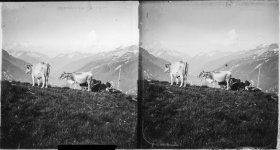
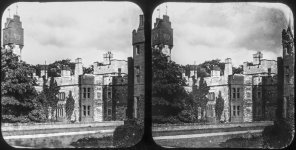
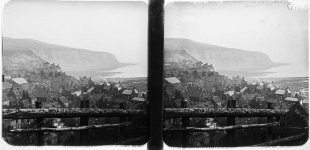
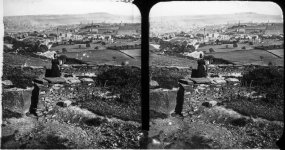
Some examples of the select sky tool, revealing some detail which isn't at all obvious to the naked eye, these being scans of @Barney stereo slides.

Stereo slides-030 - Alpine cattle copy.jpg

In the above, the cloud and background mountains aren't to be seen when viewing the slide but now can be seen. The scene must have been transmitting u/v light in abundance so the mountains are not visible in the original.

Stereo slides-072 - Ruthin Castle copy.jpg

A more pronounced example where the faintly captured clouds of the the original ortho slide can be revealed.

Stereo slides-037 - Robin Hoods Bay copy.jpg

Once more, the far cliffs have been recovered as select sky included them. Also the sky itself has a bit of depth to it.

More to follow...
 
Stereo slides-036 - Woman looking over an industrial city copy.jpg

Again the distant hills are barely visible in the original.

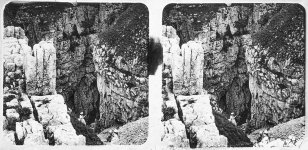
Stereo slides-047 - Gordale Scar copy.jpg

Finally, nowt to do with the other pictures, a remarkable slide of Edwardian elegance meets a geological wonder. I visited here many times with my dad when I was young. He was a geologist and fascinated by the, and nearby, limestone features.
 
I should have said that the pictures work well in 3D, print them at 160mm wide and you can view them using an OWL viewer or even a vintage Holmes viewer.
 
You have done a remarkable job there Peter, the glass was clear on those slides,
 
I would disagree that filters can't add drama though, although obviously it depends which are chosen and how they are used. Using a red filter with an infra-red sensitive film, such as Fomapan for instance, can have a striking effect, certainly something I would consider dramatic in the right scenario.
Oh, well if wwe're speaking infra-red then we may as well throw in some Aerochrome III and some space lasers.

Of course filers can be used to reveal dramatic cloud formations or to highlight them, but they don't create them.
 
Oh, well if wwe're speaking infra-red then we may as well throw in some Aerochrome III and some space lasers.

Of course filers can be used to reveal dramatic cloud formations or to highlight them, but they don't create them.

I didn't say that filters would create cloud formations at any point, merely that they could add drama. I also caveated that with a comment about it being in the right scenario, or using certain film stocks, not in all cases.

This seems to be becoming a little argumentative, which was never my intent, so I'll leave it here.
 
Back
Top