

You are using an out of date browser. It may not display this or other websites correctly.
You should upgrade or use an alternative browser.
You should upgrade or use an alternative browser.
Portable light stand
- Thread starter ndwgolf
- Start date

sk66
Advertiser
- Messages
- 9,557
- Name
- Steven
- Edit My Images
- Yes
I would get something like the Ulanzi T270. It is more like a tripod in that it has individually adjustable leg angles and leg lengths. That makes getting it stable/vertical in outdoor settings easier. You'll still probably want some cord/stakes to help secure it.
FWIW, I haven't used one... I use C-stands instead, but you don't want to hike with one.
FWIW, I haven't used one... I use C-stands instead, but you don't want to hike with one.

LongLensPhotography
Th..th..that's all folks!
- Messages
- 18,695
- Name
- LongLensPhotography
- Edit My Images
- No
Is there any way at all you could hire an assistant?

OP

- Messages
- 4,692
- Name
- Neil Williams
- Edit My Images
- No
Thanks Steven I just bought one from Lazada...........they have good reviews here in ThailandI would get something like the Ulanzi T270. It is more like a tripod in that it has individually adjustable leg angles and leg lengths. That makes getting it stable/vertical in outdoor settings easier. You'll still probably want some cord/stakes to help secure it.
FWIW, I haven't used one... I use C-stands instead, but you don't want to hike with one.
OP
- Messages
- 4,692
- Name
- Neil Williams
- Edit My Images
- No
My fiancé suggested that yesterday. She said we can use one of our caddies to help lug the gear and hold the light when we are taking pictures...........she said they would be happy to help and just cost about 20 quid............were going to try that next timeIs there any way at all you could hire an assistant?
Guys I’m looking for a new portable light stand for outdoor photography using a Profoto B1 head along with a 3 foot octabox. Something with a large footprint to help keep the light from falling over but also light enough to hike with.
When outdoors and trying to use relatively large soft boxes you are going to have significant wind problems, even on what you may consider completely wind less days. God, and Mother Nature have a sense of humor and anything easily blown down will very likely suffer from this humor when you least expect it. Never use a light stand to hold a flash outdoors, especially if it has a soft box connected, unless you weight and tie down the light stand very well. I always pack long boot laces and Gaffer Tape, and in the last 10 or more years, several hanks of parachute cord (woven miniature clothes line type rope). I buy it at Walmart, but there are other sources. Look for it where string and rope is sold (Paracord is a frequent name for it). It's about 1/4" or less in diameter and has a woven outer surface. A cigarette lighter will melt the nylon ends to keep it from fraying, but if only for one use, don't bother. I always pick the bright orange version, because in use, small cords can be trip hazards at a photoshoot. The bright orange color keeps them easily seen and safer. I would never use the black paracord on an outdoor shoot, as even I would be tripping over it. I use this orange cord and the Gaffer tape, as well as weights to tie down my camera tripods and light stands. I sometimes save the longer cut pieces of the cord, but frequently just trash it and use new the next time out. It isn't very expensive.
On known windy days, avoiding the soft boxes and just using the 7" reflectors, sometimes with a fabric diffuser over the reflector face is my usual choice, but I still weight and tie down everything. I have also used a few of my older tripods as light stands, since their legs can spread and be adjusted for length better, but tripod height when using most tripods as light stands, can be a problem as you usually will want the light much higher than most camera tripods, unless it can be placed on a high rock near the shoot, a picnic table, car, or similar for the needed extra height. For weight to hold gear and tripods down, if there is a source of sand, fine gravel, or water near the shoot location, I frequently take empty sand bags and/or empty plastic 1 gallon milk jugs with me, fill the sand bags with sand or smaller pieces of stones and the milk jugs with sand or water to use for the weights. There are water proof nylon water bags designed to use to weight the legs of the pop-up Sun shades and tents to be filled with water for weight, but the gallon jugs weigh 8 lbs when full and have a handle for easy tying to whatever you wish to hold down. Why carry heavy weights to a remote shoot if the weight can be acquired at the shoot location, and then be returned to where it came from before heading home? Large rocks that are small enough and can be moved (5-30 lb or so) can be wrapped in the parachute cord and become a weight, but again, return it to where it was when the shoot ends. Be open to using anything in shoot locations that will do what you need. Not everything needs to be photography specific and hauled there. Keep your DIY head open and ready to improvise with whatever, wherever you can.
The Profoto B1 heads and big soft boxes that don't collapse for travel easily, can be very expensive and break easily when traveling and in use outdoors. You might be better off using a lower priced light and an easily collapsing new design of soft box for your outdoor photo shoot, as traveling to and from shoot locations, and dealing with wind and Weather can take it's toll on your gear quite rapidly.
I rarely use anything but a speedlite (flashgun) or two when doing outdoor shoots, but have recently purchased three Godox AD200 Pro II lights that will likely be mostly replacing the speedlites (Flashguns) for these outdoor shoots. If the shoot will take place anywhere where there will be people, you will get many who stop to watch. So I always take several different sizes of the 5 way reflectors with me, usually when going to a local park, as it's frequently quite easy to get volunteers to help by holding these reflectors to provide needed reflected Sunlight on my subject, especially easy if the subject is pretty. If at a secluded spot with no onlookers, you may need to take some willing assistants with you. Take the time to train the these volunteers/assistants, as most will want to hold the reflector low and reflecting up at the subject. Sunlight and generally any space lighting source is naturally angled down, so it doesn't look right if the reflected light isn't also directed at a downward angle. For most shots you will want these reflectors held high, at or above the holder's heads, and the reflected light angled at least slightly down at the subject. Get the volunteer/assistant to stand where you would have placed your light, and with the reflector held at the height that you would have placed your light. This will achieve a very similar or better result than you can get by using a big heavy strobe light. If too bright, another 5 way, stripped of it's cover and only the diffuser layer showing, can be placed and held above the "too bright" reflector to reduce it's brightness. On a windy day, holding a reflector in the desired position can be quite difficult, so you will need to take extra shots, hopefully between the wind gusts.
When possible, positioning the subject in the shade of a tree or building, etc. and then reflecting light from out in the brightly lit area will be better, especially during the hot Summer days. If you can't find suitable shade, a large 5 way reflector, stripped of it's outer cover with only the scrim material exposed, and held over your subject will provide diffusion of the direct Sunlight to more evenly light your subject, and your subject won't be squinting in the shots or overheated from standing there in the hot direct Sun (but your willing assistant is going to get hot, so take frequent breaks anyway). Keep in mind also, that when the sky is overcast, but with little to no chance of rain, you will have the largest soft box and light source possible directly above for your photo shoot. Clouds work this way too, but they never seem to be where I want, when I want. You can sometimes get lucky though. Fog does not work so well, usually because it partially obscures your subject, unless floating past above with the Sunlight coming through it, but it can sometimes produce some interesting shots when it drifts by at the right time.
Good luck with however you go about this shoot.
Charley

- Messages
- 26,303
- Name
- Phil
- Edit My Images
- No
I’ve mentioned this before, but for location work I’ve used a tripod as a lightstand.
Crap in a studio setting because of the footprint but outdoors that footprint is a bonus.
Add in that mine has a hook on the bottom of the centre column, hanging a camera bag off that to make that low to the ground really works for a low centre of gravity. I’ve also hung the flash power pack off the centre column.
Not as good as an assistant, but better than a ‘light stand’ imo
Crap in a studio setting because of the footprint but outdoors that footprint is a bonus.
Add in that mine has a hook on the bottom of the centre column, hanging a camera bag off that to make that low to the ground really works for a low centre of gravity. I’ve also hung the flash power pack off the centre column.
Not as good as an assistant, but better than a ‘light stand’ imo
I have two Slik 212 Pro tripods that are a bit heavy for field work, but I'll take them with me any way . They have been my Go-To tripods for about 25 years now. Why? Many features that aren't all found in any other tripod models. Some exist, but not all. I like leg tip conversion to rubber by simply unscrewing the rubber tip until it stops. The hard point withdraws up into the center hole of the rubber tip. Nothing to loose. The legs not only extend and lock easily, but can also be angled out to near horizontal after they are angled out to the first, and usual angle stop. A release and lock then let you go to any angle from there. A 1/4-20 attachment point in the middle of the top section of one leg allows parking an attachment, or other camera or speedlite, etc. to it easily, using a cold shoe, tripod head, etc. The center column cranks up and down with a good circular rotating brake around it to keep it in any position desired. No wobble at all when the brake is locked, The center column has a male 1/4-20 thread on the bottom tip that lets the tripod head to be attached there for "Really Low shots, I keep an eye nut on each center column bottom stud , so I can tie the tripod down on windy days, or add a D-Ring and hang my camera bag or sand bag. The camera attach point on the original tripod head is a special 1/4-20 bolt with a big shouldered head that drops into a socket and then a locking lever locks the camera in place. I'm not a big fan of this camera attach, but it does work well. An ARCA attach is more preferable to me. There are another 8 or so tripods here in my studio, but none of them have all of these features, so I tend to use them less, sometimes as light stands, etc. or loan them out. Nobody is getting my Slik 212's though.
Charley
Charley
OP
- Messages
- 4,692
- Name
- Neil Williams
- Edit My Images
- No
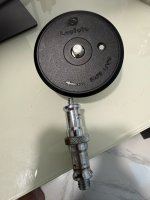
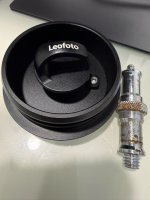
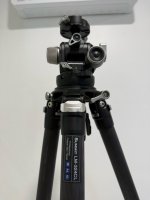
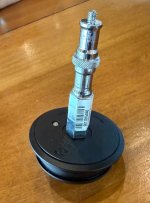
Phil I have the Leofoto LM-324CL its 2 metres tall.........let me try and figure out how to get the proforo B! head on it securelyI’ve mentioned this before, but for location work I’ve used a tripod as a lightstand.
Crap in a studio setting because of the footprint but outdoors that footprint is a bonus.
Add in that mine has a hook on the bottom of the centre column, hanging a camera bag off that to make that low to the ground really works for a low centre of gravity. I’ve also hung the flash power pack off the centre column.
Not as good as an assistant, but better than a ‘light stand’ imo
- Messages
- 26,303
- Name
- Phil
- Edit My Images
- No
Yep that’d work, but it’s a lot of parts. As long as it’s not wobbly.
This is slightly simpler and is close to what I use
Last edited:
OP
- Messages
- 4,692
- Name
- Neil Williams
- Edit My Images
- No
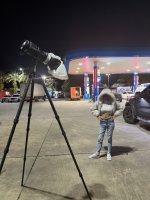
Hand tight it feels pretty stable, but I will give it a nip with a wrench before I use it. We’re going to pop out tonight and try a shoot using just a 7” reflector beside a gas station in the darkYep that’d work, but it’s a lot of parts. As long as it’s not wobbly.
This is slightly simpler and is close to what I use
sk66
Advertiser
- Messages
- 9,557
- Name
- Steven
- Edit My Images
- Yes
Very nice tripod. I have the HC-28 for it as well which gives a bit more height and the ability to boom it a little.I have the Leofoto LM-324CL
Last edited:

- Messages
- 108
- Name
- Ian Grant
- Edit My Images
- No
For a wide army of adapter look at the Amazon Camera Screw Mount sets this is a bit more comprehensive compared to the cheaper set @Phil V linked to.
I use lighting stands, Calumet, Manfrotto, etc, for my Elinchrom flash heads, and have a few Small Rig clamps, arms, and various attachments for holding Lasolite reflectors or just plain foam board reflectors. I also have a big daddy Manfrotto Groppo clamp arm, heavy duty compared to Small Rig and similar.
I don't use LED lighting as it is not powerful enough when I'm shooting LF, 5x4 or 10x8. If I need portability I have quite a few powerful Metz hammerhead flash units.
Ian
I use lighting stands, Calumet, Manfrotto, etc, for my Elinchrom flash heads, and have a few Small Rig clamps, arms, and various attachments for holding Lasolite reflectors or just plain foam board reflectors. I also have a big daddy Manfrotto Groppo clamp arm, heavy duty compared to Small Rig and similar.
I don't use LED lighting as it is not powerful enough when I'm shooting LF, 5x4 or 10x8. If I need portability I have quite a few powerful Metz hammerhead flash units.
Ian
OP
- Messages
- 4,692
- Name
- Neil Williams
- Edit My Images
- No
The setup I have right now in the pictures above is defiantly not wobbly I used a wrench to tighten everything down...............it's working greatSpigots are available with 1/4-20 or 3/8-16 female threads in their bases. You could make this shorter, less wobly, and lighter by going this way. There are double male pieces to go between as well.
Charley