Photon to Photos web site

Sootchucker

Suspended / Banned
Messages
2,824
Name
Andrew
Edit My Images
No
Can someone who is much smarter than me, tell me how to read the graphs on the linked website when it comes to comparing ISO performance between cameras please ?


I've tried, and ISO performance seems to be linked with Dynamic Range somehow, but I can't figure out how exactly, making it hard to compare what sort of high ISO advantage (or disadvantage) different bodies would provide when comparing against each other ?
 
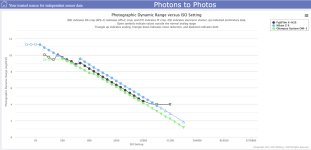
The charts show that at higher ISO the dynamic range is reduced. You can compare different cameras by adding them to the same chart.

At say 1600 ISO it is clear that there is a range of dynamic ranges so it's clear which camera would be better at that ISO
 
OK, so here's a snapshot from the website comparing 3 bodies. 2 I own and one I don't (the Fuji). If we look at for instance ISO6400, it states that at this ISO, the OM-1 has a PDR (photographic dynamic range) of 5.12, the Fuji X-H2S of 5.38 and the Nikon Z9 of 5.86. That's less than 13% difference between the M4/3 and FF bodies.

I can't imagine in the real world that the difference in high ISO performance is that small (at least to my eyes when comparing the OM-1 to the Z9) ? It is to do with resolution as obviously the OM-1 has 20mp, the Fuji 26mp and the Nikon 45mp ? It's not that I'm looking to change or add another body, I'm just trying to understand using this site how you compare one body against another ?

Also, at the bottom of the website page there is a small table that actually lists Low Light ISO, and it shows the OM-1 as 2412, the Fuji X-H2S of 2884 and the Z9 as 4144. By my reckoning that's only about 1/3 stop improvement from the Fuji over the Olympus and only about 2/3 stop from the Z9 to the Olympus - surely that can't be right ?

 
I guess the dynamic range is dependent on other factors than just sensor size. I don't know though.

The table at the bottom. I don't know what 'low light ISO' is.
 
Is dynamic range proportional to noise? As even though the dynamic range is similar the noise could be potentially completely different across all three
 
Dynamic range only tells you the difference between the maximum full well capacity, and the minimum voltage discernable... it tells you nothing about what exists in-between. The difference between "engineering" DR (DXO) and "photographic" DR (PtP) is that photographic DR is biased for noise... i.e minimum signal discernable from the noise.

The main factors in DR are photosite size/capacity (max full well capacity) and read noise (minimum). Size depends on pixel pitch; and in the case of the Z9 and the X-H2S, a secondary capacitor that is engaged in the high conversion gain state (low ISO's). This secondary capacitor increases the maximum capacity of the photosites, but it also makes the photosites less sensitive to light (can make use of more light, but also requires more light).

When the secondary capacitor is disconnected the sensor switches into low gain state, and you get the increase in sensitivity step shown. Now the DR is limited primarily only by pixel pitch, minimum amplification, and read noise (fill efficiency is pretty equal/high in modern sensors of similar design)... the fuji's pixel pitch is 86.66% the size of the Z9's or ~ 13% smaller (pitch and size are not exactly the same thing, but the specs are often interchanged).

TBH, I don't really know how the numbers in the table are derived... I could ask Bill sometime.
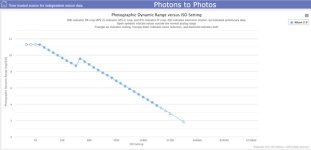
Also, when I pull up the PDR chart it looks a bit different (extending to 0 ISO).

Untitled-1.jpg
 
Last edited:
Dynamic range only tells you the difference between the maximum full well capacity, and the minimum voltage discernable... it tells you nothing about what exists in-between. The difference between "engineering" DR (DXO) and "photographic" DR (PtP) is that photographic DR is biased for noise... i.e minimum signal discernable from the noise.

The main factors in DR are photosite size/capacity (max full well capacity) and read noise (minimum). Size depends on pixel pitch; and in the case of the Z9 and the X-H2S, a secondary capacitor that is engaged in the high conversion gain state (low ISO's). This secondary capacitor increases the maximum capacity of the photosites, but it also makes the photosites less sensitive to light (can make use of more light, but also requires more light).

When the secondary capacitor is disconnected the sensor switches into low gain state, and you get the increase in sensitivity step shown. Now the DR is limited primarily only by pixel pitch and read noise (fill efficiency is pretty equal/high in modern sensors of similar design)... the fuji's pixel pitch is 86.66% the size of the Z9 sensor or ~ 13% smaller.

TBH, I don't really know how the numbers in the table are derived... I could ask Bill sometime.
Also, when I pull up the PDR chart it looks a bit different (extending to 0 ISO).

View attachment 383327
So what this says is that at ISO200, all of the cameras have a useable dynamic range of just under 10 stops, before noise overwhelms everything else in the darkest part of the image? And at ISO12800 this range is only just above 4 stops, before noise overwhelms everything? Is that correct? I'm thinking an image shot at really high ISO wouldn't have that much DR anyway, as by definition it would be quite dark?
 
So what this says is that at ISO200, all of the cameras have a useable dynamic range of just under 10 stops, before noise overwhelms everything else in the darkest part of the image? And at ISO12800 this range is only just above 4 stops, before noise overwhelms everything? Is that correct? I'm thinking an image shot at really high ISO wouldn't have that much DR anyway, as by definition it would be quite dark?
Yes... noise limits the minimum (darks) and amplification (ISO) limits the max. Even if the scene at ISO 12,800 did have a greater DR, the highlights would all be pushed into ADC clipping due to the ISO amplification.
 
Last edited:
Yes... and even if the scene at ISO 12,800 did have a greater DR, the highlights would all be pushed into ADC clipping due to the ISO amplification.
I notice that all cameras don't have the greatest DR at the lowest ISO as you would possibly expect. Is the point of greatest DR the native ISO of the sensor? And everything else is amplified / de-amplified in some way from this native sensitivity?
 
I notice that all cameras don't have the greatest DR at the lowest ISO as you would possibly expect. Is the point of greatest DR the native ISO of the sensor? And everything else is amplified / de-amplified in some way from this native sensitivity?
You would have to give me a specific example... but in general, yes. Open symbols on the charts are digital ISO's... and almost anything can happen in those ranges. But for the analog ISO ranges the highest DR typically occurs at the minimum amplification level (native ISO).

For dual gain sensors with the secondary capacitor there is also dual native ISO... minimum amplification of expanded capacity, and minimum amplification of the pixel pitch limited capacity. For those sensors that step (and *only* that step) ISO is actually a factor in sensor "exposure."
 
Some interesting reading on here, some of which still goes over my head :lol:

What I've always noticed is that Photons to Photos always measures DR lower than DXO, I assume they're using different measuring methods but does anyone know which are more accurate and therefore how much DR cameras/sensors have in the real world?
 
Some interesting reading on here, some of which still goes over my head :LOL:

What I've always noticed is that Photons to Photos always measures DR lower than DXO, I assume they're using different measuring methods but does anyone know which are more accurate and therefore how much DR cameras/sensors have in the real world?
DXO uses the "engineering" DR measurement... which is where the signal is measurable vs the noise (i.e. they are equal). However, for the signal to be visually distinct from the noise it needs to be ~ 2 stops greater. So PtP's "photographic" DR is filtered for noise, and it will more closely correspond to what you experience/perceive.

DXO's "tonality" measurement is similarly filtered for noise and goes further by describing the number of steps that exist w/in the usable DR... it is described in "bits" which is relevant for determining what recording format/depth is required. For a raw file it requires 1 bit per stop/EV... so you can interchange bits/stops/EV,

 
Last edited:
DXO uses the "engineering" DR measurement... which is where the signal is measurable vs the noise (i.e. they are equal). However, for the signal to be visually distinct from the noise it needs to be ~ 2 stops greater. So PtP's "photographic" DR is filtered for noise, and it will more closely correspond to what you experience/perceive.

DXO's "tonality" measurement is similarly filtered for noise and goes further by describing the number of steps that exist w/in the usable DR... it is described in "bits" which is relevant for determining what recording format/depth is required. For a raw file it requires 1 bit per stop/EV.

Thanks for the explanation (y)
 
@sk66 would you mind advising me which charts on photos to photos are ones which are going to be more meaningful for real world images please, Photographic DR vs Photographic DR Shadow improvement and then read noise in DNs vs input referred read noise?

Screenshot 2023-03-12 at 12.43.30.jpg
 
@sk66 would you mind advising me which charts on photos to photos are ones which are going to be more meaningful for real world images please, Photographic DR vs Photographic DR Shadow improvement and then read noise in DNs vs input referred read noise?
Sure...

Untitled-1.jpg

The photographic DR chart only shows you the useful DR capability of a camera at a given ISO. It is really only useful if deciding between cameras... and to know/show that DR necessarily decreases as ISO is increased (i.e. highlights are pushed into clipping).


Untitled-2.jpg

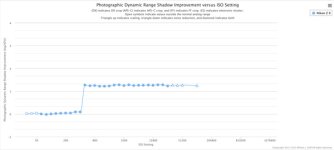
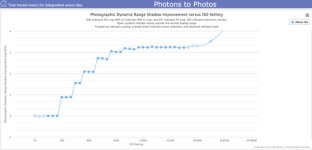
The DR shadow improvement chart shows what benefit there is to increasing the ISO...i.e. how ISO invariant a camera is. And if a camera is dual gain, where the sensitivity change is. E.g. this chart for the Z9 shows that for anything below ISO 500 I could just use ISO 64 instead, and anything above 500 I could just use 500 instead; there is about zero reason to ever clip highlights with ISO amplification. Note that this comparison (changes/increases) is only in relation to that camera itself (native/base ISO always starts at 0).


Untitled-3.jpg

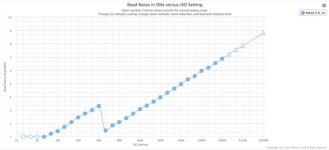
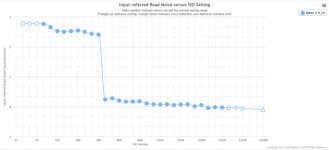
Read noise in DN's will probably make more sense... noise increases as ISO increases (except for the dual gain/increased sensitivity step).


Untitled-4.jpg

This is the voltage (electrons) the ADC is getting at each ISO to generate the image/noise... it is basically the DR shadow chart inverted.


Do not get overly wrapped up about the noise charts... it is only sensor read noise, it is not "image noise;" it's not even based on an image (it's measured from masked/optical black pixels). The primary factor in image noise with modern cameras is photon shot noise, which is scene dependent. Also note that the noise charts specifically say that they are not useful for directly comparing between different sensor sizes.
 
Last edited:
Since all these sensors are made by Sony, they are likely to have very similar characteristics before firmware processing.
I think this it a case where it would be better to suck it and see.
Each of the companies will have added their own preferences and compromises to the mix. Which might not be easily demonstrated by the testing numbers.
 
Since all these sensors are made by Sony, they are likely to have very similar characteristics before firmware processing.
Even if made by Sony, most are proprietary at least to some extent... (e.g. Nikon designed and owns the Z sensors/technology, fuji X-trans CFA, etc); there can be huge differences in the sensor performance characteristics... And if recording raw files there should be no/minimal "firmware processing."

Untitled-4.jpg
 
Sure...

View attachment 383767

The photographic DR chart only shows you the useful DR capability of a camera at a given ISO. It is really only useful if deciding between cameras... and to know/show that DR necessarily decreases as ISO is increased (i.e. highlights are pushed into clipping).


View attachment 383768

The DR shadow improvement chart shows what benefit there is to increasing the ISO...i.e. how ISO invariant a camera is. And if a camera is dual gain, where the sensitivity change is. E.g. this chart for the Z9 shows that for anything below ISO 500 I could just use ISO 64 instead, and anything above 500 I could just use 500 instead; there is about zero reason to ever clip highlights with ISO amplification. Note that this comparison (changes/increases) is only in relation to that camera itself (native/base ISO always starts at 0).


View attachment 383769

Read noise in DN's will probably make more sense... noise increases as ISO increases (except for the dual gain/increased sensitivity step).


View attachment 383770

This is the voltage (electrons) the ADC is getting at each ISO to generate the image/noise... it is basically the DR shadow chart inverted.


Do not get overly wrapped up about the noise charts... it is only sensor read noise, it is not "image noise;" it's not even based on an image (it's measured from masked/optical black pixels). The primary factor in image noise with modern cameras is photon shot noise, which is scene dependent. Also note that the noise charts specifically say that they are not useful for directly comparing between different sensor sizes.
Thanks very much, most helpful. When you say not to get too wrapped up in noise charts I assume they’re useful to compare cameras (assuming same sensor size) to give an idea which may produce less noise for a given scene?
 
Thanks very much, most helpful. When you say not to get too wrapped up in noise charts I assume they’re useful to compare cameras (assuming same sensor size) to give an idea which may produce less noise for a given scene?
Read noise, yes. But not total noise... to a certain extent total noise comparison at a given ISO is better indicated by the dynamic range capability; because image noise drowns out shadow details and results in a lower DR.

As I said, the primary factor in image noise these days is photon shot noise, which is not a characteristic of the camera so it can't really be measured/quantified. Photon shot noise is a characteristic of the scene/light. I.e. a dark scene is a weak signal with a poor signal to noise ratio.
 
Read noise, yes. But not total noise... to a certain extent total noise comparison at a given ISO is better indicated by the dynamic range capability; because image noise drowns out shadow details and results in a lower DR.

As I said, the primary factor in image noise these days is photon shot noise, which is not a characteristic of the camera so it can't really be measured/quantified. Photon shot noise is a characteristic of the scene/light. I.e. a dark scene is a weak signal with a poor signal to noise ratio.
Thanks again, much appreciated.
 
Back
Top