Photography books

Tom Pinchenzo

Suspended / Banned
Messages
1,025
Name
Tom
Edit My Images
Yes
I feel like I take too much inspiration from youtubers rather than actual photographers. Not that there aren’t some great photographers on YouTube, but there must be a difference between watching a photographer on a shoot and seeing the photos the come away with for a couple of seconds compared to looking through a presentation of a photographer’s work which they’ve taken time to collate and and present. Having been doing photography for over five years now I don’t think I’ve taken enough time to really look at the work of others. Anyway, I’ve ordered a copy of Working the Light by Joe Cornish, Charlie Waite and David Ward, which I’m really looking forward to getting some inspiration from, especially with the summer ending and autumn fast approaching.

What are people’s thoughts on photography books? What are your ‘must read’ photography books? And have they changed the way you take photographs?
 
Absolutely huge difference.

Largely books, magazines and other print media along with high end commercial websites contain quality professional images or at least images of that standard.

YouTube is a major mixed bag with huge amounts of poor information.

There is no filter to the likes of youtube, it's super easy to say what you want to say, do what you want to do and otherwise get your opinions out, no matter how wrong they are. Say it in the right way and you'll have loads of sheep following you.

In contrast most books etc. go through various layers of editing and opinions along if course with all the logistics and expense means it's very much largely filtered.
 
You could start with a varied compilation, which will give you an idea of the work you might want to explore further.

This one, 'Photobox', is very nicely done:


Phaidon have been putting out various editions of The Photo Book since the 90s (check what you are ordering - you might be getting anything from a handy paperback you can stuff in a jacket pocket, to a large coffee table book!):


They also have a nice book focusing on contemporary art photogaphy since the 60s:


Henry Carrol has a series of small books with an informal instructional approach, illustrated by some great work by major photographers:


They are targeted at beginners (especially the first one) but with the quality of photos anyone can learn something here.
 
Absolutely huge difference.

Largely books, magazines and other print media along with high end commercial websites contain quality professional images or at least images of that standard.

YouTube is a major mixed bag with huge amounts of poor information.

There is no filter to the likes of youtube, it's super easy to say what you want to say, do what you want to do and otherwise get your opinions out, no matter how wrong they are. Say it in the right way and you'll have loads of sheep following you.

In contrast most books etc. go through various layers of editing and opinions along if course with all the logistics and expense means it's very much largely filtered.
I think what’s occurred to me is that I watch YouTube photographers not necessarily because of the quality of their work but because they are enjoyable to watch. Examples being Mr Heaton and Gavin Hardcastle. I much prefer the photography of say, Adam Gibbs but I don’t find his channel as entertaining. Not to mention all the amazing photographers who don’t have YouTube channels! I guess for someone who grew up with the YouTube and the internet it’s a really easy way of engaging with the medium of photography. It’s starting to feel like it’s only a superficial engagement...
 
What are your ‘must read’ photography books?
Do you want instructional things or something deeper? If you have been serious about photography I'm guessing the latter? Perhaps a good halfway-house is The Art of Photography by Bruce Barnbaum, it is a dense book, lots of good stuff in it and it is more technical than philosophical. The classics in terms of photography philosophy are Susan Sontag's On Photography and Understanding a Photograph by John Berger, also Photography: Key Concepts by David Bate; all of these are hard going but...

have they changed the way you take photographs?

probably but not in ways that are directly explained.
 
If you're on about books of photos then it all depends on what kind of photos you like looking at and taking. Most of the photo books on my shelves are what could be loosely called documentary oriented so maybe of limited interest to someone who's into landscape. Although I would recommend looking at a range of genres, and breaking out from teh mainstream names which appear in the popular photography press etc.

The Photo Book suggested above is a good intro to the history of photographs in many genres which might give some jumping off points. I'd certainly look back beyond contemporary photographers no matter what the genre.

A book to make you think is Paul Hill's Approaching Photography (due to be reissued with updated content in December).

Has looking at photobooks influenced me? It certainly did in my early days when I tried to take pictures like the ones in the books, and more recently I've been influenced to work on long and short term projects rather than looking for individual pictures. What I have learned most is that there is no one right way to approach photography and that there are other criteria for judging photographs than the ones commonly prescribed in 'how to' guides.
 
Perhaps a good halfway-house is The Art of Photography by Bruce Barnbaum, it is a dense book, lots of good stuff in it
This. Many times this. Super book.

Also, I found Ansel Adams' 'The Camera', 'The Negative' and 'The Print' amaziong resources as well as John Blakemore's 'Black & White Photography Workshop'. Very much enjoyed Ibarionex Perello's "Making Photographs" too.

That pretty much covers a lot of the general stuff, and when it gets creative, it's a case of finding photographers that inspire you and buying their books!

For me, top picks would be Halsman's "Sight & Insight" and Andy Gotts' "Degrees" for people photography, Fay Godwin's "Land" for landscape, Gavin Watson's "Skins & Punks" and Clive Limpkin's "Battle of the Bogside" for documentary, and finally: Vivian Maier's "Self Portraits", Erwitt's "Personal Best", Saul Leiter's "All About Saul", Dennis Stock's "California Trip", and Kevin Cummins' "Looking for the light through the pouring rain" for just personal pleasure to read through. I have all of Simon Marsden's books but 'infrared gothic photography and ghost hunting' is probably a niche market :)

A good photogaphy bookshelf will always inspire - especially if you build a collection. Much more than the handful of YouTubers who need views to keep the mortgage payments going and make their videos based on that. Draw your own conclusions of the photographs you view - don't have it fed to you.
 
Last edited:
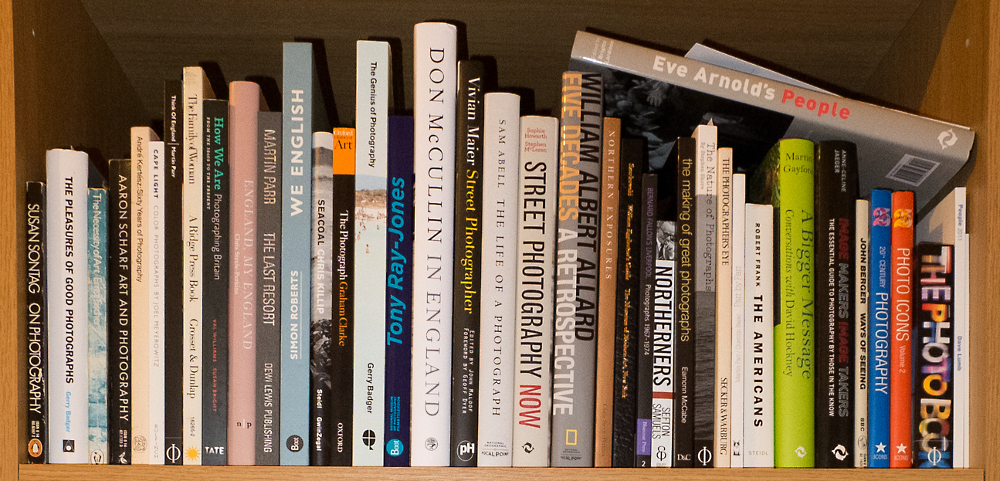
One of my shelves a few years back. The other three shelves are now overflowing and there are piles of books all over the place. :LOL:

shelf.jpg
 
And for me, the biggest improvement to my photography came from two books that aren't photography books at all! The Story of Art by Ernst Gombrich and Perception and Imaging by Richard Zakia. They taught me to look and to think about images. I've found that the more I read about art, the more I see in the world about me, and the easier it becomes to translate that to two dimensions.
 
but 'infrared gothic photography and ghost hunting' is probably a niche market
I had to google that one, I think you might be right about the niche market :)

If we are doing books of photos rather than books about photography then anything by Nadav Kander and Gregory Crewdson is a must IMHO
 
Gregory Crewdson

When we finally meet up in a pub and have pint in hand, we need to have a chat about this....
 
I have three books of "Snowdon" Portraits: "Snowdon Sittings 1979 - 1983", "Stills 1984 - 1987 Snowdon" and "Public Appearances 1987 - 1981".
Not photography books as such but books of photographs. Simple but inspiring stuff.
 
There was a time when Abingdon public library was convenient and had a lot of photography books that I borrowed. Cecil Beaton, Avedon, Brandt, Man Ray, Ansel etc. The only photographer whose style I've felt inspired by was Salgado, although there have been a couple of TP toggers who I've borrowed from.

Don't necessarily expect to be inspired or motivated by books - if you can learn then great, but you probably view the world differently from most of the authors. Also be prepared for the things you want to photograph to change over time.
 
Absolutely huge difference.

Largely books, magazines and other print media along with high end commercial websites contain quality professional images or at least images of that standard.

YouTube is a major mixed bag with huge amounts of poor information.

There is no filter to the likes of youtube, it's super easy to say what you want to say, do what you want to do and otherwise get your opinions out, no matter how wrong they are. Say it in the right way and you'll have loads of sheep following you.

In contrast most books etc. go through various layers of editing and opinions along if course with all the logistics and expense means it's very much largely filtered.
I think that this is the complete answer.

I wrote some technical books, many years ago. The starting point for the publisher was that the author needed to have appropriate qualifications, knowledge and experience and after that it was a long and frustrating business because, when I thought that they were finished they were edited for correct use of both appropriate and correct use of English and my target audience's educational standard (as well as for copyright breaches, plagiarism, libel, and technical correctness. And finally, they were further edited by a well-known expert in the field. His name appeared as joint author (in much the same way as a PhD students work also carries the name of his / her professor as joint author) and this pretty much ensured that the book would be useful to readers.

There was a downside to this process - anything even remotely controversial didn't make it to print, which could sometimes make the book a little less interesting - but you can't have everything.

None of these processes apply to internet content. Content creators don't actually need to have any knowledge of the subject, they don't need to have any communication skills and they don't even need to be honest. As most of us know, there are loads of internet tutorials and videos that are created specifically to increase sales of specific products, these masquerade as tutorials and are deliberately deceptive.

So, if you want to be 'inspired' then by all means get that inspiration from the internet, and ignore the likelihood that the examples of excellence owe far more to Photoshop than to photography, but if you want to actually learn then place your faith in the printed word, produced by a professional publisher that has a reputation to protect.
 
I prefer buying monographs/books of photos rather than technical books since I've never had much of an issue learning about stuff on the internet. Having a library of photographers (and friends!) whose work you like beats the hell out of scouring Pinterest and Instagram for moodboarding.
 
One thing that seems quite rare is a book by a truly great photographer that attempts to teach others something of the craft they have used so successfully. As mentioned above, Ansel Adams wrote a classic trilogy that is still in print. David Hurn of Magnum has published an excellent little book, On Being a Photographer, presented as a series of conversations with his friend and colleague, the late Bill Jay. It's not much concerned with technicalities, but rather with his fundamental approach to taking photos. It's fascinating to read his description of the thought process behind some of his famous images.


Google also finds a PDF as one of the top hits for this, but I won't link to it as I assume it's unauthorised.

Here he is on Promenade at Tenby:

'When I arrived at the scene I immediately saw certain elements: the cannon, the people asleep, the dog. I quickly maneuvered myself into a position where these three basic elements were all isolated from each other but together formed a strong diagonal. That was where taken care of. I shot a picture but knew it was not right. It was a bit too static for my taste. So I moved away, to the other side of the hill, saw a couple of other possible images, then returned to the original scene. Now, more was happening. The basic elements were still in place but people were walking up the hill behind the cannon’s muzzle, other figures were walking along the skyline to the left, someone was sitting down, a boy was playing on the cannon itself, and so on. I found my original position, altered it slightly to include the seated figure, and now I am watching all the other moving people as they interact and change the visual pattern. Now I am shooting small bursts of pictures because I cannot be sure that the flux of movement will be arrested at exactly the right moment. Only on the contact sheet can I see the one frame where all the elements work together.'

Incidentally, there's a good interview with Hurn here:


Andreas Feininger of Life wrote a series of detailed textbooks over several decades, now sadly out of print but mostly still available second hand. A couple are on archive.org:


Feininger had no patience with gear fetishism. This, from The Complete Photographer, may strike a nerve with some of us!:

'The Importance of Attitude

This is the most significant chapter in this book. Please, read it with care.

So you want to become a photographer—a good one. And like most students of photography, you probably believe that the key to good photography is mastery of photo-technique. Unfortunately, this assumption is at best a half-truth and at worst, a trap, a one-way road to failure. Surprised? Let me explain.

In my considerable experience there are two kinds of photographers: one, whose concern is with photography; the other whose interest is in pictures. The first (and, unfortunately, most amateurs belong to this group) is mesmerized by the technical aspects of the craft—precision cameras, sparkling lenses, fine-grain development, and so on. He owns the finest equipment, the latest cameras, the sharpest lenses, a full line of accessories. He is a walking encyclopedia of photo-technical information, and inordinately proud of the fact that he can produce virtually ''grainless" 16 X 20-inch blowups from 35 mm negatives. He knows everything there is to know about the merits and shortcomings of the various "system cameras," regularly trades up to the latest model (bravely absorbing the financial loss), but seldom knows what to photograph and rarely, if ever, makes a worthwhile picture.

At the other end of the spectrum we find the photographer whose sole interest is in the subjects he intends to photograph. In contrast to the first type, who is fascinated by gadgets and technology, he is concerned with people, natural objects, landscapes, street scenes, architecture, insects, birds or some other specific category. And because of this passion he tries to capture representatives in picture form to take home and enjoy again and again, perhaps sharing his enthusiasm with others. It is only because alternative means of visual recording like drawing or painting seem less suitable (or are beyond his ability) that he resorts to photography; and only the realization that technically perfect photographs are bound to be better interpretations of the subjects he loves than poor ones will involve him in the technical aspects of photography. Yet, despite this lack of deep interest in the medium itself, he is the better photographer of the two and his are the images which command attention. If you are this second kind of person, we should get along well.'

 
Last edited:
Feininger had no patience with gear fetishism. This, from The Complete Photographer, may strike a nerve with some of us!:

'The Importance of Attitude

This is the most significant chapter in this book. Please, read it with care.

So you want to become a photographer—a good one. And like most students of photography, you probably believe that the key to good photography is mastery of photo-technique. Unfortunately, this assumption is at best a half-truth and at worst, a trap, a one-way road to failure. Surprised? Let me explain.

In my considerable experience there are two kinds of photographers: one, whose concern is with photography; the other whose interest is in pictures. The first (and, unfortunately, most amateurs belong to this group) is mesmerized by the technical aspects of the craft—precision cameras, sparkling lenses, fine-grain development, and so on. He owns the finest equipment, the latest cameras, the sharpest lenses, a full line of accessories. He is a walking encyclopedia of photo-technical information, and inordinately proud of the fact that he can produce virtually ''grainless" 16 X 20-inch blowups from 35 mm negatives. He knows everything there is to know about the merits and shortcomings of the various "system cameras," regularly trades up to the latest model (bravely absorbing the financial loss), but seldom knows what to photograph and rarely, if ever, makes a worthwhile picture.

At the other end of the spectrum we find the photographer whose sole interest is in the subjects he intends to photograph. In contrast to the first type, who is fascinated by gadgets and technology, he is concerned with people, natural objects, landscapes, street scenes, architecture, insects, birds or some other specific category. And because of this passion he tries to capture representatives in picture form to take home and enjoy again and again, perhaps sharing his enthusiasm with others. It is only because alternative means of visual recording like drawing or painting seem less suitable (or are beyond his ability) that he resorts to photography; and only the realization that technically perfect photographs are bound to be better interpretations of the subjects he loves than poor ones will involve him in the technical aspects of photography. Yet, despite this lack of deep interest in the medium itself, he is the better photographer of the two and his are the images which command attention. If you are this second kind of person, we should get along well.'


Nailed it.
 
Back
Top