
Photographing tragedy

scottduffy

Suspended / Banned
Messages
3,348
Name
Scott
Edit My Images
Yes
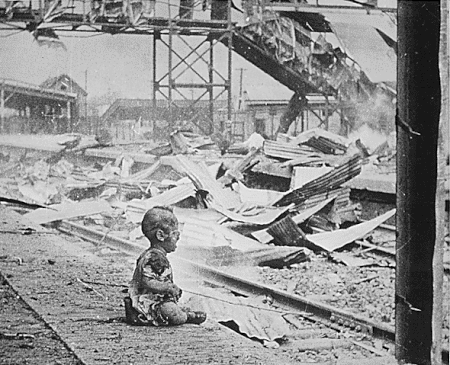
A while ago i was reading a thread in which someone considered stopping to photograph an accident on a motorway and people were rightly or wrongly outraged that someone would stop and photograph something like this rather than immediately stop and help. Today i was reading an article entitled 100 photographs that changed the world and the very first photograph i clicked into was of a baby crying at a bombed railway station called Bloody Saturday. It's harrowing and i just wonder again why would someone take a photo of this child instead of or even before they helped him/her out? I'm not being critical of the photographer because i would never have known anything about this if it weren't for this photograph but i just cannot imagine myself pointing a camera at this child as i would imagine my camera would have been dropped and i would have been busy running toward them. What do you guys think?

http://en.wikipedia.org/wiki/Bloody_Saturday_(photograph)
 
Last edited:
It depends on so many variables and would elicit a different response in a great many people, on a personal level I'd help but would have no problem with someone taking photographs as long as there were plenty of people helping, and I'd never drop my camera.
 
Hi Tim,

I just did a wee bit of research into this photo and the guy who took the shot was covering the events as part of a news team so maybe that's why he took the shot. As i said i'm not trying to be critical i am just interested.
 
If you look up the full story that baby was helped,the photo was very important as it showed the ruefulness of the Japaneses military war machine at the time.
 
you do what you think is right...

the buety of the world that we live in is that we are all different.. to then moan about people having a different value or way of doing things is a bit silly.. to presume that your values are right and everyone elses wrong is even more silly..

to add.. you havent a clue what was happening when he took the picture.. how far away he was.. how accessiblke to the baby he was... he may have put many other poeples lives at risk showing hImself.. I dont know.. neither do you..

dangerous thing judging people from a photogrpah IMHO
 
If you look up the full story that baby was helped,the photo was very important as it showed the ruefulness of the Japaneses military war machine at the time.
I was reading that the photographer never found out the sex of the baby so he was obviously focussed on the task at hand whilst others helped the injured. Fascinating stuff. I suppose a war photographers job is to show the world what's happening and if he put down his caera and helped first then we would never have seen this.
 
you do what you think is right...

the buety of the world that we live in is that we are all different.. to then moan about people having a different value or way of doing things is a bit silly.. to presume that your values are right and everyone elses wrong is even more silly..

to add.. you havent a clue what was happening when he took the picture.. how far away he was.. how accessiblke to the baby he was... he may have put many other poeples lives at risk showing hImself.. I dont know.. neither do you..

dangerous thing judging people from a photogrpah IMHO

Time to re-read the post. I am not being critical of him at all.
 
I was reading that the photographer never found out the sex of the baby so he was obviously focussed on the task at hand whilst others helped the injured. Fascinating stuff. I suppose a war photographers job is to show the world what's happening and if he put down his caera and helped first then we would never have seen this.

Yes that's his job,and in a lot of cases they do help as much as they can,sometimes their not a lot you can do :(.
 
Imagine taking photographs whilst bombs fell around you. I suppose the man should be commended for his bravery. Poor baby though. It states in the wiki page that his/her dead mother lay nearby.
 
I'd imaging this discussion has been going on for as long as news/documentary photography has been around.

Jacob Riis, how the other half lives and children of the slums, taken in 1890's.
from wikipedia:
Riis's documentary photography was passionately devoted to changing the inhumane conditions under which the poor lived in the rapidly expanding urban-industrial centers. His work succeeded in embedding photography in urban reform movements, notably the Social Gospel and Progressive movements. His most famous successor was the photographer Lewis Wickes Hine, whose systematic surveys of conditions of child-labor in particular, made for the National Child Labor Commission and published in sociological journals like The Survey, are generally credited with strongly influencing the development of child-labor laws in New York and the United States more generally.

There's many people used photography as a tool to influence social change
 
IF you as a photographer are IN and amongst the melay of a war or a bombing then as you run towards the needy stopping and getting the shot may well be an instinct - that does not mean the second later the photographer had this child in his her arms....You are not heartless if you record the event then get stuck in and help.....I think you have to be in the situation to be critical about it....If you see what I mean.

Shots from body cams or head worn cams can be automatic or frames from body worn video cams......?

what if the rescue team has a photographer with them to record events? and he stopped but just off camera a team is running towards girl......?
 
Last edited:
As an aside its a hard picture to look at though and not see just how fekking stupid the human race is...........we value everything that is worthless and devalue the very thing we should cherish - LIFE..


sorry for language
 
Donald McCullin is one of the greatest war photographers, I watched a documentary about his life and this subject came up, i.e. Do you shoot or help, his answer was , shoot first because that's the job and his job is to report tragedy to the world, second thing you do is help if you can. There was an instance in the film of refugees fleeing [I think it was Serbia or Croatia] an old woman was lagging behind and they were being fired on, she fell. He then left his Nikon and gear and picked her up, carrying her to safety.
For any normal person with normal emotions this must be a difficult job. He said later...
"I have been manipulated, and I have in turn manipulated others, by recording their response to suffering and misery. So there is guilt in every direction: guilt because I don't practice religion, guilt because I was able to walk away, while this man was dying of starvation or being murdered by another man with a gun. And I am tired of guilt, tired of saying to myself: "I didn't kill that man on that photograph, I didn't starve that child." That's why I want to photograph landscapes and flowers. I am sentencing myself to peace."
 
Was lucky to hear him talk last year? At the imperial war museum at the exhibition of his work. He's a haunted man, very humbling to hear him talk.
 
To be fair, a great many things have changed since 1937, both in the recording of images....the delivery of the same...it's difficult to compare.
 
Kinda missing the point.
I know, I was being facetious :). Just that they came around the time of this. 1935-1936?

I did bring Riis into the discussion, do I need to include brandt or others?
 
Last edited:
I know, I was being facetious :). Just that they came around the time of this. 1935-1936?

I did bring Riis into the discussion, do I need to include brandt or others?

Ah ok....missed that. Sorry. (y)
 
Interesting to read that the Japanese have stated that photograph of the child was staged. Obviously have no idea if this is true or not but here are another 2 from the scene. Th Japanese claimed that this person in the white shirt was an assistant placing the kids there for "the best photographic effect."

Either way the child was obviously still hurt in the original incident.

I can imagine as you said above that it would be haunting if your life was filled with human suffering. I don't envy them.


Last edited:
When you see vids of kids being hurt, while the parent's continue to record - and laugh! so they can stick it up on youtube or send to Jeremy Beadle ... that irritates me.

When I see tragic photograps like these, I never think that the photographer should have done something. What was he supposed to do for a start? He's there as a fly on the wall, basically, that's how I see photo journalists. Without them [oft risking their lives] there to take these compelling shots, we'd not know half of what goes on.

They are documenting history. They're not there to save lives. Other people are in place to carry out that role.
 
There is also the famous 'vulture and child' photograph Kevin Carter took in Sudan, which earned him a Pulitzer in 1994. He committed suicide a few months later, and left a note suggesting that his experiences during the years leading up to the 1994 elections in South Africa had traumatised him very badly.

"I'm really, really sorry. The pain of life overrides the joy to the point that joy does not exist... depressed ... without phone ... money for rent ... money for child support ... money for debts ... money!!! ... I am haunted by the vivid memories of killings and corpses and anger and pain ... of starving or wounded children, of trigger-happy madmen, often police, of killer executioners ... I have gone to join Ken if I am that lucky." (Ken was Ken Oosterbroek, a PJ on The Star, who was shot and killed in April 1994, during a clash in Thokoza township).

The photograph is searing and many people criticised Carter for failing, in their opinion, to help the child and simply abandoning her after he took the photograph. João Silva - another PJ - and others who were present gave a different account of what happened though.
 
Interesting to read that the Japanese have stated that photograph of the child was staged. Obviously have no idea if this is true or not but here are another 2 from the scene. Th Japanese claimed that this person in the white shirt was an assistant placing the kids there for "the best photographic effect."

Either way the child was obviously still hurt in the original incident.

I can imagine as you said above that it would be haunting if your life was filled with human suffering. I don't envy them.


The Japanese have denied a lot of things about their actions in China,and in WWII :(
 
There is also the famous 'vulture and child' photograph Kevin Carter took in Sudan, which earned him a Pulitzer in 1994. He committed suicide a few months later, and left a note suggesting that his experiences during the years leading up to the 1994 elections in South Africa had traumatised him very badly.

"I'm really, really sorry. The pain of life overrides the joy to the point that joy does not exist... depressed ... without phone ... money for rent ... money for child support ... money for debts ... money!!! ... I am haunted by the vivid memories of killings and corpses and anger and pain ... of starving or wounded children, of trigger-happy madmen, often police, of killer executioners ... I have gone to join Ken if I am that lucky." (Ken was Ken Oosterbroek, a PJ on The Star, who was shot and killed in April 1994, during a clash in Thokoza township).

The photograph is searing and many people criticised Carter for failing, in their opinion, to help the child and simply abandoning her after he took the photograph. João Silva - another PJ - and others who were present gave a different account of what happened though.

Yep by the time he got to the award ceremony his metal health was not good,then to face a barrage of questions from people who had never been near an war zone,I think pushed him over the top :(
 
I've never really thought about it in terms of humans - I suppose I always imagined that the photographer or someone with him/her would go on to help the child/victim once the shutter had clicked. However I have always been uncomfortable with wildlife films where whole camera teams leave animals to suffer 'because it's nature's way' (and all the other platitudes they use). I can't watch nature films because of it.

Every year I watch the peregrines at Notts uni and 2 years ago a really bad storm caused the death of 3 of the chicks. The web people said they would never intervene because it is 'nature's way' etc. Well I'm sorry but mother nature doesn't have nest boxes or web cams - so if you're going to record animals so the general public can share in the delights of nature, you are already going against mother nature - so go and help when you can. I could never become a silent bystander and put money/fame/arrogance before suffering :(
 
It's an amazing, powerful and extremely emotive photograph, there is no doubt about that.
In the 1st World War, war was painted as almost being glamorous. Young men, some as young as 14, were encouraged to "be a hero". The reality was far more brutal. The young men were, of course, heroes; but lions were led by donkeys. This was the first war in which we started to see the reality of war, despite only a little footage being available. Since then, as the years have gone by, we are beginning to understand the realities of war, with the work done by photographers in Vietnam etc, etc.
Without camera phones and photographers, we wouldn't have been "witness" to the killing of Ian Tomlinson by a police officer, or various acts of brutality by other police officers.

Witnessing a scene like the above photograph, must have been extraordinarily difficult. I don't think anyone could have walked on by without helping.
 
Back
Top