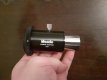
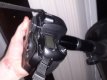
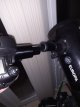
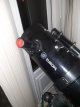
There are multiple ways to connect cameras & telescopes. With my mirrorless cameras I get best results using 'Prime Focus' where the camera body is linked directly to the telescope without either a camera lens or an eyepiece. However for infinity focus my Celestron Newtonian scope requires the camera to be closer than I can mount my DSLRs (connecting via a T2 adapter & ring - I connect my mirrorless cameras via c-mount instead) - this is not the case with all telescopes. It is apparently possible to move the primary mirror up the tube to get round the issue but that just sounds like hard work to me!
I have to admit I've never tried any of my other newtonians with a DSLR, it's just easier with a mirrorless.
Another popular approach is an 'Afocal' setup which makes use of both the cameras lens & the telescopes eyepiece. This is basically what you get if you hold a mobile phone to the eyepiece of your scope. Very high magnifications are possible with this set-up but the effective f-stop can get very small.
Connecting a camera without a lens to a telescope with an eyepiece is called positive projection. This is how my refracting telescope gets mounted as the eyepiece is fixed in place. It works OK with the eyepiece zoomed out where the scope works as a 1000mm f/16 lens, but zooming in to it's 4000mm f/64 position doesn't seem to add any detail. This zoom does help when used as a telescope.
Finally negative projection uses a barlow on the telescope but no eyepiece or camera lens. I can mount my DSLR on my Celestron this way (the barlow sits closer than the camera would).
The issues you are having could be similar to mine with the DSLR on the celestron in which case your system is focusing too close (I'd mine can focus at between 5m & 20m subject distance - not normal telescope distances but not too bad for birds in the garden.
Other setups might be focusing too far away needing the extension tubes suggested above.
Afocal set-ups might be easier to get started with. With the telescope focused for visual viewing light rays come out of the eyepiece close to parallel, the camera can then focus these on the sensor just as if they are coming from infinity. For best results use a low power eyepiece & don't use too long a focal length on your camera. Something close to normal on your camera will give a image similar to that you get directly from the eyepiece.
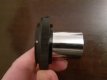
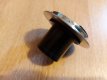
One of my eyepieces has a T2 thread hidden under the eyecup which makes it easy to use for positive projection or via a suitable stepping ring for a-focal use.
Back in 2014 I tried a set of comparison shots using different set-ups results can be seen
here but would have been better if I chosen a static subject or a less windy day... the lifeboat was really rolling!
Sadly I missed the positive projection so perhaps I should go & have another try (taking a bit more time about it too).
Here's a quick effort done with a £25 Helios 1000mm f/8.7 telescope simply stuck under my arm:
 Helios 1000 f/8.7 scope handheld 3 adj usm
 by
Mike Kanssen, on Flickr
The scope badly needs collimation as can be seen by the left hand side!