Photographing the night sky

Higgy

Suspended / Banned
Messages
52
Name
Ben
Edit My Images
No
Hi guys, complete newbie on here so I apologise if I am asking a silly question....
Is it possible to get a half decent shot of the stars/night sky with an entry level DSLR on a fairly average lens?
Im still talking high ISO, tripod, long exposure which im presuming are the necessary criteria for a shot like this, but how possible is it?

Do I need a particular expensive lens or features that are simply not available on mine or my dads camera? (Canon 600D or Nikon D5100)

I would love to take some night shots but don't want to show myself up by snapping them with kit that will give me a black screen!!

I'm obviously not expecting the same results as what I see on here when my kit costs half the price of some of these lenses but I was just curious/apprehensive :)

Thanks in advance

Ben
 
All you need is a dslr with the bulb function when you change shutter speed a tripod and a clear sky away from light pollution
 
Much as it might surprise you, the stars are not stationary so you need to use a widish angle lens, something around 18mm should give you 30seconds before you get trailing, unless you want to go for that effect. Pointing north also reduces movement and you need to find somewhere dark so you don't get light pollution from nearby towns.
 
I believe there's a couple of very good tutorials in the tutorial section that may be worth a read
 
I've just bought a Nikon D5100 for this very purpose. It should be delivered tomorrow (well, today, now). I'm particularly interested in capturing shots of the Milky Way.

I tried getting the Milky Way with my D2x and, while I did manage to get it, the results weren't pretty! A few extra stops of ISO with the D5100 should hopefully do the job, in the right conditions. :)
 
Fantastic, thanks for the responses guys!! SimonH, what lens or other equipment do you intend on using? I would be VERY interested to see your results :)
 
Ben, I've got a Nikkor 12-24mm F/4 DX lens, which should do okay. Not a brilliantly fast lens, but it has a 122 degree diagonal angle of view - should be enough to capture a decent portion of the Milky Way, I think.

Because it's a DX lens, the 12mm end equates to 18mm on full-frame, which using the 600/mm rule should allow a 30 second exposure without getting trails. An 18-55mm DX lens at the wide end works out at 27mm full frame, which works out at about 22 seconds without trails.

Really fancy the 10.5mm fisheye lens, which seems very popular for shooting the Milky Way. It has a fabulously wide angle of view, which means an even longer exposure without risking trails. I don't have a budget for it at the moment, though. :(

I've discovered that often on a misty/foggy night, if I head up into the Yorkshire Dales I can get above the fog. But the magic here is that while the fog is thick at low levels, the sky is crystal clear on the top of the hills. You get a good "dark skies" effect with the fog killing off the light pollution from the towns and cities. It doesn't always work out, but when it does it's really effective. :)
 
If you want to take photos of star trails then have a look at this -

http://www.talkphotography.co.uk/forums/showthread.php?t=355313

If you want to take shots of stars as points of light then the 600 rule is a reasonable place to start.

To prevent the stars appearing as arcs the maximum exposure in seconds =

600 / (focal length of the lens x the crop factor).

This is more of a guideline than a rule but is a good place to start experimenting.

You do not need a special lens but a very dark sky is a good thing to have. You can get some star shots from urban locations but you will see much more if you are well away from light pollution.

The comments in the above link on star trails, about what to take with you apply to any night sky photography.

Dave
 
Thanks for ALL the help guys... It's a lovely clear night tonight so I shall try and get out and take some pics!
 
If you want trails, then the tutorial Tringa posted a link to is spot on. If you want just stars and no trails, then you need a fairly dark sky away from light pollution, and a wide lens of around 24mm (or DX equivalant) and a shutter speed of no more than 20 seconds or so before trailing appears. Obviously, at such speeds, you need high ISO.

20 sec with either of the following:

ISO 6400 @ f4 or ISO 3200 @ f2.8... or any reciprocal equivalent.

A camera with good high ISO noise levels is really a must.

Obviously you need a tripod.

There is a way to take great night sky images with low ISO and longer speeds and no trails, but you need what's called an equatorial mount, which is a driven mount that rotates at the same speed as the earth's rotation and rotates around the celestial north pole. These are really for telescopes but you can easily fit cameras to them. Not cheap though.

Much easier to use a camera with really great high ISO performance.

You can also stack your 20 second exposures with software such as registax, but any foreground detail will becomes distorted as the stars are aligned... so stacking is only really useful for sky only shots... unless you digitally montage the ground back in afterwards.
 
Thanks for ALL the help guys... It's a lovely clear night tonight so I shall try and get out and take some pics!

Yep, a lovely clear night here as well, as long as you can poke your head above the heavy fog that is :shake:
 
Tonight is the perfect night to try this. It is a new moon so as long as there are no clouds it should be very dark also I use a star chart app on my phone which shows the Milky Way. Star walk I think it is called and you can change the time to see where it will be at different times of the night. Which is handy because you can work out what direction the majority of the light pollution is.
 
That shot of the nebula does require a driven equatorial mount though.
 
interesting user name.

Just point the camera at the sky and hold the shutter open.

OK then... you go and get a shot of a deep sky object like a nebula just by pointing the camera at the sky and pressing the shutter. Come back when you've done it, and we'll discuss your utter failure in more detail :)
 
Sky's reasonably clear tonight here, but lots of light pollution thanks to a bit of a mist.

Does anyone know of a freebie app that shows the location of the Milky Way in relation to the horizon?
 
Milky way is setting in the NW around 8pm now... Look for Cassiopeia.. the constellation shaped like a "W" as it runs through that.

Technically the milky way is always present and runs across the entire sky, but the best part is setting quite early now... it's getting hard to shoot.
 
Ack, 'tis what I figured. :( I got a phenomenal view back in October last year and I could see it easily with the naked eye, but my D2x was simply not up to the task of getting a decent shot.

I keep hearing that the best time of year to capture the Milky Way is around July. I hope I don't have to wait 'til then!
 
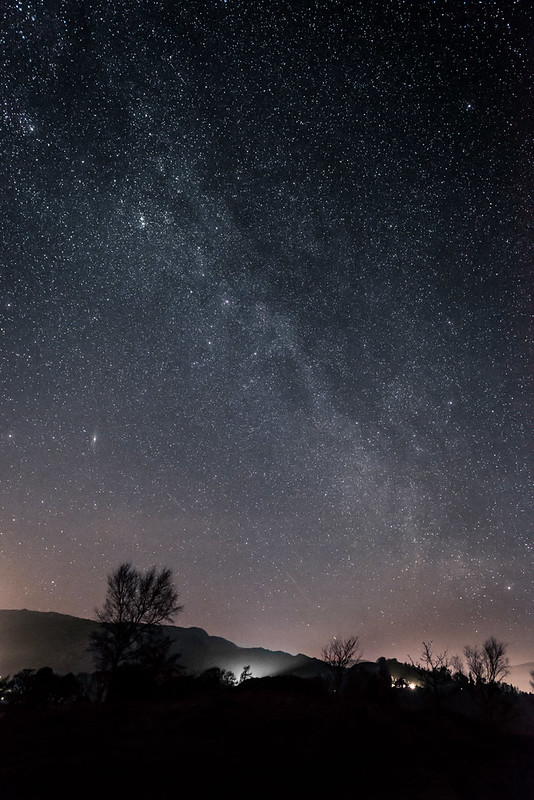
Yes, the milky way is best in summer, but I shot this 2 weeks ago.

8524603589_33ca493003_c.jpg
 
That looks brilliant. I will take all of your advice thanks guys. I took a few shots the other day which shows the stars quite well. The only problem is the sky looks to be a purple/orange colour. I'm guessing light pollution? I thought I had it pointed away from light but obviously not!

I'm guessing the higher the ground the less light pollution?
 
Lovely shot, David! I'll be happy if I can get anything remotely as defined as that! :)

Ben, it depends a lot on conditions but in the main, the further away from populated areas then the less light pollution there will be. If you can get some distance away AND on a night when there's little/no moisture in the air, you'll do even better. :)
 
wow David super shot, what sort of exposure and settings did you use for that - shows the importance of getting away from light pollution

Probably 20 seconds at f4, ISO6400 which is my default true dark sky setting. The Milky way is faint, and even with a 24mm lens on FF 20 seconds has already started to show the first signs of trailing.

There's other stuff in that frame to... 2/3rds down on the left you'll see M31 Andromeda galaxy and there are 2 meteor trails towards the bottom.
 
Last edited:
OK then... you go and get a shot of a deep sky object like a nebula just by pointing the camera at the sky and pressing the shutter. Come back when you've done it, and we'll discuss your utter failure in more detail :)

i think my point i was trying to make was not to overthink what you are doing. Most people are put off doing certain types of photography because they think they cant.

Ok my top tips for night sky stuff.

1. good size aperture
2. if you have a car nearby use it to focus on (lights come on my car when i push the button from a distance)
3.try a variety of iso and shutter options. I funnily enough cope with around F22 at iso 100

I could be totally wrong as I am a complete amateur but i have had some good photos using these
 
i think my point i was trying to make was not to overthink what you are doing. Most people are put off doing certain types of photography because they think they cant.

Ok my top tips for night sky stuff.

1. good size aperture
2. if you have a car nearby use it to focus on (lights come on my car when i push the button from a distance)
3.try a variety of iso and shutter options. I funnily enough cope with around F22 at iso 100

I could be totally wrong as I am a complete amateur but i have had some good photos using these

Why f22? That will reduce the light resulting in really long exposure times.
 
i think my point i was trying to make was not to overthink what you are doing. Most people are put off doing certain types of photography because they think they cant.

Ok my top tips for night sky stuff.

1. good size aperture
2. if you have a car nearby use it to focus on (lights come on my car when i push the button from a distance)
3.try a variety of iso and shutter options. I funnily enough cope with around F22 at iso 100

I could be totally wrong as I am a complete amateur but i have had some good photos using these


Why focus on a car if you are shooting the night sky? Why not use live view and manual focus, and find a bright star, zoom in on the live view screen and manually focus until it's as small a point as possible. That way you know for certain the lens is set to infinity. Unless the car is a very long away away there will be a definite difference in focus between it, and the night sky.

If you have foreground detail that's actually more important than the stars, then sure.... but then if that's the case, unless the car is actually meant to be in shot that won't help much either.

f22? Why? There are two reasons that's a very poor idea. 1. Your lens is gonna perform terribly at f22, and 2. Your times will be very, very long. Fine is what you want is star trails... but useless for a star shot. Even if you did want trails, the lower magnitude stars will not be showing up. Trail shots are much better done with stacking shorter exposures as noise and amp glow become an issue with seriously long digital exposures.

If you want the night sky with no trails, you're looking at ISO 3200 - 6400 most likely, and probably a shutter speed of no more than 20 seconds if you want no trailing at all.... that therefore will dictate your aperture, which will be around F4 or so.

For star trails, you're better off using the sharpest part of the lens, which is usually f5.6 to f8 and ISO100... not f22... diffraction will soften the image of such point light sources far too much. It will look soft.
 
Thanks David thats massively useful, Ive been trying different settings - I think my main thing to do is ensure I get right away from town to stand a chance of getting better photos.

Ive got a 10-24mm lens, would you recommend I use the 10 end or the 24mm end of the zoom ?

thanks again
Andrew

Light pollution - zoomable map here:-

http://www.avex-asso.org/dossiers/pl/uk/index.html

Light from a large city affects quite a large area around it.
 
That's what I meant... measured from the ground.. not from a satellite.
 
i like my long exposure times usually im looking for star trails to background a landscape rather than photos of the stars themselves. sorry for the confusion (F8 - 11 should do the job also)
 
Then yes, you are better off using a "normal" aperture for a landscape, slower ISO, and go for image quality. Stacking shorter exposures does still give better results than one long exposure though, and often, you can't get a single exposure that is actually long enough to get decent trails... even at ISO100... and even if you could, there would be so many low magnitude stars in it, it would look awful.
 
Back
Top