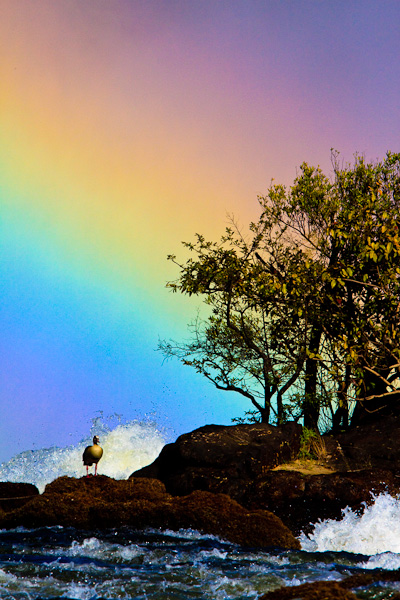
Hiya jamesrh
Thanks for sharing your photo with us here at TP.
Rainbows are one phenomena I love to capture when they present.
Firstly a rainbow will normally appear when you have the sun at your back and when there is a storm brewing.
Why is this? A rainbow is caused by light from the sun (or moon) interacting with raindrops falling from the air. These raindrops are mostly round. A ray of light entering such a droplet is bent (refracted) and decomposed into all possible colors (wavelengths) which the white light consists of. The ray then reflects internally in the droplet, and emerges roughly into the direction it came from when it entered the drop. Since the rays of the different colors all exit at slightly different directions, you see a color band in the sky.
So why is the rainbow colored? The colors are produced by a phenomenon called dispersion. Dispersion causes white light, which consists of all possible colors (i.e. wavelengths or frequencies) to break up into all components, when the light travels from one medium (e.g. air) to another (e.g. water). The different colors of light have all slightly different directions, so if you look in a certain direction in the sky from which mostly some particular colored light comes, you see that color. If you look closely at a picture of a double rainbow you will notice that the colours in a second rainbow are reversed (due to the double reflection of light inside water droplets).
Here is an example of one I recently took:
I have done a bit of research about photographing rainbows, especially as I am fortunate to have a few appear outside my house near the woodlands across from where I live and have taken lots of photos of rainbows over the last few months (so much so that I can actually see and feel when there is going to be one appear, which I suppose is a good sense to have). Best thing is to learn to recognize weather patterns, and be familiar with existing conditions (rainbows are not necessarily weather induced though; you can see rainbows appear near waterfalls or water spray which are more predictable and controllable).
Some of the pointers I have come learned are summarized as follows:
1. Metering: try to reduce the exposure by metering off a light area of the sky (the brightest part in the dark cloudy sky). Hold the shutter button depressed halfway down; compose your rainbow image and capture the shot. If your camera automatically meters from a darker area the rainbow will be lighter and appear washed-out and you may hardly see the rainbow. If you meter off the lighter part of the sky, the rainbow image darkens, resulting in deeper and more vibrant colours. This will also help if there is a second fainter rainbow next to the main rainbow. Remember though that a darker background extenuates the vibrant colours of a rainbow, conversely the colours will blend into a light sky or lighter background. If you are using the camera built-in exposure meter, be sure to have it recording the exposure from the sky and not the landscape. This will result in decreasing the exposure time, heightening the hue of the rainbow.
2. Angle: if possible, change your angle of view and position to get a better reflective image of the rainbow. The angle of your view can affect the intensity of the rainbow. (I have noticed that rainbows move as the light changes and within minutes can become faint or even disappear so sometimes you need to change position only a little to see a noticeable difference). I have found that the trick is to pay attention as to whether the colours of the rainbow are becoming more or less intense as you change position. With fuller rainbows, and in a position more perpendicular to the arch of the rainbow, the colors seem to intensify and sharpen.
3. Composition: Photo a rainbow frame with other dominant objects. For sweeping landscape shots your best chances are at sunset or sunrise. Remember you don't always need the full rainbow for a great shot, I have seen some stunning rainbow streaks. Oh and believe me there isnt a pot of gold at the end of the rainbow (seen a rainbow end now and the closest I have got is a winning £7.40 after playing lotto on the day I saw one

), but then the joy of capturing such a shot is worth its weight in gold

Where the rainbow meets the horizon (or land) is where the eye is drawn to, so zoom in on it or if you want a wider shot, have it intersecting an interesting object.
If you can't get the rainbow to intersect or frame your subject, you need to move your position which may also result in the rainbow appearing more vibrant (as mentioned above).
Leading lines such as deep shadows and long roads will draw the eye into the picture as well as add interest to the shot. If you do this use a small aperture so the foreground and rainbow are both in focus.
4. Equipment: Using a tripod will allow the photo to be as sharp as possible (although as I mentioned rainbows seem to move so be prepared to readjust position accordingly). A low shutter speed is also important to avoid blurring of image. I have not tried this yet, but have read that using polarizing filters can increase colour saturation and reduce glare and reflection from other object, i.e., bright sky.
Here is an excerpt I found regarding polarization:
"Rotate the polarizing filter until the rainbow reveals its brightest coloration. Compensate for the loss of light because of the filter (up to 1.5 stops), but underexpose by a half to a full stop to better saturate the colors. To improve your chances of perfection (and some more serendipity) bracket your exposures." (my next project
)
5. Photo Editing: If you have an image of a rainbow, you can intensify the image colour by using photo editing software. I don't have anything fancy (mainly using Picasa or MS Picture Manager).
Finally, don't forget where there is a rainbow, there is bound to be imminent rain, so it may be advisable to have an umbrella, and waterproofing ready

.
Go out there and enjoy taking pics of rainbows (after all somewhere over the rainbow dreams do come true)
Dawn
P.S. If you haven't already seen these photos, here is a link to two of the best I have seen here on TP recently
http://www.talkphotography.co.uk/forums/showthread.php?t=224708, all credit to Rory Trappe for capturing such amazing rainbows