Photographing paintings on floor - Extension for Manfrotto tripod?

Two_In

Suspended / Banned
Messages
182
Name
Andrew
Edit My Images
Yes
I photograph paintings on the floor using my Manfrotto tripod and flash lights. The problem is I can only photograph paintings up to a certain size before the tripod legs get in the way. I can get around this by tilting the tripod and securing it by tying it to something behind. But there's a risk of it all falling over. What attachment could I get for my tripod to maximise the size of paintings I can photograph? I've seen arms and booms, but it's not clear which would be the best and also economical?

Thanks
 
Daft idea !!

How about using 2 x backdrop stands ( these will go to 2.5m at least ) with the pole you'd hang the BG from then fabricate a way to clamp the camera to it. you'd prob need a ladder to view / operate the cam or trigger it remotely or via an app if that's possible
 
I've been doing this to copy large prints, and recently acquired a manfrotto arm from on here. It's like an old version of this:

It helps, though you still have to weight the tripod or the other end of the arm to stop tipping.

Till I got that, my plan was keeping an eye out for a cheap Benbo tripod as they kinda are built with an arm like that, and often come up cheap as they're large and unwieldy. Also how are you currently mounting the camera? I flipped the central column, but with the tripod at maximum height and shoot down between the legs. The repro arm makes things a bit easier but doesn't massively increase the size I could copy. How big are you going/what lens? (for me, it also makes it easier to get over a desk to copy instax prints).

Another approach I took with some success, if you have a sit-stand desk, mount the camera on the edge facing down then you can move the desk up and down.

On the clamping the camera above, I'd assume the OP tethers to photograph like this - or if not I highly advise it, much easier to get framing etc perfect (and if you've not already seen the trick, lining up the camera perfectly square using a mirror makes it much faster to setup).

 
Last edited:
I wonder if (something like) this would suit your usage requirements :thinking:

 
Last edited:
I presume you photograph the paintings on the floor so that they are flat? Then I'd think using the backdrop suggestion as above to create a plan background over which you could hang the paintings vertically also from the backdrop crossbar, would give you full flexibility to use an appropriate lens and set the tripod up normally?
Of course I'm just surmising, I don't do this type of thing myself.
 
Out of the box & very low budget - procure half a sheet (1200 x 1200mm) of manufactured board (eg 15mm mdf) and find a secure way of propping it at 45deg to support the work, and use the tripod as before.

Just being nosy - what are you doing for lighting?
 
Hanging the subject is annoying, as it's harder to line things up centred and square.

If they're on the floor, you can adjust the tripod head to get the camera square (by lining up the reflection of the centre of the lens in a mirror with the centre of the frame), then slide the subject around to get the subject centred in the frame.

If you hang the subject then you have to move the camera in multiple axes with every adjustment, it's a real pain IME.
 
Hanging the paintings is going to be far simpler than any other solution. All you need is a nail. ;)

Don't worry about trying to get it level, just get it as close as you can by 'eye' and use a geared head to level it - you'll have it set up in less than thirty seconds.
 
Look around for a used Benbo Classic #2. It can reach over 2.5m. The center column is tiltable 360˚. You can easily add a counterweight to the other end if of the column using an eye nut. And the legs are extremely versatile in positioning... plus, they are very cheap used.

I use one as my primary studio tripod. They are heavy, and can be very stable... or not, depending on how you set it up. They do take a bit of working with to get used to how they function... definitely not your traditional tripod. I think that's why they are so cheap for what they are/can do.
 
Last edited:
I do covet a geared head but they’re not cheap!

You're right, I've bought a few over the years. :eek:

I have a little Manfrotto 410 Junior that I'll let go cheap if you're interested? I bought the larger 405 a while back and was just keeping it as a spare . . .
 
Oh I had decided to stop getting more kit…but… how much? Feel free to move to PM to keep the thread on-topic.

Back on topic, I’m also interested in the OP’s light setup as I’ve been struggling with reflection of the flash or picking up the grain of the paper too much.
 
Don't worry about trying to get it level, just get it as close as you can by 'eye' and use a geared head to level it - you'll have it set up in less than thirty seconds.
Level isn't the issue, perpendicular/square is.
But that depends on how critical you're being, and how much warping/transforming is acceptable after the fact.
 
Thanks for the replies - great suggestions and will look more closely tomorrow.

For those asking about my setup: Have to photograph on the floor due to limited space to get the lights positioned well. I even have a mount on the ceiling for larger paintings - I don't like this due to having to use a step ladder. Even larger paintings I have to take outside with all my equipment into the garden and photograph at night - not good if time is pressing and if it's raining or windy not possible (paintings held vertically btw. on my easel).

I use two Lencarta Smartflash with soft boxes (if you trawl through my post history, you'll be able to find the threads of how I arrived at this setup). I position these either side of the painting on the floor - it's easy to get soft boxes and lights at the right angle as I simply angle them down towards the floor until the bottom edge is against the stand - probably 45degrees. This works very well and I don't often get too much trouble with sparkles of light on the painting. I even photographed some glazed work recently and had zero glare on the glass. When there are artefact problems I use Photoshop Elements>Filter>Noise>Dust and Scratches. This usually sorts those out - and there's other features useful for larger artefacts.
 
  • Like
Reactions: Sky
P1000251.JPG


P1000252.JPG
OjcddJi.jpg


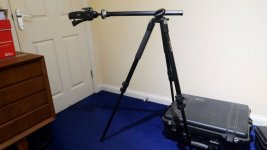
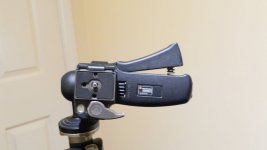
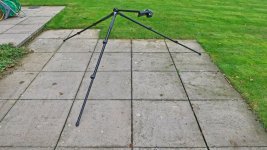
this is your answer . will go up to 6ft with a pistol grip on the end it is a Manfrotto tripod and head . Weighs a ton and would hold anything you put on it. no legs to get in the way as the arm turns 360 degrees so no leg problems.

P1011693aa.jpg

there is no way is this going to tip over or the legs obscuring
I would sell it but for collection only
I have changed all my Nikon gear D810- D300 and loads of lenses for Panasonic four thirds camera and lenses as i found them getting heavy
 
Last edited:
Back
Top