Photo stitching.

EspressoJunkie

Suspended / Banned
Messages
2,886
Name
Greg
Edit My Images
Yes
Until I get my hands on a 12mm for the XT10 the widest lens I have is 18mm (27mm equivalent).

I'm planning some urbex on Sunday and this means shooting interiors in pretty tight spaces sometimes. I used to use a Samyang 14mm on full frame for this type of thing so I'm going to take a blast at photo stitching to try and make up for lack of wide lens. Will this work?

Does anyone have any tips or advice? I'll be using a ball head which might not be ideal but it's got friction control so I'm hoping it'll be ok.
 
If I'm planning on stitching, I usually aim for about 1/2 a frame overlap to give the software a decent chance. Using a wide angle, I'd have a play before an actual shooting trip to see how much distortion/parallax error it'll give - you might be better off using a 35mm or similar and shooting more frames.
 
If I'm planning on stitching, I usually aim for about 1/2 a frame overlap to give the software a decent chance. Using a wide angle, I'd have a play before an actual shooting trip to see how much distortion/parallax error it'll give - you might be better off using a 35mm or similar and shooting more frames.

Currently the only lens I've got is the Fuji 18-55. I'll have a play tonight and tomorrow and see what works best.
 
Important to correct lens geometric aberrations before stitching. Some stitchers build that in, some leave it up to you.
 
Take the shots in 'portrait' or you could end up with a wide but not very high end result.
 
I managed to get a Samyang 12mm on ebay yesterday for a good price. Hopefully it should be here today so I'll have a wide angle again!

I'm still going to try stitching though I'd be interested to see exactly how much of a place I can get into one pic!
 
I usually aim for about 1/2 a frame overlap to give the software a decent chance.

If the scene contains lots of details like houses, books or others,
a 20~25% over lap is quite enough with recent software.

In any case, a multiple frame stitch of columns and rows should be
tested and practiced to fine tune the process and achieve good

results.

I did, for industrial clients, stitches with wide angles or tele's that went
up to 200+ frames @ 36MP each. In such endeavour, many things may
go wrong.
 
I've only done the odd stitching, just to try it really. I don't have full PS, just Elements & use micr0soft `ICE` which is plenty good enough for me.

Question (just out of interest) how do folk stitch images vertically, as opposed to the normal horizontal?
I've seen some really detailed images of eg inside buildings, where there were maybe half a dozen horizontal shots (for the width) + 2 or 3 vertical (height) all stitched together.
 
how do folk stitch images vertically, as opposed to the normal horizontal?

I don't know the software(s) you use but the one I use can recognize
small frame counts as vertical or horizontal. For multiple column and
rows, it must be indicated prior to process…
• how many frames total
• which is first an which is last
• how many rows and columns
 
There's some PhD software out there that a guy wrote to back up his thesis.

Autostitch.exe. it will take photos in any orientation and stitch them and adjust levels. Great results even with up to say 30 or 40 shots.
 
I did one recently that was done in a grid pattern think it was six across and six up, with a 50%ish overlap, in effect 36 shots. Did the stitching in Lightroom, after synchronising the all the pictures to the same details. It seems to work ok, the final picture did show up that I am still needing to keep the camera more steady. Stitching was done on the laptop, used about three quarters of the battery and took ages, so think about making a coffee or have a meal if while it is working.
 
I think it also depends on scene complexity. I'm very happy with 25% overlap, but if the scene is complex then I sometimes go to around 50% overlap. With experience, you will pick this up
 
Just tried a 36 shot with random overlap, random orientations. The software I linked to took 6 mins on my laptop. (Running under wine in Linux Mint - I'd assume faster on Windows)
 
I got some stitching software with the software disc that came with my first digital compact almost 15 year ago.. I don't think I ever got it to work properly until I upgraded the PC half a decade later to something with more than 16Mb of RAM! Then I started trying to stitch pictures taken with a 7.1Mpix compact instead of a 1.3Mpix one it came with and it didn't like the big pictures! lol! did a far job when I shrunk them a bit though.
Photo-Shop has been a little more friendly, but my PC with 8Gig of RAM now, still gets a bit over-wrought by bigger, 24Mpix pictures if you have more than a dozen or so to stitch, and I have had to pre-orientate them before stitching.
Most 'successful' has been to stitch 'sections' of 35mm negative photo'd in an old slide duplicator lens to try get 'cheap' high res scans from them since my old SCSI scanner decided it didn't like anything newer than Windows 98! Main 'lesson' of this exercise has been that 'tracking' across a flat 35mm neg, the software has no angular re-orientation to do and has a much easier time and delvers a much less distorted 'stitch' than in real world 'panning' taking a sequence of pictures from the same view-point and swivelling on the spot to get the width of view.
I the real world, lacking anything wider than the kit 18-55 on my widgetal, stitching 'success' has been a bit patchy at best and perhaps a six shot stitch, I think this was:-
15668_846150752076510_3671975031169171913_n.jpg

You get a pretty dramatic amount of bananering from the middle, far more I think than I'd get using the 'full-fish' and taking a crop out of it.
10410933_846149612076624_2696455298147796246_n.jpg

That one, I think was about ten or twelve shots, taken in portrait and two rows accross the frame to cover the whole hole of the ancient Llandudno copper mines. maintaining exposure for the stitch across frames, and selecting one to get the detail the shadow of that there 'ole, though has blown the sky... subject doesn't accentuate it like the pier, but banana distortions still there, and folk on the steps blurred from over-laying shots taken moments apart.....
Technology is impressive, BUT.. I don't think its a real substitute for a proper wide lens... actually here....
10400845_846149438743308_9219789680466041272_n.jpg

Reason for not having any other lens to hand... not much space on that to pack 'extras', especially when you have a pillion and camping gear... but I think that was about a six 'portrait' shot stitch of view from tent one morning.. for comparison, aprox the same 'range' and scale, is the same bike shot with a fish :-
11138563_974288195929431_4159075466225450140_n.jpg

Amount of bow is, I think a lot less pronounce from the full-fish, distortion on the stitch, as shown by the pier shot tending from little at the edges and increasing towards the middle, where from a fish distortion is less in the middle and not so much more at the edges.

Hopefully got a rectilinear UWA arriving this week, so will be interesting to compare how that fares in such circumstances. but I wouldn't have stumped up for that if could have got the results I'd hoped for with stitching... nice to know you can get results with a stitch, but, wider you go with one, more perverse I think the distortion gets, as said, to the same degree even as a full fish, but in a different way.

I think that stitching has to be viewed, like fish eyes, as offering a completely different effect to a rectilinear UWA rather than a substitute for one.

 
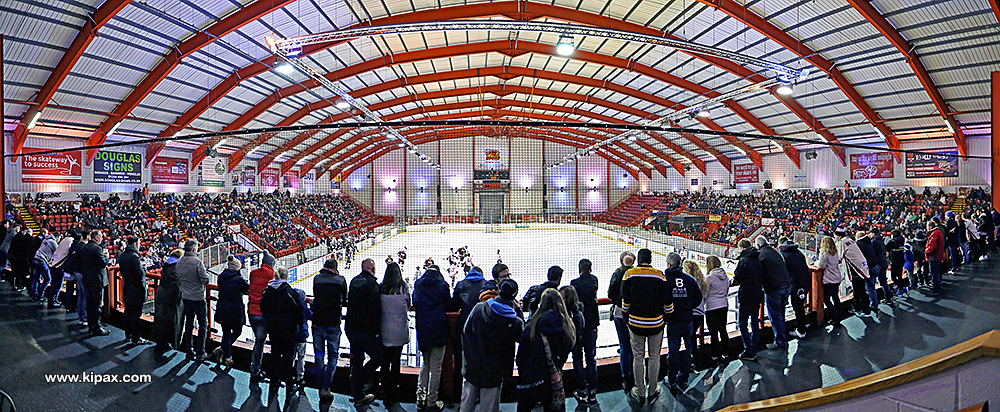
I took this with a canon 17-40 and 1dx - Three pictures.. hand held in poor light and let photoshop stitch it on standard settings ...I cant see the joins on the full size and this is very detailed.. Its a Ice hockey match ..

c2.jpg
 
Until I get my hands on a 12mm for the XT10 the widest lens I have is 18mm (27mm equivalent).
If you're stitching try and keep to a normal-ish focal length, ie. around 30mm on the Fuji.

I did an interior stitch for a holiday home brochure using the XF-14 and it did not play nice in the corners when it came to putting it together with MS ICE. It's more of an issue with interiors rather than landscapes.
 
Back
Top