Photo stacking...

appletart

Suspended / Banned
Messages
230
Name
Tim
Edit My Images
Yes
Hi..

I have been wanting to get in to taking photos of the night sky, and have been reading up on phot stacking to get better images, for example this article here http://www.digital-photography-scho...he-night-sky-introduction-to-astrophotography

my question is, are you able to photostack one picture? what i mean is, creating mutliple copies of picture, and stacking it, to reveal more and more detail, or must it be different one?

thanks

tim
 
No. Multiple pictures.
 
Short exposures. That is the point of stacking. Instead of taking one exposure of ten minutes you take twenty of 30s or forty of 15s and add then together in a stacking application.
 
how do you prevent star trails?

Short exposures. That is the point of stacking. Instead of taking one exposure of ten minutes you take twenty of 30s or forty of 15s and add then together in a stacking application.

Nope... You can stack very long exposures - and this is what most people do with DSS. You need a German Equatorial mount to do this. Decent ones come in at £600+ (the cheaper ones have too much play in the gearing and you spend all your time counteracting the mechanics of the mount). You could make do with an Astrotrac if you only wanted to mount a small lens/camera.

Beware: astrophotography makes expenditure on "normal" photography look like loose change (been there, done that ;))
 
^^^ Indeed, but stacking loads of short exposures will prevent star trails on a normal tripod mounted camera, which is what I assumed the question was about.
 
^^^ Indeed, but stacking loads of short exposures will prevent star trails on a normal tripod mounted camera, which is what I assumed the question was about.
They will, but the actual point of stacking is to increase signal to noise ratio so you can get a better picture. If your camera/lens combination can capture the detail you want at 15 or 30 secs, that's fine, but if the exposure is still stuck in the noise, the resulting picture will still be ropey.

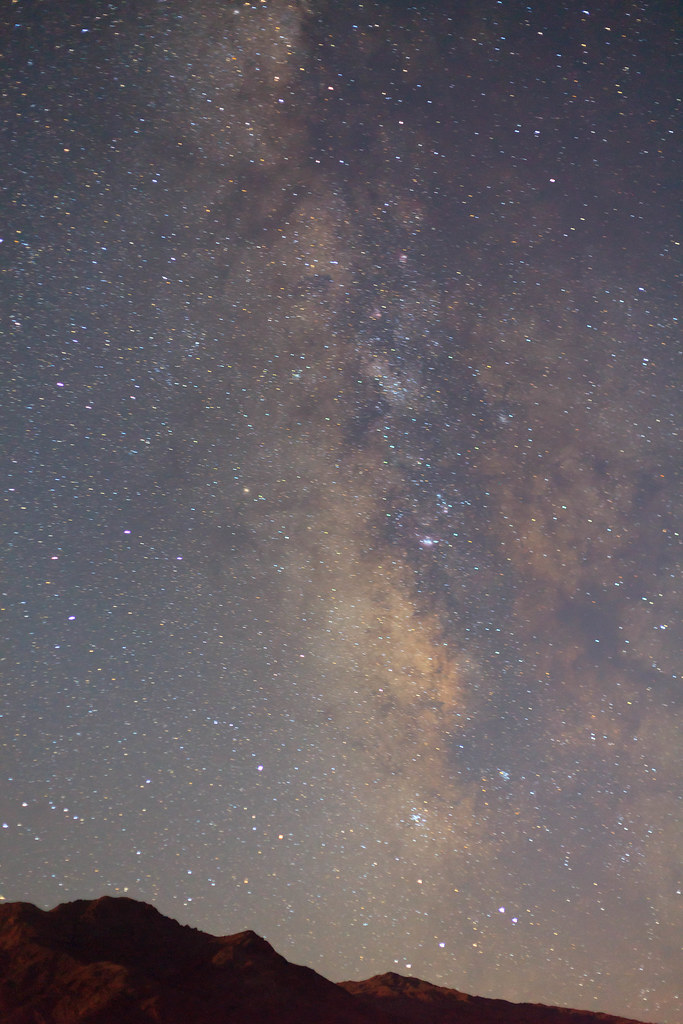
Depending on where you're pointing in the sky, a 30 sec exposure can still give you quite heavy star trails. Here's a 30sec exposure I did earlier in the year from Death Valley pointing at Sagittarius which is close to the equator (so moves the quickest). You have star trails even with a 30 sec/f2.2 exposure (BTW, Death Valley is amazing for the night sky...)

6329669321_5d2da9984e_b.jpg
 
Back
Top