pentax K100d Super and Flash?

stevescleenz

Suspended / Banned
Messages
24
Name
Steve
Edit My Images
Yes
i have a Pentax K100D Super and the other day picked up a Vivitar zoom thyristor 2500 from the boot sale with some old manual lenses, but when i attach the flash to the camera, the flash flashes but the shutter stays open too long so i get blurred photo's, i have tried it on manual flash setting and its the same, what am i doing wrong as i think the camera is thinking there isnt a flash

cheers
 
I'd be careful if I were you, it's quite possible you might fry your 100D using an old flash like that on the hotshoe....
 
The Vivitar 2500 is reported as having a max of 14.5V so will be fine with a Pentax (subject to usual disclaimers ;) )

Try a manual setting on the camera, either M or Tv. Set the shutterspeed no higher than the sync speed (1/180s). Old cameras have a sync speed of 1/60s which is a good compromise.

I'm guessing the flash has an auto setting and a guide on the back, telling you the range for various apertures and ISO settings. If it also has a manual setting, so much the better.

Your job now is to relate the guide to your camera settings and see how reliably the setup works. Assuming the shutter closes quickly enough, which I think it will ;)
 
The Vivitar 2500 is reported as having a max of 14.5V so will be fine with a Pentax (subject to usual disclaimers ;) )

Try a manual setting on the camera, either M or Tv. Set the shutterspeed no higher than the sync speed (1/180s). Old cameras have a sync speed of 1/60s which is a good compromise.

I'm guessing the flash has an auto setting and a guide on the back, telling you the range for various apertures and ISO settings. If it also has a manual setting, so much the better.

Your job now is to relate the guide to your camera settings and see how reliably the setup works. Assuming the shutter closes quickly enough, which I think it will ;)

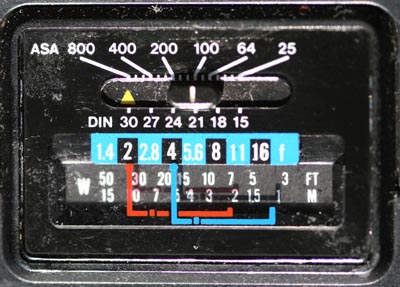
cheers for that, just had a quick play and it works, but dont understand this on the back of the flash lol, total noob alert :lol:

via.jpg


also on the flash it has the on/off switch also a switch that can switch 4 ways, a red circle, a blue circle a letter M and a white triangle, when i use it on the "M" setting it flashes only once but it is very bright, when i switch it to the other settings its not as bright but i can get 3 flashes from it then rather than just the one "big" flash if you know what i mean
 
I have/had a 3500, and was also in the dark when I first used it.

The ASA line is the same as ISO. DIN you can ignore. Then come your aperture settings, which you need to set on the lens at the chosen ASA/ISO to get the indicated range.

The flash will be controlled by its thyristor, for which you'll find an "eye" on the front. This "auto" control, by the flash, can work more reliably than the current P-TTL system, if you have highly reflective objects in the scene. Nevertheless, you need to test the setup and decide how the indicated settings relate to your results e.g you may get a better exposure at ƒ/5.6 than ƒ/8 but not for one of the ISO settings.

Your flash has a bounce head, and bouncing the light from a light-coloured (preferably white) ceiling will give better results than head-on, but will reduce your camera to subject range.

Here's a link to the manual for the Vivitar 2500. Good luck and have fun :thumbs:
 
I have/had a 3500, and was also in the dark when I first used it.

The ASA line is the same as ISO. DIN you can ignore. Then come your aperture settings, which you need to set on the lens at the chosen ASA/ISO to get the indicated range.

The flash will be controlled by its thyristor, for which you'll find an "eye" on the front. This "auto" control, by the flash, can work more reliably than the current P-TTL system, if you have highly reflective objects in the scene. Nevertheless, you need to test the setup and decide how the indicated settings relate to your results e.g you may get a better exposure at ƒ/5.6 than ƒ/8 but not for one of the ISO settings.

Your flash has a bounce head, and bouncing the light from a light-coloured (preferably white) ceiling will give better results than head-on, but will reduce your camera to subject range.

Here's a link to the manual for the Vivitar 2500. Good luck and have fun :thumbs:

many thanks for the tips and for the link for the manual :thumbs:
 
Back
Top