Paper Negatives LF

Yashica FX3

Suspended / Banned
Messages
140
Edit My Images
No
Mind blown.....the more I learn, the more I realise I do not know......paper negatives......how do you print and or enlarge images which are from paper negatives......I know nothing. Really showing my ignorance! So much to learn.
 
I’ve had some reasonable results with paper negs.
RC paper as FIber is too thick to insert into most darkslides.
Expose like ortho film .
Be aware that high contrast is a feature of paper negs.
Soup in standard wet print chrmicals.
Scan / inverse/ enlarge or contact print like a standard neg

That’s the basis of it
Like all processes you can delv deeper into the science of it all if you wish.
 
Last edited:
IIRC, printing is relatively easy - just face to face contact between the neg and the print. Getting the exposure right is rather harder (but doing test strips works well - make a note of the exposure time for the future! I used to write it on the strip print.) Enlarging would be, as Asha says, either scan, enlarge, inverse from the neg or scan, enlarge from the original positive print.

N.B. I've only ever done this from a pinhole camera and it was 40 something years ago!
 
Be aware that high contrast is a feature of paper negs.
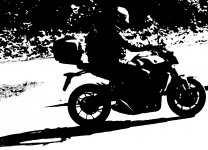
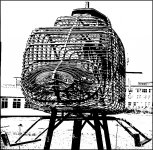
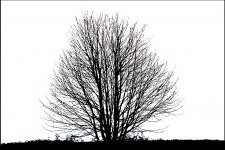
That high contrast was a useful feature for making images to be included in cheap offset printing, during the 1960s.

At the time, using a screened image could more than double the cost of a page, so converting a photo to line (no half tones) was a major saving for the plethora of cheap publications at the time. Using single weight paper for the original (printed from the film negative) the negative and the final camera copy, also saved a lot over the cost of lith (plate making) film. Using the hardest paper we could get cheaply (Ilford grade 5 was favoured) for all three stages tended to provide the best result, once you knew what you were doing.

The final printed images varied from "odd" to "ghastly" but we all agreed that the lack of half tones was part of our rebellion against "the establishment".

I still do an occassional bit of rebellion but these days I use the contrast controls :naughty:

Motorcyclist Lithoed P1140216.JPG

Wire frame model Helicopter Weston Super Mare A65 ADSC01678 lith.JPG

Litho tree DSC02324.JPG
 
Last edited:
That high contrast was a useful feature for making images to be included in cheap offset printing, during the 1960s.

At the time, using a screened image could more than double the cost of a page, so converting a photo to line (no half tones) was a major saving for the plethora of cheap publications at the time. Using single weight paper for the original (printed from the film negative) the negative and the final camera copy, also saved a lot over the cost of lith (plate making) film. Using the hardest paper we could get cheaply (Ilford grade 5 was favoured) for all three stages tended to provide the best result, once you knew what you were doing.

The final printed images varied from "odd" to "ghastly" but we all agreed that the lack of half tones was part of our rebellion against "the establishment".

I still do an occassional bit of rebellion but these days I use the contrast controls :naughty:

View attachment 342346

View attachment 342348

View attachment 342349

The motorcyclist lends itself well to the very hard contrast , more so than the other two images imo.
Of course it’s all personal choice or what the customers demand.
 
The motorcyclist lends itself well to the very hard contrast , more so than the other two images imo.
Of course it’s all personal choice or what the customers demand.
I was thinking the biker was the example of "ghastly"! :naughty:

Still, as you say: the creator proposes but the viewer disposes,
 
When I started professional photography in the 50's there were still a number of photo establishments that had reflection enlargers for printing from paper negatives. Or could make direct. Prints from positive prints. Using direct reversal processes.
This was also a quick way of making copies from customers own photographs, without making a negative first.
The enlargers worked much like an epidiascope and usually very ancient but upgraded to take very bright bulbs

Kodak and others supplied suitable papers and chemicals. Though the first direct positive process was invented 180 years ago. Though the details are forgotten.
 
I’d forgotten that I started that thread .
Iwonderwhat other useless info of mine is publicly available :runaway::LOL:
Most if it I should think :LOL:
 
And some of it is publicly available... :P
 
Back
Top