

You are using an out of date browser. It may not display this or other websites correctly.
You should upgrade or use an alternative browser.
You should upgrade or use an alternative browser.
On Shutters
- Thread starter Barney
- Start date

Ian Grant
Suspended / Banned
- Messages
- 108
- Name
- Ian Grant
- Edit My Images
- No
The size of the shutter needed is determined by the size of the optical cells of a lens. To keep costs down the smallest practical shutter was used.
Here's a link, the Deckel sizes made went up to #5, over #3 were Compounds.
Copal sizes matched the later Deckel (Compur & Compound) and Gauthier (Prontor,etc).
Ian
Here's a link, the Deckel sizes made went up to #5, over #3 were Compounds.
Copal sizes matched the later Deckel (Compur & Compound) and Gauthier (Prontor,etc).
Ian
Last edited:
Ian Grant
Suspended / Banned
- Messages
- 108
- Name
- Ian Grant
- Edit My Images
- No
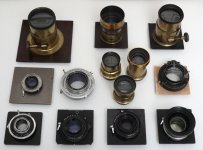
Here's a rough guide.
Bottom left late US 203mm f7.7 Ektar, Compur #1. then 3 210mm lenses in Copal #1, a Commercial Osaka f6.3 a Tessar type lens, a Rodenstock Geronar f6.8 a modern MCCooke triplet design. Then a 210mm f5.6 Symmar S.
Middle row, early British 203mm f7.7 Ektar, Epsilon #0. 8" Raptar on Alpax #3 (US) and far right CZJ 210mm f4.6 Tessar Compound #3
Top row is 8" approx Petzvals, inc a Dalmeyer 2b f3 lens for 1864.
The largest shutter practical on a 5x4 camera is a #3.
Shutters to avoid as Compur #OO and #2, very difficult to get repaired, don't go near early electronic Compurs, and the early Epsilon.
Ian
Last edited:

- Messages
- 5,607
- Name
- Stephen
- Edit My Images
- Yes
And as far as the image goes
1. Physical lens size determines the shutter, so if you select a specific shutter, you limit your lens choice.
2. The shortest shutter speed possible becomes longer as the shutter gets bigger. A copal 0 will have 1/500th; go bigger and the speed drops to 1/300th.
1. Physical lens size determines the shutter, so if you select a specific shutter, you limit your lens choice.
2. The shortest shutter speed possible becomes longer as the shutter gets bigger. A copal 0 will have 1/500th; go bigger and the speed drops to 1/300th.
- Messages
- 5,607
- Name
- Stephen
- Edit My Images
- Yes
A Calumet lens board let's us know what camera it can fit, but not what lens will fit it. I have Wista boards with different size holes to accommodate the different shutter sizes. All Wista; not all compatible with all lenses.
We need to know the shutter size to specify the board. I can use Sinar, Wista and Canham boards but they are camera specific. I can't put the Wista board directly on to my Canham MQC or Canham 10x8 without an adapter.
So we can suggest a lens, but we'd need to know the hole size in your board. And if it's a Copal 3 hole, the lens will be bigger, heavier and probably more expensive than one for a Copal 0.
We need to know the shutter size to specify the board. I can use Sinar, Wista and Canham boards but they are camera specific. I can't put the Wista board directly on to my Canham MQC or Canham 10x8 without an adapter.
So we can suggest a lens, but we'd need to know the hole size in your board. And if it's a Copal 3 hole, the lens will be bigger, heavier and probably more expensive than one for a Copal 0.
Last edited:
OP

Barney
Suspended / Banned
- Messages
- 3,043
- Name
- Wayne
- Edit My Images
- No
And as far as the image goes
1. Physical lens size determines the shutter, so if you select a specific shutter, you limit your lens choice.
2. The shortest shutter speed possible becomes longer as the shutter gets bigger. A copal 0 will have 1/500th; go bigger and the speed drops to 1/300th.
I am clueless Stephen, do not understand that which you you are attempting to convey.
OP
Barney
Suspended / Banned
- Messages
- 3,043
- Name
- Wayne
- Edit My Images
- No
I have some aluminium sheet approx 3-4mm, I can make any size of accurate hole on the lathe in a 4 jawA Calumet lens board let's us know what camera it can fit, but not what lens will fit it. I have Wista boards with different size holes to accommodate the different shutter sizes. All Wista; not all compatible with all lenses.
We need to know the shutter size to specify the board. I can use Sinar, Wista and Canham boards but they are camera specific. I can't put the Wista board directly on to my Canham MQC or Canham 10x8 without an adapter.
So we can suggest a lens, but we'd need to know the hole size in your board. And if it's a Copal 3 hole, the lens will be bigger, heavier and ptobablymoreexpensive than one fora Copal 0.
- Messages
- 5,607
- Name
- Stephen
- Edit My Images
- Yes
Then if you don't have too big a hole to start with, any lens should fit.
But you can't use a lens with a focal length greater than your maximum bellows extension. You can't use a lens with a focal length less than your minimum bellows extention. Both these statements have caveats, but I won't confuse you with extra information.
And some lenses are physically too big to fit certain cameras.
But you can't use a lens with a focal length greater than your maximum bellows extension. You can't use a lens with a focal length less than your minimum bellows extention. Both these statements have caveats, but I won't confuse you with extra information.
And some lenses are physically too big to fit certain cameras.
- Messages
- 5,607
- Name
- Stephen
- Edit My Images
- Yes
That at least is clear.I dont really know what I need or what I want, I would like the combo to have the ability to stay with me as I develop my skills.
Get a 150mm lens with a shutter. That's all you need until you know what you want. If you can find one, get a Symmar - NOT Apo Symmar, NOT Symmar S. Reasons withheld to avoid confusing you.
Last edited:
- Messages
- 5,607
- Name
- Stephen
- Edit My Images
- Yes
Probably short bellows, limits options for close ups with a longer lens. 150mm or 135mm then, but only you know what you photograph, what perspective you prefer you use.
Start by looking at the Intrepid camera site for the advice there.
Start by looking at the Intrepid camera site for the advice there.
- Messages
- 5,607
- Name
- Stephen
- Edit My Images
- Yes

- Messages
- 5,607
- Name
- Stephen
- Edit My Images
- Yes

Buying A Lens For Your 4x5 Camera
You can't just use any lens on your large-format camera - it has to be specially designed for the job, but don't worry, this guide will quickly teach you everything you need to know and where to find the perfect lens at surprisingly good value!
 intrepidcamera.co.uk

PeterSpencer
Suspended / Banned
- Messages
- 1,661
- Name
- Peter
- Edit My Images
- Yes
The lens board for the Calumet is 4" x 4" x 1/8" thick. On edge of the board has to be chamfered about 1/16". As it happens 102mm square by 3mm thick MDF works with a chamfer on one edge, without any light leaks. The hole size depends on the lens, of course.
OP
Barney
Suspended / Banned
- Messages
- 3,043
- Name
- Wayne
- Edit My Images
- No
Have you got open and closed dimensions Peter?The lens board for the Calumet is 4" x 4" x 1/8" thick. On edge of the board has to be chamfered about 1/16". As it happens 102mm square by 3mm thick MDF works with a chamfer on one edge, without any light leaks. The hole size depends on the lens, of course.
OP
Barney
Suspended / Banned
- Messages
- 3,043
- Name
- Wayne
- Edit My Images
- No
for the bellows, you said it was critical for lens selectionDare I ask for what? I've lead a sheltered life, and never encountered a folding lensboard.
- Messages
- 5,607
- Name
- Stephen
- Edit My Images
- Yes
The camera determines what focal lengths you can use and what lens board you can use. A lens board per se limits the choice of lenses, and the choice of camera unless board adapters are available. A lens will limit the choice of camera and lens board.
We have 3 completely independent variables.
We have 3 completely independent variables.
- Messages
- 5,607
- Name
- Stephen
- Edit My Images
- Yes
As a concrete example, I have a 450mm lens in a Copal 0 shutter. The lens is mounted on a Wista board.
The lens is too long a focal length to focus on infinity in my Intrepid 5x4 (max bellows about 380mm from memory). It might just manage it using depth of field on my Walker Titan and Canhan DLC cameras (max bellows 430mm) but for the Canham requires Canham's adapter for the smaller Wista board. Canham boards are larger. It will work with my 10x8 cameras, but only with a Wista to Sinar adapter unless I change the board. And, with the Canham adapter, is happy on my 5x7 MQC. The Gandolfi Variant 5x7 is sui generis among my cameras: same board area as Wista, but different thickness.
So it physically can be fitted to all my cameras, but not easily used on my 5x4 cameras.
Given the camera, choice of board is fixed (adapters apart), and so is the range of focal lengths you can use.
The lens is too long a focal length to focus on infinity in my Intrepid 5x4 (max bellows about 380mm from memory). It might just manage it using depth of field on my Walker Titan and Canhan DLC cameras (max bellows 430mm) but for the Canham requires Canham's adapter for the smaller Wista board. Canham boards are larger. It will work with my 10x8 cameras, but only with a Wista to Sinar adapter unless I change the board. And, with the Canham adapter, is happy on my 5x7 MQC. The Gandolfi Variant 5x7 is sui generis among my cameras: same board area as Wista, but different thickness.
So it physically can be fitted to all my cameras, but not easily used on my 5x4 cameras.
Given the camera, choice of board is fixed (adapters apart), and so is the range of focal lengths you can use.
OP
Barney
Suspended / Banned
- Messages
- 3,043
- Name
- Wayne
- Edit My Images
- No
I am optimistic that your post will all make sense..As a concrete example, I have a 450mm lens in a Copal 0 shutter. The lens is mounted on a Wista board.
The lens is too long a focal length to focus on infinity in my Intrepid 5x4 (max bellows about 380mm from memory). It might just manage it using depth of field on my Walker Titan and Canhan DLC cameras (max bellows 430mm) but for the Canham requires Canham's adapter for the smaller Wista board. Canham boards are larger. It will work with my 10x8 cameras, but only with a Wista to Sinar adapter unless I change the board. And, with the Canham adapter, is happy on my 5x7 MQC. The Gandolfi Variant 5x7 is sui generis among my cameras: same board area as Wista, but different thickness.
So it physically can be fitted to all my cameras, but not easily used on my 5x4 cameras.
Given the camera, choice of board is fixed (adapters apart), and so is the range of focal lengths you can use.
One day!

stevelmx5
Suspended / Banned
- Messages
- 10,176
- Name
- Steve
- Edit My Images
- No
The two most popular lenses I build cameras for (and have myself) are the Schneider 90mm f6.8 and Schneider 150mm f5.6.I need a decent lens combo for first ever try at 5x4. on a calumet lens board
Decent means highest quality for lowest money. Bang for the buck lens.
Any suggestions?
The 90mm is tiny, light, covers 4x5 giving decent results on a relatively wide angle (roughly equivalent to 30mm focal length on a full frame/35mm camera) and is quite easy to find for less than £150-200.
The 150mm is a solid ‘nifty fifty’ equivalent that gives a better angle of view for portraits than a 90mm but isn’t much larger in size.
- Messages
- 5,607
- Name
- Stephen
- Edit My Images
- Yes
In one of the Sherlock Holmes books - I think it was the first SH book, A Study in Scarlet - Holmes remarks to Watson that a perfect logician would be able to look at a drop of water and infer an ocean. At the moment, you appear to be attempting to infer the whole mechanics of large format photography by looking at a lens board - perhaps in smaller format terms, infering how to use a camera, and what lenses do, by examining a lens cap.I am optimistic that your post will all make sense..
One day!

Last edited:
Ian Grant
Suspended / Banned
- Messages
- 108
- Name
- Ian Grant
- Edit My Images
- No
No, a Copal #3 shutter has a top speed of 1/125. As size increases the fasters speeds also have a greater aperture effect.A Copal 3 shutterwill give shutter speeds up to 1/300th. A Copal 0 1 to 1/500th. This is down to the physical size.
The tiny 90m Schneider you refer to is the plain Angulon which covers 5x4 with very little room for movements. Many early ones have sharpness issues, post 5,000,xx SN are fine. The late Dean Jones who made Razzledog cameras discovered the issue was the Compur #- shutters, it was a large batch only used for these lenses with no preview lever. He found the issue was poor machining of the shutter tube length, he was a repair technician and would machine the shutter tube to the correct length, and that solved the sharpness of poor 90mm Angulaon lenses.The two most popular lenses I build cameras for (and have myself) are the Schneider 90mm f6.8 and Schneider 150mm f5.6.
The 90mm is tiny, light, covers 4x5 giving decent results on a relatively wide angle (roughly equivalent to 30mm focal length on a full frame/35mm camera) and is quite easy to find for less than £150-200.
The 150mm is a solid ‘nifty fifty’ equivalent that gives a better angle of view for portraits than a 90mm but isn’t much larger in size.
I have owned or tried 4 90mm f6.8 Angulon lenses and the first 2 were really poor, the second was borrowed worse. The third was fine, nice and sharp, it's now owned by another Forum member, the 4th is also excellent but in a late Compur with a preview lever, so more practical.
My main 90mm lenses are a Gradagon N f6.8. loads of room for movements, extremely sharp, and also a 90mm f5.6 Super Angulon, both very significantly out-perform the plain Angulon in terms of movement, and sharpness at wider apertures
A good 90mm f6.8 Angulon is great in a light-weight 5x4 kit, but lack of room for movements is quite restrictive, and don't pay more than around £120. That's decades of experience with these lenses.
Oh, why the light-weight LF kit, I lived abroad for a few years while still having a house here in the UK. Then two reasons, to keep weight down in extreme heat, often over 35º July/August and as I'd stop maybe 42ºC as it was just too dangerous. The second was I could (still can) go into areas where backpacks aren't allowed, but maybe I'll say no more

Ian
OP
Barney
Suspended / Banned
- Messages
- 3,043
- Name
- Wayne
- Edit My Images
- No
My main 90mm lenses are a Gradagon N f6.8. loads of room for movements, extremely sharp, and also a 90mm f5.6 Super Angulon, both very significantly out-perform the plain Angulon in terms of movement, and sharpness at wider apertures
Ian
Is the 90 MC any good?
stevelmx5
Suspended / Banned
- Messages
- 10,176
- Name
- Steve
- Edit My Images
- No
Cheers, I was suggesting the 90 as a starter lens as the OP seems new to large format, and basing it on popularity among my own customers. The 90/6.8 is by no means a perfect lens but it’s a decent option to start.No, a Copal #3 shutter has a top speed of 1/125. As size increases the fasters speeds also have a greater aperture effect.
The tiny 90m Schneider you refer to is the plain Angulon which covers 5x4 with very little room for movements. Many early ones have sharpness issues, post 5,000,xx SN are fine. The late Dean Jones who made Razzledog cameras discovered the issue was the Compur #- shutters, it was a large batch only used for these lenses with no preview lever. He found the issue was poor machining of the shutter tube length, he was a repair technician and would machine the shutter tube to the correct length, and that solved the sharpness of poor 90mm Angulaon lenses.
I have owned or tried 4 90mm f6.8 Angulon lenses and the first 2 were really poor, the second was borrowed worse. The third was fine, nice and sharp, it's now owned by another Forum member, the 4th is also excellent but in a late Compur with a preview lever, so more practical.
My main 90mm lenses are a Gradagon N f6.8. loads of room for movements, extremely sharp, and also a 90mm f5.6 Super Angulon, both very significantly out-perform the plain Angulon in terms of movement, and sharpness at wider apertures
A good 90mm f6.8 Angulon is great in a light-weight 5x4 kit, but lack of room for movements is quite restrictive, and don't pay more than around £120. That's decades of experience with these lenses.
Oh, why the light-weight LF kit, I lived abroad for a few years while still having a house here in the UK. Then two reasons, to keep weight down in extreme heat, often over 35º July/August and as I'd stop maybe 42ºC as it was just too dangerous. The second was I could (still can) go into areas where backpacks aren't allowed, but maybe I'll say no more
Ian
The Schneider 90/8 and 90/5.6 are lenses with better sharpness in the corners and mix more space for movement, but are also considerably larger, heavier and more expensive. There are definitely numerous options in large format lenses to suit everyone.
Last edited:
PeterSpencer
Suspended / Banned
- Messages
- 1,661
- Name
- Peter
- Edit My Images
- Yes
I'll post a photo of the camera tomorrow. I'm off to do some photography at the museum archive now so it will have to wait until later I'm afraid.

Kevin Allan
Suspended / Banned
- Messages
- 2,823
- Name
- Kevin
- Edit My Images
- No
Some details of the camera are here:
OP
Barney
Suspended / Banned
- Messages
- 3,043
- Name
- Wayne
- Edit My Images
- No
Thanks for that Kevin, I found a couple of videos also. It looks a bit agricultural, but with that comes strength and longevity. It also appears to have a complete range of movements that the field cameras sometimes appear to lack. I am also impressed by the size of the bellows behind the front standard, that should give a full range of movement.Some details of the camera are here:
!0 kilo is not heavy really. I will stick to 50 yards from the car.

Ian Grant
Suspended / Banned
- Messages
- 108
- Name
- Ian Grant
- Edit My Images
- No
I think you might mean the 90mm Super Angulon MC there were two versions f5.6 & f8, the main difference, apart from speed, is size, weight, & cost. There was also a very late 90mm f6.8 SA.Is the 90 MC any good?
Earlier coated Schneider (or Rodenstock) lenses are another option, preferably post 1964, Coating technology took a leap forward in 64, with coatings better optimise for colour films, this was often reflected in the lens name, like Color Skopar, or the CZJ Pancolar - identical to the Flekton but with greatly improved coating.
It's a bit like Apo, many lenses were Apochromatic and didn't use the term in their name, until Canon added it as a marketing feature. Many high-end lenses, particularly LF lenses from Schneider & Rodenstock used multiple layers of coatings. It was only when Pentax launched their SMC - Super Multi Coated lenses in 1971 that the term Multi coating came into general use. Yes, SMC was an improvement over the already excellent coatings of Super Takumars, but the significance was really only noticeable with Zoom lenses which have far more internal air/glass surfaces than fixed FL lenses, inc LF.
Avoid the early 90mm f8 Super Angulons in Compur #00 shutters, unreliable, no preview lever, very fiddly. Also the Wray 89mm is very soft.
Ian
- Messages
- 5,607
- Name
- Stephen
- Edit My Images
- Yes
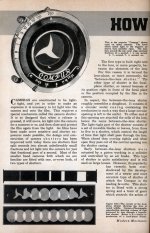
For what it's worth, my first LF camera was a Calumet. It looked exactly like the illustration, had short bellows (which meant I missed one image of a tree because I couldn't focus on it) and weighed 4.2 kilos according to our local post office scales. I took it in, and asked if they would weigh it for me.
It wouldn't fit in my normal backpack, so when we took a stroll up the north face of Ben Nevis path one year I had to carry it in my hand by the strap, with my RZ67 and tripod in the backpack.
@Ian Grant - thank you for the correction on the shutter speeds. I have enough lenses in that shutter and shouldn't have made the slip.
It wouldn't fit in my normal backpack, so when we took a stroll up the north face of Ben Nevis path one year I had to carry it in my hand by the strap, with my RZ67 and tripod in the backpack.
@Ian Grant - thank you for the correction on the shutter speeds. I have enough lenses in that shutter and shouldn't have made the slip.

OP
Barney
Suspended / Banned
- Messages
- 3,043
- Name
- Wayne
- Edit My Images
- No
Gradagon 90 MCI think you might mean the 90mm Super Angulon MC there were two versions f5.6 & f8, the main difference, apart from speed, is size, weight, & cost. There was also a very late 90mm f6.8 SA.
Earlier coated Schneider (or Rodenstock) lenses are another option, preferably post 1964, Coating technology took a leap forward in 64, with coatings better optimise for colour films, this was often reflected in the lens name, like Color Skopar, or the CZJ Pancolar - identical to the Flekton but with greatly improved coating.
It's a bit like Apo, many lenses were Apochromatic and didn't use the term in their name, until Canon added it as a marketing feature. Many high-end lenses, particularly LF lenses from Schneider & Rodenstock used multiple layers of coatings. It was only when Pentax launched their SMC - Super Multi Coated lenses in 1971 that the term Multi coating came into general use. Yes, SMC was an improvement over the already excellent coatings of Super Takumars, but the significance was really only noticeable with Zoom lenses which have far more internal air/glass surfaces than fixed FL lenses, inc LF.
Avoid the early 90mm f8 Super Angulons in Compur #00 shutters, unreliable, no preview lever, very fiddly. Also the Wray 89mm is very soft.
Ian
OP
Barney
Suspended / Banned
- Messages
- 3,043
- Name
- Wayne
- Edit My Images
- No
I will get a frame type rucksack and mount it on there with a waterproof cover. Some of the ex -army type are only 20 quid.For what it's worth, my first LF camera was a Calumet. It looked exactly like the illustration, had short bellows (which meant I missed one image of a tree because I couldn't focus on it) and weighed 4.2 kilos according to our local post office scales. I took it in, and asked if they would weigh it for me.
It wouldn't fit in my normal backpack, so when we took a stroll up the north face of Ben Nevis path one year I had to carry it in my hand by the strap, with my RZ67 and tripod in the backpack.
@Ian Grant - thank you for the correction on the shutter speeds. I have enough lenses in that shutter and shouldn't have made the slip.
Out of all your lenses you must have one going spare?
Ian Grant
Suspended / Banned
- Messages
- 108
- Name
- Ian Grant
- Edit My Images
- No
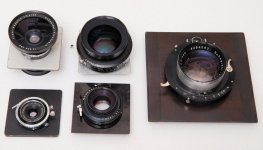
For @Barney here's a few lenses to get an idea of size.
Bottom left is a late 90mm f6.8 Angulon, in a Compur #1 shutter, above that is a 90mm f5.6 Super Angulon, same shutter. Middle lower lens is a 210mm f6.8 Geronar in a Copal #1, above that a 240mm f5.6 Nikkor SW in a Copal #3 which is tight on a Linhof/Wista fit lens board. Finally, a 300mm f4.5 Xenar.
So there's a huge difference in size & weight between the 90mm Angulon and Super Angulo, the f8 SA is only slightly smaller than the f5.6.
The 300mm f4.5 Xenar is a large lens, I have a 300mm f9 Nikkor M. it is in a Copal 1, and a bout the same size as the Geronar,
Ian
Ian Grant
Suspended / Banned
- Messages
- 108
- Name
- Ian Grant
- Edit My Images
- No
There's more than one, Grandagon, and later Grandagon-N f4.5 of f6.8, I have the f6.8 N and it's a superb lens.Gradagon 90 MC
Ian