

On-camera flash disaster - how can I do it better?

mhuk

Suspended / Banned
Messages
196
Name
Mark
Edit My Images
Yes
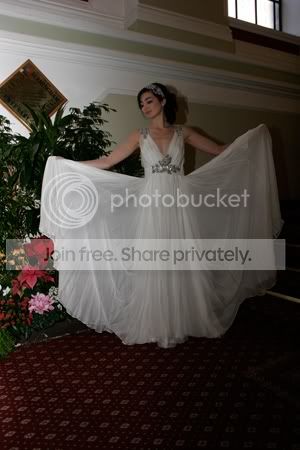
I had a bit of a on-camera flash disaster today. At the end of a wedding dress fashion show shoot they wanted a few shots on the staircase. I put the flash on my camera and looked at the high ceilings and wide apart walls.

I tried to bounce the flash on the wall to the left of the model but as you can see the result is not very good. It was all over in less than 2 minutes and spare time for thinking was in short supply.

How could I have done it better? Should I have to tried to bounce it either off the ceiling (25ft?) or one of the walls?

Would I have been better using a stofen or pointing the flash directly at the model with -3ev?

Technical stuff:
Canon 20d in manual + Canon 430ex in eTTL
ISO 800 f5.6 1/125 17-55mm @17mm


Thanks.

Image is hotlinked to a larger version.
 
It looks like you bounced the flash on your left side ? I'd have bounced it on you right so that the flash would have more evenly lit her . Another option stofen with flash pointing up to defuse the light . I'm sure that others will have better ideas as I'm still learning too .
 
Flash with white things and bounce is usually a mare for me, it looks like the flash has detected the correct exposure from the light bounced back off the wall and quenched the light.

could be wrong though.....open to be put right as flash is something i really struggle with myself.
 
Great recovery, bit noisy to the right but a massive improvement.

Doesn't really help the Op avoid a repeat performance though :)
 
The 430 has struggled for enough power to cover the distance you have tried to bounce at at the aperture you have asked it to cover.

Don't forget when using flash your aperture controls the flash exposure. Shutter speed controls ambient.

I'll make a guess that you didn't shoot with everything on Manual?

Shooting manually, you could have opened up the aperture a little and got more power from the flash by doing so.

The best way to shoot an image like this is with some form of off camera lighting. Then you don't have the distance problems because you can place your flash where it is needed, lighting your subject. The other option is to use a video light. I keep a cheap one in my bag and it's a great little creative tool. SO much so I'm seriously considering a blooming expensive one :)
 
Great recovery, bit noisy to the right but a massive improvement.

Doesn't really help the Op avoid a repeat performance though :)

yeah i know just thought id give it a blast.

how do know/see if its noisy i just dont see it :shrug:
 
That's an interesting idea Ali........ /thinks :)

The 430 shouldn't have struggled with that tbh, i've used mine over greater distances and with less available light.

it would be nice to see the exif though.

Cameraman

look along the right edge especially in the darker areas, there's noise a plenty :)
 
I'm happy to recover the photo in ACR but I posted the uncorrected photo so that next time I get in right first time :) - and hopwfully minimise the harsh shadow behind the model/ get a more even exposure between the short and broad sides. (Is it broad & short lighting or short & long?).

Yes, the camera was in full manual mode. The settings were the ones I'd been using with a 60" brolly and two flashes in the main room. In the "quick, quick - to the stairs" I didn't change them :( But would f3.2, for example, have helped get a more even exposure? I'm feeling that the bounce was too close to the model. Now if I'd had an assistant they could have held a reflector besides me (behind and they'd be lower down the stairs) and bounced off that.

I hear what you're saying bouncymelons but it was a quick - go. A planned approach would have been better but it was the last 5 minutes of the day etc. Video light - I've seen Yervant uses one. Have you tried one of those LED jobbies on ebay?

Thanks for all the replies - much appreciated. And the 99% of the rest of the day's photos are more evenly lit (except the ones where the crappy AAA batteries played up in the twin flash head receiver. How much are PWs?!), and some nice natural light ones from the "getting ready" part.
 
Sorry, I don't know what you should have done, but I always have this problem when I shoot in portrait orientation, with a 580EX on the camera. I always get the same effect, Ok on one side, and dark on the other. I'm guessing that this is because the lighting has come from one side. I usally end up shooting in landscape, and cropping to portrait. The flash gives out a more even exposure this way. I know that's not the right thing to do, so would love to know how you can over come this. BTW, I'm no portrait photographer, it's just shots of the family etc.
 
I'd shoot in landscape format for a start, and then try to get large shoot through umbrella or softbox near the model, and a few reflectors. High iso, or even better - shutter dragging with some fill in light would be a neat alternative.
 
I can't see much bounced light in there - it's mainly direct flash, but because you've tried to bounce it half the flash has missed the target and hit the wall. Not sure it can do much from that angle though. The shadow cast behind is directly from the gun.

You'd probably have got a good exposure if you'd used E-TTL. If you want to use manual, you need to take a few test shots first - nobody is that good at guessing and flash is very critical of distance.

If you're in a wide open space, you have to provide you're own diffuser/reflector. A Stofen won't do any good - it will just blast light everywhere and nowhere. They work brilliantly with a normal ceiling, but without that, or a well positioned wall at least, they just waste light. A Lumiquest bouncer works quite well, but you need to be a bit closer for that to be significantly better than direct flash.

What you really need there is a softbox on a stand up a bit and slightly to one side. Assuming that you didn't have a softbox handy, or even time to set one up, direct flash with the gun held up and to one side on a remote cord would look better, exposure on E-TTL and if you need to moderate it, use +/- compensation. Or you could use manual but the big advantage of E-TTL is that it will adjust the exposure for you if you suddenly need to move forward a bit, then back again or whatever. Trying to keep up with exposure changes like that manually is very testing!

Edit: crossed post with Daugirdas - slow-sync flash (dragging the shutter) is a very good idea for that! If there is at least a bit of ambient going on, let it do most of the work and just add some direct flash as fill-in to lift everything and give it some punch and sparkle :thumbs:
 
Why landscape? I don't think I'd have got everything in the frame - I was at 17mm and it's the dress that I was photographing as much as the model.

I hear what you're saying about umbrella/ softboxes but that wasn't an option.

The flash was in eTTL (I'm 99% sure - does it say in the EXIF data?) and the was aimed at the wall to the right of the model - it wasn't pointed directly at the model. Holding the flash off-camera: that's a good idea I didn't think of at the time.

I'll have a search for Lumiquest bouncers. In retrospect, trying to use more ambient light and possibly setting -2EV on the flash would have been better.

I think I need to try to recreate the location and try a few different techniques and see which gives the best result (without using any external lighting or modifiers. Any more suggestions/ comments are more than welcomed :)
 
http://www.abetterbouncecard.com/

You could look at knocking up a simple bounce card out of white foam for about 50p.

Mine took about 2 minutes to make with a bit of foam and a pair of scissors, but I'm really surprised by the effect it has when you can't get the light off the camera. Even if it does look a bit ridiculous!

The Lumiquest range are here

http://www.lumiquest.com/

I have the softbox III, but hardly use it.
 
That's an interesting idea Ali........ /thinks :)

The 430 shouldn't have struggled with that tbh, i've used mine over greater distances and with less available light.

One EX430 pointing left with a diffuser fitted and a wall that is a distance away?

Don't forget inverse square law that means if you double the distance you 1/4 the light. Light falls off a lot faster than you might think. If you look at the pic, the light is just hitting the left of the model but has gone by the time you get to the right. That's a fairly classic light fall off pattern and I would guess that it comes from shooting at f5.6 with a diffuser where you already lose a stop and a wall that's too far to effectively bounce the amount of light back effectively. Bouncing loses you a stop or two as well because not all the light is reflected or reflected in the right direction. Add it all up and you probably lost about 4 stops by trying to bounce a diffused flash off a wall too far away.

Getting the flash off camera is the answer :) Even if you don't have time to rig a softbox, a voice activated light stand (any other human you can coerce!) with the stofen fitted would have done a job :thumbs:
 
I feel the call of some DIY this week.

The point about the voice activated light is well made - next time I'll be keeping that one in my toolkit of ideas. And open my mouth more "I haven't got a good shot yet - do you mind if we try over there please?"

I look at it from the point of view that every time something goes wrong it's an opportunity to learn. I seem to be learning a lot lately :)
 
Oh I get days/weeks like that all the time and then something will click and I take a step forward. Don't worry, happens to us all :) Thing is, you are not on your own!
 
The support and suggestions are much appreciated :)

Now I need to find a light stand and umbrella adapter that can support the weight of a 60" umbrella and two flashes. The Koenig one was a little bendy...
 
I've got his book "On Camera Flash" in my bag - have been reading it on the train and it's been useful & interesting reading. Page 81 touches on when there's nothing to bounce off. I'm thinking a DIY better bounce card is a good starting point.

I've not looked at his website yet though - thanks for reminding me :)
 
I did lol at his black foamie thing.

(And no, that's not rude!) :)
 
The book is easier to read on the train :D

I've been trying the black foam thing but not quite nailed it yet. Might try a cardboard and gaffer tape version.

His book has made me think much more about bouncing light, where/ how/ why etc. It's helped my gig photography (in those small places with really, really crappy lighting not proper venues with decent lighting). Needing all the practice I can get before I shoot a wedding in April...
 
I've got his book "On Camera Flash" in my bag - have been reading it on the train and it's been useful & interesting reading. Page 81 touches on when there's nothing to bounce off. I'm thinking a DIY better bounce card is a good starting point.

I've not looked at his website yet though - thanks for reminding me :)

Bounce cards are great, but only if you have a ceiling to work with and one that is 25ft high or whatever in that situation is effectively no ceiling at all. Stofen works in exactly the same way, but squirts light out of the sides and back also - brilliant in a small room but the bigger the venue, the less use they are. If you use one outside for example they will do absolutely nothing more than direct flash, other than blast most of the light into nowhere.

Holding the camera in landscape mode, as suggested earlier, would prevent that big shadow being projected behind the model since the flash is in the hot-shoe. The inevitable shadows created with direct flash look much better if the flash is directly above the lens.
 
Bounce cards are great, but only if you have a ceiling to work with and one that is 25ft high or whatever in that situation is effectively no ceiling at all. Stofen works in exactly the same way, but squirts light out of the sides and back also - brilliant in a small room but the bigger the venue, the less use they are. If you use one outside for example they will do absolutely nothing more than direct flash, other than blast most of the light into nowhere.

Holding the camera in landscape mode, as suggested earlier, would prevent that big shadow being projected behind the model since the flash is in the hot-shoe. The inevitable shadows created with direct flash look much better if the flash is directly above the lens.

Maybe a flash bracket, one of the rotating ones?
 
You might have tried to bounce, but the flash was still pointing at her a little which caused the shadows. Looking at the corner in the carpet was there a wall behind you ? Point the flash behind you and up a little, instant softbox behind your head.
 
Thanks for the explanation - now I understand the landscape comment :)

I was stood at the top of a staircase so the "wall" besides me disappeared as the stairs descended, with nothing at my head height and the closest wall to my left or right was possibly about 15ft away and was staircase railings. Thankfully the shot wasn't a "I must have this photo" but I would like to have a few ideas to try next time.

Would a bounce card with a hood (there's a thread on them on POTN) have helped shape the light at all, in a useful way?
 
Thanks for the explanation - now I understand the landscape comment :)

I was stood at the top of a staircase so the "wall" besides me disappeared as the stairs descended, with nothing at my head height and the closest wall to my left or right was possibly about 15ft away and was staircase railings. Thankfully the shot wasn't a "I must have this photo" but I would like to have a few ideas to try next time.

Would a bounce card with a hood (there's a thread on them on POTN) have helped shape the light at all, in a useful way?

Do you mean like a Lumiquest, like this? http://www.warehouseexpress.com/buy-lumiquest-quik-bounce/p1031217 I use one of these, it does everything pretty well and helps a bit regardless of whether you have a ceiling to work with - fill or bounce/fill - and can be orientated in all sorts of different ways. Very handy and versatile :thumbs:

With the flaps closed, it softens the light usefully as short range. But as distance increases the light gets relatively smaller compared to the subject and for your shot it wouldn't have made a huge difference. Better than direct flash, but not a transformation.

If you want to soften the light and reduce the shadows, you just have to make the light source bigger - usually a lot bigger. That's how softboxes and brollies work. With lighting attachments, the size of the light reduces, relative to the subject, quite quickly with distance.

For that reason, bouncing off a ceiling or wall is favourite - instant huge softbox. But the light is of course then coming all from above which casts shadows under chins and eyes so if you can then add a bit of fill-in as well you get a very nicely balanced result. The fill-in lightens faces and puts a sparkle in the eyes, plus the bounce off the ceiling spreads nice soft light over a wide area. Needs a fair bit of flash power though.
 
I was stood at the top of a staircase so the "wall" besides me disappeared as the stairs descended, with nothing at my head height and the closest wall to my left or right was possibly about 15ft away and was staircase railings. Thankfully the shot wasn't a "I must have this photo" but I would like to have a few ideas to try next time.

It's an 'I need a deeper bag of tricks' moment, the biggest thing I try and work on, deepening that bag :D

slightly out of the box idea, if you NEED ttl for the one shot one kill thing what about using an off shoe ttl cable in your umbrella adapter then you get a brolly with an assistant (or even you left hand) holding it off axis

just an idea (one I intend to test out at some point)
 
Cheers for the continued input and ideas :)

Thinking about it I probably should have asked her to stand in the dog-leg part of the stairs (above the corner) so I could have bounced the flash off the wall behind & above me. Clearly I need to be more alert to opportunities and not accept what I see (or where the model decided to stand).

TTL cable sounds like a good idea. I also plan to scare myself and look at the prices of Pocket Wizards although I hope to visit some friends in the US soon so might look at the US price as well. PW do support TTL?
 
The new PWs do auto-TTL (Canon only ATM) but cost over £400 a set and are not without their problems.

If you want manual-only radio triggering, I use the very good little Yongnuo RF-602 which are a rather more appealling £28 a set from Our Graham (that's Flash In The Pan - see advertisers' section below).

TBH I'm not sure what real advantage there is to using PWs over the RF-602. Many others think the same apparently; I sold my PWs. A clue to the price differential might be that one is made in the US and the other in China ;)

Having said that, in your position my first option would be to go off-camera using the built in E-TTL with a master controller unit like the 580EXII. It really works very well indeed and the only problem is range if you shoot outside in bright light. However, indoors I get ten meters quite reliably. Or an ST-E2 master is much cheaper. Or get a long off-camera E-TTL cord.
 
£400! Maybe not then...

I was using a 433mhz twin flash head unit (from FITP) in the fashion show but the AAA batteries were rubbish and in the 2nd show the unit failed more times than it worked. I either need to use primes or hook up some external batteries to the receiver.

Here's one from the fashion show, taken using a 60" umbrella with a 430ex and a Vivitar 3700, behind my right shoulder:

20766_315695310235_556840235_5123202_3763967_n.jpg


I'm wondering whether having the umbrella a little lower would have reduced the shadow under the chin?
 
That's better! You can hardly tell any flash has been used there - looks like a nice big window. There's also a lot of ambient light in there helping to fil-in and soften.

I wouldn't move the light at all. As a general rule, don't move the main key light below eye level as it just look unnatural. Can be very effective, but unnatural.

Would you straighten the verticals please? :D
 
Thanks :)

b****r - hadn't noticed that....
 
Folks - while on the subject of on-camera flash modifiers - I personally think these are some of the best on the market.

http://www.dembflashproducts.com/diffuser/

I used these and the Gary Fong lightspheres last year for my weddings and the Demb stuff is much more versatile and provides excellent lighting. I only used the lightspehere occassionally as as the Demb was much better and more controllable imo.

HTH
 
Thanks :)

b****r - hadn't noticed that....

Love the way you've used that cookie for the shadow above the bridesmaid. Perfect! ;)

Folks - while on the subject of on-camera flash modifiers - I personally think these are some of the best on the market.

http://www.dembflashproducts.com/diffuser/

I used these and the Gary Fong lightspheres last year for my weddings and the Demb stuff is much more versatile and provides excellent lighting. I only used the lightspehere occassionally as as the Demb was much better and more controllable imo.

HTH

Those are good aren't they :) Works really well and versatile if you know how to use it.

Thing about the Stofen is - it's small, robust, and foolproof - you need very little knowledge to get a decent result in most situations, which is probably why it's so popular with press togs ;) The big advantage of the Fong is... marketing :D

I also like this Lumquest Quik Bounce, which does a lot of similar things to the Demb :thumbs: http://www.lumiquest.com/products/quik-bounce.htm
 
Love the way you've used that cookie for the shadow above the bridesmaid. Perfect! ;)


Those are good aren't they :) Works really well and versatile if you know how to use it.

Thing about the Stofen is - it's small, robust, and foolproof - you need very little knowledge to get a decent result in most situations, which is probably why it's so popular with press togs ;) The big advantage of the Fong is... marketing :D

I also like this Lumquest Quik Bounce, which does a lot of similar things to the Demb :thumbs: http://www.lumiquest.com/products/quik-bounce.htm

Cheers Hoppy, I'll check out the Lumiquest thingie.

I'd have to disagree with you a little on the stofens. Personally, I don't like them. For me, they make the flash less controllable and only have the affect of reducing power. I think they are pointless outdoors and difficult to control indoors. Far better to bounce the flash off something and use a card to direct a little back to the subject - which is ideal for catchlights. I suppose some people can get the best from Stofen's but I think there are FAR better items on the market to stick on a flash gun :)

Hope this is helpful - will get my coat if not :coat:
 
Cheers Hoppy, I'll check out the Lumiquest thingie.

I'd have to disagree with you a little on the stofens. Personally, I don't like them. For me, they make the flash less controllable and only have the affect of reducing power. I think they are pointless outdoors and difficult to control indoors. Far better to bounce the flash off something and use a card to direct a little back to the subject - which is ideal for catchlights. I suppose some people can get the best from Stofen's but I think there are FAR better items on the market to stick on a flash gun :)

Hope this is helpful - will get my coat if not :coat:

No disagreement from me there. You obviously know what you're doing!

I think the thing about the Stofen is that in most common situations (average room etc) you just stick it on and shoot, without any thought needed (providing you've remembered to switch on the E-TTL :D ). Quite often you'll get a really nice result and furthermore, even in situations where it isn't ideal, it might help a bit and at the very worst won't do any harm.

Just thinking about it now, I don't think I've ever used my Stofen in anger other than to test in it various situations. I prefer the bounce-card (hi-lite panel) built into my 580EX because I generally like to position the angle of the flash for optimum bounce angle off the ceiling.

And when that's not the right idea, I use the Lumiquest Quik. I really like that thing - does so many things with a decent amount of control, then folds away flat. I'd like to try that Demb thingy though - seems to do everything and with great control as you say, plus it's really small :thumbs:
 
Technical stuff:
Canon 20d in manual + Canon 430ex in eTTL
ISO 800 f5.6 1/125 17-55mm @17mm

Any particular reason you shot at f/5.6 instead of f/2.8, or 1/125 rather than 1/60, or 800 ISO rather than 1600? You have really pulled in no ambient light at all. The flash is doing everything, and with that large expanse of white it has probably quenched early, unless you dialed in some +ve FEC. Also, given relative distances and placements, it does look like bouncing to the left was a poor option. Pulling in more ambient would have eased the problem. You could have raised ambient exposure by 4 stops in total, with different settings, leaving the flash with only a little work to do.

I routinely shoot indoor evening stuff at 1/60, f/2.8, 1600 ISO, with bounced flash, and the results turn out well, and sufficiently low in noise, even with a 30D. Here's an example with no edits....

20080829_202854_2980_LR.jpg
 
Good advice Tim. This recipe works well for me 1/80 sec, ISO 800, F2, Flash at half power (or less).

Hoppy - just had a look at that Lumiquest quick bounce - it looks good and I like the look of the 80/20 option. Are they available in the UK?
 
Back
Top