

On being a Digitech

myotis

Suspended / Banned
Messages
4,503
Name
Graham
Edit My Images
No
I suspect there will be a reasonable number of people on here who have never heard of a digitech or know what they do, but with high end studio/commercial photography, digitechs look after all the technical stuff. leaving the photographer to concentrate on the creative stuff.

Although a bit of an advert for Capture One (the industry standard, along with Photoshop, for this type of work) this short (3.5mins) video gives a quick overview on the life of being a digitech

View: https://www.youtube.com/watch?v=ZpyAcwfqznw


Anyone interested in finding out more about being a digitech, there is a series of videos (lectures from what appears to be a college digitech/photographic assistant course) on Youtube that cover a wide range of topics, not just Capture One and Photoshop.

Each video seem to be unedited recordings of classroom lectures (around 2 hours long) and cover everyday college admin material like dates for handing in assignments etc, so not for the faint hearted.

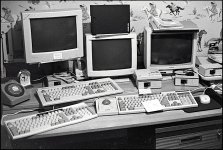
 
Allegedly, half the fun used be printing your pictures in the darkroom...

...now it's messing about with a screen, a keyboard and the pointing device of your choice!

Multiple screens and keyboards Unknown Camera 1996 10-34.jpg

:naughty:
 
Allegedly, half the fun used be printing your pictures in the darkroom...

...now it's messing about with a screen, a keyboard and the pointing device of your choice!

View attachment 448463

:naughty:
And you had people that made their living as darkroom printers. along with studio assistants that did a lot of the techie stuff.

I don't think I've ever found photography as "fun" but the feelings of anticipation watching a print emerge from an inkjet printer are very similar to watching a black and white print emerge in the developer, or lifting the lid of a rotary colour print processor. Laterly, we had a roller based colour print processor, so not that different from a modern inkjet processor.

I can't say I enjoy messing about with the computers that much, but I like the flexibility for colour photography that digital brings, and pleased enough to not have to live with the smell of fixer on my hands.
 
And you had people that made their living as darkroom printers.
Yep!

I did three months as a black and white printer at a large London banqueting photographers, during the late 1960s. There were three of us in the lab and we were expected to turn out a saleable full plate (6 ½ x 8 ½ in) black and white print every 45 seconds.

There were operators we loved, who nailed the exposure with every frame, and those we wished to shake warmly by the throat, due to their magical ability to get the exposure across the frame to vary by five stops every time! Mind you, it was a highly transferable skill, especially if you freelanced for the local press. ;)
 
Yep!

I did three months as a black and white printer at a large London banqueting photographers, during the late 1960s. There were three of us in the lab and we were expected to turn out a saleable full plate (6 ½ x 8 ½ in) black and white print every 45 seconds.

There were operators we loved, who nailed the exposure with every frame, and those we wished to shake warmly by the throat, due to their magical ability to get the exposure across the frame to vary by five stops every time! Mind you, it was a highly transferable skill, especially if you freelanced for the local press. ;)
Wow, you got as long as 45s :)

When, as a school boy, I started working for my local photographer it was at a time when you had black and white "proofs to reception" with up to 10 weddings being photographed on a Saturday (not all were proofs to reception). Most of the photography was done by photographers employed for the day, The owner did the printing and I did the film and print processing, shuffling several prints at time in the developing tray., washing them, and putting them through the "glazer" to quickly dry them.

There used be a lot of cursing from the direction of the enlarger during this process which seemed to vary in intensity depending on which photographer had taken the photographs.

One Saturday, the owner had shingles, and couldn't use the enlarger, so without warning, I also became the "printer" and I'm not sure he ever printed again. I should point out, that I had already built up a lot of experience printing by that time, just not under the pressure of getting proofs to reception
 
Wow, you got as long as 45s :)

When, as a school boy, I started working for my local photographer it was at a time when you had black and white "proofs to reception" with up to 10 weddings being photographed on a Saturday (not all were proofs to reception). Most of the photography was done by photographers employed for the day, The owner did the printing and I did the film and print processing, shuffling several prints at time in the developing tray., washing them, and putting them through the "glazer" to quickly dry them.

There used be a lot of cursing from the direction of the enlarger during this process which seemed to vary in intensity depending on which photographer had taken the photographs.

One Saturday, the owner had shingles, and couldn't use the enlarger, so without warning, I also became the "printer" and I'm not sure he ever printed again. I should point out, that I had already built up a lot of experience printing by that time, just not under the pressure of getting proofs to reception
I assume that you only used the glazing drum to dry them print side down? IMO prints had a nasty habit of sticking, always when there wasn't time to print another:(

Your experiences are similar to mine, life was hectic, pressured and badly paid.
 
For anyone who may be interested in this side-conversation, we used to have a glazing drum in pro studios/darkrooms, I think that ours was about 3'wide, a pretty big machine. Chromium-plated revolving drum, put the print on the conveyor belt, face-up, and the extreme pressure forced it against the slowly revolving, heated drum. The drum had to be spotlessly clean and so did the print, and the print had to be coated with a chemical that stopped it sticking to the drum. Prints on glossy paper came out with a very high gloss finish, and the drum was also used, with the prints face-down, to dry them.

The one that we had was supposed to be fitted with a guard to stop the operators' fingers from being crushed, but didn't.
From memory, there were also home darkroom versions available, basically a heated metal plate with a canvas stretcher, same result but for single prints, I used to see them advertised but never saw one in the flesh.

Those were the days, but fortunately we've moved on:)
 
From memory, there were also home darkroom versions available, basically a heated metal plate with a canvas stretcher, same result but for single prints, I used to see them advertised but never saw one in the flesh.
At one time, I had a 24" Kodak drum glazer for my home darkroom.

I bought it at a local auction for some ridiculously low price (£5, possibly) and it lived in the shed that was built underneath our car port, It worked and was reliable for drying prints but glazing involved so much effort in cleaning the drum that I only used it, as intended, if there was serious profit involved!
 
From memory, there were also home darkroom versions available, basically a heated metal plate with a canvas stretcher, same result but for single prints, I used to see them advertised but never saw one in the flesh.
I had one of these in my bedroom "darkroom". I took the idea of living, eating and sleeping photography very seriously.
 
From memory, there were also home darkroom versions available, basically a heated metal plate with a canvas stretcher, same result but for single prints, I used to see them advertised but never saw one in the flesh.

Those were the days, but fortunately we've moved on:)
I had one of those and it worked really well...sometimes!
Dont know where I got it or where it went. :oops: :$
 
Back
Top