Older Nikons vs Newer Micro 4/3

This is one of the main reasons I prefer to use my FF over my m4/3, in fact I’ve paired my m4/3 kit right back to the bare minimum now. I do think there is a more noticable difference in IQ between FF and m4/3 as opposed to APS-C vs m4/3 though obviously. Even when I had the best of the best m4/3 lenses the FF ones still gave me more pleasing images. YMMV.
I did pick up the 75 1.8 and it’s great but in dof terms it’ produces a cropped 75mm image at ff equivalent f3.2 which is hard to use as a portrait lens when there’s a 105 1.4 on a D850 next door!
 
When it comes to auto everything lenses, this is true.
Not auto everything - just fast acquisition af-c. I shot long teles mf on slrs for decades -a pita cf modern long teles.
...but you can get round it in various ways if you really want to. For example, I have one of the old Tampon AD2 500mm mirror lenses and fitted to a M43 camera via the appropriate adaptor, it's a useful ultra long lens.
tricky - nearly got one cheap as chips from lce but onion bokeh and oof just put me off.
you are a genius if you can focus one handheld on a small sensor body

Not as long but just about manageable for semi still shots handheld but at the absolute limit of ibis in my z6 is mf 300 or 400 like a classic 300 or even a 80-200 VS with a mutar 2x or the mindlessly expensive 100-300 vs.
really these are now tripod jobs for me
Then again, the Panasonic 100~400mm is relatively cheap, compared to an equivalent full frame lens but its small size and weight make a very useful lens for long distance grab shots, like these two from yesterday...
I think a used sig C 150-600 ie 900mm reach on an apsc comes out cheaper used than the PL ( which I had for 2 weeks till it broke ) prefer the oly.

Also I was thinking of older but AF lenses and maybe long and not quite so long from sig tam tokina atx pro as well as some okder nikkors. Best is a d7xxx to get the screw drive motor - more possibilities.
 
Last edited:
But Andrew, unless there's some great emotional attachment to those people and those moments most people would have deleted those two shots as they're just full of issues. Any shot is better than none I suppose but apart from the fact that these two shots exist it's difficult to imagine in what scenario these are good adverts for the capabilities of the kit, unless there's some factor I'm just not seeing.
I agree, straight in the bin. I probably wouldn’t even keep them if they were a special moment :eek:
 
But Andrew, unless there's some great emotional attachment to those people and those moments most people would have deleted those two shots as they're just full of issues.
I've never, ever, claimed to bother about "image quality" and I've frequently indicated this. But "most people"? How many and who, have you asked?

I agree, straight in the bin. I probably wouldn’t even keep them if they were a special moment :eek:
I'm sure you can show much more technically correct pictures than I can. I've long since passed the point where a sharp image is preferable to an illustration that I find useful or interesting.
 
You are a genius if you can focus one handheld on a small sensor body...
Not a genius, just determined.

This Tamron 500mm shot onto a Olympus E-PL5 was handheld and is sharp enough for my needs, though I can think of at least two of our "friends" who will find negative comments to make...

Crow in a tree 500mm E-PL5 P6200014.jpg
 
Not a genius, just determined.

This Tamron 500mm shot onto a Olympus E-PL5 was handheld and is sharp enough for my needs, though I can think of at least two of our "friends" who will find negative comments to make...

View attachment 365072
I stand corrected - good shot and I could maybe even ignore the strange bokeh in this.
 
...and I could maybe even ignore the strange bokeh in this.
"Bokeh" is something that has just passed me by.

To me, a picture is an illustration and it's what it illustrates that matters, not how it achieves that. I don't intend to disparage those who care about such things but in a choice between a sharp line and a captured expression, I'll take the expression every time.
 
Not a genius, just determined.

This Tamron 500mm shot onto a Olympus E-PL5 was handheld and is sharp enough for my needs, though I can think of at least two of our "friends" who will find negative comments to make...

View attachment 365072
Genius/determined or Olympus' legendary in body IS :D
 
"Bokeh" is something that has just passed me by.

To me, a picture is an illustration and it's what it illustrates that matters, not how it achieves that. I don't intend to disparage those who care about such things but in a choice between a sharp line and a captured expression, I'll take the expression every time.
I agree.
Many forums have a lot of photos posted that I wonder why the person has posted them, and that family snapshots are best kept for a family album, no matter how well focussed and exposed they are.
Too many "will never do that" whatever "that" may be, many times for unfathomable reasons, or just stubbornly stuck with their beliefs.

However, whatever I think of a photo, I refrain from commenting unless comments are asked for or invited, then I might comment if I have an opinion, not just to post to try and look smart, and I will give my honest opinion, accepting that views are subjective, and other views won't be the same as mine.

We all have different ideas, that is what makes it such a great hobby :)
 
deep sigh...

The DR you need from the kit depends on the DR of the scene, unless you're doing HDR or have some other way of mitigating things.

Imagine a pathway with high bushes and trees on either side and a low northern sun and lots of glare above and you may have seen this scene as I've posted about a million pictures of it. In that place MFT blows the highlights most of the time and even the A7 struggles and with MFT there's much less scope for boosting the shadows without the issues being immediately obvious.

Next imagine a wide open beach but trying to get someone's face or other thing nice and bright. Again the choice could be between blown highlights and impossible without issues shadow recovery. And flash isn't always the answer due to not having one or the power of the one you have or because it's just more hassle.

No offense to people who don't shoot in high DR scenarios or just don't notice blown highlights or excessively blotchy detail from raised too far shadows but there's no glossing over technical short comings if they matter to the person using the kit. I have two 20mp MFT cameras, GX9 and G100. Other MFT cameras may be a bit better but that's the kit I have.

Yup. We can all enjoy pictures of the moment which are full of issues but this is a kit thread in the gear section of the forum not the rose tinted memories thread.

Anyway. I really shouldn't have mention FF or DR as I should have known what would happen :D I only did so as IMHO DR is MFT's only real drawback, for me. I think Keith is looking at technical aspects here but MFT v APS-C, I see a lot to lose if going from mirrorless to DSLR, too much for me so even though MFT is a smaller format that's what I'd stick with given these choices.
I agree with you on this, however the difference in DR for the cameras mentioned by the OP is negligible imo (y)
I've never, ever, claimed to bother about "image quality" and I've frequently indicated this. But "most people"? How many and who, have you asked?


I'm sure you can show much more technically correct pictures than I can. I've long since passed the point where a sharp image is preferable to an illustration that I find useful or interesting.
This is genuinely not a dig or anything but I find this surprising as we've had several discussions regarding IQ. What I will say though is that when looking at demonstrations/reviews of the strengths/benefits of some piece of equipment then I do judge it to a large degree on image quality. If I didn't/wasn't bothered then I'd just buy a large zoom compact camera and be done (y)
"Bokeh" is something that has just passed me by.

To me, a picture is an illustration and it's what it illustrates that matters, not how it achieves that. I don't intend to disparage those who care about such things but in a choice between a sharp line and a captured expression, I'll take the expression every time.
This I almost agree with completely, however there does come a point where a photo is unusable for one reason or another, this of course will depend on the individual.
I agree.
Many forums have a lot of photos posted that I wonder why the person has posted them, and that family snapshots are best kept for a family album, no matter how well focussed and exposed they are.
Too many "will never do that" whatever "that" may be, many times for unfathomable reasons, or just stubbornly stuck with their beliefs.

However, whatever I think of a photo, I refrain from commenting unless comments are asked for or invited, then I might comment if I have an opinion, not just to post to try and look smart, and I will give my honest opinion, accepting that views are subjective, and other views won't be the same as mine.

We all have different ideas, that is what makes it such a great hobby :)
This is very true, I'm sure people get bored of seeing my photos of Betty (my dog), and maybe most things that I shoot however they mean something to me, or I'm proud of the way I captured it etc and so like to share. I'm sure others are the same which is why I try not to judge or question why something's been shot.

That being said most of the time the photos are in the critique section (there are specific places to post if you don't want critique) and/or they're used as part of a discussion or to demonstrate some specific equipment and therefore it is only to be expected that they are going to be judged,..... imo (y)
 
20 vs 24 mpx - little difference IMO. I tend to think of only say 24-45 mpx as significant, certainly for print size.

According to the photons2photos site, photographic dynamic range is similar except at base iso. Doubt you will see any difference in practice

Either will probably do what you want BUT - more lenses for m43 in general and IBIS on the G90. Also not so many bright lenses for Nikon APS-C so even though light gathering and/or getting a narrow enough depth of field might seem an issue I wonder in practice if it is - you would need to be looking at only a few ( but good ) primes for the D5300 like the 35/1.8G DX or the 50 or 85/1.8 G FX - OK gives you a bit more light that the ( say oly ) 25/1.8, 45/1.8. I am glossing over both the expensive pro 1.2's in m43 and the 1.4's (FF FX ) for the D5300

I have shot olympus ( mainly ) m43 for 10 years and Nikon APS-C and FF DSLRs ( only 20-24 ppx ) for nearly as long. Don't really see much of a difference - but that is a personal take.

Wide angles are easier to get on a larger sensor: the af-p 10-20 would be a candidate for the D5300 ( it is compatible ). For m43, the cheapest, and a nice option is the oly 9-18 but not as wide.

There is the viewfinder issue: again personal taste - I prefer an OVF as in the D5300 but actually have to use EVF's in m43, Nikon 1 and a Z6 most of the time.

If you KNOW that you want/need long or very long lenses to do wildlife, esp birds then it might influence how you start out. There are far more and cheaper ways into that with a Canon or Nikon APS-C DSLR than with m43 which has a short and expensive long tele ( > 300mm ) lens list. But that is pretty niche - except for those who do it.

Final suggestion: have a look, if you can at the Olympus OM-D E-M10 Mark 2 ( not the Mark 1 ). Really cheap used and a good camera. I just use my old em5.1 nowadays
I had a look at the Oly M10 MkII and yes it looks very good, thanks for all the help.
 
I find this surprising as we've had several discussions regarding IQ.
I find that "image quality" can be taken to mean different things in different contexts.

My default use of the term comes down to: "can I see what I intended to show?" Other people have quite different meanings in mind when using the phrase. There's nothing wrong with this, provided all the parties involved are agreed on which set of meanings are the context.
 
One thing I will say is DOF is not something I find unsatisfactory with MFT, I get all the bokeh I want and near to far focus when I desire it. Maybe this is an area where not having a comparison is an advantage.
 
One thing I will say is DOF is not something I find unsatisfactory with MFT, I get all the bokeh I want and near to far focus when I desire it. Maybe this is an area where not having a comparison is an advantage.
I think it’s down to preference, shallow DOF is not for everyone nor is it the holy grail. I think some people can fall into the trap of thinking shallow DOF must be better as the faster lenses cost more.

That being said I prefer shallow dof :lol:
 
I think it’s down to preference, shallow DOF is not for everyone nor is it the holy grail. I think some people can fall into the trap of thinking shallow DOF must be better as the faster lenses cost more.

That being said I prefer shallow dof :LOL:
I think you're right, and not only personal but what suits your eye and what you're trying do with a photo. Take this one for example, I took several and some had more DOF and some had less, but this is the one that worked for me. Enough bokeh for the stone to stand out, but for my personal preference, just a slight blur so that the location and scene can be appreciated.
Basically what I wanted to achieve and the one that pleased my eye the most.

Judging by the comments, highly unlikely I could shoot a shot that pleases me more with a DSLR.

Celtic stone.jpg
 
I think you're right, and not only personal but what suits your eye and what you're trying do with a photo. Take this one for example, I took several and some had more DOF and some had less, but this is the one that worked for me. Enough bokeh for the stone to stand out, but for my personal preference, just a slight blur so that the location and scene can be appreciated.
Basically what I wanted to achieve and the one that pleased my eye the most.

Judging by the comments, highly unlikely I could shoot a shot that pleases me more with a DSLR.

View attachment 365089
Well, it looks like you’ve nailed it to my taste :D
 
A nitty gritty point to remember about apparent depth of field is that four main things affect it...
  • Focal length of the lens
  • Aperture set
  • Distance from the camera's sensor to the subject you want in focus
  • Distance to the objects you don't want in focus
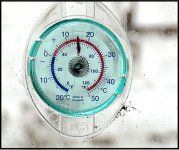
Here's a crude example. The thermometer is roughly 8 cm high...

Outdoor thermometer on window FZ82 P1000701.JPG
  1. The lens was set to 5.38 cm (equivalent to 30 cm on 35mm)
  2. The aperture was f5.5
  3. The sensor to subject distance was 20 cm
  4. Distance to the wall behind was roughly 2.5 metres
  5. The sensor size (Panasonic FZ82) was 8.8 mm x 6.6 mm
So: you can control depth of field regardless of the sensor size, provided you can get to the distance that permits you to work with the aperture / focal length you have available (and provided the subject and focal length are suitable for one another).
 
Last edited:
A nitty gritty point to remember about apparent depth of field is that four main things affect it...
  • Focal length of the lens
  • Aperture set
  • Distance from the camera's sensor to the subject you want in focus
  • Distance to the objects you don't want in focus
Here's a crude example. The thermometer is roughly 8 cm high...

View attachment 365101
  1. The lens was set to 5.38 cm (equivalent to 30 cm on 35mm)
  2. The aperture was f5.5
  3. The sensor to subject distance was 20 cm
  4. Distance to the wall behind was roughly 2.5 metres
  5. The sensor size (Panasonic FZ82) was 8.8 mm x 6.6 mm
So: you can control depth of field regardless of the sensor size, provided you can get to the distance that permits you to work with the aperture / focal length you have available (and provided the subject and focal length are suitable for one another).
I didn't know you also had an FZ82, and yes I have had some pretty good results with mine in the right scenarios.
 
I've never, ever, claimed to bother about "image quality" and I've frequently indicated this. But "most people"? How many and who, have you asked?


I'm sure you can show much more technically correct pictures than I can. I've long since passed the point where a sharp image is preferable to an illustration that I find useful or interesting.
I'm not in the 'ultimate image quality' camp either, but those pictures are only good as an illustration of why cheap gear isn't always worth having. :LOL:
 
HDR is a technique that uses multiple images exposed differently and blended in post to create an image from a scene with a wider dynamic range than the cameras sensor could cope with.

Dynamic range is the range of light levels that a camera sensor can record reliably in this context.

Probably worth talking about HDR a little more in the context of m43 vs full frame. What AM is referring to there is HDR capture, but HDR just means "High Dynamic Range", and one way to achieve this is to do an HDR capture, that is, say three shots with different settings, one exposing for highlights, one for midtones and one for darks. The clever software then smashes them together to get the "best bits" of all three. The resulting image often looks ultra vivid and unreal because that isn't how you see it in real life. The shortcoming of any sensor is that their dynamic range is less than the human eye, around half the variation your eye can cope with at a time.

There is also the possibility of creating an HDR image in post processing, I normally refer to that as "Qasi HDR" because with HDR capture, you store more information, post production HDR is software driven. Where this plays into the conversation is where you make mistakes. Say for example you screw up in taking the image, and under expose badly - this is an instance where it makes a difference if you shoot RAW or jpg - If you shoot raw, you have the option of post processing HDR which is more successful in my experience than simply lifting the shadows (although that is clearly is a key part of it). You certainly can also HDR process a jpg, but I've found that it is more successful working from RAW. Here's an example of one I took earlier, got wrong, but was able to make reasonably acceptable with that technique. If you look at the person seated on the right, you will see their face has an unreal look about it, the "HDR" process has kept some deep shadows as well as lifting the exposure on the rest.

So, if you started with a FF which has a greater dynamic range, you also potentially can fix screw-ups better.

 
Despite the fact that I like new shiny stuff, I always remember that I started out with manual everything, on film. Then progressed through grim small digital cameras to a D50, D90, 7000 range. And then, finally to M43 and FF

There is no doubt that focussing and exposure are way easier. But to me that just makes it that much harder to take really great photos. Flaws that would have been acceptable in film days are not any more. As for bokeh - well, back in film days wide aperture lenses were rare and expensive. They are still expensive, but not so rare.

To me great photos come from great composition and timing. Unless computational photography is going to refuse to take a photo unless it conforms to some compositional rules, or only allows certain shots (timing-wise) then that is still a skill that requires a photographer.

M43 and FF will both help a photographer take great shots. M43 will probably be more manageable though, like an old 35mm SLR was.
 
Probably worth talking about HDR a little more in the context of m43 vs full frame. What AM is referring to there is HDR capture, but HDR just means "High Dynamic Range", and one way to achieve this is to do an HDR capture, that is, say three shots with different settings, one exposing for highlights, one for midtones and one for darks. The clever software then smashes them together to get the "best bits" of all three. The resulting image often looks ultra vivid and unreal because that isn't how you see it in real life. The shortcoming of any sensor is that their dynamic range is less than the human eye, around half the variation your eye can cope with at a time.

There is also the possibility of creating an HDR image in post processing, I normally refer to that as "Qasi HDR" because with HDR capture, you store more information, post production HDR is software driven. Where this plays into the conversation is where you make mistakes. Say for example you screw up in taking the image, and under expose badly - this is an instance where it makes a difference if you shoot RAW or jpg - If you shoot raw, you have the option of post processing HDR which is more successful in my experience than simply lifting the shadows (although that is clearly is a key part of it). You certainly can also HDR process a jpg, but I've found that it is more successful working from RAW. Here's an example of one I took earlier, got wrong, but was able to make reasonably acceptable with that technique. If you look at the person seated on the right, you will see their face has an unreal look about it, the "HDR" process has kept some deep shadows as well as lifting the exposure on the rest.

So, if you started with a FF which has a greater dynamic range, you also potentially can fix screw-ups better.


"The resulting image often looks ultra vivid and unreal because that isn't how you see it in real life"

That is down to the person adjusting the sliders, not the process itself.

As I mentioned earlier, the process can make it like you saw it in real life, because the camera does not have the DR to do so.

Some times, depending on the scene, "ultra vivid and unreal" can add to the impact and effect of the shot, but not usually.
 
A general note to @Crotal Bell - when discussing the qualities of kit, how well it performs and effective it is, some are very persuasive in their arguments. I would suggest that although the discussion is good, look at the kind of images people produce as part of assessing the validity of their arguments. So if you think that @snerkler takes great pictures (which he does - Toby has won stuff with his pictures) then give his words more credence than those of someone like me whose work is less appealing to you.

I say this not to put him on a pedestal or myself down, but even though some are very persuasive you may not wish to copy their output because it doesn't work for you. Principles and arguments in abstract are of a limited value in this kind of discussion.
 
Probably worth talking about HDR a little more in the context of m43 vs full frame. What AM is referring to there is HDR capture, but HDR just means "High Dynamic Range", and one way to achieve this is to do an HDR capture, that is, say three shots with different settings, one exposing for highlights, one for midtones and one for darks. The clever software then smashes them together to get the "best bits" of all three. The resulting image often looks ultra vivid and unreal because that isn't how you see it in real life. The shortcoming of any sensor is that their dynamic range is less than the human eye, around half the variation your eye can cope with at a time.

There is also the possibility of creating an HDR image in post processing, I normally refer to that as "Qasi HDR" because with HDR capture, you store more information, post production HDR is software driven. Where this plays into the conversation is where you make mistakes. Say for example you screw up in taking the image, and under expose badly - this is an instance where it makes a difference if you shoot RAW or jpg - If you shoot raw, you have the option of post processing HDR which is more successful in my experience than simply lifting the shadows (although that is clearly is a key part of it). You certainly can also HDR process a jpg, but I've found that it is more successful working from RAW. Here's an example of one I took earlier, got wrong, but was able to make reasonably acceptable with that technique. If you look at the person seated on the right, you will see their face has an unreal look about it, the "HDR" process has kept some deep shadows as well as lifting the exposure on the rest.

So, if you started with a FF which has a greater dynamic range, you also potentially can fix screw-ups better.
As above HDR can look perfectly natural it all depends how it’s processed, just like any image. A single shot image can equally look unnatural with heavy handed processing.

With regards to your quasi HDR example I guess this depends on your definition of HDR photography. My definition of HDR photography is combining shots of different exposures to create a dynamic range greater than the camera can achieve.

A single shot image will never be HDR for me as you aren’t increasing DR, all you’re doing with processing is making certain parts of the dynamic range more apparent.
 
A general note to @Crotal Bell - when discussing the qualities of kit, how well it performs and effective it is, some are very persuasive in their arguments. I would suggest that although the discussion is good, look at the kind of images people produce as part of assessing the validity of their arguments. So if you think that @snerkler takes great pictures (which he does - Toby has won stuff with his pictures) then give his words more credence than those of someone like me whose work is less appealing to you.

I say this not to put him on a pedestal or myself down, but even though some are very persuasive you may not wish to copy their output because it doesn't work for you. Principles and arguments in abstract are of a limited value in this kind of discussion.
Thanks for the kind words, it’s much appreciated.

Whether anyone should actually listen to me though is a different matter :lol:
 
I'm not in the 'ultimate image quality' camp either, but those pictures are only good as an illustration of why cheap gear isn't always worth having. :LOL:
They weren't taken on cheap gear.

The two that some people have tak'n agin were made in a Panasonic G9 through a 100~400mm Leica DC lens. So whatever you don't like about them is all my own work... :naughty:
 
The two that some people have tak'n agin were made in a Panasonic G9 through a 100~400mm Leica DC lens. So whatever you don't like about them is all my own work... :naughty:
In that case they're fantastic proof that spending money on gear doesn't guarantee your photos will improve. :giggle:
 
As above HDR can look perfectly natural it all depends how it’s processed, just like any image. A single shot image can equally look unnatural with heavy handed processing.

Agreed

With regards to your quasi HDR example I guess this depends on your definition of HDR photography. My definition of HDR photography is combining shots of different exposures to create a dynamic range greater than the camera can achieve.

A single shot image will never be HDR for me as you aren’t increasing DR, all you’re doing with processing is making certain parts of the dynamic range more apparent.

Despite the fact I pretty much said the same, I'm really not 100% convinced that it is completely invalid.

I'd be fascinated to hear how it actually operates, my guess is that it interpolates data, it's easy to see why RAW works better, as jpg are limited to 8 bits per pixel (up to 256) where a RAW is likely to be 12 bits or more (4,096+ values per pixel). So, there are going to potentially 16 different values that will all be translated into a "1", it would be entirely legitimate to take those values and remap them to a broader range. There's nothing ever going to be recovered from a zero, but if for example your dark shadows are, say, values 1 - 30, recovering the intermediate data that wasn't differentiated sufficiently to process onto your screen or printer is still your data, amplified. It might not be as good as HDR capture, but it is still your image with a greater dynamic range.

If all the HDR software does is to process highlights/lowlights by masking and adjusting luminance before combining then I dont think you would recover data in the same way.

It would be interesting to experiment to see how much colour space and gamut influence what happens, possibly a lot or possibly not at all.
 
In that case they're fantastic proof that spending money on gear doesn't guarantee your photos will improve. :giggle:
Your opinion is duly noted and filed away under "ignore"... :naughty:
 
A general note to @Crotal Bell - when discussing the qualities of kit, how well it performs and effective it is, some are very persuasive in their arguments. I would suggest that although the discussion is good, look at the kind of images people produce as part of assessing the validity of their arguments. So if you think that @snerkler takes great pictures (which he does - Toby has won stuff with his pictures) then give his words more credence than those of someone like me whose work is less appealing to you.

I say this not to put him on a pedestal or myself down, but even though some are very persuasive you may not wish to copy their output because it doesn't work for you. Principles and arguments in abstract are of a limited value in this kind of discussion.
Thanks for that.
 
Well HDR is certainly taking over the thread, but it's been interesting to read peoples thoughts on that and other aspects. I do like my MFT, but I also like to learn more about areas I have no experience. I do think a lot of the features on my G80 may never be used, I like things simple, but I'll be exploring them in time to see what I may like to use.

I'll do more experimenting but I guess the most important aspect is I like the photos I get with my MFT, but I like to ask questions and learn about all aspects of photography and the equipment.
 
When it comes to auto everything lenses, this is true.

...but you can get round it in various ways if you really want to. For example, I have one of the old Tampon AD2 500mm mirror lenses and fitted to a M43 camera via the appropriate adaptor, it's a useful ultra long lens.

Then again, the Panasonic 100~400mm is relatively cheap, compared to an equivalent full frame lens but its small size and weight make a very useful lens for long distance grab shots, like these two from yesterday...

View attachment 365059
View attachment 365060
Even without any user experience, I can appreciate what your saying in this respect, and I realise lenses with come into discussions about bigger cameras/sensors. I have the Pana 100-300mm and it's a light set-up to carry with the G80. I've looked at the size and weight of the same sort of crop sensor set-up and not sure I would fancy that on a long walk.
I like these photos, they may not be technically perfect, but I like the look on the face of the swimmer and the position of the jumper.
 
When it comes to auto everything lenses, this is true.

...but you can get round it in various ways if you really want to. For example, I have one of the old Tampon AD2 500mm mirror lenses and fitted to a M43 camera via the appropriate adaptor, it's a useful ultra long lens.

Then again, the Panasonic 100~400mm is relatively cheap, compared to an equivalent full frame lens but its small size and weight make a very useful lens for long distance grab shots, like these two from yesterday...

View attachment 365059
View attachment 365060
I think you should have put a NSFW warning on your Tampon photos.

Tidied for pytos
 
Last edited:
Agreed


Despite the fact I pretty much said the same, I'm really not 100% convinced that it is completely invalid.

I'd be fascinated to hear how it actually operates, my guess is that it interpolates data, it's easy to see why RAW works better, as jpg are limited to 8 bits per pixel (up to 256) where a RAW is likely to be 12 bits or more (4,096+ values per pixel). So, there are going to potentially 16 different values that will all be translated into a "1", it would be entirely legitimate to take those values and remap them to a broader range. There's nothing ever going to be recovered from a zero, but if for example your dark shadows are, say, values 1 - 30, recovering the intermediate data that wasn't differentiated sufficiently to process onto your screen or printer is still your data, amplified. It might not be as good as HDR capture, but it is still your image with a greater dynamic range.

If all the HDR software does is to process highlights/lowlights by masking and adjusting luminance before combining then I dont think you would recover data in the same way.

It would be interesting to experiment to see how much colour space and gamut influence what happens, possibly a lot or possibly not at all.
The bit in bold is the part that I don’t think is true, although I think essentially we’re saying the same thing.

As I’m sure you’re aware dynamic range is the range from the darkest to lightest parts of an image captured. If we take a camera with a 14ev sensor we can capture luminance from 0ev to 14ev where 0ev is the darkest part of the image. In post if you boost the parts of the image from 0-3ev for example to improve the differentiation of the darkest parts of the image, whilst this will likely improve the visible detail of the blacks/shadows you’re still not improving DR as it still goes from 0ev to 14ev (y)
 
I've never, ever, claimed to bother about "image quality" and I've frequently indicated this. But "most people"? How many and who, have you asked?

OK Andrew.

I have pictures I've taken which are technically poor but I keep them because they mean something to me but I would not post them as any proof of the technical ability of the kit because they wouldn't be proof of that. They'd be captures of moments and memories and there's nothing wrong with that and there's a place for those pictures and some may mean more to me/you than the most technically correct pictures we take.

If I'd taken those pictures I'd only keep them if I felt an emotional connection. If they were just snaps of random people taken at a random time I'd delete them... And here's the leap of faith... I suspect other people would too... Soz if the pictures do mean something to you and if they do you're right to keep them. Good for you.
 
Last edited:
I agree with you on this, however the difference in DR for the cameras mentioned by the OP is negligible imo (y)

I know. And again. I wish I hadn't mentioned FF :D

I was actually paying MFT a compliment as IMO the only weakness is a lack of DR. I've had MFT since the GF1.
 
Back
Top