

Now, this seriously has me beaten, suggestions as to what is happening here please?

EdBray

Suspended / Banned
Messages
7,179
Name
Edward Bray
Edit My Images
Yes
Okay, this is weird. I was processing another of my recent South Devon Railway images and I realised that the front of the locomotive is not as sharp as I would have expected.

The image was shot on 5x7 film using a 210mm Apo-Symmar lens at 1/250th sec at f11 on HP5+ film, now I would have expected a sharper image than that recorded, but when I started working on the image in Photoshop CS5 I noticed that the number on the front of the engine was a distinct double image, but nowhere else showed a similar double image, this is not a blurred image such as would normally be expected from too slow a shutter speed. The film was processed in Pyrocat HD for 8 ins at 24 degrees C with a TF-3 alkaline fix. The image was scanned on my Epson V750 scanner with the better scanning film holder. I have checked the negative on a lightbox with an 8x lupe and it is definitely a double image on the negative!

Now I have been known in the past to play a little photographic practical joke or two, but this is not a joke, I genuinely do not know what has happened here???

Full Image: focus was on the sleeper 8 up from the trackside marker as can bee seen in the third image:
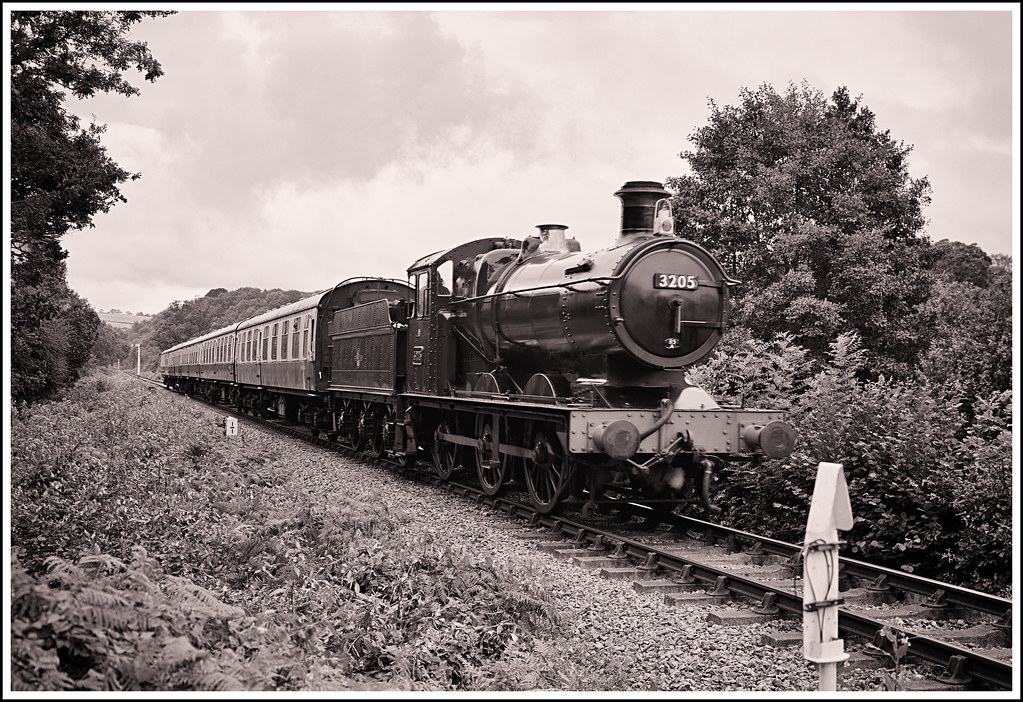

SDR: 3205 GWR Collett 0-6-0 5x7 by Ed Bray, on Flickr

Second image, the locomotive's number at 100% crop
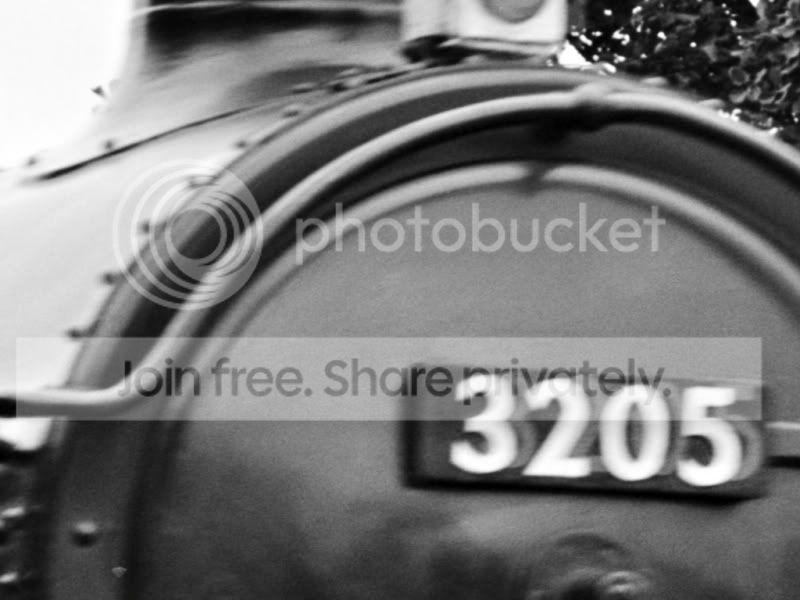
Doubleimage.jpg


Third image: Focus point on 8th sleeper from tackside marker, sleeper marked 631.

focuspoint.jpg
 
Last edited:
Camera moved?
 
Camera moved?

Only seems to affect the number though, nothing else.


Vibration on the front of the loco?

.....do we win anything if we get it right? :lol:


Heather
 
Last edited:
I'm not sure what might have caused it but the double image can be seen in places other than the loco's front. Looking at the very big Flickr photo, then you can see it in the highlight area on the front of the top edge of the coal tender as well. It's only noticeable on the bright in focus areas. I can't make my mind up whether you can see it on the first carriage's number or on the rivets of the driver's cab and tender.
 
Camera moved?

Hi Arthur, that's the one thing I'm pretty sure didn't happen, nowhere else shows that happening within the image and the sleepers/gravel under the wheels are sharp.
 
There is a fair bit of blurring on the front of the engine - the lamp, the boiler handle, but as you say everything else is sharp.

Maybe the engine 'shuddered' at the instant of taking the photo (I don't know the technical term) although I would have thought 1/250th would have eliminated that but maybe not. :shrug:
 
I think John's suggestion is plausible, that the engine shook while the shot was taken. By the time you reach the first carriage it seems the double image has gone, probably because the vibrations are less by the time it reaches there.
 
Know nowt about film stuff but have you considered that new numbers had simply been painted over the old plate?

As for the softness, I reckon you just missed the focus point which should have been the front of the engine?
 
Last edited:
I am so perplexed by this I am seriously considering visiting the main station area in the next couple of days to check it out.
 
Somebody forgot to secure the smokebox door.

Except it's also visible on the lamp above it as well. I suspect the double image is present across the loco (if not the frame) but more easily seen on the smoke box numbers as these are white.
 
Somebody forgot to secure the smokebox door.

Except it's also visible on the lamp above it as well. I suspect the double image is present across the loco (if not the frame) but more easily seen on the smoke box numbers as these are white.

.......is that a techy explaination to my question about vibration at the front of the loco then? :lol:


Heather
 
Thanks all, some interesting suggestions, I thought that it could have been from a secondary flash exposure but, I didn't use or even have a flash with me.
 
I noticed a similar effect when i was shooting a boat with my RB67, the same sort of double image, it was just the movement of the boat though, nothing suspicious :D
 
Repeat with faster shutter speed? I think it really is only movement blur but the angle of the camera means you have a more sideways view of the front of the train so it exaggerates any blur.

How fast was the train travelling? If you know that you could work out how far it would have travelled in 1/250th of a second.
 
Can only go to 1/400 sec with that lens, any longer focal length then the top SS drops to 1/200th
 
I'd try it with 1/400th and maybe 1/125th to rule out motion blur as the effect should be stronger at 1/125th. If it isn't noticeable on either then you have a real mystery!
 
It can only be the loco itself, maybe it ran over something on the line, it would only need to be one of those ballast rocks or something smaller even.
Could be a change in the rail camber, its quite close to a joint, whatever, I think you've been kinda unlucky to take that shot from that position at that moment in time..:)
 
Now that is weird. I was thinking about posting a similar question about my V700 when scanning 645 b/w negs, because I've been scratching my head over it and not coming up with any answers.

With my last roll of BW400CN I noticed I'd been getting double images too, but only in the highlights. At first I thought it was camera movement, but the dark tone detail was perfectly sharp. As if to confirm, I was getting the same double image on the dust too, so it couldn't be motion blur at the time of capture (and I know for a fact that for some of the affected shots I w shooting at 1/1000 sec and my hands aren't that shaky...).

I'm using the latest version of Vuescan for Mac with an Epson V700.

I'll see if I can post up an example later.
 
Last edited:
It can only be the loco itself, maybe it ran over something on the line, it would only need to be one of those ballast rocks or something smaller even.
Could be a change in the rail camber, its quite close to a joint, whatever, I think you've been kinda unlucky to take that shot from that position at that moment in time..:)

Thanks. Line looked clear and there had been four other trains along it before this one.

Now that is weird. I was thinking about posting a similar question about my V700 when scanning 645 b/w negs, because I've been scratching my head over it and not coming up with any answers.

With my last roll of BW400CN I noticed I'd been getting double images too, but only in the highlights. At first I thought it was camera movement, but the dark tone detail was perfectly sharp. As if to confirm, I was getting the same double image on the dust too, so it couldn't be motion blur.

I'm using the latest version of Vuescan for Mac with an Epson V700.

I'll see if I can post up an example later.

Definitely not a scanner issue as I specifically checked the negative on a lightbox with an 8x Loupe, clear as day on the negative.
 
Yep. I realised that just after I hit 'submit', and then my internet connection died :)

A thought on your question: is it possible the shutter is 'bouncing back' open for a fraction of a second after it is (supposed to be) closed? I've heard about similar things with focal plane shutters on 35mm, but I'm not sure about LF, which I assume would be a leaf shutter.
 
Following your lead, I'll get my negs under a loupe before pursuing my question any further.
 
Yes. that seems to be the most likely option along with too slow a shutter speed and the Loco rocking (not sure I go with this one though).
 
If the shutter speed was too slow, I'd have expected an actual blurring due to motion, not two distinct images. it's clearly in the direction of travel of the loco. If you look carefully on your close up, you can see the same double image below on the lock of the smoke box door. With a high contrast area like the number, it would be more likely to be visible.

That rather rules out either of the alternatives, actually.
 
FYI

http://www.mraggett.co.uk/shuttertester/shuttertester.htm

Lack of bounce

Shutter bounce is a small secondary exposure occuring after the main picture is taken and usually occurs at high shutter speeds. In focal plane shutters you will see an irritating pale stripe along one edge of the picture's frame, and you will need to get the shutter service to get rid of this bounce. In leaf shutters you will only notice the effect if you are photographing moving objects, where the secondary exposure may cause a ghost image.

It is quite common for leaf shutters to bounce at their highest speed, and this circuit will detect the bounce as a second pair of peaks shortly after the main exposure. This is caused by the shutter blades re-opening briefly as the last of the shutter spring's energy is released. [Note that this bounce may not be recorded if you use a slightly misaligned laser instead of a torch as a light source]. Strictly speaking, the bounce time should be added to the main opening time to get a total time for the shutter. In practice, if the bounce time is the equivalent of 5 stops less than the main exposure, which equates to about 1/30th of the main time, no ghost image will be recorded on the film. If the bounce time is excessive, say 1/8th or 1/4 of the main time, which is only 3 or 2 stops down from the normal exposure, this will make a significant difference and could leave a ghost image. Since most people avoid using the highest shutter speed, this may not be a problem for you, and in any case, a service may not help. What's most important is that you know about it!
 
Blame it on a dodgy rail joint :) Look closely at a lot of my rail photos and you'll see similar.

Going off topic but I'm sure 3205 is a former resident of my town, sure it was shedded here in the 50s. Would love to get my hands on a Peco one...
 
I am almost convinced that while the shutter speed is appropriate for the train's motion, the locomotive's resonance is causing this blurriness. You see the same effect in the lap on top, and I am almost certain on the number plate under the large handle.
 
Cheers gents.

I know for a fact that my photography experience and capability is no where anything that which you've got; that said, I hope you did find a satisfactory reply to this anomaly.
 
I know for a fact that my photography experience and capability is no where anything that which you've got; that said, I hope you did find a satisfactory reply to this anomaly.

Not sure about the first bit, but the main consensus from the different forums is that it is just the movement of the train 'bouncing' and the numbers being captured at 'each end of the microscopic (in time) bounce. Others think it may be leaf shutter bounce which registers the second set of numbers when the shutter bounces slightly at the end of its normal movement.

Still not wholly sure, but it has raised some discussion and bumped up the visits to my Flickr page :lol:
 
Given that your shutter speed froze the movement of the train and looking at the timing of that secondary opening in the 'shutter bounce' link, I'm more inclined to go with a bouncing shutter rather than a 40 ton loco bouncing fast enough to beat a 1/250 second exposure.
 
Back
Top