North Macedonia

Barney

Suspended / Banned
Messages
3,043
Name
Wayne
Edit My Images
No
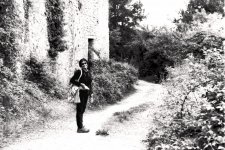
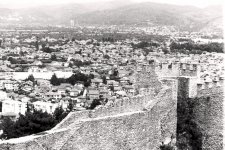
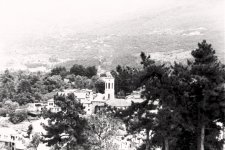
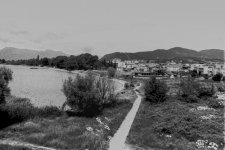
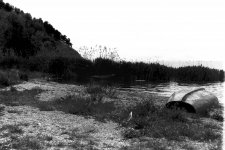
A few shots from a recent visit to North Macedonia.

Olympus OM2n
Zuiko 35-105
Agfa APX100
Euro HC 1:31 for 6 1/2 minutes at 21
Scanned
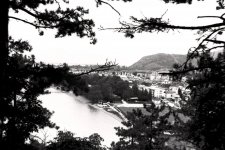
DB 1.jpg

DB 2.jpg

DB.jpg

DB 3.jpg

The Mrs said "that's an old picture" which was nice, as it took her a while to realize it was only a few weeks ago.
Over all a bit unhappy as a lot of the roll was poor, any advice gratefully received. I have a feeling that a lot of the shots that I wanted to take had a very wide exposure latitude and metering from ambient blew them to smithereens.
 
Last edited:
Without the negatives, I can only speculate from what appears on my tablet (not at my desktop at the moment). What I'm seeing looks like high contrast and blocked shadows, suggesting underexposed and overdeveloped. I'm assuming that you weren't using a red filter...
 
No red filter Stephen,
 
The skies made it unlikely, but a remote possibility. Scanning could produce this appearance, as could darkroom printing. Only the negatives can tell the story. And my diagnosis is built on the sort of tonal range I prefer; it's perfectly possible that this is the effect you intended.
 
Rather, I think that is the result of the technique I employed. the bellini is very aggressive, too much for me.

Most of the negatives are mostly black
 
Without the negatives, I can only speculate from what appears on my tablet (not at my desktop at the moment). What I'm seeing looks like high contrast and blocked shadows, suggesting underexposed and overdeveloped. I'm assuming that you weren't using a red filter...

I agree with Stephen. The fact that you describe the negs as "mostly black" indicates severe overexposure. We've all done that at some point!
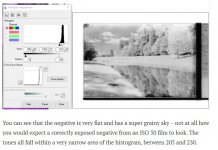
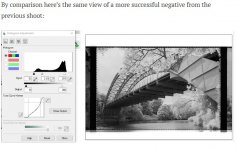
You could confirm if overexposure was the problem by looking at the histogram that your scanning process provides. Below are examples of negs (which happen to be infrared) scanned with EpsonScan - the first is very overexposed and the second fairly normal.


overexposed.jpg
normal exposure.jpg

Ilford have a good summary of the effects of processing problems here - https://www.ilfordphoto.com/common-processing-problems/
 
Kevin the Histograms were Flat in the middle with a peak at either end.

I have adjusted the levels and a couple of other minor changesDB 5.jpg

DB 4.jpg
 
Rather, I think that is the result of the technique I employed. the bellini is very aggressive, too much for me.
I try to avoid the shorter times for HC-110 1+31 (what the Bellini Euro-HC is based on); 1+47 feels a lot smoother. I'd try 1+63, but I can't get 6 ml of "syrup" per film for that, given my tank size!
 
I try to avoid the shorter times for HC-110 1+31 (what the Bellini Euro-HC is based on); 1+47 feels a lot smoother. I'd try 1+63, but I can't get 6 ml of "syrup" per film for that, given my tank size!

Whats your water like there Chris, would you say its hard or soft?

I have a feeling that the lack of solid matter in my water is exacerbating the reaction times.
 
Whats your water like there Chris, would you say its hard or soft?

I have a feeling that the lack of solid matter in my water is exacerbating the reaction times.
Our water is a bit middling. We do use a filter jug for our cups of tea, but it's not seriously hard. I use de-ionised water with Photo-Flo (bottle bought in 2015!!!) for the final wash. I didn't know that water hardness had a specific influence on the dev process itself.
 
The water quality is usually accounted for in the developer constituents. Developers are usually alkaline, and the activity can be influenced by the pH of the water used, hence makers of developers include some buffering agent. For non chemists, this is something than can mop up extra acidity or alkalinity without affecting anything else (and even O level chemists will probably throw a fit over that description :) ).

It's the different ways of adjusting for tap water variations that mainly accounts for the different published formulae for D76 and ID11, which are fundamentally the same formula.
 
The water quality is usually accounted for in the developer constituents. Developers are usually alkaline, and the activity can be influenced by the pH of the water used, hence makers of developers include some buffering agent. For non chemists, this is something than can mop up extra acidity or alkalinity without affecting anything else (and even O level chemists will probably throw a fit over that description :) ).

It's the different ways of adjusting for tap water variations that mainly accounts for the different published formulae for D76 and ID11, which are fundamentally the same formula.
I am just guessing Stephen,
I remember in my home brewing days that I was forever having to adjust my water profile to recreate the beer styles of other countries and regions. When I saw Sodium metabisuphate in a developer recipe it just struck me that all waters are not equal.
 
Back
Top