

You are using an out of date browser. It may not display this or other websites correctly.
You should upgrade or use an alternative browser.
You should upgrade or use an alternative browser.
Nikon Announces 3 New Lenses
- Thread starter texfoto
- Start date

wilsnunn
Suspended / Banned
- Messages
- 215
- Name
- Daniel
- Edit My Images
- Yes
I don't see what difference it makes. You could use lenses that go to f1.4, so why wouldn't you? What advantage is there to using one that goes only to f2.8?
They can zoom...

Dman
Suspended / Banned
- Messages
- 3,656
- Name
- Dave
- Edit My Images
- No
I don't see what difference it makes. You could use lenses that go to f1.4, so why wouldn't you? What advantage is there to using one that goes only to f2.8?
I don't really know where you're coming from to be honest, you're trying to compare a 1.4 fixed length lens with a 2.8 zoom lens

I don't really know where you're coming from to be honest, you're trying to compare a 1.4 fixed length lens with a 2.8 zoom lens
I'm pointing out that having the widest aperture isn't the only thing that is useful in a lens. The ability to change to different focal lengths, being lighter and being cheaper are reasons you might choose an f2.8 lens over f1.4 lenses, and they are also reasons you might choose an f4 lens over an f2.8 lens.


danbroad
Suspended / Banned
- Messages
- 1,634
- Name
- Dan
- Edit My Images
- No
Sorry Dan, but that is one condescending post :|.
I don't come from a 35mm film background, so I don't really 'feel' the improvements in high ISO shooting that come modern DSLRs and I shoot a D700! But, there are plenty of times when I find that I can't get the shutter speed/ISO quality relationship that I want (as I don't do all of my photography in bright sunlight).
Halving the shutter speed (f/2.8 vs. f/4) is absolutely crucial when you find yourself on the limit of what your camera/lens can offer you :shrug: and that happens to me quite often enough (especially with the longer lenses for wildlife shots, where camera shake and/or subject motion blur come into play) to justify my preference for 'faster' glass.
And what about bokeh :shrug:!? I'm a shallow DOF junkie and even f/2.8 doesn't do enough to isolate the subject for my tastes, when that subject is not close to the lens. F/4 is only any good at blurring backgrounds if you have a close subject and a distant background - high ISO isn't going to help you there either.
To state, as you did, that "an extra aperture is no reason to 'cling onto' a lens", suggests to me that you are not in touch with what many people want from a lens.
Sorry, but I just had to put my opinion on record :|.
No condescension - a shame you read it that way, but it's probably because it doesn't read with the same intonation that I envisaged when I wrote it. No offence meant, so don't take any, and accept my apologies if you have already.
Still, I'll restate my standpoint here - I love faster glass and that extra stop - but I appreciate that "on the limit" photography is way beyond the limits imposed on us even as recently as 5 years ago. I guess it can be summarised thus; "we all want one extra stop"...! Is it that we won't be satisfied until we can handhold 600mm primes in full-darkness? If you can't handhold a long prime at night for fast action, that's because you're pushing the boundaries of light, physics and available electronics, and there'll always be a situation in your work where the movement is too fast and the light too low; it's just the goalposts move with every improvement in sensor technology. But for the great majority of photographers f/4 coupled with the increases in clean ISO made over the last few years is plenty good enough to justify carrying an f/4 rather than an f/2.8.
You mentioned nicer bokeh - that's to me another example of what I'm talking about when I mention reasons to go with faster glass.

cambsno
Suspended / Banned
- Messages
- 20,999
- Name
- Simon
- Edit My Images
- Yes
Cost maybe (and not to mention lens size)...? Not everyone can afford f2.8 lenses, and so an f4 range is the next best option. People have complained for years Nikon don't offer a god range of f4 lenses like Canon so it's good they are now catching up. A 24-120 f2.8 would be massive and mega expensive. For those that want the extended range it offers over the 24-70, if the f4 is optically good then it makes sense.
We will have to see what the real selling price is after launch, but at this stage we are talking just over £100 difference on +£1000 lenses - if you cant afford the 2.8 you probably cant afford the f4 either. Hardly think this is an affordable lens... if it was around £500 I may be tempted to go for that... but not at that price when i could get the best mid range zoom around for not a lot more.
Dman
Suspended / Banned
- Messages
- 3,656
- Name
- Dave
- Edit My Images
- No
We will have to see what the real selling price is after launch, but at this stage we are talking just over £100 difference on +£1000 lenses - if you cant afford the 2.8 you probably cant afford the f4 either. Hardly think this is an affordable lens... if it was around £500 I may be tempted to go for that... but not at that price when i could get the best mid range zoom around for not a lot more.
One can only assume that for the price they're charging, the IQ would be on a par with the 24-70, but we shall see. Even if it is, it wouldn't have made any difference in my decision to get the 24-70.

boyfalldown
Suspended / Banned
- Messages
- 17,486
- Name
- Hugh
- Edit My Images
- No
At nearly twice the price of the un-fautable existing model....hhhmmm :shrug:
Though I will try it just to see if they can improve on perfection
I think I'll be trying it some point to see too. I'll say, atleast keep myslef happy, price will decrease after launch
Coming from Canon brace yourself for about 1,000 'Should I buy the 24-70 or 24-120?' threads. On the 85mm f/1.4 is there any reason Nikon has never released an 85mm f/1.2 like Canon did? It's one of the lenses I miss moving over to the D700.

- Messages
- 10,503
- Name
- Raymond
- Edit My Images
- No
This is the AGE old question Canon Shooters has had for years and years and years and years.
Just do a poll and ask wedding togs what they would choose, 24-70 or 24-105. I bet my bottom dollar that the 24-70 will come out in the majority. Why? Because it can be pushed further than the 24-105.
Just do a poll and ask wedding togs what they would choose, 24-70 or 24-105. I bet my bottom dollar that the 24-70 will come out in the majority. Why? Because it can be pushed further than the 24-105.
Richard Peters
Suspended / Banned
- Messages
- 1,323
- Edit My Images
- No
That cost comment was more aimed at saying having the 24-120 and f2.8 would be more expensive. I get why it's an f4 lens and I get why some might choose it over the 24-70, because of it's extra reachWe will have to see what the real selling price is after launch, but at this stage we are talking just over £100 difference on +£1000 lenses - if you cant afford the 2.8 you probably cant afford the f4 either. Hardly think this is an affordable lens... if it was around £500 I may be tempted to go for that... but not at that price when i could get the best mid range zoom around for not a lot more.
This all depends on real world IQ of course as to if the lens makes sense...
Last edited:
- Messages
- 10,503
- Name
- Raymond
- Edit My Images
- No
Coming from Canon brace yourself for about 1,000 'Should I buy the 24-70 or 24-120?' threads. On the 85mm f/1.4 is there any reason Nikon has never released an 85mm f/1.2 like Canon did? It's one of the lenses I miss moving over to the D700.
Something to do with their mount can't take 1.2 aperture lenses. If you look at the rear element of Canon's 85/1.2, the glass is FLUSHED against the rear mount.
/me waits for some Nikon shooter to show me Nikon DID make a 1.2, in MF.
- Messages
- 10,503
- Name
- Raymond
- Edit My Images
- No
Just a note on the 'its the same price as the 24-70' comments - what's the actual srp for the 24-70?...about £1500 I think, so actually the new 24-120 will probably settle and end up a fair whack cheaper.
No doubt it will be, but when you are spending that much, like the Canon equilvant, that 10/15% shouldn't be an issue. If you are saving up, save up a bit more ! Unless you really want the VR.
The 24-105 or 24-120 DOES have its place, but its usefulness is less of that of the 24-70.

grotty
Suspended / Banned
- Messages
- 2,980
- Name
- Joe
- Edit My Images
- No
The 24-105 or 24-120 DOES have its place, but its usefulness is less of that of the 24-70.
That's surely just an opinion...the extra reach and VR may well be a lot more useful to some, assuming the optics are decent.
- Messages
- 10,503
- Name
- Raymond
- Edit My Images
- No
That's surely just an opinion...the extra reach and VR may well be a lot more useful to some, assuming the optics are decent.
Lets assume the optics are decent, on par with the 24-70 even.
VR is useful but there are always the Monopod or rest the camera somewhere....sure, its cumbersome to carry a tripod, i give you that. But people who shoot landscapes do carry a tripod around so it makes the VR pointless. The only example i get when VR is useful is when shooting inside a building, like a church, where a tripod is prohibited. Well, unless you shoot inside buildings a lot then this is going to be pointless. As also, VR can't stop motion.
Extra reach - I always thought about that, but i have learn early on that it is MUCH MUCH MUCH more easier to walk forward than to step back. Not applicable here but my point is that stepping forward to make that 50mm is not difficult. I do concede that it is useful, and I have already said the 24-105 and the 24-120VR has its place in both line ups. I am just saying the 24-70 can take photos in more situations that 24-120 can but not the other way round.

Naboo32
Suspended / Banned
- Messages
- 3,278
- Name
- Andy
- Edit My Images
- Yes
No condescension - a shame you read it that way, but it's probably because it doesn't read with the same intonation that I envisaged when I wrote it. No offence meant, so don't take any, and accept my apologies if you have already.
Still, I'll restate my standpoint here - I love faster glass and that extra stop - but I appreciate that "on the limit" photography is way beyond the limits imposed on us even as recently as 5 years ago. I guess it can be summarised thus; "we all want one extra stop"...! Is it that we won't be satisfied until we can handhold 600mm primes in full-darkness? If you can't handhold a long prime at night for fast action, that's because you're pushing the boundaries of light, physics and available electronics, and there'll always be a situation in your work where the movement is too fast and the light too low; it's just the goalposts move with every improvement in sensor technology. But for the great majority of photographers f/4 coupled with the increases in clean ISO made over the last few years is plenty good enough to justify carrying an f/4 rather than an f/2.8.
You mentioned nicer bokeh - that's to me another example of what I'm talking about when I mention reasons to go with faster glass.
Hi Dan!
Thanks for the reply, definitely no offence taken anywhere along the line
.I think I see what you're saying now, following your latest post. You're pointing out that other elements of photographic technology have come such a long way in recent years, that shooting today at f/4 is so much less limiting than shooting at f/4 was as little 5 years ago - is that the gist of it :shrug:!?
If so, I completely agree
.In the context of what a lot of people are trying/expecting to do with their DSLRs today though, I still feel that the benefits brought by a wider max aperture are just as relevant as they ever were and that many of us really do need f/2.8 (on mid-long length lenses) to get the kind of results that we're striving for :|.
As for the point about bokeh, I wasn't sure if that was covered by your term "optical superiority" or not
, which is why I brought it up.Anyway, it seems that we are agreed that "f/2.8" (in this instance) is more than just a 'badge', which old toggers 'cling onto' (love that expression
 ) for the sake of it .
wilsnunn
Suspended / Banned
- Messages
- 215
- Name
- Daniel
- Edit My Images
- Yes
/me waits for some Nikon shooter to show me Nikon DID make a 1.2, in MF.
http://imaging.nikon.com/products/imaging/lineup/lens/mf/normal/50mmf_12/index.htm
They can make f/1.2 lenses! :nono: :rules: (and still do :razz
Daniel
- Messages
- 10,503
- Name
- Raymond
- Edit My Images
- No
http://imaging.nikon.com/products/imaging/lineup/lens/mf/normal/50mmf_12/index.htm
They can make f/1.2 lenses! :nono: :rules: (and still do :razz
Daniel
I stand corrected.
But is it AF ?

puddleduck
Suspended / Banned
- Messages
- 6,776
- Name
- Andy Drake
- Edit My Images
- Yes
I stand corrected.
But is it AF ?
There is no technical reason why they can't make an AF f/1.2, Nikon haven't made any f/1.2 for years, but the mount can take f/1.2 fine.
grotty
Suspended / Banned
- Messages
- 2,980
- Name
- Joe
- Edit My Images
- No
Lets assume the optics are decent, on par with the 24-70 even.
VR is useful but there are always the Monopod or rest the camera somewhere....sure, its cumbersome to carry a tripod, i give you that. But people who shoot landscapes do carry a tripod around so it makes the VR pointless. The only example i get when VR is useful is when shooting inside a building, like a church, where a tripod is prohibited. Well, unless you shoot inside buildings a lot then this is going to be pointless. As also, VR can't stop motion.
Extra reach - I always thought about that, but i have learn early on that it is MUCH MUCH MUCH more easier to walk forward than to step back. Not applicable here but my point is that stepping forward to make that 50mm is not difficult. I do concede that it is useful, and I have already said the 24-105 and the 24-120VR has its place in both line ups. I am just saying the 24-70 can take photos in more situations that 24-120 can but not the other way round.
It's still just an opinion that suits what and how you shoot. To say "the 24-70 can take photos in more situations that 24-120" isn't true for everybody, the former cannot shoot at 120mm focal length for example, and to say that everyone who shoots static subjects carries a tripod is probably pushing it a bit.
It's horses for courses and likely a very welcome addition to the line up for many, and I'd guess it will be a good £300 or so cheaper once prices settle.
OP

texfoto
Suspended / Banned
- Messages
- 401
- Edit My Images
- No
Wow, what is this hang up on 2.8? Such a lack of consideration for an alternative with more range at f/4 in here. About 2 of us on this forum need 2.8. haha
There is no alternative to the 24-70. And don't fool yourselves, the only reason folks lug around heavy equipment with no range is IQ then 2.8 not the other way around.
What, a 24-120 2.8? Whatever. Like I want to carry that and a 70-200 around.
The 14-24 may be the sharpest lens in Nikon but it is given up because it won't take filters and the range is short for some. It's got nothing to do with losing f/2.8.
The 16-35 is selling well and is popular on the Nikon forums because it is sharp and it takes filters. Filters and range over 2.8, imagine that? This 16-35 is still near £900.
On DX, the 16-85 has a more usable range than the 17-55 2.8. The difference with this pair is the 16-85 is much more affordable. Who wants heavy limited range though!? I admit I loved my 17-55 but only kept the 16-85 as a walk around lens.
FX bodies are already big. We need some smaller lenses with good IQ with less weight and size. Look for more f/4 lenses from Nikon in the future. With bodies like the D3s, F/4 is really the new 2.8 from a light perspective. (Yes, f/4 does produce some bokeh.....really).
Of course, all of this rests on IQ right now. I suspect the 24-120 will drop in price nearer to the 16-35 after it hits the shelves for a few months.
I'll say it again, if the 24-120 is good in the IQ area, I along with many others will sell our 24-70's to fund this lens instead for the reach alone. If I can afford it, I'll keep the 24-70.
There is no alternative to the 24-70. And don't fool yourselves, the only reason folks lug around heavy equipment with no range is IQ then 2.8 not the other way around.
What, a 24-120 2.8? Whatever. Like I want to carry that and a 70-200 around.
The 14-24 may be the sharpest lens in Nikon but it is given up because it won't take filters and the range is short for some. It's got nothing to do with losing f/2.8.
The 16-35 is selling well and is popular on the Nikon forums because it is sharp and it takes filters. Filters and range over 2.8, imagine that? This 16-35 is still near £900.
On DX, the 16-85 has a more usable range than the 17-55 2.8. The difference with this pair is the 16-85 is much more affordable. Who wants heavy limited range though!? I admit I loved my 17-55 but only kept the 16-85 as a walk around lens.
FX bodies are already big. We need some smaller lenses with good IQ with less weight and size. Look for more f/4 lenses from Nikon in the future. With bodies like the D3s, F/4 is really the new 2.8 from a light perspective. (Yes, f/4 does produce some bokeh.....really).
Of course, all of this rests on IQ right now. I suspect the 24-120 will drop in price nearer to the 16-35 after it hits the shelves for a few months.
I'll say it again, if the 24-120 is good in the IQ area, I along with many others will sell our 24-70's to fund this lens instead for the reach alone. If I can afford it, I'll keep the 24-70.
Last edited:

- Messages
- 19,708
- Name
- Darren
- Edit My Images
- Yes
Wow, what is this hang up on 2.8? Such a lack of consideration for an alternative with more range at f/4 in here. About 2 of us on this forum need 2.8. haha
There is no alternative to the 24-70. And don't fool yourselves, the only reason folks lug around heavy equipment with no range is IQ then 2.8 not the other way around.
What, a 24-120 2.8? Whatever. Like I want to carry that and a 70-200 around.
The 14-24 may be the sharpest lens in Nikon but it is given up because it won't take filters and the range is short for some. It's got nothing to do with losing f/2.8.
The 16-35 is selling well and is popular on the Nikon forums because it is sharp and it takes filters. Filters and range over 2.8, imagine that? This 16-35 is still near £900.
On DX, the 16-85 has a more usable range than the 17-55 2.8. The difference with this pair is the 16-85 is much more affordable. Who wants heavy limited range though!? I admit I loved my 17-55 but only kept the 16-85 as a walk around lens.
FX bodies are already big. We need some smaller lenses with good IQ with less weight and size. Look for more f/4 lenses from Nikon in the future. With bodies like the D3s, F/4 is really the new 2.8 from a light perspective. (Yes, f/4 does produce some bokeh.....really).
Of course, all of this rests on IQ right now. I suspect the 24-120 will drop in price nearer to the 16-35 after it hits the shelves for a few months.
I'll say it again, if the 24-120 is good in the IQ area, I along with many others will sell our 24-70's to fund this lens instead for the reach alone. If I can afford it, I'll keep the 24-70.
If the IQ is absolutely as good as the 24-70f2.8 then for a lot of purposes it would be useful. In the studio it would be a bonus. It would just be another option really but as a lot of people carry both the 24-70 and 70-200 having the 24-120 just gives an overlap unless the 70-200 is fitted to a crop body in which case this would be a useful combination.
OP
texfoto
Suspended / Banned
- Messages
- 401
- Edit My Images
- No
If the IQ is absolutely as good as the 24-70f2.8 then for a lot of purposes it would be useful. In the studio it would be a bonus. It would just be another option really but as a lot of people carry both the 24-70 and 70-200 having the 24-120 just gives an overlap unless the 70-200 is fitted to a crop body in which case this would be a useful combination.
Agreed. Where is the 120-300 f/4? ;-)

slt_roopan
Suspended / Banned
- Messages
- 1,774
- Name
- Rooban
- Edit My Images
- No
Hi,
I've got an email from Nikon with the prices as I registered for announcements for only two products of their new launches . I thought it may be useful to you guys as I had seen some discussion around the price and sale dates.
D3100
[FONT=Arial, Helvetica, sans-serif]The D3100 is an easy shooting DSLR camera with full HD movie mode for capturing the action at any family occasion, day or night. As the ideal entry level DSLR it is stunningly simple to use, and is every busy family's answer to beautiful images.
[/FONT] [FONT=Arial, Helvetica, sans-serif]Enhanced Guide Mode helps you take your best pictures straight out of the box[/FONT]
[FONT=Arial, Helvetica, sans-serif]14.2-megapixel resolution, advanced autofocus system and fantastic low-light shooting ability[/FONT]
[FONT=Arial, Helvetica, sans-serif]Shoot stunning, high-definition movies at the touch of a button[/FONT][FONT=Arial, Helvetica, sans-serif]
Automatic scene-mode selection and face detection[/FONT]
[FONT=Arial, Helvetica, sans-serif]The D3100 kit comes complete with the versatile 18-55mm VR f/3.5-5.6 zoom lens - so go ahead, be a sharp shooter![/FONT]

[FONT=Arial, Helvetica, sans-serif]On sale end of September 2010
Body £499.99 Kit (VR): £579.99[/FONT]


[/FONT] [FONT=Arial, Helvetica, sans-serif]The 5.5x zoom brings the action closer whether you like shooting sports, wildlife or portraits[/FONT]
[FONT=Arial, Helvetica, sans-serif]Say goodbye to blur thanks to the built-in Vibration Reduction system[/FONT]
[FONT=Arial, Helvetica, sans-serif]Enjoy higher contrast, punchier images with the new, easy-fit lens hood[/FONT]
[FONT=Arial, Helvetica, sans-serif]Lightweight and beautifully designed, it's ideal with compact DSLRs like the new D3100[/FONT]
[FONT=Arial, Helvetica, sans-serif]On sale 2 September 2010
Kit RRP £369.99[/FONT]

I've got an email from Nikon with the prices as I registered for announcements for only two products of their new launches . I thought it may be useful to you guys as I had seen some discussion around the price and sale dates.
D3100
[FONT=Arial, Helvetica, sans-serif]The D3100 is an easy shooting DSLR camera with full HD movie mode for capturing the action at any family occasion, day or night. As the ideal entry level DSLR it is stunningly simple to use, and is every busy family's answer to beautiful images.
[/FONT] [FONT=Arial, Helvetica, sans-serif]Enhanced Guide Mode helps you take your best pictures straight out of the box[/FONT]
[FONT=Arial, Helvetica, sans-serif]14.2-megapixel resolution, advanced autofocus system and fantastic low-light shooting ability[/FONT]
[FONT=Arial, Helvetica, sans-serif]Shoot stunning, high-definition movies at the touch of a button[/FONT][FONT=Arial, Helvetica, sans-serif]
Automatic scene-mode selection and face detection[/FONT]
[FONT=Arial, Helvetica, sans-serif]The D3100 kit comes complete with the versatile 18-55mm VR f/3.5-5.6 zoom lens - so go ahead, be a sharp shooter![/FONT]
[FONT=Arial, Helvetica, sans-serif]On sale end of September 2010
Body £499.99 Kit (VR): £579.99[/FONT]
[FONT=Arial, Helvetica, sans-serif]AF-S DX NIKKOR 55-300mm f/4.5-5.6G ED VR[/FONT]
[FONT=Arial, Helvetica, sans-serif]Increase your shooting options and get closer to the action with this generous 5.5x zoom - it's great value for money, easy to use, with high-quality results: this is one zoom lens you won't leave home without.
[/FONT] [FONT=Arial, Helvetica, sans-serif]The 5.5x zoom brings the action closer whether you like shooting sports, wildlife or portraits[/FONT]
[FONT=Arial, Helvetica, sans-serif]Say goodbye to blur thanks to the built-in Vibration Reduction system[/FONT]
[FONT=Arial, Helvetica, sans-serif]Enjoy higher contrast, punchier images with the new, easy-fit lens hood[/FONT]
[FONT=Arial, Helvetica, sans-serif]Lightweight and beautifully designed, it's ideal with compact DSLRs like the new D3100[/FONT]
[FONT=Arial, Helvetica, sans-serif]On sale 2 September 2010
Kit RRP £369.99[/FONT]
- Messages
- 19,708
- Name
- Darren
- Edit My Images
- Yes
Agreed. Where is the 120-300 f/4? ;-)
Well we don't need it if we just stuff a 70-200f.8 on a D300s/D2x which will give us 105-300
slt_roopan
Suspended / Banned
- Messages
- 1,774
- Name
- Rooban
- Edit My Images
- No
Thanks Arkady
Even though the 55-300 has a slightly longer range than the current 70-300, its cheaper ?
I thought 55-300 was discussed before as above and 3100 is an added info.
I've registered for only these two.

HoppyUK
Suspended / Banned
- Messages
- 23,200
- Name
- Richard
- Edit My Images
- No
They do; the new one just has fairy dust coatings and an internal focus motor (Silent Wave Motor.) And a CA $1900 price tag compared to $1200 for the AF-D.
There's a lot more than a bit of fairy dust in the new 85 1.4. Completely new optical and mechanical design with more glass in it.
The phrase 'walkabout' makes me want to kill myself.
Bikeabout then
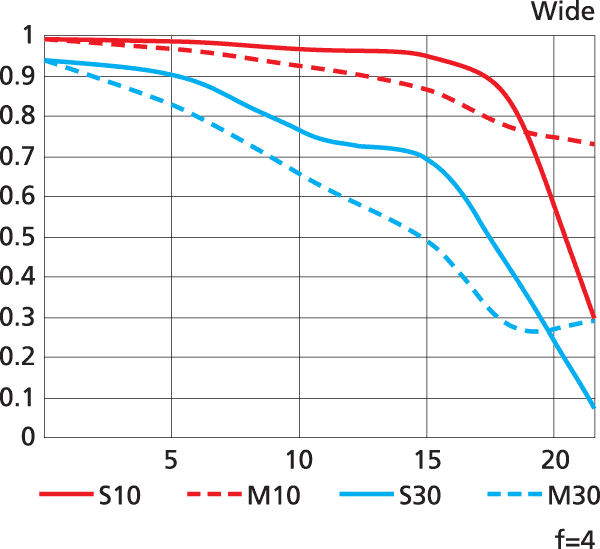
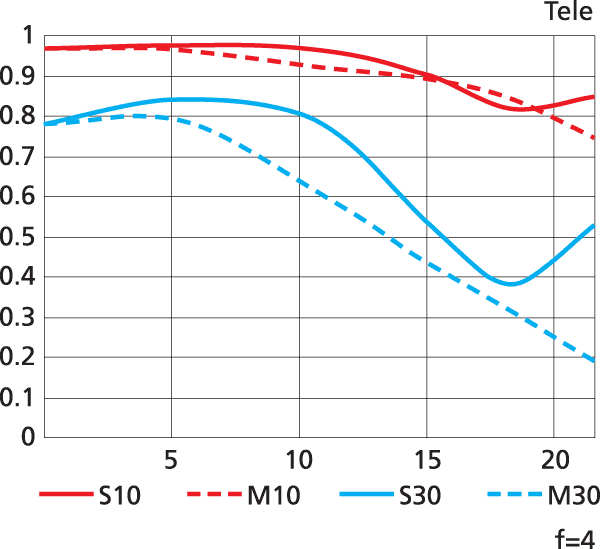
24-120:
Wide:
Tele:
<snip>
Thos are very impressive graphs Dan. 24-120 should be very good

These graphs are the Canon 24-105L 4 and should be directly comparable http://www.usa.canon.com/cusa/consumer/products/cameras/ef_lens_lineup/ef_24_105mm_f_4l_is_usm For those unfamilar with these things, and a couple of graphs don't tell the whole story but are a good indicator, I would say that the new Nikon lens will be at least as sharp as the Canon and well able to hold its own against the 24-70 2.8.
All this argument about f/2.8 vs f/4 is surely the reason why Nikon have introduced the new lens, with a different but equally valid set of compromises.
- Messages
- 19,708
- Name
- Darren
- Edit My Images
- Yes
All this argument about f/2.8 vs f/4 is surely the reason why Nikon have introduced the new lens, with a different but equally valid set of compromises.
I agree. People have complained about the lack of certain ranges and F4 lenses in comparison to Canon so Nikon launch one.
Naboo32
Suspended / Banned
- Messages
- 3,278
- Name
- Andy
- Edit My Images
- Yes
Thos are very impressive graphs Dan. 24-120 should be very good
These graphs are the Canon 24-105L 4 and should be directly comparable http://www.usa.canon.com/cusa/consumer/products/cameras/ef_lens_lineup/ef_24_105mm_f_4l_is_usm For those unfamilar with these things, and a couple of graphs don't tell the whole story but are a good indicator, I would say that the new Nikon lens will be at least as sharp as the Canon and well able to hold its own against the 24-70 2.8.
...
I don't know how to read these graphs, Richard, but do they tell us anything about image distortion at all :shrug:? I would have thought that this would be the obvious drawback with such a wide range of focal lengths, but I'm no expert :|.

MartinH32
Suspended / Banned
- Messages
- 792
- Name
- Martin
- Edit My Images
- No
For me shooting weddings the new 24-120 is an interesting prospect.
I currently carry two D700 bodies with a 70-200 on one and a 24-70 on the other. The loss of an F stop apart, I'd be tempted by the new 24-120 as I've often needed that extra reach on my 24-70 which has resorted to camera juggling to my 70-200. I could see the 24-120 being used the majority of the time. The VR would be extremely handy and is what the 24-70 is lacking. I can also soon crank the ISO up a stop and not be worried too much about noise with the D700.
I don't know, I guess it's me but I think the sharpness of the 70-200 is awesome, but the 24-70 isn't any better than the 24-70 Sigma HSM I owned and swapped previously.
I'd be seriously interested if build and optical quality is up to scratch!
I currently carry two D700 bodies with a 70-200 on one and a 24-70 on the other. The loss of an F stop apart, I'd be tempted by the new 24-120 as I've often needed that extra reach on my 24-70 which has resorted to camera juggling to my 70-200. I could see the 24-120 being used the majority of the time. The VR would be extremely handy and is what the 24-70 is lacking. I can also soon crank the ISO up a stop and not be worried too much about noise with the D700.
I don't know, I guess it's me but I think the sharpness of the 70-200 is awesome, but the 24-70 isn't any better than the 24-70 Sigma HSM I owned and swapped previously.
I'd be seriously interested if build and optical quality is up to scratch!
puddleduck
Suspended / Banned
- Messages
- 6,776
- Name
- Andy Drake
- Edit My Images
- Yes
I don't know, I guess it's me but I think the sharpness of the 70-200 is awesome, but the 24-70 isn't any better than the 24-70 Sigma HSM I owned and swapped previously.
I'd be seriously interested if build and optical quality is up to scratch!
I think if you really had a Sigma that was as good as the 24-70 you either had the world's worse Nikkor, or a handcrafted by fairies Siggy 24-70 HSM
I'm no lens snob, but the Nikon 24-70 really a LOT better than that Sigma.
I don't get why you need VR for weddings - this is a short lens and should be easy to handhold, and VR doesn't stop motion blur.
I would say you need f/2.8 more than you need VR.. dunno I don't shoot weddings, but I can't see how a slower lens with VR is ever going to do better than an f/2.8 lens in a low light scenario?

ryanyboy
Suspended / Banned
- Messages
- 5,275
- Name
- Ryan
- Edit My Images
- Yes
I think if you really had a Sigma that was as good as the 24-70 you either had the world's worse Nikkor, or a handcrafted by fairies Siggy 24-70 HSM
I'm no lens snob, but the Nikon 24-70 really a LOT better than that Sigma.
I don't get why you need VR for weddings - this is a short lens and should be easy to handhold, and VR doesn't stop motion blur.
I would say you need f/2.8 more than you need VR.. dunno I don't shoot weddings, but I can't see how a slower lens with VR is ever going to do better than an f/2.8 lens in a low light scenario?
I agree on the VR issue.
And with regards the Nikon 24-70 being on a par with the Sigma version I would recommend trying another Nikon 24-70. Some are better than others. Not many bad 'uns but they do exist.
HoppyUK
Suspended / Banned
- Messages
- 23,200
- Name
- Richard
- Edit My Images
- No
I don't know how to read these graphs, Richard, but do they tell us anything about image distortion at all :shrug:? I would have thought that this would be the obvious drawback with such a wide range of focal lengths, but I'm no expert :|.
Andy no, those MTFs are just for sharpness - percentage contrast up the left, as it drops off across the frame to the right (shown as mm from the centre). Edge of a full frame sensor is 18mm from the centre and you can see how the designers have tried to hold good sharpness to that point then let it drop off in the corners - commonly practise really, one of the trade-offs.
The two colours are 10 cycles per mm and 30cpmm, which they publish for mainly historical reasons I think (and because it makes the lenses look better - Canon and Sigma do the same
). But current sensors go much higher than that and if you take pixel count as relevant here then many crop format sensors can theoretically resolve more than three time that level of detail - over 100cpmm.So while those graphs only show the contrast performance at a quite modest level of resolution (actually a much more important level for everyday subjects than pixel peeping minutiae) you can easily see how the trend of contrast dropping consistently as resolution increases. Therefore it's not unreasonable to project that high contrast at low resolution will be held to deliver relatively high contrast at high resolution also. So on that basis, those graphs look promising
On the distortion thing, I expect that to be pretty poor at the wide end, ditto the Canon 24-105L 4. I think manufacturers now take the view that folks with this level of kit will have access to post processing where it's a doddle to correct distortion, whereas it's a right pain to do optically with both a wide angle and high ratio zoom. Another compromise decision.
Just on that, I think Nikon already have both limited CA and vignetting correction in-camera. This trend is certain to continue, where it is easier to do things in software rather than by optical design. The pay off for us is better, lighter, cheaper lenses - at least in theory.
All other things aside, f/2.8 lenses are much bigger and usually around twice the weight of f/4 equivalents. That's an issue for most people on general walkabout.
agreed i would be tempted by the weight saving and carry 50mm for the dark bits
Weight: Approximately 710 g
HoppyUK
Suspended / Banned
- Messages
- 23,200
- Name
- Richard
- Edit My Images
- No
agreed i would be tempted by the weight saving and carry 50mm for the dark bits
Weight: Approximately 710 g
Don't be so sensible!
You mean tuck a really fast prime in your pocket rather than hump a great big lump of f/2.8 zoom around all day?! Now there's a thought

desantnik
Suspended / Banned
- Messages
- 9,848
- Name
- Vlad
- Edit My Images
- Yes
Extra reach - I always thought about that, but i have learn early on that it is MUCH MUCH MUCH more easier to walk forward than to step back. Not applicable here but my point is that stepping forward to make that 50mm is not difficult. I do concede that it is useful, and I have already said the 24-105 and the 24-120VR has its place in both line ups. I am just saying the 24-70 can take photos in more situations that 24-120 can but not the other way round.
I disagree actually.
It does depend on what you are shooting. I shoot what I guess you could call "candid portraits", a little bit "pap" I guess. If I have a chance I will always choose a 70-200 over the 24-70 to do those shots - because you don't get in the face of the subject and loose the candidness of the shot. I would choose this every time from a photographic point of view.
However, if its a real press scrum, then you need the 24-70 so you can stand in front of the others! A 70-200 is useless in that eye gouging fight!
With a 24-120 I can have one lens to cope with all situations - providing its reasonable enough quality, which the old 24-120 wasn't.
MartinH32
Suspended / Banned
- Messages
- 792
- Name
- Martin
- Edit My Images
- No
I think if you really had a Sigma that was as good as the 24-70 you either had the world's worse Nikkor, or a handcrafted by fairies Siggy 24-70 HSM
I'm no lens snob, but the Nikon 24-70 really a LOT better than that Sigma.
I don't get why you need VR for weddings - this is a short lens and should be easy to handhold, and VR doesn't stop motion blur.
I would say you need f/2.8 more than you need VR.. dunno I don't shoot weddings, but I can't see how a slower lens with VR is ever going to do better than an f/2.8 lens in a low light scenario?
The VR isn't the winner here, merely a nice to have. It's the extra reach up to 120 that I would really like.