Nikon Announces 3 New Lenses

I think the new 85mm f/1.4 will probably kill of the Sigma 85mm f/1.4 HSM that came out - has anyone seen one "in the wild"?

 
Not sure why some folks are expecting the 24-120 4 to be optically less good than the current 24-70 2.8.

The Canon 24-105L 4 is really on a par with the 24-70L 2.8, both are extremely sharp. And as a general rule, slower lenses (ie f/4 compared to f/2.8) are less prone to flare and have less vignetting.

The new lens certainly should be very good indeed, especially for the price, or Nikon will surely have shot themselves in the foot. And you get a smaller, lighter, cheaper lens with a lot more range and VR. All for one click on the ISO.
 
Well I'll be seriously looking at the 24-120 .... If it is as sharp as the Canon 24-105 (my copy was VERY sharp at F/4) then it will be perfect for weddings ... the D3 and D3s don't need f/2.8 and when I shot Canon f/4 even on their noisy bodies didn't affect how I worked
 
Not sure why some folks are expecting the 24-120 4 to be optically less good than the current 24-70 2.8.

A 5x zoom as opposed to a 3x zoom seen with the 24-70 and the 70-200?

I'm looking forward to being proved wrong, but I can't see you can keep the quality up... something has to give!
 
prices are just silly

i wont be tradeing in my 85 its more than good enough
 
Sales start date: 22nd September 2010
UK pricing: £1049.99

Is it just me or is that VERY expensive for a slow f/4 lens?

When you can get the f/2.8 24-70.. its a head scratcher!

Feel like it needs to be a £700 lens, not £1k+?

The RRP is not the same as what something actually costs to buy, at least not after it's been available for a while.
 
From what I've seen, the 24-70 f2.8 gets some stunning images, it will need something special to beat it.

Isn't this what the camera companies do? Attempt to mimic the other's highly successful lenses? Canon's 24-105 IS has been said to be very good, so Nikon would like to try it?
Similar thing happened when Nikon introduced the 18-200, a compact zoom with big focal length range was what a lot of people seemed to be after. Canon saw the success, and released their own. Probably wasn't as much of a hit, but it certainly sold. Sure, this is at the low end of the spectrum, where the average person on the street doesn't care about F4 or F2.8, but the same still pretty much applies.
 
From what I've seen, the 24-70 f2.8 gets some stunning images, it will need something special to beat it.

Isn't this what the camera companies do? Attempt to mimic the other's highly successful lenses? Canon's 24-105 IS has been said to be very good, so Nikon would like to try it?
Similar thing happened when Nikon introduced the 18-200, a compact zoom with big focal length range was what a lot of people seemed to be after. Canon saw the success, and released their own. Probably wasn't as much of a hit, but it certainly sold. Sure, this is at the low end of the spectrum, where the average person on the street doesn't care about F4 or F2.8, but the same still pretty much applies.

It's less of Nikon try to do something Canon has, its more of people see nikon has holes in their line up as Canon has a range of lenses they don't.

Canon's 24-105L was like £600 not long ago, even when the 24-70 was £800, so £1k for the 24-120 is a lot of money for an F/4 lens, IS or no IS (or VR)
 
Let alone the very valid point of spotting the difference between f/4 and f/2.8 on 72 dpi toilet paper...

Is anyone remembering the silly high ISO numbers modern D-SLR's are capable of?

Have we forgotten all of the film era rules of photography???

If I can get decent results at 6400 ISO I will definitely be happy with an f/4 lens if it is optically good!:geek:


exactly - those who lust after f/2.8 glass might do so for many reasons - tonality, resolution, low-light focusing, weather sealing, longevity - but the whole 'extra stop to freeze motion' argument went out the window moons ago, the moment sensors managed clean ISO 1600 and above.

It's as though people forget that you don't have to change/sacrifice a half-roll of film to double your ISO/ASA these days. F/4 to f/2.8 to freeze motion - or ISO 800 to 1600 [or even 3200, or 6400, or 12800, or 25600, or 50,200, or 102,400...]?

Even entry level digital SLR's out-noise 1600 ASA film these days at equivalent speeds. It's as though ex-film photographers are grimly clinging onto the past, telling themselves they need an f/2.8 prime to do what an f/4 can't, even though they're falling over themselves to appreciate the ISO 102,000 of the latest full-frame cameras.

If there's a reason to cling onto f/2.8 zooms, it's the optical superiority, not the extra aperture.
 
It's less of Nikon try to do something Canon has, its more of people see nikon has holes in their line up as Canon has a range of lenses they don't.

Canon's 24-105L was like £600 not long ago, even when the 24-70 was £800, so £1k for the 24-120 is a lot of money for an F/4 lens, IS or no IS (or VR)

Agree that the current f/4 range is priced high, but it's just the usual 'early adopter' tax. The RRP if the 24-105 is a grand - street much lower. Same will eventually be true of the 16-35 and the 24-120; it just takes time and market saturation.
 
exactly - those who lust after f/2.8 glass might do so for many reasons - tonality, resolution, low-light focusing, weather sealing, longevity - but the whole 'extra stop to freeze motion' argument went out the window moons ago, the moment sensors managed clean ISO 1600 and above.

It's as though people forget that you don't have to change/sacrifice a half-roll of film to double your ISO/ASA these days. F/4 to f/2.8 to freeze motion - or ISO 800 to 1600 [or even 3200, or 6400, or 12800, or 25600, or 50,200, or 102,400...]?

Even entry level digital SLR's out-noise 1600 ASA film these days at equivalent speeds. It's as though ex-film photographers are grimly clinging onto the past, telling themselves they need an f/2.8 prime to do what an f/4 can't, even though they're falling over themselves to appreciate the ISO 102,000 of the latest full-frame cameras.

If there's a reason to cling onto f/2.8 zooms, it's the optical superiority, not the extra aperture.

An extra stop is an extra stop.

Clean ISO at 1600. It might be clean at 1600, even to 3200, but 6400 it won't be and i much rather be shooting 1 stop lower if it is available to me. Stepping forward is EASY, cropping is EASY.

Apart from Optics, there is the Depth of Field too, 2.8 is more pleasing than 4.0.
 
Raymond, I expected the argument from someone that 'it might save me from using ISO 25,000, instead I can shoot 12,800' - it comes along every time I or others post this viewpoint - but really, it seems a little contrived, doesn't it?

An extra stop is an extra stop, but from ASA 100 equivalent to ASA 12,800 is seven stops. If we really needed true low light ability, we'd shoot f/1.4 primes - like you do. How many times a year do you genuinely need to save a shot from a metered ISO 25,000? To print large? I'd wager it's a theorietically small number, made larger only to serve the argument at hand, rather than a commonly encountered situation.

If anyone really needs wafer thin depth of field, they should be shooting really fast primes - like you do. And besides, as I said there are any number of reasons to shoot faster glass - but 'minimal depth of field photography' isn't 'stopping action in low light', which is the commonly cited reason for going with fast glass.

For example... 8 years ago ISO 800 was noisy, then we got clean ISO 800 and noisy 1600. The argument went 'I need f/2.8 to avoid shooting beyond 800'. Then, 1600 got clean and 3200 was noisy. The f/2.8 stalwarts decided the extra stop was to 'prevent them from shooting beyond 1600'. Now 3200 is clean, we want that extra stop so we don't have to 'endure 6400', despite the fact that even with an f/4 lens we're able to maintain shutter speeds two stops faster than we could with an f/2.8 lens half a decade ago. Once cameras have clean ISO 50k, will the goalposts be moved yet again? At what point should we accept that the ISO boundaries have been pushed beyond the realms of that thought possible, even at the turn of the 21st century? Or will this continue until cameras can shoot in the darkness of deep space, and we want that extra stop so as to avoid ISO 1.6 million?

Anyway, I love fast glass. Really. I'd love to try your 35/1.4 - it's a marvellous and aspirational lens, and your wedding shots are superb. It's just I don't see how we can justify buying that extra stop just to freeze action, when the benefits of faster glass are apparent in so many other ways.
 
Last edited:
All other things aside, f/2.8 lenses are much bigger and usually around twice the weight of f/4 equivalents. That's an issue for most people on general walkabout.
 
How much distortion will 24-120 have? How will it compare to Canon? These are the major questions. I would personally prefer 24-1xx f/4 over my 24-70mm f/2.8 as long as distortion was better, not worse, and as long as the price was somewhat lower. I don't need f/2.8 for any of my landscape work; primes are for the thin DOF!
 
Raymond, I expected the argument from someone that 'it might save me from using ISO 25,000, instead I can shoot 12,800' - it comes along every time I or others post this viewpoint - but really, it seems a little contrived, doesn't it?

An extra stop is an extra stop, but from ASA 100 equivalent to ASA 12,800 is seven stops. If we really needed true low light ability, we'd shoot f/1.4 primes - like you do. How many times a year do you genuinely need to save a shot from a metered ISO 25,000? To print large? I'd wager it's a theorietically small number, made larger only to serve the argument at hand, rather than a commonly encountered situation.

If anyone really needs wafer thin depth of field, they should be shooting really fast primes - like you do. And besides, as I said there are any number of reasons to shoot faster glass - but 'minimal depth of field photography' isn't 'stopping action in low light', which is the commonly cited reason for going with fast glass.

For example... 8 years ago ISO 800 was noisy, then we got clean ISO 800 and noisy 1600. The argument went 'I need f/2.8 to avoid shooting beyond 800'. Then, 1600 got clean and 3200 was noisy. The f/2.8 stalwarts decided the extra stop was to 'prevent them from shooting beyond 1600'. Now 3200 is clean, we want that extra stop so we don't have to 'endure 6400', despite the fact that even with an f/4 lens we're able to maintain shutter speeds two stops faster than we could with an f/2.8 lens half a decade ago. Once cameras have clean ISO 50k, will the goalposts be moved yet again? At what point should we accept that the ISO boundaries have been pushed beyond the realms of that thought possible, even at the turn of the 21st century? Or will this continue until cameras can shoot in the darkness of deep space, and we want that extra stop so as to avoid ISO 1.6 million?

Anyway, I love fast glass. Really. I'd love to try your 35/1.4 - it's a marvellous and aspirational lens, and your wedding shots are superb. It's just I don't see how we can justify buying that extra stop just to freeze action, when the benefits of faster glass are apparent in so many other ways.

I get all that, you can shoot crystal clean at 12,800 ISO and I would STILL take the 2.8 lens.

It is because my experiences tells me to shoot FASTER lenses, and I shoot with 5Dmkii, not like I can't push high ISO, I have shot 4000 ISO clean but i STILL prefer to shoot with a faster glass.

May be I am spoilt by the 1.4, as since i have experienced what it can do in the dark, using a 2.8 glass in the same situation just seem slow. That stop does make a difference.

edit - Also, It is still a lot of money for an F/4 lens.

Also, shooting 6400ISO might be clean out of the camera, but i find that high ISO photos gets noisy REALLY quickly through processing. Lower ISO photos has much higher tolerance through processing.
 
Last edited:
I was in Grays on Tuesday, and I was talking about the 85mm f/1.4 and asking if they had any idea about an update. They said that they didnt see an update to the optics in the near future as the current optics were superb enough. However if there was to be an update, it would just be to add an AF-S motor, but they didnt see it coming any time soon. And now 2 days later, THIS!!

Daniel
 
I was in Grays on Tuesday, and I was talking about the 85mm f/1.4 and asking if they had any idea about an update. They said that they didnt see an update to the optics in the near future as the current optics were superb enough. However if there was to be an update, it would just be to add an AF-S motor, but they didnt see it coming any time soon. And now 2 days later, THIS!!

Daniel

They would say that to sell you their stock!!
 
Why on earth people would want to go to F4 if there's a F2.8 lens of equal or better quality is beyond me.

A 2.8 lens can be shot at f4 all day long. But an f4 lens can NEVER shoot at 2.8. And it's not just about shutter speeds. There's the dof issue too.

I take the weight argument but other than that I'm lost.......
 
Why on earth people would want to go to F4 if there's a F2.8 lens of equal or better quality is beyond me.

A 2.8 lens can be shot at f4 all day long. But an f4 lens can NEVER shoot at 2.8. And it's not just about shutter speeds. There's the dof issue too.

I take the weight argument but other than that I'm lost.......

VR ....

Just remember because you can't see a point doesn't mean others can't

VR in a non moving Church coverage situation will give more advantage than f/2.8 .... assuming the image quality is the same
 
Can't see any reason why they made a new 85mm, unless it focuses a lot closer, in which case I may be tempted. :shrug:
But as I've said before the existing 85mm 1.4, IS sex in a barrel :)

And look at the extra price too even with the really really useful feature "G". So no aperture ring for older cameras. Looks like it is going to have to be very special to be worth that.
 
exactly - those who lust after f/2.8 glass might do so for many reasons - tonality, resolution, low-light focusing, weather sealing, longevity - but the whole 'extra stop to freeze motion' argument went out the window moons ago, the moment sensors managed clean ISO 1600 and above.

It's as though people forget that you don't have to change/sacrifice a half-roll of film to double your ISO/ASA these days. F/4 to f/2.8 to freeze motion - or ISO 800 to 1600 [or even 3200, or 6400, or 12800, or 25600, or 50,200, or 102,400...]?

Even entry level digital SLR's out-noise 1600 ASA film these days at equivalent speeds. It's as though ex-film photographers are grimly clinging onto the past, telling themselves they need an f/2.8 prime to do what an f/4 can't, even though they're falling over themselves to appreciate the ISO 102,000 of the latest full-frame cameras.

If there's a reason to cling onto f/2.8 zooms, it's the optical superiority, not the extra aperture.

Sorry Dan, but that is one condescending post :|.

I don't come from a 35mm film background, so I don't really 'feel' the improvements in high ISO shooting that come modern DSLRs and I shoot a D700! But, there are plenty of times when I find that I can't get the shutter speed/ISO quality relationship that I want (as I don't do all of my photography in bright sunlight).

Halving the shutter speed (f/2.8 vs. f/4) is absolutely crucial when you find yourself on the limit of what your camera/lens can offer you :shrug: and that happens to me quite often enough (especially with the longer lenses for wildlife shots, where camera shake and/or subject motion blur come into play) to justify my preference for 'faster' glass.

And what about bokeh :shrug:!? I'm a shallow DOF junkie and even f/2.8 doesn't do enough to isolate the subject for my tastes, when that subject is not close to the lens. F/4 is only any good at blurring backgrounds if you have a close subject and a distant background - high ISO isn't going to help you there either ;).

To state, as you did, that "an extra aperture is no reason to 'cling onto' a lens", suggests to me that you are not in touch with what many people want from a lens.

Sorry, but I just had to put my opinion on record :|.
 
VR ....

Just remember because you can't see a point doesn't mean others can't

VR in a non moving Church coverage situation will give more advantage than f/2.8 .... assuming the image quality is the same

Easy Simon. I can see your point but (as you are relating this to weddings) we both know full well that the VR won't freeze movement. Other than when the church is empty I've never know it to be non-moving. And as other's have said ISO is good enough these days that we can get shutter speeds high enough to negate the need for VR.

Clearly it's a marmite thing and we'll not agree on what's best.
 
Sorry Dan, but that is one condescending post :|.

I don't come from a 35mm film background, so I don't really 'feel' the improvements in high ISO shooting that come modern DSLRs and I shoot a D700! But, there are plenty of times when I find that I can't get the shutter speed/ISO quality relationship that I want (as I don't do all of my photography in bright sunlight).

Halving the shutter speed (f/2.8 vs. f/4) is absolutely crucial when you find yourself on the limit of what your camera/lens can offer you :shrug: and that happens to me quite often enough (especially with the longer lenses for wildlife shots, where camera shake and/or subject motion blur come into play) to justify my preference for 'faster' glass.

And what about bokeh :shrug:!? I'm a shallow DOF junkie and even f/2.8 doesn't do enough to isolate the subject for my tastes, when that subject is not close to the lens. F/4 is only any good at blurring backgrounds if you have a close subject and a distant background - high ISO isn't going to help you there either ;).

To state, as you did, that "an extra aperture is no reason to 'cling onto' a lens", suggests to me that you are not in touch with what many people want from a lens.

Sorry, but I just had to put my opinion on record :|.

I agree - in fact it's pretty much echoing what I said.
 
It will be interesting to see the IQ of the 24-120 f4 but at that price it will have to stay on the "maybe sometime" list. Need that 70-200f2.8 vr II first !
 
Why on earth people would want to go to F4 if there's a F2.8 lens of equal or better quality is beyond me.

A 2.8 lens can be shot at f4 all day long. But an f4 lens can NEVER shoot at 2.8. And it's not just about shutter speeds. There's the dof issue too.

I take the weight argument but other than that I'm lost.......
Cost maybe (and not to mention lens size)...? Not everyone can afford f2.8 lenses, and so an f4 range is the next best option. People have complained for years Nikon don't offer a god range of f4 lenses like Canon so it's good they are now catching up. A 24-120 f2.8 would be massive and mega expensive. For those that want the extended range it offers over the 24-70, if the f4 is optically good then it makes sense.
 
Last edited:
Email from Nikon this morning:


AF-S NIKKOR 85mm f/1.4G

"I AM PORTRAIT PERFECTION"

The sharpest, fastest portrait lens on the market: Nikon's flagship 85mm f/1.4G delivers the ultimate in sharp, naturalistic images and outstanding performance.


Brand new optical system for assuredly sharp images
Ultra-fast lens for effortless low-light shooting
Fast, whisper-quiet and reliably smooth focusing
The ideal medium-telephoto companion for the D3S and D3X


On sale 2 September 2010
RRP £1499.99


AF-S NIKKOR 24-120mm f/4G ED VR

"I AM RAISING THE STANDARD"

Designed for the D700, this FX-optimised standard zoom is a must for photographers who demand superior quality and exceptional value.

Extremely compact and manageable - perfect for travel and documentary work


Superior image integrity with fixed maximum f/4 aperture and broad 5x zoom


Built in Vibration Reduction (VRII) reduces blur in low light or at long focal lengths by enabling a shutter speed equivalent to four stops faster


On sale 22 September 2010
RRP £1049.99


AF-S NIKKOR 28-300mm f/3.5-5.6G ED VR

"I AM A PERFECT TEN"

This ultra high-ratio zoom is a high performance all-rounder - great for sports, travel, wildlife and portraits, and the ideal partner for the D700.

10.7x zoom covers almost every imaging opportunity without changing lenses


With shutter speeds equivalent to four steps faster, thanks to the built in Vibration Reduction system, you'll achieve blur-free shots at long focal lengths, even in low light


ED glass and aspherical elements guarantee sharper, more accurate images


On sale 2 September 2010
RRP £869.99
 
The phrase 'walkabout' makes me want to kill myself.

walkabout walkabout walkabout walkabout walkabout walkabout walkabout walkabout walkabout walkabout walkabout walkabout walkabout walkabout


Sorry, just in my silly mood :p


Cost maybe (and not to mention lens size)...? Not everyone can afford f2.8 lenses, and so an f4 range is the next best option. People have complained for years Nikon don't offer a god range of f4 lenses like Canon so it's good they are now catching up. A 24-120 f2.8 would be massive and mega expensive. For those that want the extended range it offers over the 24-70, if the f4 is optically good then it makes sense.

Actually, I wish Nikon would pull more f/4 lens to provide a mid-range at affordable prices, not just to tackle Canon better :shrug:. It amazes me how they just ignore that market. It's as if, you're either with the Pro. or with the Amateur, nothing in between :shrug:

The 24-120 VR (original) was a very good kit lens; and while many did argue for its' lack of sharpness, I enjoyed mine to no ends.

I hope this incarnation resolves the sharpness problem.

Sure, f/4 doesn't compete with f/2.8 for DoF and that extra one stop can be a deal breaker; but that's the two issues going against the f/4 vs. the 24-70 f/2.8! On the flip side, the f/4 has price, range and 3-stops better (when you factor in the VR vs. f/4-f/2.8).

I recall, when I got my 24-70 (back in 2007), the first thing I wished it had was VR.

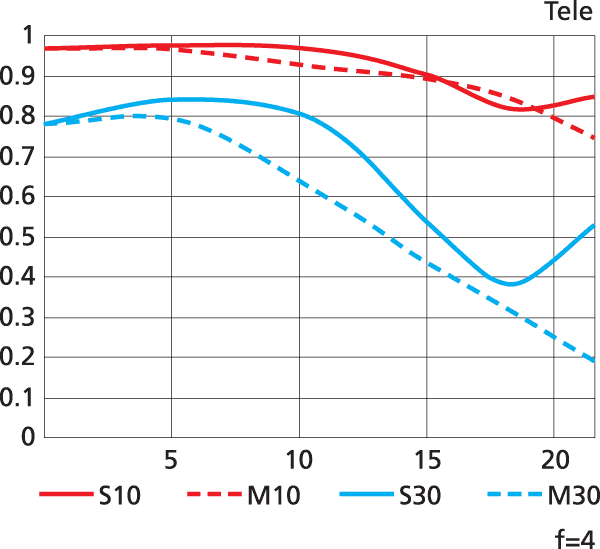
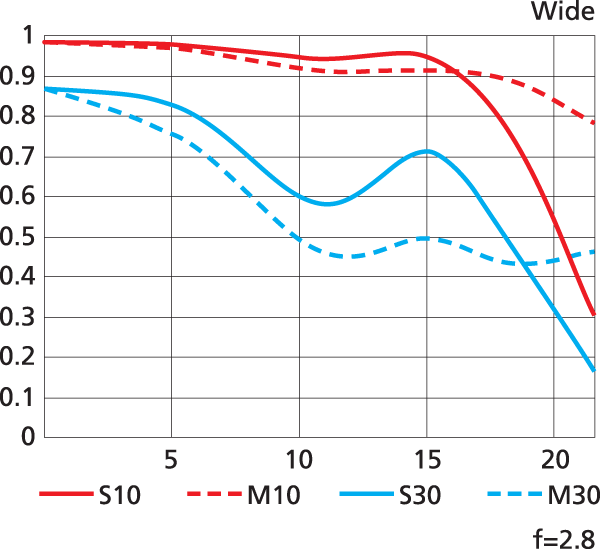
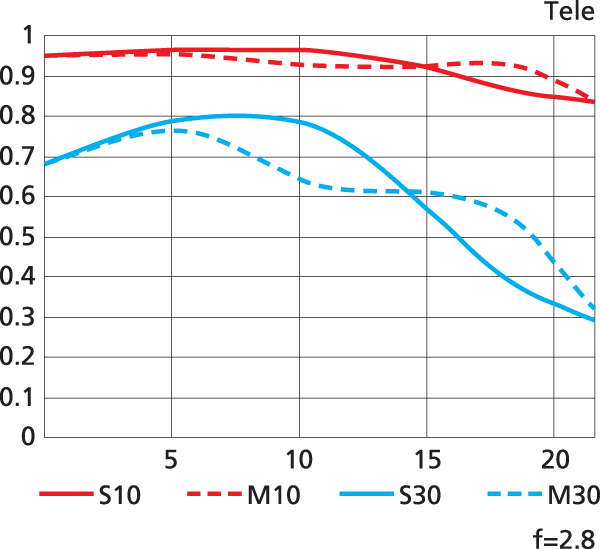
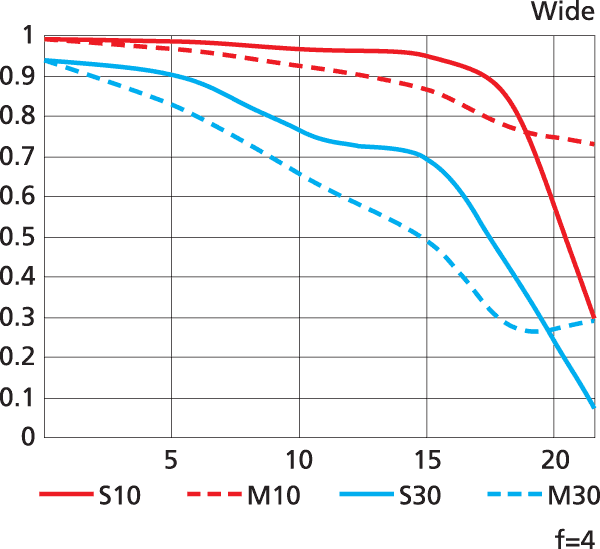
Now, I guess we'll just have to wait and see a real side by side comparison of IQ from the 24-120 vs. 24-70; and if someone can find an MTF chart :thumbs:. It would be interesting if they're equal :eek:, how many would sell their 24-70 :suspect:
 
Why on earth people would want to go to F4 if there's a F2.8 lens of equal or better quality is beyond me.

Why would anyone want to go to F2.8 when there are F1.4 lenses of equal or better quality? Similar reasons I suspect.
 
Now, I guess we'll just have to wait and see a real side by side comparison of IQ from the 24-120 vs. 24-70; and if someone can find an MTF chart :thumbs:. It would be interesting if they're equal :eek:, how many would sell their 24-70 :suspect:
24-120:

Wide:
mtf-24mm.gif


Tele:
mtf-120mm.gif


24-70:

Wide:
24-70mm-mtf-wide.gif


Tele:
24-70mm-mtf-tele.gif


Hope these help,

Daniel
 
Email from Nikon this morning:


AF-S NIKKOR 85mm f/1.4G

"I AM PORTRAIT PERFECTION"

The sharpest, fastest portrait lens on the market: Nikon's flagship 85mm f/1.4G delivers the ultimate in sharp, naturalistic images and outstanding performance.

...

When I read this in the Nikon press release, I though to myself, "Aren't 'sharp' and 'naturalistic' two opposing adjectives where lenses are concerned" :shrug:?

For instance, IIRC, the old "cream machine" was often described as 'naturalistic' (is that a proper English word :thinking:), because it wasn't tack sharp, but produced very flattering, natural looking portraits.

Perhaps "naturalistic" refers to the colour rendition, as opposed to the optical resolution, who knows :shrug:!?

Anyway, I bet it's going to be a fantastic portrait lens :).
 
Why would anyone want to go to F2.8 when there are F1.4 lenses of equal or better quality? Similar reasons I suspect.

That's not a relevant comparison though.
 
Back
Top