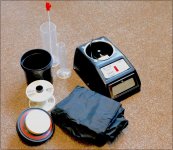
Nightmare film experience

Barney

Suspended / Banned
Messages
3,043
Name
Wayne
Edit My Images
No
Yesterday after processing dozens of films in my darkbag and patterson tank setup I had a flipping mare.

When trying to load the film onto the spool I got two thirds of the way and on and it would not go any further, I didn't want to force it so to speak so took the film out and started again, same thing happened next time so again I took the film of and decided to breakdown the spool and reassemble it in the dark bag, three quarters way in and same again.

Five attempts it took me to get the flipping film wound on, a good 45 minutes, everything was hot and sweaty inside the bag, I couldn't get my arms out, in the end they were stuck to the bag!

I am surprised I got any images from the roll at all, As expected numerous marks and scratches.

I just thought I would share my frustration here as at home its like talking to the wall, nobody understands. :)
 
Last edited:
I hear you! I had a terrible time the first time I tried to load 120 film into the spiral. Start - stuck - take it out - repeat - repeat. I was getting sweaty. The film was getting dirty and sticky from my sweat.
 
I have had plenty trouble free experiences and find 120 easier than 135.

This just came out of the blue!
 
Yesterday after processing dozens of films in my darkbag and patterson tank setup I had a flipping mare.

When trying to load the film onto the spool I got two thirds of the way and on and it would not go any further, I didn't want to force it so to speak so took the film out and started again, same thing happened next time so again I took the film of and decided to breakdown the spool and reassemble it in the dark bag, three quarters way in and same again.

Five attempts it took me to get the flipping film wound on, a good 45 minutes, everything was hot and sweaty inside the bag, I couldn't get my arms out, in the end they were stuck to the bag!

I am surprised I got any images from the roll at all, As expected numerous marks and scratches.

I just thought I would share my frustration here as at home its like talking to the wall, nobody understands. :)
Back in the film only days I had a darkroom, occasionally I would get a film that didn't want to load (usually 120) but I used to keep a second spiral to hand for such occasions which was usually the quick fix. Can't imaging getting the problem in a changing bag though and I no longer develop my own so won't experience it either (as things stand). I feel for you Wayne.
 
When trying to load the film onto the spool I got two thirds of the way and on and it would not go any further
Possible explanation: did you dry the reel properly?

When thoroughly dry, Paterson reels are easy to load but if you leave a single drop of water in one, it becomes a total nightmare. I always placed mine in the airing cupboard for half an hour after giving them a good shake, to remove as much water as possible.

On the rare occasions I develop a film these days, I use this handy little reel dryer that I found on Ebay, so both the film and the reel come out ready for further use.

Film developing kit D600 D60_4990.jpg
 
Possible explanation: did you dry the reel properly?

When thoroughly dry, Paterson reels are easy to load but if you leave a single drop of water in one, it becomes a total nightmare. I always placed mine in the airing cupboard for half an hour after giving them a good shake, to remove as much water as possible.

On the rare occasions I develop a film these days, I use this handy little reel dryer that I found on Ebay, so both the film and the reel come out ready for further use.

View attachment 475917
I didn't check it to be honest, It had been on the shelf a couple of weeks so I just assumed it was dry.

The dryer looks nifty!
 
You need to give the spirals a good clean, make sure the two ball bearings move smoothly. I'm still using Paterson spirals I bought 50+ years ago without problems.

Over time you get a thin build up of Gelatin from the super coat, this can get slightly sticky, a good wash in warm water, a scrub with an old toothbrush.

Ian
 
You need to give the spirals a good clean, make sure the two ball bearings move smoothly. I'm still using Paterson spirals I bought 50+ years ago without problems.

Over time you get a thin build up of Gelatin from the super coat, this can get slightly sticky, a good wash in warm water, a scrub with an old toothbrush.

Ian
will try that !
 
Happens to us all, Wayne. :D

Thankfully not very often!

I'll second what others have said about ensuring the reels are washed and dried after each use, and that you give the bearings a wiggle before loading film. If the worse happens, then place the film in the dev tank (even if it's uncoiled) and close the lid so it's light tight. That way you can at least remove your arms, cool off, and air out the bag before giving it another go.
 
You can never have too many spools. It's easier to start a fresh one than it is to go back for repeated attempts IME. As has been said above - clean and dry is a must.

Changing bags get moist far too quickly for me - I prefer to use a pop-up dark tent. There's a lot more room and nothing is trying to cling to your hands.

I also prefer Jobo tanks and spools over Paterson.
 
I've always struggled getting film onto a spiral using dark bag and as the sweat builds up the harder it gets.

Having a darkroom helps no end with this. If I'm still having the occasional issue getting a film on the spiral I put the film in a second tank, seal it up, go have a cuppa and a calm down then go back to it.
 
The dryer looks nifty!
A hair dryer on a hot setting will do the trick too. The few times I've dev'd films and then needed the spirals for more film deving I used the hair dryer to get them done instead of drying naturally. (I always wash a spiral after each use).
 
A hair dryer on a hot setting will do the trick too. The few times I've dev'd films and then needed the spirals for more film deving I used the hair dryer to get them done instead of drying naturally. (I always wash a spiral after each use).
I have not considered a proper wash as necessary, my bad, I just give them a quick swish around and rinse in some clean water.

I will give them a proper clean and see if that improves things
 
Happens to us all, Wayne. :D

Thankfully not very often!

I'll second what others have said about ensuring the reels are washed and dried after each use, and that you give the bearings a wiggle before loading film. If the worse happens, then place the film in the dev tank (even if it's uncoiled) and close the lid so it's light tight. That way you can at least remove your arms, cool off, and air out the bag before giving it another go.

That's a great tip Nigel, I just persisted, TRYING to stay calm as I got hotter and more bothered. :)
 
I prefer the stainless steel spirals. They load from the centre outwards so no need to slide.
 
You need to give the spirals a good clean, make sure the two ball bearings move smoothly. I'm still using Paterson spirals I bought 50+ years ago without problems.

Over time you get a thin build up of Gelatin from the super coat, this can get slightly sticky, a good wash in warm water, a scrub with an old toothbrush.

Ian
These are old spirals of indeterminate usage so probably suffering from build up!
 
I prefer the stainless steel spirals. They load from the centre outwards so no need to slide.
do they fit into the patterson type tanks?
 
SS spirals need SS tanks. They have no column through the centre so the Paterson light trapping system won't work.
I only use a Paterson tank now for sizes I don't have a SS one for - 127 and 220.
 
If I remember correctly when the Paterson System 4 came out centre loading spirals were available as an option. I don't think they were around for long.
 
If you get a bit stuck and need to take a break, just put the partly loaded film in the tank with the center pipe and lid on, it will be light tight, so you can take your hands out and cool off.
 
Are you using rinse aid in the final wash? If so, don’t immerse the reels in that because it can build up on the plastic and make it less slippery. It’s even worse with C41 stabiliser. Instead, take the film and reel out of the tank, pour the rinse aid water into the open tank, take the film off the reel then, with the emulsion on the inside (so it doesn’t scratch on the sides of the tank) gently move the film through the water a couple of times so it’s fully covered. Keep the reel well away from the tank of final rinse.

If you’ve got a gunked-up reel, scrub it with a toothbrush and hot water. If it’s still not right after a wash, try running a pencil along the inside edges of the reel. The carbon acts as a lubricant.
 
Last edited:
Are you using rinse aid in the final wash? If so, don’t immerse the reels in that because it can build up on the plastic and make it less slippery. It’s even worse with C41 stabiliser. Instead, take the film and reel out of the tank, pour the rinse aid water into the open tank, take the film off the reel then, with the emulsion on the inside (so it doesn’t scratch on the sides of the tank) gently move the film through the water a couple of times so it’s fully covered. Keep the reel well away from the tank of final rinse.

If you’ve got a gunked-up reel, scrub it with a toothbrush and hot water. If it’s still not right after a wash, try running a pencil along the inside edges of the reel. The carbon acts as a lubricant.

I have always wetting agent in all my developing tanks. That has never been an issue, but you do need to clean the reels in warm water every so often. I was typically shooting 20 - 30 35mm & 120 films some weeks, B&W, C41, & E6.

The wetting agent itself is not the problem, as I said in post #8 in this thread it's the gelatin build up, and that then retains wetting agent.

Ian
 
Are you using rinse aid in the final wash? If so, don’t immerse the reels in that because it can build up on the plastic and make it less slippery. It’s even worse with C41 stabiliser. Instead, take the film and reel out of the tank, pour the rinse aid water into the open tank, take the film off the reel then, with the emulsion on the inside (so it doesn’t scratch on the sides of the tank) gently move the film through the water a couple of times so it’s fully covered. Keep the reel well away from the tank of final rinse.

If you’ve got a gunked-up reel, scrub it with a toothbrush and hot water. If it’s still not right after a wash, try running a pencil along the inside edges of the reel. The carbon acts as a lubricant.

Yes I use a rinse aid, and always use it in the tank with the film on the reel and give it a shake about.

Another likely cause.
 
Yes I use a rinse aid, and always use it in the tank with the film on the reel and give it a shake about.

Another likely cause.
I always use rinse aid, but rarely get films sticking to the reels when loading, even after hundreds of dev sessions. I wash them in warm soapy (washing-up liquid) water using a dish cloth and then a quick, not particularly thorough, brush around the grooves with a toothbrush. The rinse with tap water and leave to air dry.
 
I do find that cameras that wind on reversing the film's curve can make the film more difficult to load on to Patterson spirals, I have occasional problems with films that have been through the Nikons and Leica M2 which advance as above, my Contaxes which wind on with the film's natural curl are not a problem. The type of film and thickness of base do also make a difference, thinner film bases can be more difficult, my now used up stocks of outdated Agfa APX 100 and 400 come to mind.
 
Yes I use a rinse aid, and always use it in the tank with the film on the reel and give it a shake about.
I make up my PhotoFlo in a separate jug, 1-2 ml to ~400 ml of de-ionised water. Bearing in mind I'm using a Rondinax, I just gently pull the film off the reel after the final rinse, pass it into the jug and allowing it to roll up with its natural curl, jiggling it back and forth a few times on the way. Just take care not to let the emulsion side (which will curl up inside) touch the rim of the jug as it goes in. Take the jug upstairs and hang the roll, bring it back down ready for the next roll. That way I don't have to make up fresh rinse-aid (the de-ionised water is one of the more expensive parts of the whole process!).
 
I once spent an hour and a half trying to get a 120 onto the reel in the dark bag. Other times it's about 30 seconds!
For 135 I leave the film in the can so I can start the leader onto the reel in daylight, then finish it off in the bag.
 
One thing I do if its getting stuck is to chamfer the corners on the leading edge, also try bending the first few mm back against the natural curve of the film.

The main thing though is to go over the spiral with a stiff tooth brush every time immediately before use.
 
One thing I do if its getting stuck is to chamfer the corners on the leading edge, also try bending the first few mm back against the natural curve of the film.

The main thing though is to go over the spiral with a stiff tooth brush every time immediately before use.
I agree with the first two points above but have never tooth brushed my spirals despite living in hard water areas.
 
I prefer the stainless steel spirals. They load from the centre outwards so no need to slide.
Absolutely. Stainless steel spirals are far quicker to load, only a few seconds and nothing to stick. They could be loaded into a cage for processing in bulk in 3 gallon tanks.
I had cages and spirals. and hangers for 5x4 cut film as well as heaters all for the Kodak system. I 'm now down to a few spirals and steel tanks for 35mm, 120 and 127 films..
 
I make up my PhotoFlo in a separate jug, 1-2 ml to ~400 ml of de-ionised water. Bearing in mind I'm using a Rondinax, I just gently pull the film off the reel after the final rinse, pass it into the jug and allowing it to roll up with its natural curl, jiggling it back and forth a few times on the way. Just take care not to let the emulsion side (which will curl up inside) touch the rim of the jug as it goes in. Take the jug upstairs and hang the roll, bring it back down ready for the next roll. That way I don't have to make up fresh rinse-aid (the de-ionised water is one of the more expensive parts of the whole process!).

De-ionised water is only really necessary on the final rinse, well filtered water is fine for everything else. Mains. Cartridge filters for photography used to be quiet cheap, but they seem to have vanished from the market
 
Last edited:
I normal clip the corners of the film and on 120 put a small fold about 12mm against the curl so the film points upwards towards the bearing but have never thought to do it on 135
 
De-ionised water is only really necessary on the final rinse, well filtered water is fine for everything else. Mains. Cartridge filters for photography used to be quiet cheap, but they seem to have vanished from the market
Yes, de-ionised water and photo-flo as the final rinse. The rest is warmed up or cooled down tap waater (some of it from the filter jug, but that's just because it's usually closer to room temperature).
 
Yes, de-ionised water and photo-flo as the final rinse. The rest is warmed up or cooled down tap waater (some of it from the filter jug, but that's just because it's usually closer to room temperature).

When I lived and worked in London in the 50's the tap water would leave a while scum on the film because the water was so hard. Johnson's of hendon sold photographic tap fitting cartridge filters that were fine enough to clear it completely. Even today it is always safest to use filtered water when processing and washing.
 
Back
Top