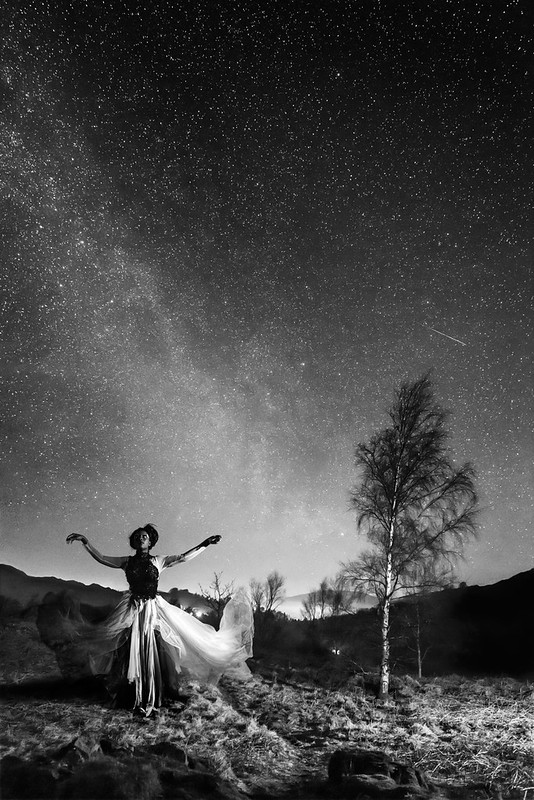
Night sky

fred2511

Suspended / Banned
Messages
423
Edit My Images
No
Hi , I really want to try to take a photo of the sky with a castle in the foreground and looking up at an angle were the structure of the castle can be seen 1/3 castle , 2/3 sky.
I have a Nikon D800 and thought about trying f.3.5 2000iso. 30 second
Anyone got any tip of how to get the stars sharp but maintaining the castle relatively sharp.
 
you have two options shoot both parts separately, not sure what lenses you have but for the stars shoot at iso 3200 at f2.8 30 seconds this should pull through a lot more stars and freeze them then expose for the castle. option 2 is the same but in the middle of the exposure try painting the castle with an of camera flash you might need to try this a few times
 
Trouble with a wide aperture will be that the sky won't look completely correct in terms of colour, Keep to a 30sec exposure but experiment with the aperture value until you get the results, try not to mess about with ISO too much as you'll get noise which can be avoided if you stick to the right exp length. I shoot all my night shots on 30sec, F/16 - F/22 (F/11 sometimes but not all the time) ISO 800 or lower and focus set to infinity.
Another thing you can do (this is what I do) - get yourself a hotshoe flash and a wireless trigger, if that castle is close enough, setup the flash to illuminate the castle during the exposure and possibly add a gel to the flash for some colour - in your situation I would possibly use 3 flashes with different gels on to get a colourful effect!
 
From you OP is suggests that you want static stars rather than star trails so you need to consider the below to ensure that you avoid trails..

Based on the fact that you are using a full frame camera there is something called the "600 rule" for getting an image without the stars starting to trail, this is quite basic but works well, taking the 600 and dividing that by your focal length in 35mm format that will give the number of seconds that you can expose for without star trails showing 600/50 this gives you a 12 second exposure to avoid trails

So let's say you need a 12 second exposure :thumbs: you then need to think about letting in enough light to pick everything up, now this is a balance of aperture and ISO, personally I never shoot wide open on the aperture when using a fast lens, most of my star images have been shot between f/3.5 and f/5.6 but for your instance if we stick to the f/2.8 aperture then you need to set the ISO to a high enough level to expose the scene without noise taking over the scene. It's all about striking up the right balance :thumbs: personally I'd use a shorter focal length to increase the time you can expose :thumbs:

It's difficult without being totally aware of the subject and and lighting that is on it to say exactly what settings will be best but going with the below should be of some assistance

now how to do it, if you need a time that is available in your cameras programmed shutter speeds then you can set up the exposure values in manual, and then set a shutter delay and press the shutter to then take a exposure 2-10 seconds after you've pressed the shutter giving the camera/tripod to avoid camera shake :thumbs:

Ideally the best solution however would be to use a wired or wireless trigger to fire the camera, there will be a counter on the camera to show how long your exposure has been if your using bulb :thumbs: but I don't think that you'd ever really need to use bulb as I cannot think of a time when you'd use a expousre longer than 30 seconds unless we start down the telescope and motor mount but that's a whole different ball game ;)


Matt
MWHCVT
 
For static stars... you don't want more than 20 seconds unless you are using a really wide lens (less than 20mm)... in which case maybe 30 seconds.

Because you are limited to such short times before trails start to appear, you need to shoot at very high ISO and wide apertures. I tend to use f4, as one stop down from max sharpens things up a little, yet is still fast enough. I shoot at ISO6400. With a D800 you'll be fine at that if you know what you're doing with noise reduction at the RAW stage.

Your real enemy is light pollution. Most light polluted places will just yeild an over exposed, orange sky with 30 secs, f4, ISO6400, so you may have to lower ISO, but then you'll get less stars.

You really need a dark sky to get the best results.

This was 20 secs, f4, ISO6400 with a D800... but it was well away from light pollution.
8596752874_917eacccc9_c.jpg
 
Dave, I must say that is a cracking image! Did you just use one flash to the right?
 
I did indeed.

Cheers.
 
I captured this recently, using a D60 30 sec exposure and I light painted the ruins.

476818_557158424329506_1632206875_o.jpg


Obviously I don't have many stars about, but using a higher ISO with a darker sky would do the job.
 
Last edited:
It looks like the sun hasn't even set yet! :)
 
Back
Top