night shot settings - Canon 600D

mikebeecham

Suspended / Banned
Messages
212
Name
Mike
Edit My Images
No
Hi guys,

I was out earlier this evening trying to take some shots of the stars, see if I could get something decent of the night sky. I tried to set my camera to let in as much light as I could, set it on a tripod and used a remote.

The shots came out with decent light, but didn't really pick up stars... The sky was just a lot brighter. When I checked around the internet I found a post that suggested settings of iso400, around f2.8 for 12 seconds when using a 50mm lens.

However, how do I time 12 seconds? Is this a setting in the camera, or do I hold the shutter in for this length of time, or do I need to do something else?

The shot I'm looking for is a nice dark sky, with lots of really nice stars... Maybe even the milky way if I'm lucky.

Can anyone help?
 
It really depends on the lens that your using and to an extend the direction that your facing as to the length of the exposure you can get away with...

On your camera a 50mm lens (eqv. of 80mm), now there is something called the 600 rule for getting an image without the stars starting to trail, this is quite basic but works well, taking the 600 and dividing that by your focal length in 35mm format that will give the number of seconds that you can expose for without star trails showing 600/80 this gives you a 7.5 second exposure to avoid trails

So let's say you need a 7.5 second exposure (round it up to 8 to be easy :thumbs: you then need to thing about letting in enough light to pick everything up, now this is a balance of aperture and ISO, personally I never shoot wide open on the aperture when using a fast lens, most of my star images have been shot between f/3.5 and f/5.6 but for your instance if we stick to the f/2.8 aperture then you need to set the ISO to a high enough level to expose the scene without noise taking over the scene. It's all about striking up the right balance :thumbs: personally I'd use a shorter focal length to increase the time you can expose :thumbs:

now how to do it, if you need a time that is available in your cameras programmed shutter speeds then you can set up the exposure values in manual, and then set a shutter delay and press the shutter to then take a exposure 2-10 seconds after you've pressed the shutter giving the camera/tripod to avoid camera shake :thumbs:

Ideally the best solution however would be to use a wired or wireless trigger to fire the camera, there will be a counter on the camera to show how long your exposure has been if your using bulb :thumbs: but I don't think that you'd ever really need to use bulb as I cannot think of a time when you'd use a expousre longer than 30 seconds unless we start down the telescope and motor mount but that's a whole different ball game ;)

Matt
MWHCVT
 
It really depends on the lens that your using and to an extend the direction that your facing as to the length of the exposure you can get away with...

On your camera a 50mm lens (eqv. of 80mm), now there is something called the 600 rule for getting an image without the stars starting to trail, this is quite basic but works well, taking the 600 and dividing that by your focal length in 35mm format that will give the number of seconds that you can expose for without star trails showing 600/80 this gives you a 7.5 second exposure to avoid trails

So let's say you need a 7.5 second exposure (round it up to 8 to be easy :thumbs: you then need to thing about letting in enough light to pick everything up, now this is a balance of aperture and ISO, personally I never shoot wide open on the aperture when using a fast lens, most of my star images have been shot between f/3.5 and f/5.6 but for your instance if we stick to the f/2.8 aperture then you need to set the ISO to a high enough level to expose the scene without noise taking over the scene. It's all about striking up the right balance :thumbs: personally I'd use a shorter focal length to increase the time you can expose :thumbs:

now how to do it, if you need a time that is available in your cameras programmed shutter speeds then you can set up the exposure values in manual, and then set a shutter delay and press the shutter to then take a exposure 2-10 seconds after you've pressed the shutter giving the camera/tripod to avoid camera shake :thumbs:

Ideally the best solution however would be to use a wired or wireless trigger to fire the camera, there will be a counter on the camera to show how long your exposure has been if your using bulb :thumbs: but I don't think that you'd ever really need to use bulb as I cannot think of a time when you'd use a expousre longer than 30 seconds unless we start down the telescope and motor mount but that's a whole different ball game ;)

Matt
MWHCVT

wow, what a incredible explanation. That explained a lot. Help me learn. Thank you
 
If you are getting a light sky with no stars you are either overexposing, or there is too much light pollution where you are.
 
If you are getting a light sky with no stars you are either overexposing, or there is too much light pollution where you are.

I think it's going to be a combination of lacking experience and light pollution. Fortunately, I'm surrounded by lots of gorgeous countryside and hills away from towns, so I'm going to wait until the next clear night, then take a drive with my camera and tripod!
 
It really depends on the lens that your using and to an extend the direction that your facing as to the length of the exposure you can get away with...

On your camera a 50mm lens (eqv. of 80mm), now there is something called the 600 rule for getting an image without the stars starting to trail, this is quite basic but works well, taking the 600 and dividing that by your focal length in 35mm format that will give the number of seconds that you can expose for without star trails showing 600/80 this gives you a 7.5 second exposure to avoid trails

So let's say you need a 7.5 second exposure (round it up to 8 to be easy :thumbs: you then need to thing about letting in enough light to pick everything up, now this is a balance of aperture and ISO, personally I never shoot wide open on the aperture when using a fast lens, most of my star images have been shot between f/3.5 and f/5.6 but for your instance if we stick to the f/2.8 aperture then you need to set the ISO to a high enough level to expose the scene without noise taking over the scene. It's all about striking up the right balance :thumbs: personally I'd use a shorter focal length to increase the time you can expose :thumbs:

now how to do it, if you need a time that is available in your cameras programmed shutter speeds then you can set up the exposure values in manual, and then set a shutter delay and press the shutter to then take a exposure 2-10 seconds after you've pressed the shutter giving the camera/tripod to avoid camera shake :thumbs:

Ideally the best solution however would be to use a wired or wireless trigger to fire the camera, there will be a counter on the camera to show how long your exposure has been if your using bulb :thumbs: but I don't think that you'd ever really need to use bulb as I cannot think of a time when you'd use a expousre longer than 30 seconds unless we start down the telescope and motor mount but that's a whole different ball game ;)

Matt
MWHCVT

That's a wonderful explanation. Thankyou
 
The shot I'm looking for is a nice dark sky, with lots of really nice stars... Maybe even the milky way if I'm lucky.

Can anyone help?

Yes.. to get that you absolutely need to get away from light pollution. If all your getting is bright skies, then that's why. Also.. was there a moon in the sky? That will cause you problems too.. the sky will eventually just go blue and look like daylight if there is a bright moon. If your skies are going orange, it will be light pollution.

Can you post up an example of your images you are not happy with so I can advise further?
 
So...it was a beautiful night out and, equipped with a bit more understanding, I went outside the village to shoot!

Apart from the fact that there was still way too much light pollution bleeding through, I found that the stars it did pick up we're slightly blurry.

So, this is where I come across as a complete novice and ask how you can effectively focus on the sky and your subject, in the middle of nowhere, in the pitch black and not able to see anything?

I set my camera to 400iso, around f2.8 and shot for around 8 seconds on bulb. I was using my 50mm f1.4 USM prime lens.

Any thoughts?
 
If the sky is the subject then in daylight focus on a object that is at "infinty" and note where the lens is set. Then at night use manual focus and adjust the lens to the same position.

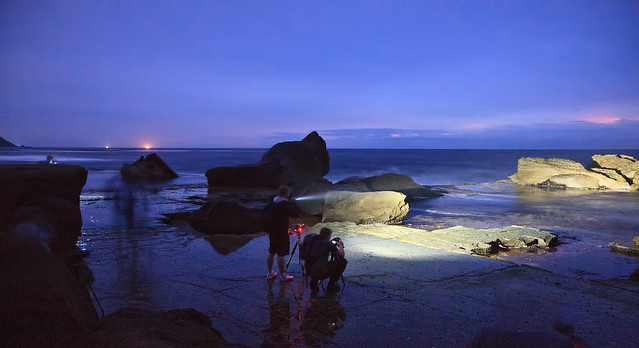
If the sky is not your subject you can do what these guys are doing by using a torch to illuminate the subject when focussing, as well as possibly do a bit of light painting if you want to.
Shot before sunrise. 5 seconds, f5.6, ISO 3200


The photographers. (1) by dicktay2000, on Flickr
 
Last edited:
Back
Top