Beginner Night shot help

Sqwelchy

Suspended / Banned
Messages
35
Name
Darren
Edit My Images
Yes
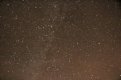
So I went out in the garden last night to try my luck at getting the milky way, just having a mess around so I wasn't expecting anything amazing.

How the hell does everyone focus their lenses? My camera wouldn't take a long exposure if it was set to AF. Using the standard 15-55mm lens that came with my kit

And what shutter speed is best etc. Just won't as much info I can to get that perfect beginners picture.
 
I have only trird this a cpouple of times.
Manual focus.
I focus on something at infinty during the daytime and note where that is on the lens.
Then at night I just turn the lans to that focus distance.
With some lenses the infinity focus marking is correct.

I use the "500" rule for no star trails if possible.

http://petapixel.com/2015/01/06/avoid-star-trails-following-500-rule/

Generaly speaking you will need fastish lenses (f2 or f2.8) and very high ISO values (3200+). I shoot RAW and do some noise reduction when post processing.
 
Last edited:
Hiya Darren, as Richard said above, you need to apply the '500 rule' but on a crop body it becomes the '350 rule' :D I'm guessing you mean an 18-55 kit lens not 15-55? :confused: If so divide 350 by 18 = this gives you a shutter speed of 19 seconds but you can just about get away with 20 ;). Aperture needs to be wide open, f3.5? on your lens and focus on something on the ground say around 50 ft away, at that distance even at f3.5 every thing beyond should be acceptable :) ISO will need to be around 4000/5000 because not being able to open the aperture to 2.8 will loose you 2/3rds of a stop and, as above, shoot in raw ( I actually shoot in both)

As for how to get a focus point in the dark,there's a few ways but I usually zoom up to 55mm, then light someone/thing up with a good torch, then manual focus, when you come back to 18mm the focus is still the same (remember to leave the camera/lens in manual focal)

Hope that helps, one thing I will say, it's easier for me to show someone than it is for me to try explain it in a forum! :D
 
One other thing to add is that you may well struggle in the back garden die to light pollution, ideally you need to be in a dark zone to get the best shots.
 
Focus wise if you use live view and then zoom in electronically you can manual focus to see the stars at their sharpest. To minimise movement as well as being on the tripod use mirror lock up and a cable release. If you don't have a cable or remote you can use the self timer to operate the shutter. If you've got a fast wide lens that would help but it's not an absolute must, just use the widest setting that is available to you.
 
Good advice above. I apply the 500 rule by including the crop factor in the calculation -

Max exposure in seconds = 500/(focal length of lens x crop factor), but the result is not much different to Phil-D's method.

Probably more than than anything else that will help a shot of stars and the Milky Way is, as Snerkler has noted, a really dark sky.

The shot that includes the Milky Way (no where near as good as many on here) I posted in this thread - https://www.talkphotography.co.uk/threads/a-couple-from-the-lights-last-night.604778/#post-7081096 was with the kit lens at 18mm, f3.5 (widest the lens will go), 20 seconds and an ISO of 12,800. However, it was very dark,. The nearest light I could identify was the obscured glow from a lighthouse 12 miles away.

A good source of information about the sky is Stellarium which is free.

Dave
 
Last edited:
That's alot to take in :confused: haha but thank you everyone:D. Will get a few trail shots in before next week, might have to write settings down so I remember. Just hope it's decent weather.

And yes I did mean 18-55 lol
 
Don't know what your setting were, Darren but given this is probably your first attempt, it is not bad.

There is a fair bit of noise but I don't know your setup up or settings. There is light pollution but the stars are points.

I'm nowhere an authority on star photos but, like most other things, a lot of practice is involved; and for star shots, a dark sky.

If you have to travel far to get a good sky make sure you have something warm to wear, some where to sit, a head torch, with a red light if possible, and if you have any, a pair of binoculars.

Dave
 
It was F5 iOS 6400 and shutter was 14 seconds. Just found out how to view camera info, got a lot of road works going on around me at the minute. Need to look at at noise reduction, not set up photoshop yet so cannot adjust things
 
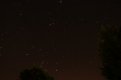
Also got this one. Again just messing around with things getting used to it
 

Attachments

  • 20151012001918_IMG_0031.JPG
    20151012001918_IMG_0031.JPG
    31 KB · Views: 24
Darren, it does look a little soft? did you have the lens switched to AF, I'm wondering if it was hunting and not actually focus on anything.......:thinking:.....although if that was the case, you would have had to switch AF off for it to fire :confused:

What camera you using and what is the focal length of the shot above?....unsure but it looks more like 55mm end than 18

Also, you can set the WB manually to counter act some of the light pollution, I'm usually around 3330K, but if you shoot raw you can alter it in post :)
 
Canon 750d, don't know why but I had to switch it from AF and then to MF to fire. Carnt remember what focal length, was just messing around to see what I could get.
 
Canon 750d, don't know why but I had to switch it from AF and then to MF to fire. Carnt remember what focal length, was just messing around to see what I could get.

That probably explains why it looks soft, the lens was hunting because it couldn't focus and why you had to switch to manual to get it to fire. The more you practise the easier it gets, things will just start to fall into place (y)

This shot was taken so I could use the sky in another shot ( I've been leaning to use layers in E11) . The focus point was somewhere around the rocks, but it shows that you don't need to focus on the stars for them to look sharp :)

Just to explain why I did this, I know that when I spin an orb it takes me between 25 to 30 seconds, meaning that any stars in shot have started to trail. I wanted to be able to take the two shot seperately, them merge them using layers in E11 (something I've only just learned to do) the result is the 2nd image below

Focal Length 17mm
15 seconds
f2.8
ISO 1000

starry sky layer by Phil D, on Flickr

Blue orb by Phil D, on Flickr
 
Cheers guys, sucking it all in like a sponge. Hoping to get up to hound tor next week so hopefully all this info will pay off:)
 
Here is an example shot without a lot of light polution, except for a couple of shooting stars.
20 secs @f2.8 (wide open) and ISO 6400. Olympus compact system camera. Manual focus in "live view" (there is no optical viefinder on that camera).
A tripod and remote release was used.


Uploaded for a thread. by Richard Taylor, on Flickr
 
Last edited:
Great info.

Just about to order a remote for my Canon 60D and after having a half hearted attempt at last weeks fireworks I am determined to get some more long exposure night time experience when we get a clear night.

Must investigate the "mirror lock" capabilities, not heard of that before.
 
Back
Top