Newbie question: Sharpness on film photos

chrisfowler

Suspended / Banned
Messages
85
Name
Chris
Edit My Images
No
Apologies if this is a stupid question but I'm interested in how other film photographers obtain such amazingly sharp images.

Assuming accurate exposure, then obviously the quality of the lens is important, but how much do the camera and film impact sharpness/quality of image?

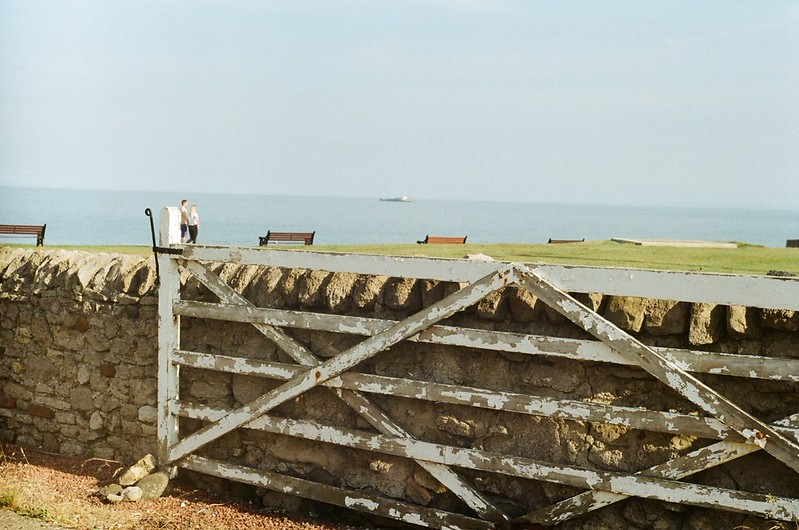
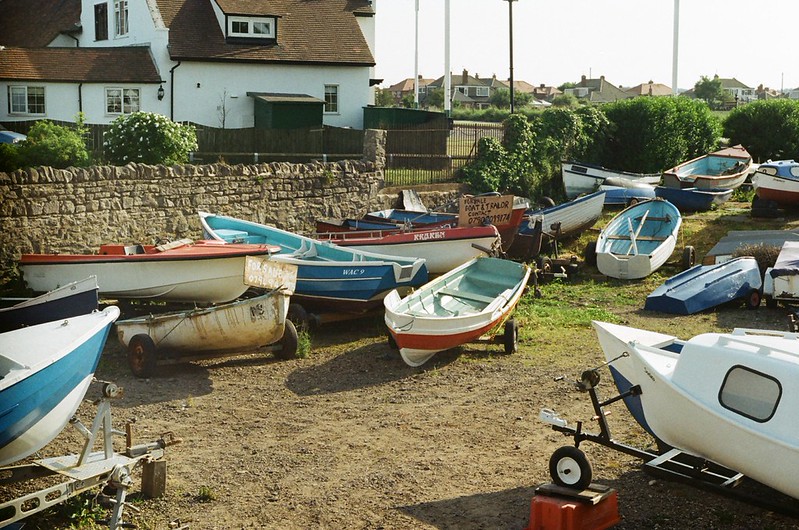
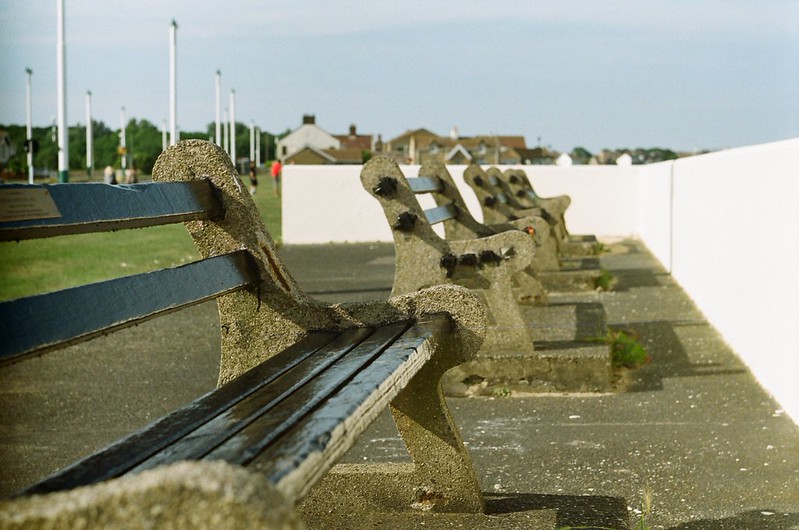
I'm using a Zenit E and Helios 44m lens, with Kodak Colormax 200 film and getting the following results:

9300491841_cbceb0c260_c.jpg


9300489819_c725120ce6_c.jpg


9303266730_1d24dc8a2d_c.jpg


So what process should I follow to improve the quality of my shots? Better film? better lens or is the camera producing the 'lomo' look? I know I'm not using a £3000 camera but I'm a little unsure of how to proceed....
 
Last edited:
The Helios lens is well regarded & I took some nice photos with one. Almost 30 years ago now.

What shutter speed were you shooting at? The Helios probably performs best stopped down a couple of stops & unless you have rock steady hands, a shutter speed below 1/60th of a second could bring in an element of camera shake which will affect sharpness. There is a rule for hand holding that the shutter speed shouldn't be below the focal length of the lens being used (VR lenses aside). A 44mm lens at 1/60th. a 200mm lens at 1/250th & so on.

I am not a fan of the cheaper Kodak films. The just seem brown & muddy to me. For cheaper films I prefer Fuji. The reds & greens are nicer. Do like your middle picture though.
 
Tbh, the main weak link with most analogue photography is the digitisation of the negatives.

Very true as well. There is something to be said for slide film which you can see without a scanner in the way.
 
With that lens you should be getting near to a VG DSLr with a good kit lens, but although the sharpness of the detail is on the film the problem is getting it off cheaply by a scanner, supermarket's and home scanners cannot do the job at best..but it's not all gloom as you can get scans good enough for 10 X 12" print with 35mm and for a computer screen and forums it's very easy as most forums will only accept shots equivalent of about a 2MP digital camera.
The sharpness of your shots is good and and the film is usually the last thing to suspect if you are unhappy with the sharpness...but you can use programs like Photoshop to sharpen more but you have to be careful as an over sharpened shot looks terrible.
 
Last edited:
They seem plenty sharp to me. As others have said it is a more than adequate lens.
 
They look pretty sharp to me also, I thik you need to take on board with film folk took a lot of shots to get that great shot, going out and shooting just a few shots its a low sample. Its a passion film not the seeking of perfection, digital full frame will give that in spades.
 
Thanks for the comments - the images above are some better examples, the entire roll of film is here: http://www.flickr.com/photos/45664764@N00/sets/72157634671138090/ although I did snap the film getting it out of the camera so the last ones were ruined....

I'm interested in the impact of film, camera and lens on the final shot - DNH's comments are the sort of thing I'm interested in, in fact I've picked up some Fuji Superior 200 to try as I wondered if the colour was a Kodak 'feature'.

In regards to seeking perfection - I have a DLSR for that! I just want to know I'm getting the best out of the kit I've chosen :)
 
TBH I don't think the Helios lenses were ever particularly ever highly regarded, they were budget lenses supplied with budget cameras and somehow have obtained some sort of cult status.

Don't get me wrong, they have their own look and feel and I had the classic Russian combination of the Zenit ~E~ and Helios 44-2 58mm f2 lens and produced some acceptable shots but the difference between that and my next camera, the OM1 and basic 50mm lens is like somebody had polished the world.

The Helios lenses are quirky, fun and can produce some great images but they're not now nor ever have been what would be considered a quality lens. If you want to get the best from film photography on a consistent basis you need to be using decent lenses, quality film and reliable processing.
 
TBH I don't think the Helios lenses were ever particularly ever highly regarded, they were budget lenses supplied with budget cameras and somehow have obtained some sort of cult status.

Don't get me wrong, they have their own look and feel and I had the classic Russian combination of the Zenit ~E~ and Helios 44-2 58mm f2 lens and produced some acceptable shots but the difference between that and my next camera, the OM1 and basic 50mm lens is like somebody had polished the world.

The Helios lenses are quirky, fun and can produce some great images but they're not now nor ever have been what would be considered a quality lens. If you want to get the best from film photography on a consistent basis you need to be using decent lenses, quality film and reliable processing.

Huh! You go to other forums and seen the shots from Helios lenses for sharpness, of course there are copy variations, but anyway I've found that with the lens stopped down it's difficult to see the difference from many nifty fifty lenses (for sharpness) even my Centon 50mm F1.7 stopped down looks sharp :lol: and the difference between the cheaper and expensive lenses are usually they are faster lenses and much better when used wide open. :shrug:
 
Experience tells me that they are adequate at best, yes if the conditions are right and a favourable wind you'll obtain some acceptable shots, maybe even some great shots but if you compare the output of a Helios with a standard Nikon or Olympus lens from the same era the Helios just won't stack up.
 
My Daughter has been using my Zenith EM, with Helios 44 to cut her teeth on. As said its not a 44mm lens, nor a 50mm, its a 58mm. One of its quirks.... but there you go.
It' isn't the 'best' big of glass in M42 fit; best bit of M42 Glass I possess is a Ziess Jena 50... its just 'nice', but seriously, you would be hard pressed to tell from two identical crop photo;s which had been used in a standard sized print, let alone re-processed digital scan.

Zenith E. Now. My ME has a fake selenium cell in the pentaprism, but no actual meter. Have to meter with hand held Leningrad to get Exposure values then set them on the camera.

I have read a couple of reviews of the variouse Zeniths and they seem to comflict; some suggesting that they have others suggesting they don't have integral meter, some suggesting that its completely uncoupled and simply provides an EV others that its coupled and provides swing-needle over or under expose indication.

What you actually got? What you using.

There doesn't seem to be much wrong with them shots; and if you'd told me they were taken with your Cannon, I'd not have seen much to query it. But they do seem a tad 'bright' and you might have over exposed a tad.

My Zenith only has five shutter speeds from 30th to 500th and Bulb, and the Helios, apertures from f2 to f11 in half stop increments, & a full stop increment to f16.. another quirk I suppose.... so its a bit course on exposure control, but not much more course than other manual focus era cameras.

You might get slightly better results, though thinking about how you meter, and possibly bracketing to find what works best with that lens and film combination.

Otherwise; next Q; where did the scans come from?

Daughter's films were Developed & Printed at ASDA and put straight on disc by them.

Mini-Lab prints, it seems are now often made digitally, rather than optically; the film is developed, then the negative scanned, and the print made from the digi-file not shining light through the neg. Ie they are not as great quality as optical prints of yore, while the scan-files they made them from are not that high resolution. Scans I make at home from my ancient archive of negs are about 5,200 x 3,400 pix aprox 17Mpix. The Mini-Lab scans are 1850 x 1232 aprox 2.5Mpix.....

Zenith mat be a low-tech, low rent SLR.. but its still a full frame camera, with reletively good quality film, and 'prime' optics that ought to be at least as good as most modern kit zooms.....

But you are NEVER going to see what its really capable of, if what you are looking at has been dummed down to the lowest possible 'acceptable quality level'.... that is worse than you get from most micro-sensor pocket compacts or even a ruddy phone-cam!

I have been experimenting lately with Digitising techniques.... and it JUST SO HAPPENS, and it is pure co-incidence, these snaps I have been playing with, were taken ooooh.... 1992ish, 20+years back anyway... on that same Zenith ME & Helios 44. I acquired it in a box of camera 'stuff' that included a couple of interesting M42 lenses I actually wanted and at the time, My Grandad was suffering Glycoma and struggling with his old Kodak Retinette range-finders tiny view-finder. One of the Zenith's few strengths was large bright viewfinder... so I gave it to My Grandad, and when I went motorbike racing... he brought it along and took THIS snap of me. (I'm the fella behind!)

7-2-2013_321.jpg


That's the pic he got, full-frame; standing behind the spectator fences; scanned originally 5184 x 3360, 16bit, on pretty low-rent web-cam-scanner; re-sized for web, to 800x500. (15% original size)

7-2-2013_321b.jpg


That's a crop taken from the web-cam-scan; at 800x500, so no reduction.

OK... now THIS is slightly 'off' on exposure; but the same crop (near enough) taken on my Nikon D3200, lenseless; laid on its back under my old print enlarger. BIT of a ball-ache process. I had to put it on a view-lead to TV to see what the camera was getting and focus the enlarger on the sensor, and then guestimate exposure, while keeping stray light from between enlarger and camera with a black jacket! And 'guesstimate' exposures! So it is a TAD 'off' on exposure... but here you go....

dsc_00183.jpg

Image came off camera 6000x4000 and is re-sized for web display, 800x500.

But THIS is what you get if you take an unshrunk crop from the full size camera-scan.

dsc_0018b.jpg


That's the level of detail on the film; in that high-magnification crop, you are looking at the actual silver halide chrystal 'grain' in the film emulsion.

That is 15% of the 6000x4000 pixel image, itself barely 15% of what was cought on the full-frame of film... that's something over 200x magnification, and you are STILL seeing detail.

800 pixels by 500 pixels... flash that out to the full 35mm frame, you get something over 18,000 x 11,000 pixels or near enough 200MPix.

Your mini-lab 1850x1232pix scan, then, has just ONE pixel covering an area of the image, my high-res crop is has a 10x10 pixel square. And that's BEFORE you shrink that to web-res, we see, when every four pixels in your scan gets reduced to one.....

dsc_00184.jpg

crop, sized to pixilate as a mini-lab scan....

dsc_0018d.jpg

And again, sized & re-sized to pixilate at web-res.

Yup... my helmet in that 200x magnification crop is a BIT fluffy.... but by HECK do you have to enlarge the thing a hell of a long way before you can tell!

A LONG way. To a resolution FAR higher than most modern full-frame DSLR's can deliver!

So what process should I follow to improve the quality of my shots? Better film? better lens or is the camera producing the 'lomo' look? I know I'm not using a £3000 camera but I'm a little unsure of how to proceed....

There doesn't look to be anything wrong with the quality of your shots.

You might like to think a bit about exposure, as said, I have no idea what metering method you are using, and the Zenith is a bit 'coarse'.... but other wise.... they look sharp enough, and if there is anything that could be improved before you need think about the camera's limitations, its digitising the image. There is just SO much more detail 'in the neg' that you will struggle to get off it without seriousely high quality scanning.

In regards to seeking perfection - I have a DLSR for that!

Hmmm..... MIGHT just want to re-think that comment!

Film may be old hat; BUT.... dispite claims to the contrary, I do NOT believe that Digital has yet 'matched' the IQ that may be obtained in Halide.

Seriously, look at the crops. That old Helios and Zenith is resolving 10x the detail of even 'good' full frame digital cameras.... And this is this is the 'small' sensor of the film camera world! 36x24mm! You want really high resolution images; you have 120 roll film putting it on 60mm of film, or cut sheet putting it over 120mm!

AND every time you take a new picture? You are using a brand new clean sensor!
 
Last edited:
Experience tells me that they are adequate at best, yes if the conditions are right and a favourable wind you'll obtain some acceptable shots, maybe even some great shots but if you compare the output of a Helios with a standard Nikon or Olympus lens from the same era the Helios just won't stack up.


The Helios lenses (and others) are copies of Zeiss lenses when they captured factories and personnel in WW2.....with Russian mass production the quality would vary and maybe you have bad copies, but my 44-2 and 44m are very good.
The Helios lens is a Zeiss Biotar clone
 
Last edited:
Mike - Thanks for the informative response! It's prompted me to go back and look at some other things - I had the above photos scanned at Snappy Snaps and some previous ones scanned at Tesco. The SS scans are double the resolution of the the Tesco scans! Most of the shots above were taken at around f11 and 1/500, which was accurate based on the Zenit's light meter - perhaps I will try an external light meter to compare. I also hadn't really considered the whole image quality difference between film and digital - my assumption was that my ability to render much sharper images digitally was a result of the camera, when perhaps it's a result of the automatic settings for exposure coupled with a higher quality optic.

In regards to lenses - from the discussion above it's clear the Helios debate polarises opinion, is there an affordable alternative in m42 that people prefer? I've ordered another Zenit, which supports auto aperture to allow me to use a wider selection of m42 lenses, so I'm shopping for an appropriate lens now...
 
Asahi 50mm f/1.4 Super Takumar has a very good reputation, they seem to sell for £40-80 on a well known auction site.
 
If you can, put your Helios lens on your digital camera and check it out.
 
If you can, put your Helios lens on your digital camera and check it out.

Yep the Helios is amazingly sharp on the DSLR, even hand held and indoor light. Much sharper than I get on a comparable shot on the Zenit. That could be down to my focusing though - on the DSLR I'm able to use live view to focus!
 
If its sharp on the dslr then your problems probably lie either with the body, mount not square, film not quite in the correct place, prism out of place, eye for manual focus not so well attuned or with scanning, poor scanning, curly film, broken scanner, scanner holder used incorrectly.

The medium itself can record as sharp an image as is passed by the rest lens/body and well scanned can return as much quality as the scanner can record.
 
Yep the Helios is amazingly sharp on the DSLR, even hand held and indoor light. Much sharper than I get on a comparable shot on the Zenit. That could be down to my focusing though - on the DSLR I'm able to use live view to focus!

Ok that eliminates the lens......so using film, it's camera shake or scanning, unless your Zenit is only firing at slow speeds.
 
The shutter speed on the camera seems fine so it's likely a combination of focus, shake and/or scanning. I'll keep up the practice and perhaps think about buying a scanner of my own to play with :)
 
Have you compared the meter in the Zenit to the one in your DSLR for accuracy? 1/500th & F11 seems a bit short to me for two of the scenes given the amount of darker areas in them which you want to be able to see clearly. Hard to say though as I wasn't there admittedly.

The Zenit E meter is about as unsophisticated as camera meters get. No TTL & easily influenced by a bright sky. When I was using my EM I got a little Gossen Sixtino handheld meter to go with it. Gave the option to take incident light readings which were more accurate. The other thing I used to do was to get the Zenit quite close to the main part of the image & see what the reading for the light reflecting off it was & use that.

As a test it is sunny where I am & I have taken a reading off of a brick wall opposite that has the sun shining on it & it is telling me that it wants 1/125th at F11 with ASA 200 film. The last film through the camera was slide which came out OK so I am confident that the meter is accurate.

If your negatives are under exposed then that will affect the quality of the scans from them.
 
You could try process and scan from Photo Express in Hull (see sticky in this forum), £4 per film scanning at 2000 dpi for TP members, plus £1 postage (but you pay the postage to Hull). I hate scanning negative film as the orange colour of the substrate makes getting accurate colour difficult in many cases, and I don't really know how to do colour correction! BW and transparency I'm very happy to scan...
 
Once again I am going to say I think your pictures on the origonal post are very very good.
I wonder if you are just maybe just having a slight exposure issue ad David above says, but for me they are very good pictures for the 35mm format.
 
I also hadn't really considered the whole image quality difference between film and digital - my assumption was that my ability to render much sharper images digitally was a result of the camera, when perhaps it's a result of the automatic settings for exposure coupled with a higher quality optic.
The assumptions & presumtions are... well... this is the Film & Conventional board, so comment on topic is likely not unbiased... BUT.
Idea that Digital, because its 'new' has to be 'better' and that 'better' must mean higher quality.... its shakey ground... shakey ground in deed!
Scans above; show, that Digital is still not resolving the level of detail that 'might' be captured on silver halide.
And the test neg? Well, if you look at the full frame scan, there's a little bit of damp damage in the sky in top corner; its twenty years old and degraded.
Subject is pretty big in the frame; it was taken with a standard lens, from a distance; And I have no idea what settings he was using, or if it was wondefully focused to start with!
Blurr in the wheel spokes suggests he was probably using a lower shutter speed, maybe 60th, so the milkiness around my hat in the 200x crop, could just be motion blur... so the negative probably isn't showing the 'best' film could do to start with.
And THEN we might start debating the metering, or the clarity of the optics or the rigidity of the camera chassis!
OK, lets do that; Lets start with chassis rigidity.
That old Zenith... well, mine's referred to affectionately as 'The BRICK'... it's a bit of HEAVY METAL, dude! Might have been critasised for being a little crude, unrefined and lacking sophistication, BUT every-one admitted it was a SOLID bit of kit! (Popular choice for the more... 'Robust' teenage boys birthday present!)
Shear weight, damps vibration. Works in cars, doesn't it? Luxuary cars tend to be heavier... more 'mass' in the 'body' the more it resists shake and movement from the wheels or engine... Force = Mass x Aceleration. More mass you got, more force you have to have to get anything to shift. Simple physics... but effective.
Heavy body then, anything moving inside it... mirror, shutter, aperture... less advantage its moving has to make the body shift or shake.
Moving on. M42 screw lenses. Very fine thread, round a relatively big 'diameter'. Connecting lens to body then, you are squashing quite a big area of metal against metal, and can make a pretty 'tight' and rigid connection between the two.. you are litterally bolting them together.
More 'sophisticated' cameras usually use 'bayonet' type mountings. usually just three TINT little tangs that slot into ramped slots to tighten the lens against the body. Its basically just 'wedged' in place!
I used to use OM10's... and on one, with a particularly worn aluminium bayonet mount, I could actually 'waggle' the lens and see a half mm gap beween mount flanges! Whats that going to allow when the camera shakes a bit?!
M42 screw? When worn? Well, the thread just takes a tiny bit more turn to tighten up.... Its a very 'solid' mounting system.
Onto the lens optics. We are talking M42, and hence for the most part we are talking 'prime' fixed focal length lenses... 'fixed' well that suggests a little more solidity for a start. We only have one 'movement' inside the lens body; the focal length is restrained by the body, the only thing we alter, and by a small amount is the focus.
This means that the lens can be a lot simpler in design and construction; you might only have one glass lens element, and you only need a very short 'screw' adjustment to alter fine focus distance of it. The lens can be made a lot more cheaply, and accurately, and rigid... purely because its so 'simple'.
'Zoom' variable focal length lens; you have to have at least two movements, one to vary the focal length, one adjust fine focus. Imedietly its double the complexity; and more difficult to make as cheaply or as accuratly or as rigid. start layering up complexity, using multi-element lenses, and moving more than one of them about inside the body to effect focal length changes... you start multiplying the tolerences, and exponentially; so that the lens HAS to be more expensive, less rigid and less accurate.
Back to that OM10... worst case scenario; I had a worn 'one touch' zoom lens on it; multi-element design, and 'one' control ring to change fine focus and focal length; push-pull for zoom, twist for focus... GOD that thing was 'sloppy'... Honestly, I could have used the thing as a shift lens there was so much movement between film plane and front element!
Worst case, for illustration, but you get the idea.....
Modern Digital cameras, have inherited an awful lot of 'sophistication' from film cameras, and with them an awful lot of inherent 'compromises' to ultimate Image Quality.
The low rent, Russian made Zenith and Helios.... cheap it may have been... NASTY it was NOT.
Back to basics, simplicity, removed an awful lot of the compromises of higher end cameras, and so offered potentially HIGHER ultimate IQ than you were likely to get with significantly 'better' cameras.
The OM10 might have been able to offer much more refined exposure control; its lens offering 1/3 stop increments between aperture f-stops, its electronically controlled curtain shutter, offering a wider range of shutter speeds, again, with possibly 1/3 stop increments between them, giving 7 possible aperture/shutter combinations, between full stops, where the Zenith only offered 1.... this degree of instrument accuracy, is all very well and good, and may be quite 'nice' to have.... but if the ruddy lens isn't in focus, or the front element is going to de-focus the picture twice... once when the shutter releases the opening curtain, then again when it releases the closing curtain... having a picture that is '1/8th' of a stop closer to perfect exposure means bog all really! And only of much use IF that 1/8th stop difference is any use!
320948_545696542121934_1088888062_n.jpg

Little montage of the same shot taken on the Nikon, this winter, trying to explain 'Exposure Compensation' and the 18% Grey meter presumption to one of my kids.
If you have pointed camera at a less than usual subject, in this case 'snow', which is near 100% white, not 18% grey, the camera don't know that!
More sophisticated camera's metering system; and here it was that in one of the latest Nikon DSLR's.... STILL presumed what it was pointed at was 18% grey, and so tried to under expose, probably one, one and a half stops.
OM10, would have done just the same, with its state of the art (30 years ago) coupled, Through The Lens Meter Auto-Exposure.
Zenith? Using through the lens selenium cell, or hand held Leningrad... STILL would have made same mistake.

So, even within Manual-Focus era film cameras; there are a lot of variables, and the biggest difference is YOU... the camera user.

Bottom line, at the end of the day, the camera is merely a light tight box with a hole in the front, and something 'photo-sensitive' in the back.
You point it; you know what you are pointing it at. You should know how it works.

And if you do? Well, little searching on here I'm sure and you'll find 'pin-hole' photos taken without even a lens that are pretty damn sharp and well exposed.

Having a lens then just widens the range of situations you might get a sharp picture in... IF you know how to use it.... increases your chances of getting a 'better' picture. Good Photos are taken by GOOD photographers, NOT good cameras.

And 'good' is subjective, and very different from 'sophisticated'.

Snow-shot shows; very very 'sophisticated', incredibly accurate and refined Nikon 3d-Matrix Metering system.... metered that snow shot with an incredible degree of accuracy and set the aperture and shutter speeds very very precisely..... WRONG! Because it was STILL basing all its calculations on an errant PRESUMPTION what it was looking at, on average was 18% grey.

Modern Digital Cameras... look at them. Lightweight. Often plastic chassis. Bayonet mount lenses. And incredibly complex Zoom lenses with how many elements inside? And Motor Driven! And how much do they cost?

In 1982, the Olympus OM10, with standard 50mm lens came as a 'kit' I recall for about £100.

I bought my Nikon D3200 this Christmas (2013) for £350, with 'kit' 18-55 zoom.

Both middle market, 'Entry' level SLR cameras from the different eras, seperated by about 30 years; £100 for the Olly, represented 'about' a month of the eras 'average wage'. The Nikon, now, represents 'about' 1/3 of a months modern average wage. So reletively speaking the Nikon is about 1/3 the 'cost' of the Olympus.

Yes, technology and manufacturing technology and consumer expectations have moved on a lot. But.... to pack THAT much compexity and sophistication into a camera THAT price... the compromises are going to be tough. And whats going to give?

They are not going to take out the 'sales features' of auto-focus or a zoom lens, that buyers 'expect' from a modern camera, are they?

Only way to get the costs down to market expectation is to sacrifice ultimate IQ.

And... 12-16Mpix. If that is still twice or four times the resolution that people are going to 'accept' for screen or web-display, or what a mini-lab will use to make album sized prints from? Not MUCH point in being so BOTHERED about it!

Yup; shift up and up the market, and Digital cameras do get better; BUT. its increments of 'better' and at a cost far out of proportion to the gains.

Film era. The image sensor; the resolution was deturmined as much as anything by the film you put in the camera. Mentioned it before... a 'fresh' sensor every shot....

Cameras were still made down to a price; but the technology of the era meant that they was less opportunity for them to add sophistication, so cost optimums were found through simplicity, WHICH almost by accident, could offer quality gains!

Which brings us back full circle.

Zenith has no 'image sensor'. It can offer a resolution as high as the grade of film you stick init. Then the simple, rugged, robust construction offers a lot of advantages to help give you very good potential IQ, and potentially a LOT higher than you could get with a modern Digital SLR. Sure the Digital SLR will make it a lot easier..... and not having to buy a new film every thirty or so shots, makes it a lot cheaper to run... BUT... its a good photographer that makes good photos, and the potential is there with that simple rugged old 'Brick' to get shots as near as good as the high end SLR's and Lenses it was a copy of, as far as IQ is concerned, and that is likely to be equal of better to anything with even a 'full-frame' 24x36mm CMOS sensor instead of film.

But FEW would drive either hard enough to tell thr difference ANYWAY!

That's the 'con' of digital, if there is one. The technology has reached a plateau, where the 'Acceptable Quality Level' is 'there or there-abouts, 'good enough' for most.

And as always, bigger differences will be found from how people use the hardware, rather than whats ion the hardware.

So... what I am saying is.... that 35mm film, had a HUGE 'redundancy' of potential IQ, few even in the film era, found or exploited very often.

There's nothing wrong with your kit; and your technique dont seem too bad. And having to manually meter and set, is making you think a bit more, rather than point and press, where you were able to rely on the auto-modes of the Cannon to get the results you did with it.... and like so many, believed your IQ was coming fro the camera, 'suggesting' and often forcing on you, focus distance, and shutter and apperture settings.

Nope. They are ONLY suggestions; and only YOU know what you are pointing the camera at, to know whether those settings may be 'apropriate' let alone 'right'.... Camera presumes everything is 18% Grey... You can SEE where it is or it isn't. You can SEE where the scene had lots of dark shaddows or bright high-lights. You can see what is 'important' in that scene and where you want focus or selective focus.

The camera is STUPID. It has no idea what it is looking at. It is GUESSING the settings. And more setting you let it guess, the more chance its guess will be WRONG.

Yeah, fantastic that modern programs are so sophisticated that they so often guess right... but they are STILL guessing!

As is the TTL meter in the Zenith......

Don't guess.... 'Assess'!

Then you may decide whether to accept the cameras suggestions..... or not.

Whatever the camera. Digital OR film.

In regards to lenses - from the discussion above it's clear the Helios debate polarises opinion, is there an affordable alternative in m42 that people prefer? I've ordered another Zenit, which supports auto aperture to allow me to use a wider selection of m42 lenses, so I'm shopping for an appropriate lens now...

I think you are searching for a unicorn, to be honest. The holy-grail of ultimate IQ..... its a journey destined to lead only to frustration.

Like the Zenith itself. Think BASICS, think fundementals, rugged, robust simplicity.

How 'good' do you REALLY need your shots to be?
Why?
Who is going to look at them?
Where?
How?
Why will they be looking?
What will they be interested in?

Whether or not the Helios is the best bit of glass you can screw into a Zenith... is it 'good enough'?

Remember, those 200 x crops were taken from a neg exposed in a Zen, with Helios.

If you are never going to make a full frame print over 5x7 from any of them; whether they are printed digitally or optically; you are NOT going to see bog all difference in sharpness from another lens.

Scanned? Well, I'm sat looking at a 17" monitor, its almost 50% more area than a 10x8" print.... but screen resolution, is only what? 1280x1040 pixels?

There's a 40" Flatscreen TV on the other side of the room connected to another PC via VGA cable; G/F's currently playing a face-book game on it... could ask her nicely and open pic up on that machine and view it, 27"x16".. I dont know what her graphics card is bunging out.... but probably STILL only 1280x1040 pixels.... they are just bigger! Means I can see the edges of them more clearly, if I get as close to that screen as I am to this.... there's no more 'detail' there; even if the properties for the image file tell me that its a 4000x6000 pixel image.

How far do you want to chase this 'idea' of ultimate IQ and detail sharpness?

And even if you really must go on a quest for it.....

Are you really going to find it in your lens choice, or your lens choice alone?

Opinion may be divided on how 'good' a lens the Helios may or may not be...

But it is by far and away NOT the weak link in the chain at the moment.

Other glass? Well, a lot of M42 fit lenses were made by only a couple of factories, and badged for different retailers.

I seem to recall that Sigma were one of the most prolific independents, and put variouse names on thier lenses, Panomar, Pentacon, and a few others. Hanimar, Hanimex, are a couple of others that spring to mind, that are probably related, whether to Sigma or not I dont know.... and TO BE HONEST I never really cared!

I got 'in' to M42, when I was given a Richoch copy badged by Sigma, with that Ziess Jena 50 on the front. For me, twenty years ago, it was 'pocket money photography'; an opportunity to spend time looking through all the second hand lenses in the cabinet when I went to buy some film; looking for anything 'interesting' and under a fiver.

I rated it by looking at the lens; considering whether there was any damage, if the glass was moldy; how smooth the aperture worked, counting aperture blades, looking at the range of apertures, then screwing it into my camera and LOOKING THROUGH IT!

I avoided zooms; and the more obiousely low rent lightweight lenses; and going by feel, most of them are pretty OK... and ultimately, STILL not the weak link in my IQ....

That I grudgingly accept is probably ME!

 
That was just a great read and be be honest laid a level field for me.

Thanks Mike.
 
Tbh, the main weak link with most analogue photography is the digitisation of the negatives.

Yes. So it's better not doing that.

The scan is always the weak link (if you really must digitise them) and scanners range from awful to excellent.

Zenith mat be a low-tech, low rent SLR.. but its still a full frame camera, with reletively good quality film, and 'prime' optics that ought to be at least as good as most modern kit zooms.....

But as it's got an M42 mount, you can get top quality lenses made by Pentax and many other third party manufacturers to fit on it.

Once again, Teflon-Mike has made a superb, well thought out response.


Steve.
 
Last edited:
I certainly wasn't expecting such enlightening responses - thanks everyone!

It's inspired me to pay a bit more attention to what I'm doing, but just to get out and take more photos with my trusty Zenit :)
 
I certainly wasn't expecting such enlightening responses - thanks everyone!

It's inspired me to pay a bit more attention to what I'm doing, but just to get out and take more photos with my trusty Zenit :)

THAT'S the spirit!
 
Ignoring prints.....another point about sharpness whether you are using a 24mp digital camera or film camera with Zeiss or Contax lenses, is what do you expect i.e. You have these fantastic cameras and lenses then reduce the image to a poxy 1000px on the longest side, then post to somewhere like Photobucket, to relay the shot to a forum to be viewed on your average monitor.
So what do you do with with an image 1000px X670px? Well in depends on whether you want to bother finding out about ways to get the best out of the image in programs.
 
OK last question then - I'm using a basic Zenit E. If in theory I were to purchase a top of the range m42 camera, still running 35mm film and use the same lens, how would the 'better' camera impact my photos? After all it's just a frame for the film and lens, right?

Are better bodies just more automated? Better protected against light leaks etc.?

I should point out that I'm not about do so, I'm just curious as to why everyone isn't using these cheap and accessible cameras...
 
Last edited:
OK last question then - I'm using a basic Zenit E. If in theory I were to purchase a top of the range m42 camera, still running 35mm film and use the same lens, how would the 'better' camera impact my photos? After all it's just a frame for the film and lens, right?

Are better bodies just more automated? Better protected against light leaks etc.?

Form a point of the basic mechanics possibly more accurate metering and shutter speeds, maybe a slightly more accurate film guide system.
 
OK last question then - I'm using a basic Zenit E. If in theory I were to purchase a top of the range m42 camera, still running 35mm film and use the same lens, how would the 'better' camera impact my photos?

It wouldn't. It's just a box to keep the darkness in.


Steve.
 
It wouldn't. It's just a box to keep the darkness in.


Steve.

Agreed the only advantage may be, better build and consistent quality with more accurate light meter, but if you have an independent meter then?

If you do decide to buy a different body look German made or I have the complete set of the very best Cosina bodies and the CSL, CSM and CSR are very well made and you can still nick one with Cosinon f1.7 for under £20.00, if you can get one with a Braun lens then brilliant. See another secret I have given away.
 
I'm just curious as to why everyone isn't using these cheap and accessible cameras...

Thread has concerned itself with your search for the holey-grail of 'ultimate' Image Quality, and addressed your preconception that newer, more modern, more sophisticated and more expensive cameras must be 'better' and that implies a level of higher potential Image Quality.

We have tackled that one, and pointed out that the Zenith; in spite of being 'old' old fasioned, crude, ugly, ill-balenced and some-times just plain painful to use.. to the point of points... particularly the corners of the ruddy strap hangers... digging in bits of flesh! Has a 'potential' for Image Quality far beyond what you presumed, or implied by its crudimentary specification.

And we already discussed how often, 'Ultimate Image Quality is often 'redundant', and never going to be needed, in viewing medium that dont push enlargement to the degree any lack of detail resolution becomes apparent. AND that modern Digital SLR's actually RELY on that, in making design compromises, in order to make cameras with the level of sophistication and features they do, at costs the consumer is prepared to pay.

Why are people buying Modern DSLR's then, for £300 up to silly money, when they could be buying old film cameras, that are technically 'Superior' for £3 up.. to well.... not very much at all in the greater scheme of things?

Because Ultimate Image quality is only ONE feature of a camera, and usually not the 'Most' important in most people's buying criteria.

If I were to purchase a top of the range m42 camera, still running 35mm film and use the same lens, how would the 'better' camera impact my photos?

Any of a number of things. As said, the 'Brick' is not a particularly 'Nice' camera to use. Strap-Hanger Corners asside; its a heavy chunk of metal to lug around. all the controls are heavy to operate, and many of them are quite fiddly.

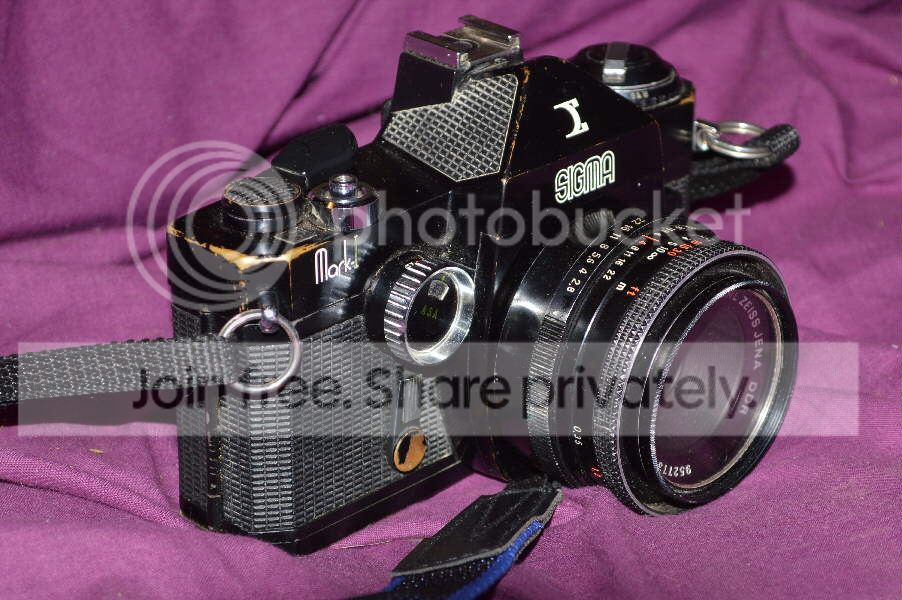
This is my favourite M42 Camera; a 1970's Sigma Mk1 'Richoch' copy, made in Japan.
dsc_1319_zps2afa5d05.jpg

Takes the same lenses that the Zenith would; and only boasts a couple of technical features over my Zenith; It has a few extra shutter speeds. Goes up to 1/1000th over the Zeniths 1/500th, and down to 1s below the Zeniths 1/30th. It also has Coupled, and electronic (takes one long lasting, {if you remember to switch it off!} mushroom battery) swing needle through-the-lens meter, giving over or under exposure indication, for manually set shutter and aperture.

But the 'Handling' is in a different legue.

Setting the shutter speed on the Zenith is 'fiddly'. I have to take the camera away from my eye and lift up the control dial and twist it round, careful not to get my big banana fingers jammed in the shutter release or advance lever!
On the Sigma, the large knob on the front, is easy to turn, without moving eye from view-finder or taking my eye off the meter needle.
Advance mechanism is not so heavy, and nice and precice 'one sweep' per frame. While the frame number is clearly displayed in the advance window... no faffing trying to guestimate from the Zeniths non marked sweep lever, or work it out from the dial round the rewind bezel, IF I remembered to set it, and can remember if it counts up or counts down and which mark I should be looking at next to it!
Rewinding the film? I press button underneath, flip the rewind crank, and it rewinds nice and smoothly with lots of 'feel' when I get to the end. Not a fiddly pop up spindle I have to spend five minutes prodding to get popped up, and then half the time twisting without it actually engaged in the film spool!
To open the back, once I have rewound? I just lift the rewind crank. I dont have to hunt for another catch. AND as I do that, spring resets the advance counter AND the advance clutch, so when I put another film in, I dont spend five minutes wondering why the film wont catch on the sprockets, then back to wondering how many fames I have left!

Its a LOT easier and more intuative to use; and it does it with the slick action of a precission, quality instrument.

I have had another M42 Camera, that was an East German Praktica. They were well regarded little cameras, and a lot more user freindly than the Zenith, bit lacked either the tractor like mechanical 'ruggedness' of the Zenith, or the precission of the Sigma. I played with a couple of College Pentax, and I have to say that they were nicer to use than the Praktica, or the Zenith, and did have a few tricks beyond the Sigmas simple TTL swing-Needle meter... but I didn't find them as 'nice' to work with.

So; the first thing you get is ease of use, then you get 'niceness' for want of a better word. Sheer 'feel'.

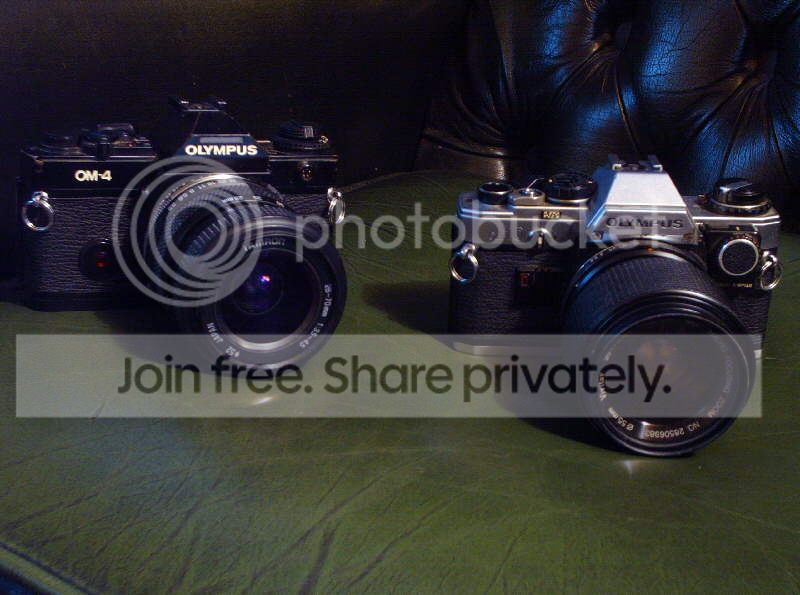
Moving on, and away from M42, these are my two Ollys.
imag3008_zps8d594234.jpg

Black one on Left is the 'Pro' level 'single digit' Olympus OM4; on the right, the Silver & Black one is the 'Entry-Level' OM10.

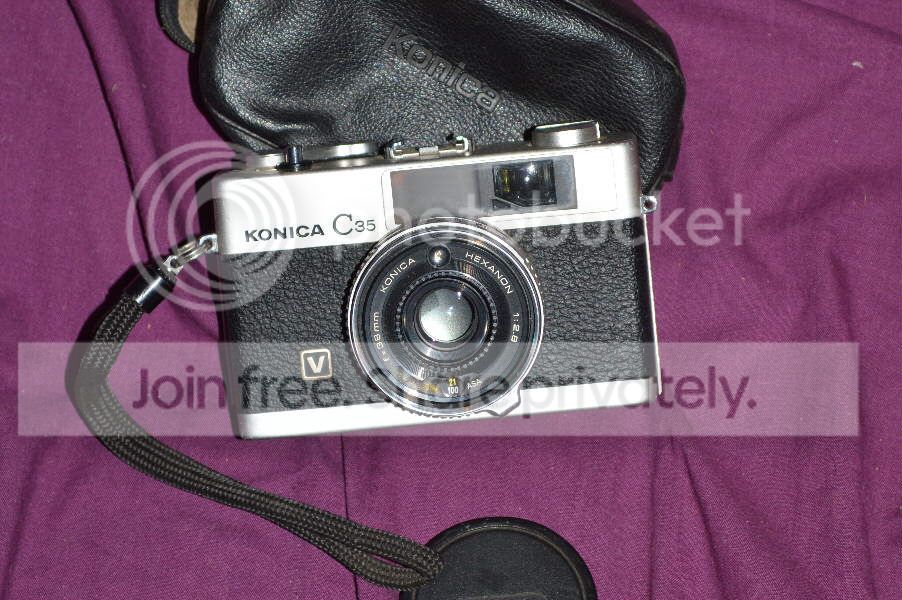
The OM10 was a very popular camera; Entry Level SLR's at that time, were usually like the Zenith, Practika, or my Sigma. Fully manual, with perhaps a coupled TTL meter, and commonly the 'old' M42 screw-fit lens, though some were starting to use the Pentax K Bayonet mount. These were cameras you had to know a bit to use, compared to a point & press cartridge load 'instamatic'. In between were more or less user freindly cameras; range-finders or zone focus 'compact' cameras, and here's a couple.

dsc_1312_zpsc29ffcf2.jpg

the Konika C35.
Very popular Camera in the 1970's. It was a 'zone focus' camera; you had three settings on the lens marked with mountains for 'far' focus, a group of of people stood up for 'middle focus' and a face, for 'near' focus. Exposure was by programmed automatic electronic shutter, metered by sensor next to the lens. This was 'point and press' simple photography.... provided you remembered to remove the lens cap! With 35mm 'quality'.

Big advantage that 35mm camera has over a 110 cartridge camera, is that, first you have a MUCH bigger bit of film to put your image on; aprox twice the dimensions, four times the area. Second, the only thing keeping the film 'flat' when its exposed in a cartridge camera, is the tension on the spools... 35mm cameras generally have a spring loaded guide plate, pressing the back of the film against the film 'gate'.

So, rank no-nothing non enthusiasts, could, with the C35 and its ilk, take pretty good photo's without having to know anything about metering or exposurem or even focusing, just point and press, and the camera did all the work, and would return pictures much more reliably... so long as the user remembered to remove teh lens cap.... than with a cartridge instamatic, and with a much higher image quality.

Did I mention these had a problem that it was very easy to forget to take the lens cap off?
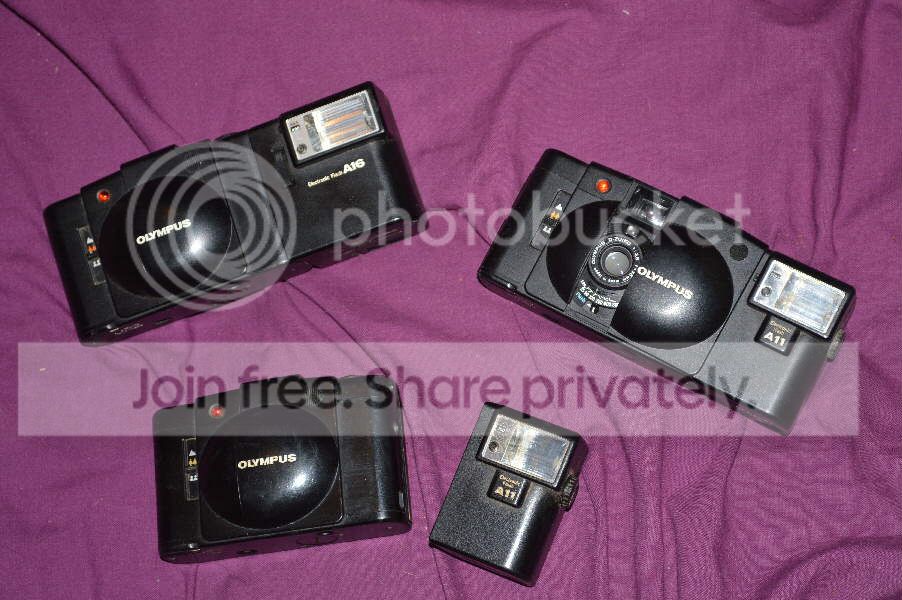
dsc_1310_zpsfa485763.jpg

Olympus XA2... note the sliding cover over both lens AND view-finder.... also switched on the meter, so you couldn't forget to take the lens cap off! This was an award winning bit of design at the time; and the feature became obligatory on later 35mm 'compact' cameras from most makes. BUT, again, a zone-focus camera, with point and press 'ease of use'... and the XA2 was at one point as expensive as an OM10 in the shop! It ws a 'high-end' compact. I think my (first one) was £90 with flash and a film, in 1982.

Anyway, back to the OM10. As sold, it was a dedicated 'Auto-Only' SLR. It had a pretty sophisticaed metering system for its day; meter recorded light reflected off the film during exposure, and controlled electronics that electromagnetically fired a cloth, two-curtain shutter, one to reveal the film, one to cover it back over again. Delay between each curtain moving, setting very finely, to within 1/3 of a stop, the shutter speed; Depending on how much light had been reflected at the meter; and adjusting the shutter 'speed' DURING exposure. Made it very very good for long exposure low light photography.

However; for general use, it was point and press freindly. Compared to the Konica or XA2, you did have to focus it, but rather than 'guessing' whether subject fell on mountains or people... you could see through the view-finder if what you wanted was in focus, and twist ring to get it. All you had to do beyond that was twist the apperture ring to get the LED in the view-finder display to light up near a number close to the length of the lens, 60 or so, if using the standard 50mm lens, and press the shutter release. Bit more involved than using point & press compact or instamatic; but not hard.

It was a light, easy handling and intuative to use camera. And like the C35 or XA2, automatic metering, and a pretty fabulouse lens, in comparison, delivered Image Quality to photo 'Dummies' in spades.

For the more clued up, it was still also a very powerful bit of kit; and utilising the ASA dial to effect exposure compensation, and being a bit careful choosing the shutter and aperture speeds, offered pretty much as much control as fully manual cameras of the era.... BUT leaving it to the electronics, you coudl work a HECK of a lot faster.

Takes me to the OM4. The Pro-Grade, single-digit Olympus; when I got that camera, I think about 1994ish? Was still listed in the Olympus catalogue and I seem to recall that body only, THEN it was near enough a £2K camera. Olympus had usually been ahead of the game in the 80's technology wise; and the last 'Ameteur' 35mm SLR that had offered, was I think the OM101, which unlike most SLR's DIDN'T offer interchangeable lenses. It had an integral, and I think Auto-Focus 10X 'Super-Zoom' from something like 28-280mm... figuring that few users ever went beyond those extremes anyway, so give it all in one package... but proved to be a flop, probably too far ahead of the market, I suppose. HOWEVER... Cannon were forging ahead with Auto-Focus technology, and Nikon was following them more cautiousely; and still offered its high end Manual Focus, F4 Ithink it was, along side the new AF bodies, for the more concervative, and they were I seem to recall a few quid cheaper then the OLLY! At least brand new. The OM series were the 'unloved' and I think mine only cost something like £350, barely three years old, with barely half a dozen films ever having been put through it! Still... thats as much as my D3200 cost this Christmas just gone! But gives you an idea of how far 'up-market' that camera was.

So what did you get for your dosh, over the OM10?

NOT A LOT! I have to admit! Handling wise, like the Sigma, you can 'feel' the qualty in its operation; its a slick, precission instrument. Other than that? Well, it got a faster shutter speed, I think 1/2000th, and a more sophisticated metering system. OM merely offered 'center weighted average' metering; the OM4 offered spot and multi-spot metering; while it also offered full manual operation, having a shutter speed selection ring around the back of the lens mount. There were a few 'optional' bits of capability it offered; it could take interchangeable focus screens, and film backs. One film back would print the date and time optically on the negative; another, would load bulk rolls of movie film. And you can fit a 'motor-drive' that offered faster advance rates than the 'winder' and would rewind films as well.

So; what you got in more expensive and more sophisticated cameras was rarely much if any higher 'potential' Image Quality. That was as much as anything down to the glass you put on the front and the film you put on the back... and then how well you used it all.

What you did get was more options, and often nicer, and frequently easier, and hence 'faster' operation.

Zooms. explained the perils of them before as far as Image Quality; BUT. Back to convenience and ease of use.

OM10 with winder and 70-210 zoom on the front. If I was at a race track; I could get a three picture sequence of a car or motorbike coming through a corner. More, I could rack out and get an extra shot of the subject, fiilling the frame as it aproached the corner, and another, racking in, as it left, using the zoom, where if I was using say a 135mm 'prime' instead of the 70-210, on the aproach to the corner my subject would have been tiny in the frame, and on exit, over flowing the frame... and if light levels changed, as I panned with the subject, say they went from a bit of track in bright sunlight, into a bit shaddowed by trees.... the AE would adjust the shutter speed for me, without me having to hunt for a dial and possibly miss the shot.

Shooting Rock-Bands, which I did a fair bit; under changing light; again, the camera is very responsive, and very fast to use, and under changing stage lighting, I could concentrate on composition and getting the performer in exactly the right pose, rather than worrying whether a light is going to blow my exposure or leave my frame black.

This was the beginning, of modern, Auto-Focus, mult-mode evaluative matrix metering, auto exposure do-it-all for you cameras, that laid down the foundation for modern Digital SLR's.

Some considered it photography for dummies, other lazy photrography, or as I think of it; "Fast-Photo" letting the camera do the laboriouse stuff, while you get on with finding the shots.... there's some truth in all opinions... and it all really depends on what you want to achieve and how much you value technical 'know-how' over asthetic appeal.

As said, the OM's were my 'front line' cameras, the workhorses that let me do, well... most things, and made it as 'easy' as they could. The Nikon Digital, has pretty much superceded them in that role.

The Sigma is still in use. Not frequent use, as it was, but, the camera I turn to to enjoy the practice of taking photo's, rather than 'necesserily' the results. Slower to use, more considered; its like enjoying a fine meal, rather than filling up on fast food. Lacking the 'Fast-Photo' capabilities of more sophisticated cameras, I have to think a bit more and work with the camera, and slow down to do it; consequently I take far fewer 'Grab' shots with it, 'on spec', and what I do get out of it, tends to more often be 'better'; but I dont get as many pictures from it working slower, and not picking it to shoot in situations where the Olly or Nikon would be more 'at home'.

Makes the Zenith sound 'horrible'; but in a similar vein to the Sigma, its a 'Slow-Photo' camera... just a bit slower. And you work with the limitations of the camera, and think about what you are doing with it to get the best from it. And there is a different sort of pleasure to be got from it; its tractor like clunkiness, delivering what it does.

And its a good tool for learning 'slow-photo'. It may not be the 'nicest' of cameras to handle, but it does the job; and for my daughter wanting to learn from first principle, or yourself, a very good starting place.

How far you want to go with it; how long until you feel that you want something 'more' from a film camera, or you are frustrated by the Zenith's short-comings, is pretty much down to what you want from a camera. But it does represent something of an extreme juxtoposition to a modern 'Fast-Photo' camera, and its ultimate potential IQ is something that you might like to savour about it.
 
Back
Top