I also hadn't really considered the whole image quality difference between film and digital - my assumption was that my ability to render much sharper images digitally was a result of the camera, when perhaps it's a result of the automatic settings for exposure coupled with a higher quality optic.
The assumptions & presumtions are... well... this is the Film & Conventional board, so comment on topic is likely not unbiased... BUT.
Idea that Digital, because its 'new' has to be 'better' and that 'better' must mean higher quality.... its shakey ground... shakey ground in deed!
Scans above; show, that Digital is still not resolving the level of detail that 'might' be captured on silver halide.
And the test neg? Well, if you look at the full frame scan, there's a little bit of damp damage in the sky in top corner; its twenty years old and degraded.
Subject is pretty big in the frame; it was taken with a standard lens, from a distance; And I have no idea what settings he was using, or if it was wondefully focused to start with!
Blurr in the wheel spokes suggests he was probably using a lower shutter speed, maybe 60th, so the milkiness around my hat in the 200x crop, could just be motion blur... so the negative probably isn't showing the 'best' film could do to start with.
And THEN we might start debating the metering, or the clarity of the optics or the rigidity of the camera chassis!
OK, lets do that; Lets start with chassis rigidity.
That old Zenith... well, mine's referred to affectionately as 'The BRICK'... it's a bit of HEAVY METAL, dude! Might have been critasised for being a little crude, unrefined and lacking sophistication, BUT every-one admitted it was a SOLID bit of kit! (Popular choice for the more... 'Robust' teenage boys birthday present!)
Shear weight, damps vibration. Works in cars, doesn't it? Luxuary cars tend to be heavier... more 'mass' in the 'body' the more it resists shake and movement from the wheels or engine... Force = Mass x Aceleration. More mass you got, more force you have to have to get anything to shift. Simple physics... but effective.
Heavy body then, anything moving inside it... mirror, shutter, aperture... less advantage its moving has to make the body shift or shake.
Moving on. M42 screw lenses. Very fine thread, round a relatively big 'diameter'. Connecting lens to body then, you are squashing quite a big area of metal against metal, and can make a pretty 'tight' and rigid connection between the two.. you are litterally bolting them together.
More 'sophisticated' cameras usually use 'bayonet' type mountings. usually just three TINT little tangs that slot into ramped slots to tighten the lens against the body. Its basically just 'wedged' in place!
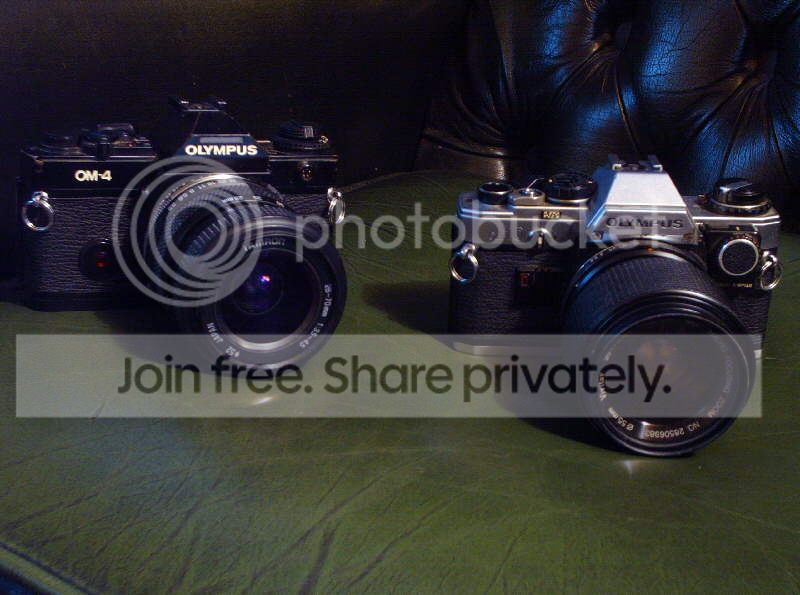
I used to use OM10's... and on one, with a particularly worn aluminium bayonet mount, I could actually 'waggle' the lens and see a half mm gap beween mount flanges! Whats that going to allow when the camera shakes a bit?!
M42 screw? When worn? Well, the thread just takes a tiny bit more turn to tighten up.... Its a very 'solid' mounting system.
Onto the lens optics. We are talking M42, and hence for the most part we are talking 'prime' fixed focal length lenses... 'fixed' well that suggests a little more solidity for a start. We only have one 'movement' inside the lens body; the focal length is restrained by the body, the only thing we alter, and by a small amount is the focus.
This means that the lens can be a lot simpler in design and construction; you might only have one glass lens element, and you only need a very short 'screw' adjustment to alter fine focus distance of it. The lens can be made a lot more cheaply, and accurately, and rigid... purely because its so 'simple'.
'Zoom' variable focal length lens; you have to have at least two movements, one to vary the focal length, one adjust fine focus. Imedietly its double the complexity; and more difficult to make as cheaply or as accuratly or as rigid. start layering up complexity, using multi-element lenses, and moving more than one of them about inside the body to effect focal length changes... you start multiplying the tolerences, and exponentially; so that the lens HAS to be more expensive, less rigid and less accurate.
Back to that OM10... worst case scenario; I had a worn 'one touch' zoom lens on it; multi-element design, and 'one' control ring to change fine focus and focal length; push-pull for zoom, twist for focus... GOD that thing was 'sloppy'... Honestly, I could have used the thing as a shift lens there was so much movement between film plane and front element!
Worst case, for illustration, but you get the idea.....
Modern Digital cameras, have inherited an awful lot of 'sophistication' from film cameras, and with them an awful lot of inherent 'compromises' to ultimate Image Quality.
The low rent, Russian made Zenith and Helios.... cheap it may have been... NASTY it was NOT.
Back to basics, simplicity, removed an awful lot of the compromises of higher end cameras, and so offered potentially HIGHER ultimate IQ than you were likely to get with significantly 'better' cameras.
The OM10 might have been able to offer much more refined exposure control; its lens offering 1/3 stop increments between aperture f-stops, its electronically controlled curtain shutter, offering a wider range of shutter speeds, again, with possibly 1/3 stop increments between them, giving 7 possible aperture/shutter combinations, between full stops, where the Zenith only offered 1.... this degree of instrument accuracy, is all very well and good, and may be quite 'nice' to have.... but if the ruddy lens isn't in focus, or the front element is going to de-focus the picture twice... once when the shutter releases the opening curtain, then again when it releases the closing curtain... having a picture that is '1/8th' of a stop closer to perfect exposure means bog all really! And only of much use IF that 1/8th stop difference is any use!

Little montage of the same shot taken on the Nikon, this winter, trying to explain 'Exposure Compensation' and the 18% Grey meter presumption to one of my kids.
If you have pointed camera at a less than usual subject, in this case 'snow', which is near 100% white, not 18% grey, the camera don't know that!
More sophisticated camera's metering system; and here it was that in one of the latest Nikon DSLR's.... STILL presumed what it was pointed at was 18% grey, and so tried to under expose, probably one, one and a half stops.
OM10, would have done just the same, with its state of the art (30 years ago) coupled, Through The Lens Meter Auto-Exposure.
Zenith? Using through the lens selenium cell, or hand held Leningrad... STILL would have made same mistake.
So, even within Manual-Focus era film cameras; there are a lot of variables, and the biggest difference is YOU... the camera user.
Bottom line, at the end of the day, the camera is merely a light tight box with a hole in the front, and something 'photo-sensitive' in the back.
You point it; you know what you are pointing it at. You should know how it works.
And if you do? Well, little searching on here I'm sure and you'll find 'pin-hole' photos taken without even a lens that are pretty damn sharp and well exposed.
Having a lens then just widens the range of situations you might get a sharp picture in... IF you know how to use it.... increases your chances of getting a 'better' picture. Good Photos are taken by GOOD photographers, NOT good cameras.
And 'good' is subjective, and very different from 'sophisticated'.
Snow-shot shows; very very 'sophisticated', incredibly accurate and refined Nikon 3d-Matrix Metering system.... metered that snow shot with an incredible degree of accuracy and set the aperture and shutter speeds very very precisely..... WRONG! Because it was STILL basing all its calculations on an errant PRESUMPTION what it was looking at, on average was 18% grey.
Modern Digital Cameras... look at them. Lightweight. Often plastic chassis. Bayonet mount lenses. And incredibly complex Zoom lenses with how many elements inside? And Motor Driven! And how much do they cost?
In 1982, the Olympus OM10, with standard 50mm lens came as a 'kit' I recall for about £100.
I bought my Nikon D3200 this Christmas (2013) for £350, with 'kit' 18-55 zoom.
Both middle market, 'Entry' level SLR cameras from the different eras, seperated by about 30 years; £100 for the Olly, represented 'about' a month of the eras 'average wage'. The Nikon, now, represents 'about' 1/3 of a months modern average wage. So reletively speaking the Nikon is about 1/3 the 'cost' of the Olympus.
Yes, technology and manufacturing technology and consumer expectations have moved on a lot. But.... to pack THAT much compexity and sophistication into a camera THAT price... the compromises are going to be tough. And whats going to give?
They are not going to take out the 'sales features' of auto-focus or a zoom lens, that buyers 'expect' from a modern camera, are they?
Only way to get the costs down to market expectation is to sacrifice ultimate IQ.
And... 12-16Mpix. If that is still twice or four times the resolution that people are going to 'accept' for screen or web-display, or what a mini-lab will use to make album sized prints from? Not MUCH point in being so BOTHERED about it!
Yup; shift up and up the market, and Digital cameras do get better; BUT. its increments of 'better' and at a cost far out of proportion to the gains.
Film era. The image sensor; the resolution was deturmined as much as anything by the film you put in the camera. Mentioned it before... a 'fresh' sensor every shot....
Cameras were still made down to a price; but the technology of the era meant that they was less opportunity for them to add sophistication, so cost optimums were found through simplicity, WHICH almost by accident, could offer quality gains!
Which brings us back full circle.
Zenith has no 'image sensor'. It can offer a resolution as high as the grade of film you stick init. Then the simple, rugged, robust construction offers a lot of advantages to help give you very good potential IQ, and potentially a LOT higher than you could get with a modern Digital SLR. Sure the Digital SLR will make it a lot easier..... and not having to buy a new film every thirty or so shots, makes it a lot cheaper to run... BUT... its a good photographer that makes good photos, and the potential is there with that simple rugged old 'Brick' to get shots as near as good as the high end SLR's and Lenses it was a copy of, as far as IQ is concerned, and that is likely to be equal of better to anything with even a 'full-frame' 24x36mm CMOS sensor instead of film.
But FEW would drive either hard enough to tell thr difference ANYWAY!
That's the 'con' of digital, if there is one. The technology has reached a plateau, where the 'Acceptable Quality Level' is 'there or there-abouts, 'good enough' for most.
And as always, bigger differences will be found from how people use the hardware, rather than whats ion the hardware.
So... what I am saying is.... that 35mm film, had a HUGE 'redundancy' of potential IQ, few even in the film era, found or exploited very often.
There's nothing wrong with your kit; and your technique dont seem too bad. And having to manually meter and set, is making you think a bit more, rather than point and press, where you were able to rely on the auto-modes of the Cannon to get the results you did with it.... and like so many, believed your IQ was coming fro the camera, 'suggesting' and often forcing on you, focus distance, and shutter and apperture settings.
Nope. They are ONLY suggestions; and only YOU know what you are pointing the camera at, to know whether those settings may be 'apropriate' let alone 'right'.... Camera presumes everything is 18% Grey... You can SEE where it is or it isn't. You can SEE where the scene had lots of dark shaddows or bright high-lights. You can see what is 'important' in that scene and where you want focus or selective focus.
The camera is STUPID. It has no idea what it is looking at. It is GUESSING the settings. And more setting you let it guess, the more chance its guess will be WRONG.
Yeah, fantastic that modern programs are so sophisticated that they so often guess right... but they are STILL guessing!
As is the TTL meter in the Zenith......
Don't guess.... 'Assess'!
Then you may decide whether to accept the cameras suggestions..... or not.
Whatever the camera. Digital OR film.
In regards to lenses - from the discussion above it's clear the Helios debate polarises opinion, is there an affordable alternative in m42 that people prefer? I've ordered another Zenit, which supports auto aperture to allow me to use a wider selection of m42 lenses, so I'm shopping for an appropriate lens now...
I think you are searching for a unicorn, to be honest. The holy-grail of ultimate IQ..... its a journey destined to lead only to frustration.
Like the Zenith itself. Think BASICS, think fundementals, rugged, robust simplicity.
How 'good' do you REALLY need your shots to be?
Why?
Who is going to look at them?
Where?
How?
Why will they be looking?
What will they be interested in?
Whether or not the Helios is the best bit of glass you can screw into a Zenith... is it 'good enough'?
Remember, those 200 x crops were taken from a neg exposed in a Zen, with Helios.
If you are never going to make a full frame print over 5x7 from any of them; whether they are printed digitally or optically; you are NOT going to see bog all difference in sharpness from another lens.
Scanned? Well, I'm sat looking at a 17" monitor, its almost 50% more area than a 10x8" print.... but screen resolution, is only what? 1280x1040 pixels?
There's a 40" Flatscreen TV on the other side of the room connected to another PC via VGA cable; G/F's currently playing a face-book game on it... could ask her nicely and open pic up on that machine and view it, 27"x16".. I dont know what her graphics card is bunging out.... but probably STILL only 1280x1040 pixels.... they are just bigger! Means I can see the edges of them more clearly, if I get as close to that screen as I am to this.... there's no more 'detail' there; even if the properties for the image file tell me that its a 4000x6000 pixel image.
How far do you want to chase this 'idea' of ultimate IQ and detail sharpness?
And even if you really must go on a quest for it.....
Are you really going to find it in your lens choice, or your lens choice alone?
Opinion may be divided on how 'good' a lens the Helios may or may not be...
But it is by far and away NOT the weak link in the chain at the moment.
Other glass? Well, a lot of M42 fit lenses were made by only a couple of factories, and badged for different retailers.
I seem to recall that Sigma were one of the most prolific independents, and put variouse names on thier lenses, Panomar, Pentacon, and a few others. Hanimar, Hanimex, are a couple of others that spring to mind, that are probably related, whether to Sigma or not I dont know.... and TO BE HONEST I never really cared!
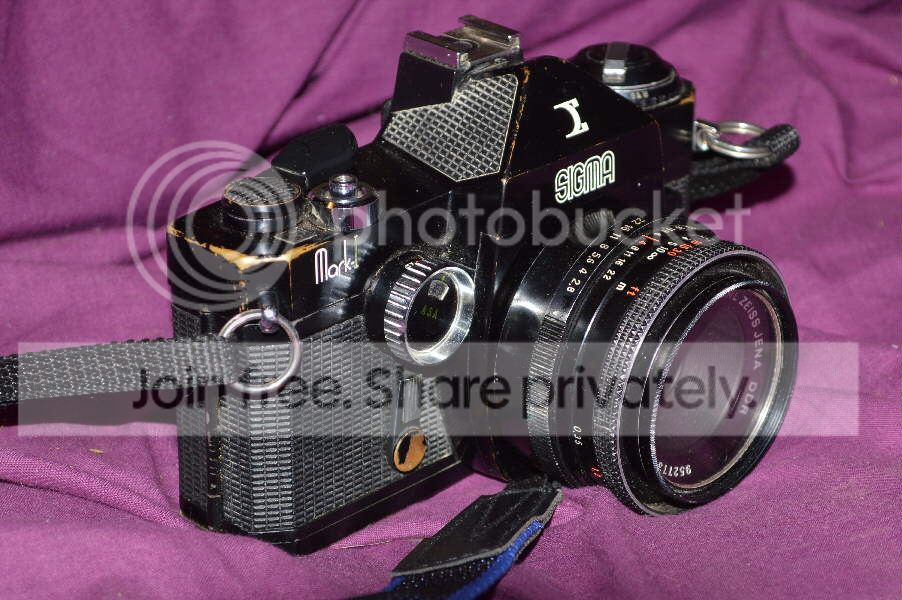
I got 'in' to M42, when I was given a Richoch copy badged by Sigma, with that Ziess Jena 50 on the front. For me, twenty years ago, it was 'pocket money photography'; an opportunity to spend time looking through all the second hand lenses in the cabinet when I went to buy some film; looking for anything 'interesting' and under a fiver.
I rated it by looking at the lens; considering whether there was any damage, if the glass was moldy; how smooth the aperture worked, counting aperture blades, looking at the range of apertures, then screwing it into my camera and LOOKING THROUGH IT!
I avoided zooms; and the more obiousely low rent lightweight lenses; and going by feel, most of them are pretty OK... and ultimately, STILL not the weak link in my IQ....
That I grudgingly accept is probably ME!





 and the difference between the cheaper and expensive lenses are usually they are faster lenses and much better when used wide open. :shrug: