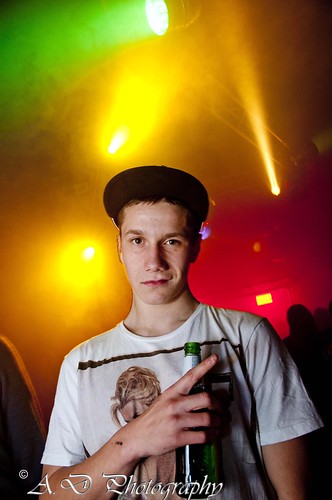
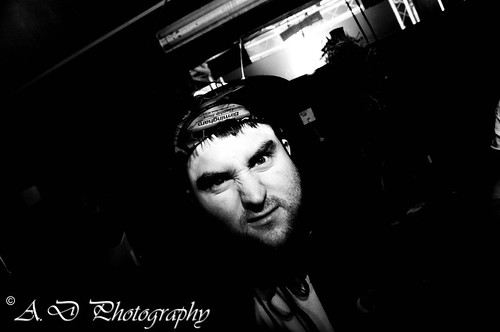
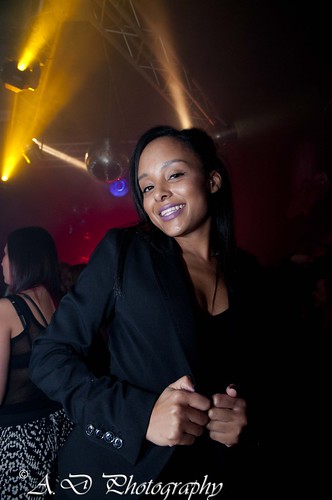
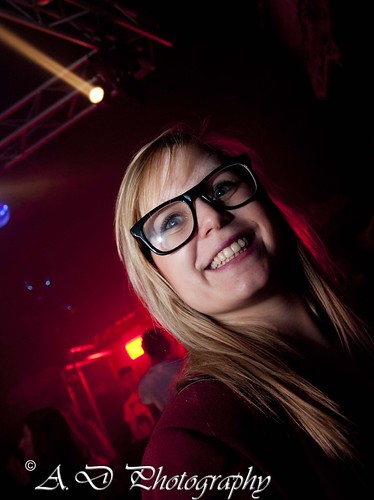
Need help for nightclub pictures!

R.E. Ohara's posts

I really cant stand the navigation of that site but 2 quick examples of why ETTL isnt as good as your making it out to be:

http://www.smileonthetiles.com/smiles/displayimage.php?album=17450&pos=6
Under exposed because of the girls white top

http://www.smileonthetiles.com/smiles/displayimage.php?album=17486&pos=3
Over exposed because they are wearing black (then looks like they've tried to do a B+W conversion to save it)

From the photos I've seen there the distance doesn't change much (as I mentioned earlier) so why not use manual flash? Also what does AF have to do with ETTL? Are you really going to bother shining a bright light in everyones face to try to prove a point? Running with your point about manual focus it wont change much so with some experience it should only take a fraction of a second to do (If you can see anything). (If you don't believe me about focus staying quite similar try a 18-55 and take note of how little the front of the lens rotates) Again though why would you do it when AF is probably better than what you could do in MF 99% of the time for nightclub work.

Photos of mine (might have to like the pages to see them):

https://www.facebook.com/statusbangor
https://www.facebook.com/cafeceol

<loads more stuff>

I'm not saying the way I do it is right, and by no means am I saying the way you do it is wrong. By the look of those sites you've got a fair amount of decent shots. What I'm saying is the techniques that we use work best for us. There's nothing stopping us from using manual focus, manual flash...but why would we when AF and TTL are easier?

Yes I understand TTL can be fooled easily by very bright or very dark clothing - believe me this probably affects at least 10% of our photos each night! However it's a limitation to the system that we can't avoid (without using FEL or manual flash) so we learn to live with it, at the end of the day the other 90% or so of the nights shots will be correct. The same thing with AF, sometimes it's not perfect and you'll get the odd out of focus shots here and there.

I'm just saying this is what works for me and it should be a good starting point for another person who is just entering the world of nightclub photography.

I accept that people prefer old fashioned methods of doing things, don't get me wrong I don't hate manual focus at all (I use it all the time for video), however it's just not feisable to use it in this situation (at least for me). Some people prefer shooting on film, with manual focus, manual flash etc. Doing this sort of job where you are taking potentially 2000 shots in one night, for two nights in a row and each time where you aim to deliver them to the web within 12 hours, it is obviously out of the question as we need the quickest workflow. Digital is a god send for that...without it our website would not exist. The same goes for manual focus, TTL etc. Without them we would not be able to work as productively as we do.

Re. having white walls in clubs, I know a lot don't but there are a few which do and those are easily the ones you get the best light in. Bouncing flash outside also works well depending on the colour of the building that you are stood next to.

And finally on the subject of manual flash...a lot of the time the people we photograph will literally just jump out on us wanting to get their photo taken (the website is very well known in the city) and sometimes we'll have multiple people waiting around us for their turn, some people will stop you in the hallway of a club or as you're making your way down a staircase and want their photo there and then, and a lot won't want to stick around as you're messing about trying to set your flash up properly. Some people get frustrated if you have to retake the shot a couple of times because of bad framing, out of focus, someone has walked into the shot and ****ed it up etc. There's a whole host of things which can happen, eg random people putting their hand in the way of someone's face, a drunk **** pouring a pint of beer over your lens (it has happened) etc, using all these things helps to make us easier and quicker and ensure maximum productivity.

Hope you understand where I'm coming from. :)
 
Last edited:
I'd have thought a fast prime like the 20mm 2.8D would be good for this type of work with a cropped sensor. Much less intimidating than a huge zoom stuck in peoples faces as well.

I reckon a 20mm would work fine, f/2.8 will help greatly. However I like having a bit of zoom so I can go for shallower DoF photos when it's just one or two people in the frame and you have enough room, and sometimes I have a large group, 18mm is not wide enough and in a lot of venues which are packed to capacity, moving further back is not an option.

My personal favourite 2 lenses for nightclub work are 18-55 kit lens (17-55 f/2.8 IS would also work very well) and if your budget can stretch to one, the 16-35 L lens.
 
You use a fish eye lens which creates horrible affects... Like when you see like a mixing deck that should be straight is now curved. Looks terrible when EVERY picture is like that. Also alot of weird shadows on them, I'll look else where I think for a style. Cheers :)

To be fair to duttytd the fisheye affect is quite popular in club photography. I actually like a lot of his shots of the artists, not sure on some of the punter shots but they are better than some of my feable attempts!
 
To be fair to duttytd the fisheye affect is quite popular in club photography. I actually like a lot of his shots of the artists, not sure on some of the punter shots but they are better than some of my feable attempts!

Thanks Dave.

Here are a few of my more recent shots


DSC_1189 copy by Duttytd, on Flickr


DSC_1143 copy by Duttytd, on Flickr


DSC_1191 copy by Duttytd, on Flickr


DSC_1114 copy by Duttytd, on Flickr


DSC_1102 copy by Duttytd, on Flickr


DSC_1080 copy by Duttytd, on Flickr
 
I'm not saying the way I do it is right, and by no means am I saying the way you do it is wrong. By the look of those sites you've got a fair amount of decent shots. What I'm saying is the techniques that we use work best for us. There's nothing stopping us from using manual focus, manual flash...but why would we when AF and TTL are easier?

Yes I understand TTL can be fooled easily by very bright or very dark clothing - believe me this probably affects at least 10% of our photos each night! However it's a limitation to the system that we can't avoid (without using FEL or manual flash) so we learn to live with it, at the end of the day the other 90% or so of the nights shots will be correct. The same thing with AF, sometimes it's not perfect and you'll get the odd out of focus shots here and there.

I'm just saying this is what works for me and it should be a good starting point for another person who is just entering the world of nightclub photography.

I accept that people prefer old fashioned methods of doing things, don't get me wrong I don't hate manual focus at all (I use it all the time for video), however it's just not feisable to use it in this situation (at least for me). Some people prefer shooting on film, with manual focus, manual flash etc. Doing this sort of job where you are taking potentially 2000 shots in one night, for two nights in a row and each time where you aim to deliver them to the web within 12 hours, it is obviously out of the question as we need the quickest workflow. Digital is a god send for that...without it our website would not exist. The same goes for manual focus, TTL etc. Without them we would not be able to work as productively as we do.

Re. having white walls in clubs, I know a lot don't but there are a few which do and those are easily the ones you get the best light in. Bouncing flash outside also works well depending on the colour of the building that you are stood next to.

And finally on the subject of manual flash...a lot of the time the people we photograph will literally just jump out on us wanting to get their photo taken (the website is very well known in the city) and sometimes we'll have multiple people waiting around us for their turn, some people will stop you in the hallway of a club or as you're making your way down a staircase and want their photo there and then, and a lot won't want to stick around as you're messing about trying to set your flash up properly. Some people get frustrated if you have to retake the shot a couple of times because of bad framing, out of focus, someone has walked into the shot and ****ed it up etc. There's a whole host of things which can happen, eg random people putting their hand in the way of someone's face, a drunk **** pouring a pint of beer over your lens (it has happened) etc, using all these things helps to make us easier and quicker and ensure maximum productivity.

Hope you understand where I'm coming from. :)

Yeah i understand where your coming from :) Wasn't sure about your first reply (I assumed it meant that basically ETTL was right and everything else was wrong and old fashioned (oops))
In all honesty I started using manual flash both because ETTL was killing my workflow (exposure changing quite a bit for each photo) and I was starting to get bored of being able to take shots without having to even think about them.
I tried it a few times one night and havnt really looked back since (If its something im not comfortable with (a strange distance or bouncing light etc) I'll use ETTL and if I have time do a quick manual flash.
I very much understand where your coming from with people rushing at you and not wanting to wait (been shooting quite a few different clubs for close to 2 years now) but I think with experience that using manual flash (for me, and in my experiences atleast) is worth the extra second or 2 that it takes to take a photo for 3 reasons:

1. It saves me time after the night is finished and allows me to process them quicker.
2. If people aren't willing to wait a second or 2 for a photo then chances are they won't go online and try to find it later.
3. Most times (as you said always keeping shutter speed at 1/20th sec for example) aslong as you know what settings you need for most situations you can return to them after taking a photo then you will know immediately what adjustments to make. If your in a hurry you can just change the aperture rather than setting the flash power (faster than changing FEC)

Either way we each do what we think works best for us, if you havnt tried it I'd suggest you atleast try a few photos like this (something nobody ever told me and took me a year and a half to get to by myself)

If you want to discuss workflow then feel free to PM me as I'd prefer not to go into that here :)
 
can you help me with FEC. What is it and how will understanding it help me

FEC = Flash Exposure Compensation. Allows you to adjust flash exposure when using ETTL, independently of the ambient light exposure.

There's also FEL = Flash Exposure Lock, which allows you to fire the pre-flash independently and lock the power output. Useful for things like off-centre subjects when you would aim the camera at the subject, fire the pre-flash via FEL button, then recompose as you want it.
 
thanks Richard for your reply. The problem i am having is under/over exposure when using flash. The pictures I am shooting have a dark background and i use the flash to light the subjects. If you can spare some more of your time do you think FEC help.
 
olimat333 said:
thanks Richard for your reply. The problem i am having is under/over exposure when using flash. The pictures I am shooting have a dark background and i use the flash to light the subjects. If you can spare some more of your time do you think FEC help.

Slow the shutter and maybe up your ISO to pick up some of the ambient light.
 
:lol:

Some good tips here....amongst the fighting and under exposed shots:p

OMG.... was having a drink las night and came up to this thread just now, been reading comments, and i see my avator on left side..... thought what did i write yeaterday here.... read it through and can't remember why i wrote that comment.... checked that isn't me


:lol::lol::lol:
 
thanks Richard for your reply. The problem i am having is under/over exposure when using flash. The pictures I am shooting have a dark background and i use the flash to light the subjects. If you can spare some more of your time do you think FEC help.

Happy to help but it could be all sorts of things. Post up some problem pics and explain the circumstances - it should be easy enough from there :)
 
thanks Richard for your reply. The problem i am having is under/over exposure when using flash. The pictures I am shooting have a dark background and i use the flash to light the subjects. If you can spare some more of your time do you think FEC help.

Are you underexposing/overexposing the SUBJECT or the BACKGROUND?
 
thanks everyone for the help, i am going to upload a couple of images shortly. In all the photos I take have a dark background because that what is it is as their is nothing but unlit space behind the subjects.
 

Inverse Square Law. Light reduces over distance, and the ratio is double the distance, one quarter the brightness.

In other words, flash falls off very rapidily, much more than you might think, and the closer you are, the quicker it reduces.

If there is some ambient light, you can reduce the shutter speed to try and bring that up, but chances are you'll run into movement blur as there just ain't much light around - or you wouldn't be using flash in the first place.

Or move the subject indoors where there's a white ceiling so you can bounce the light around and fill the room.
 

First photo looks like it has too little flash. Did the little light come on on the flash after the photo to indicate it exposed correctly? It may have fired at full power and still been too far away to expose properly.

Second photo looks like it has too much flash. Were you running the flash in manual or using TTL?

Edit: the dark colour of the dogs fur may have confused the TTL of the flash causing it to fire with more power. If this is the case try putting your active focus point over the face of one of the people and using flash exposure lock.
 
Last edited:
Ah thats a useful tip Ohara-I never knew thats how FE Lock worked even after just reading the manual for the 7d (oops)

As for the pictures the white sign and fence might have been enough to throw of exposure slightly on the first. I'd agree with Oharas edit for the second shot (dark dog and dark coats) causes flash to overexpose as its assuming everything will average out to be gray.

Olimat-> The other alternative (that I used before switching to manual and that I used because I didnt have the benefit of oharas short explanation above) is to remember to add(+) 1 or 2 clicks of flash exposure compensation when shooting scenes with large amounts of white and subtract(-) 1 or 2 clicks when shooting scenes with black in it. (Here im using 1 click= 1/3rd of a stop)
 
Invest in a 1.8 50mm! Forget the zoom need big appature for low light and also not to high on the iso as it goves to much noise.

no way! well tight. go real wide like 8mm!
 
Last edited by a moderator:
Back
Top