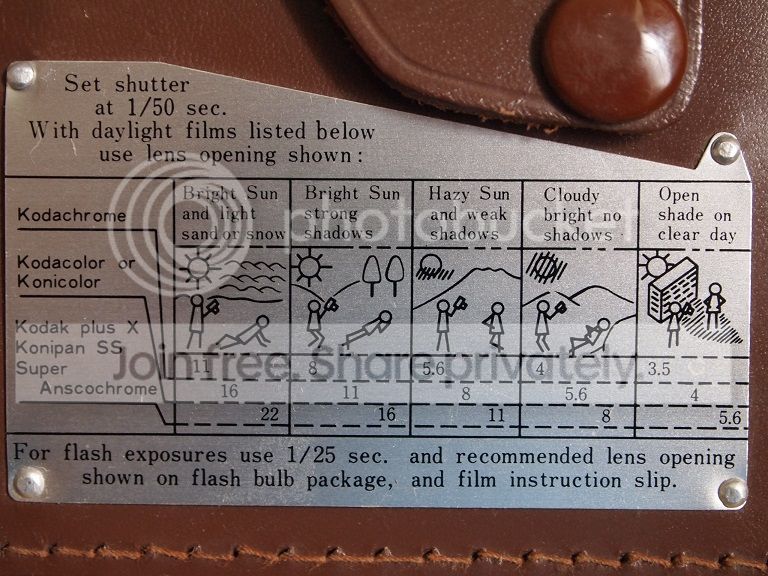
My sunny 16 challenge

Cheers Alastair, thats very useful.

/copy printed and stuffed in camera bag.
 
Yup, visible, and nothing else other than an ini file.

Is this right on the ISO:

"ISO speed (moving up or right increases the sensitivity of the film/sensor to the light striking it)"

Moving to the right bit is correct, but it looks like moving up gets to lower ISO/sensitivity?
 
Possibly Chris.. my eyes were going cross-eyed figuring that table out and trying to make sure it went in the same direction for all three parameters. I did ask a friend to proof-read, but it it confused him as much as me.
 
Now updated to correct the ISO table, version 2 on the same link.

Suggestions for improvement are always welcome. It is still legible (at least to me) when printed at A5.
 
This is the suggested setting for the Konilette - 45mm f/3.5 Konitor lens...

Konilette.jpg


Get them girlie poses :D

So that's what they mean by Camera Porn.
 
As you may have gathered, the roll of Acros that I used for my totally manual sunny 16 experiment with the QL17 has some problems and is currently back at the processors. I also tried some experiements with my Pentax ME; this is a bit of a trial as it is an Aperture Priority camera through and through and doesn't have a proper manual mode, so I've had to try using bracketing with the exposure compensation dial when I suspect the exposure might be off. I've run a roll of Ektar 100 and Portra 160 while trying to keep my mind on the sunny 16 rule.

I've been looking more closely at the results, and there's something really strange here. The Pentax manual says "set the dial at 1x for normal exposure. The scale (4x, 2x.... 1/4x) indicates the exposure factor... 1/2x and 1/4x automatically program the camera to deliver one half and one quarter of the light to the film. The 2x and 4x settings automatically double and quadruple the light reaching the film."

So if the exposure is correct at 1x and you set at 1/2x you'd expect under-exposure, right? Likewise set at 2x you'd expect over-exposure.

One more bit of background: I used a portable voice recorder to capture the scenes and the settings and the conditions. It's nerdy, I know, but I couldn't see any other way of remembering them.

I have several bracketed sets in Kenilworth Castle. All are in the sequence 1x, 2x, 1/2x. All give results like this:

1x Castle keep F/5.6 1/125 Overcast
40200013.jpg


2x same aperture, didn't record shutter
40200014.jpg


1/2x same aperture, didn't record shutter
40200015.jpg


Now that looks all wrong to me. Surely the third one is (a little) over-exposed and the second one is under-exposed? But the third is at 1/2x and the second at 2x!

My poor brain isn't up to this. Maybe the simple answer is that I did all three brackets the other way and simply recorded them wrongly. But I am really confused!
 
It could be that your scanner has bumped up the exposure on the underexposed negative, removing the underexposure and maybe overexposing it? and done the opposite to the overexposed one?
 
It could be that your scanner has bumped up the exposure on the underexposed negative, removing the underexposure and maybe overexposing it? and done the opposite to the overexposed one?

They were scanned by Photo Express on a Noritsu Koki, so this didn't seem too likely... inspection of the negatives shows that the middle neg is lighter than the other two, consistent with the images above (in reverse, obviously).

So this morning I did the obvious: sat the ME on a table and looked at the shutter settings. For 1x it was 1/30, for 2x it was 1/15, for 4x 1/8, for 1/2x it was 1/60...

So the answer must be, I am an idiot and recorded 2x and 1/2x each time when it should have been 1/2x and 2x!!! :thumbsdown: :bang: :bonk: :cuckoo:
 
OK, this thread started with me saying I was going to put a roll (Acros 100) through my QL17 in manual mode with no light meter at all. I did that, and recorded the conditons as best I could. It's taken an age to get results, as this was the "process-only" roll that got those dark splodges and had to go back to be re-washed. It's now free of dark splodges but has acquired some extra scratches, since each strip has come out of its plastic sleeve 3 or 4 times now.

In terms of the challenge, how did it go? TBH it went pretty well, I suspect largely due to the flexibility of the BW film. Artistically, that's another thing :thumbsdown:.

What I'd forgotten, and this process reinforces, is how flat things get once you move away from the "sunny" settings. Even scenes where I could see a great deal of variation, presumably I was seeing colour rather than tonal variation. I do remember that after I started with colour, I tried using colour in one camera nd BW in another for a while, but gave up as I seemed to have lost my tonal "eye", and as a result got far too many flat BW images.

Anyway, enough blathering and a few pics...

1 Robsart cottage, light rain at the time, 1/125 at f/5.6 (I guess this one's not flat because of the BW cottage!)

CB1208QLAr06.jpg


2 Chimney corner, castle kitchens, 1/125 at f/16. Sunny as you can see, works OK despite the relatively dark subject

CB1208QLA11.jpg


3 Bridge in Leamington, f/8 1/125 Cloudy no shadows.
Under-exposed; did not take account of the darkness of the subject; pulled back a bit with recovery sliders

CB1208QLAr19.jpg


4 Giant plants in Jephson Gardens, f/8 1/125 Quite cloudy, virtually no shadows, quite dark scene. Maybe a stop under?

CB1208QLA28.jpg


5 Coventry canal basin f/16 1/125 Sunny

CB1208QLAr33.jpg


6 Canal bridge at entry to Coventry canal basin; note absence of towpath as a control feature to support gathering tolls! f/16 1/125 Sunny

CB1208QLAr362.jpg


I'll have some comments from other experiments as well later... But I would welcome any views on the exposures above, particularly. As usual, they look a bit different when previewing this post than they did in Aperture!

 
I don't know how they picked up that slight yellow cast, they were scanned in greyscale and processed without any colour adjustment!
 
Interesting experiment Chris, I think it's always a challenge when the skies are flat and grey.

I don't know how they picked up that slight yellow cast, they were scanned in greyscale and processed without any colour adjustment!

As far as your yellow cast I can't see it sorry :shrug:
 
Interesting experiment Chris, I think it's always a challenge when the skies are flat and grey.

As far as your yellow cast I can't see it sorry :shrug:

It was number 1 in particular; comparing the sky to the white background, I guess.
 
Back
Top