My sunny 16 challenge

ChrisR

I'm a well known grump...
Suspended / Banned
Messages
11,730
Name
Chris
Edit My Images
Yes
I think I said in the first of my posts on shots from past cameras (in the "Show us yer film shots" thread) that my first camera was a Werra 1, with no meter. I managed without metering for around 4 years, mainly black and white but a couple of rolls of colour as well. The number of shots lost to bad exposure was MUCH less than the number of shots lost to forgetting to change the focus zone!

Since that camera, I've always had a meter in the camera, and I've got out of the habit of estimating the exposure. So, my challenge to myself is to shoot a few rolls just using estimated exposure, with the "sunny 16" rule. I've got a Canonet QL17 now, that can be easily set off automatic exposure (which neither the Pentax ME nor the Oly Trip can).

So, can anyone point me to a reliable version of the sunny 16 guide? There seem to be lots about, but their descriptions are very variable. Ideally something I can get into a Word document, so I can make up small strips for different film speeds...
 
The guide on the back of my Rolliecord iv is very good, it only translates to Ev but I tried a roll of Tri-X using only that guide and every frame was technically printable (artistically however :) is another matter). I'm back home tomorrow and could take a pic of it for you if you cannot find one online.
 
I think I said in the first of my posts on shots from past cameras (in the "Show us yer film shots" thread) that my first camera was a Werra 1, with no meter. I managed without metering for around 4 years, mainly black and white but a couple of rolls of colour as well. The number of shots lost to bad exposure was MUCH less than the number of shots lost to forgetting to change the focus zone!

Since that camera, I've always had a meter in the camera, and I've got out of the habit of estimating the exposure. So, my challenge to myself is to shoot a few rolls just using estimated exposure, with the "sunny 16" rule. I've got a Canonet QL17 now, that can be easily set off automatic exposure (which neither the Pentax ME nor the Oly Trip can).

So, can anyone point me to a reliable version of the sunny 16 guide? There seem to be lots about, but their descriptions are very variable. Ideally something I can get into a Word document, so I can make up small strips for different film speeds...


I have been using the same info that is in the link that Tigger has posted, and it seems to work for me... I found that when using my mamiya 645 with the waist level finder that doesn't have a meter, it just seemed easier than using a seperate light meter or using my digital camera as a light meter ... the motorcycle image on this page http://www.talkphotography.co.uk/forums/showthread.php?t=53681&page=214 that I took, was using the sunny 16 rule ( and looks to be exposed ok ) and several of my other images that I have uploaded have been done the same way..
So I will continue to practice this way and see how it goes..

Steve.
 
Thanks folks for the hints. The one Heather posted is short and sweet; the Parker one that Wilson mentioned, I've seen before. It's comprehensive but long and kinda hard to subset. Not to mention hedged with dire copyright warnings!

I'll be putting a yellow Hoya coated filter on (I hope, if the 48-49mm stepup ring ever arrives from Hong Kong). Would that take a whole stop, or less?
 
Thanks folks for the hints. The one Heather posted is short and sweet; the Parker one that Wilson mentioned, I've seen before. It's comprehensive but long and kinda hard to subset. Not to mention hedged with dire copyright warnings!

I'll be putting a yellow Hoya coated filter on (I hope, if the 48-49mm stepup ring ever arrives from Hong Kong). Would that take a whole stop, or less?

I would guess it would take off about half a stop, worth checking with a lightmeter though as your results may vary
 
sunny 11 seems to work best for me ,,,might be because it tends towards overexposure
 
I would guess it would take off about half a stop, worth checking with a lightmeter though as your results may vary

Now Rob, the one thing I CAN'T do is check it with a light meter!!!! Actually, at half a stop with black and white film's latitude, I'm probably better off ignoring it, at least at first. (Eg noting donutagain's suggestion of "Sunny 11"!)
 
You could check it with one of your digital cameras?
 
You could check it with one of your digital cameras?

Yes... but the challenge is NOT to do that! The whole thing has to be by eye and judgement, so that I learn to understand the light better!
 
Yes... but the challenge is NOT to do that! The whole thing has to be by eye and judgement, so that I learn to understand the light better!

I was on about checking the density of the filter, to make sure you dont shaft the exposure :shrug: unlikely though with negative film but it's still something to consider
 
Haven't tried this for donkeys years, but did it all the time when I was a kid/young teenager because the only light meter I could afford was the one printed on the box of film! As far as I can remember, I got quite good at it and I still have some of my slides and negatives from the 60s that look well exposed. Both my film cameras are in SA, but I might give it a go with my 30D, estimating the exposures and setting it accordingly.
 
Haven't tried this for donkeys years, but did it all the time when I was a kid/young teenager because the only light meter I could afford was the one printed on the box of film! As far as I can remember, I got quite good at it and I still have some of my slides and negatives from the 60s that look well exposed. Both my film cameras are in SA, but I might give it a go with my 30D, estimating the exposures and setting it accordingly.

Ditto, Martin. If your 30D has a fully manual mode, it should be possible. I think I could do it with the X10, but I suspect the impulse to switch into A or P would be too great. Hence the plan to use the QL17; it's much more of an effort to move that ring to the A point!

However, before I start, I want to see the results of my test film (TMax 100) with the QL17. Sent to Genie first class on Monday, entered into production 16:58 on Tuesday, I was expecting it Wednesday morning but nothing yet.:(

I've got an Acros 100 and a HP5+ sitting on the shelf. Given the month of the year, and that the QL17 only goes to 1/500, I think I'm going to try the Acros (if I had another roll of FP4 I might try that... and might still get one tomorrow, let's wait and see).

Anyone else want to try this, please feel free to post to this thread! (But not from digerati cameras, obviously :naughty:)
 
I have just run a roll of Ektar 100 through my Yashica-Mat using the sunny 16 rule and will hopefully get Steve to develop it at the weekend (or before!) so will see if it is any good!

Sadly, the sun has been quite elusive this week! :(

Heather
 

+1, I've been using this guide for a while. I've been adding "calibration" notes based on the EXIF data from digital shots. I note scenes and times of day that I'm familiar with and that I can compare to a scene in front of me.

When shooting at night it's very handy and much easier to use than any lightmeter. I think I've posted my version of it before which I have as a Word/pdf document and carry a laminated print in my camare bag (if not, you'll find it as a jpg searching for "exposure" in my Flickr stream).

Most of my night shots on film have been based on the Fred Parker guide.
 
I have just run a roll of Ektar 100 through my Yashica-Mat using the sunny 16 rule and will hopefully get Steve to develop it at the weekend (or before!) so will see if it is any good!

Sadly, the sun has been quite elusive this week! :(

Heather

No problem Heather I will pick it up in the morning and maybe develop it tomorrow night.....or wait untill you are over saturday and you can have a go yourself, including getting your 120 film and my 120 film on the same jobo spiral ;)

On a serious note I will stick them both on the same spool, and you can have a go at colour deleloping yourself if you want...

Steve.
 
I dunno first she nicks me film challenge 17, then she's done my sunny 16 challenge while I'm still talking about it:bang: ;)

I'd better get shooting! :runaway:

Seriously Heather, do post some results. It looks like it'll take me a couple of weeks to get through a film and processing, at this rate!
 
I was on about checking the density of the filter, to make sure you dont shaft the exposure :shrug: unlikely though with negative film but it's still something to consider

Rob, on mature reflection :cuckoo: you're right, I was being grumpy, it is worth a test, so I did. Pentax ME at f/1.7 pointed at the wall of my room: 1/15 with or without the yellow filter. Strange digeri X10 thing pointed at same wall with filter held in front (or not): f/2.2 and 1/20 with or without. So I think I can safely say it's less than a stop, so I can stop worrying about it. :D:thumbs:
 
I usually allow 2/3 (two-thirds, not two or three stops :lol:) of a stop for my Hoya K2 filter if i'm working with an external meter and one of the older cameras - and frankly, my "exposure eye" isn't blessed with the kind of accuracy that 2/3 of a stop would make a material difference tbh :lol:
 
I dunno first she nicks me film challenge 17, then she's done my sunny 16 challenge while I'm still talking about it:bang: ;)![/QUOTE

ooooooops sorreee, Chris :$

I got all excited about getting some colour film and was waiting for a Weston Master V to turn up but got impatient!

......have now got to figure out how to use the thing! :eek:

No problem Heather I will pick it up in the morning and maybe develop it tomorrow night.....or wait untill you are over saturday and you can have a go yourself, including getting your 120 film and my 120 film on the same jobo spiral ;)

Noooooooo!

I have enough trouble getting one film on a Paterson reel thanks!


Heather
 
ooooooops sorreee, Chris :$

I got all excited about getting some colour film and was waiting for a Weston Master V to turn up but got impatient!

......have now got to figure out how to use the thing! :eek:

No, I should apologise; I've been annoyed with myself for that post all night; sorry about that. Events in real life intruding, perhaps.:(

The other thing I want to know is how people remember their settings. It seems to me it's hard to learn if you can't check the results of what you did, so when you see the results, you need to know what you did. EXIF data provide this with digital cameras.

My brother told me recently he's always taken a notebook with him and written down the details of every shot. My sister-in-law must be a patient woman (well, she's a saint!). I don't think I could do that. My recent attempt is to use a voice recorder I got for some consulting work; it's as small as a mobile phone, and I just turn it on, record the shot number and a few details, and turn it off again. But then I have to transcribe it later. A little mobile phone "app" would be nice; maybe a development of one of those lightmeter apps? (Not that I have a smart phone, but it could be a reason to get one.)

So what do others do?
 
ChrisR said:
Rob, on mature reflection :cuckoo: you're right, I was being grumpy, it is worth a test, so I did. Pentax ME at f/1.7 pointed at the wall of my room: 1/15 with or without the yellow filter. Strange digeri X10 thing pointed at same wall with filter held in front (or not): f/2.2 and 1/20 with or without. So I think I can safely say it's less than a stop, so I can stop worrying about it. :D:thumbs:

:thumbs:
 
No, I should apologise; I've been annoyed with myself for that post all night; sorry about that. Events in real life intruding, perhaps.:(

The other thing I want to know is how people remember their settings. It seems to me it's hard to learn if you can't check the results of what you did, so when you see the results, you need to know what you did. EXIF data provide this with digital cameras.

My brother told me recently he's always taken a notebook with him and written down the details of every shot. My sister-in-law must be a patient woman (well, she's a saint!). I don't think I could do that. My recent attempt is to use a voice recorder I got for some consulting work; it's as small as a mobile phone, and I just turn it on, record the shot number and a few details, and turn it off again. But then I have to transcribe it later. A little mobile phone "app" would be nice; maybe a development of one of those lightmeter apps? (Not that I have a smart phone, but it could be a reason to get one.)

So what do others do?

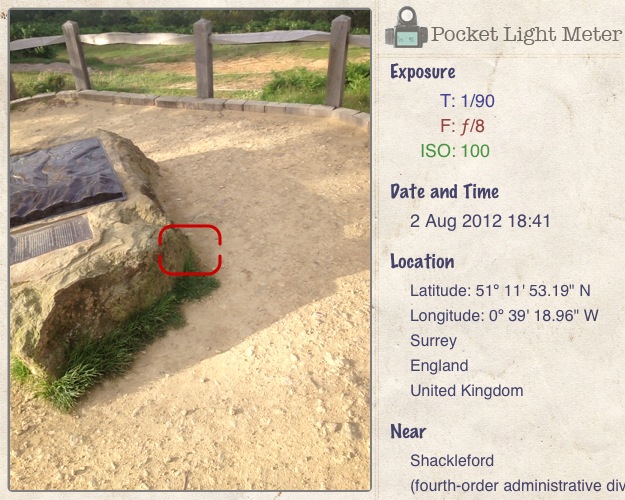
I've stuck a light meter app on my iPhone and one of the options is to take a pic and tag it with the exposure data, so I have a reasonably accurate light meter and a record of settings per picture:

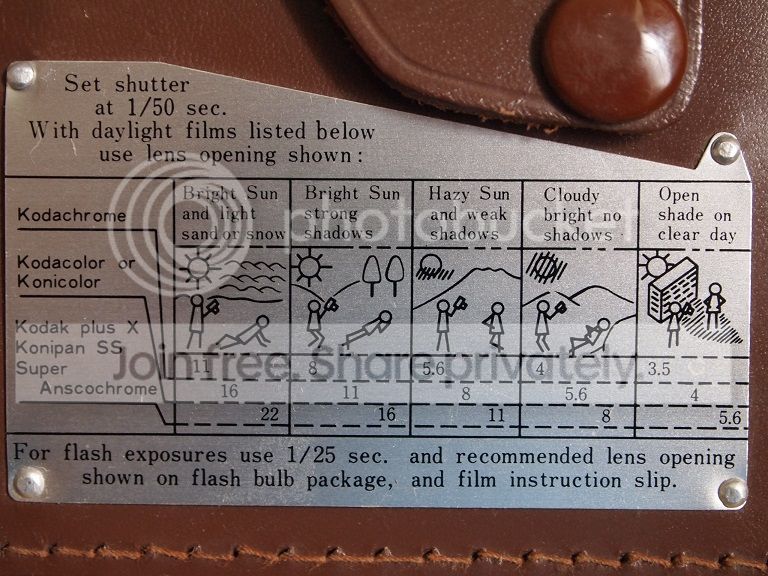
My sunny 16 rule on the back of the camera:
IMG_0032.JPG


example of light meter app:
IMG_0034.JPG
 
I've stuck a light meter app on my iPhone and one of the options is to take a pic and tag it with the exposure data, so I have a reasonably accurate light meter and a record of settings per picture:

My sunny 16 rule on the back of the camera:
IMG_0032.JPG

Thanks puggie. Um, this one is NOT self-explanatory! At least, I couldn't understand the relationship of the top 10 scenes and the numbers against the ISO settings. The bottom line, with EV adjustments for time of day and cloudiness, that makes sense.

example of light meter app:

So the workflow would be: use the lightmeter app to determine exposure parameters, take a snap with it, take a shot with the film camera using the settings, then later cross-match and enter (or import?) the settings into the metadata. Is that right? It sounds very useful! (You also get the GPS coordinates for free.)
 
Right so for example this pic:

Frame%252011.jpg


I'm using Tri-x for ISO 400 and its of something in a shaded area mid to late afternoon.
Subject in the shade is the 4th pic top row, so go down to ASA 400 and you get EV14 (showing 200=13 and 800=15). It was cloudy and mid afternoon so I'd go with -2 compensation looking at the bottom 2 rows. Giving me a final EV of 12, not my rolleicord has a coupled iris and shutter speed setting so I just select EV12 and then choose an appropriate speed/aperture combo, which I would guess may have been F5,6 1/125th.

Its simpler with the Rollei where it directly accepts EV as an input for exposure.

My workflow is as you assumed, you can then easy match the pic to the recorded settings and get a feel for the limits of the meter.
 
I recognise those Wolves. Keep meaning to get over to the Uni and take them myself. Nice shot BTW..
 
If you like, PM me before you do Trevor and I'll meet you for a coffee ('tis my place of work) :)
 
puggie said:
If you like, PM me before you do Trevor and I'll meet you for a coffee ('tis my place of work) :)

Great, thanks. I only live down the road.
 
Thanks puggie. Um, this one is NOT self-explanatory! At least, I couldn't understand the relationship of the top 10 scenes and the numbers against the ISO settings. The bottom line, with EV adjustments for time of day and cloudiness, that makes sense.

My first guess is that it's for a fixed shutter speed camera (probably 1/200th) and you pick the closest scene (sunny day at the beach, street level beneath deep buildings, large interiors) follow it down and cross reference against the film loaded for the correct aperture.

That was my guess, but if that's Puggie's Rolleicord IV then I'm a bit stumped as it has a Synchro Compur MX shutter, not a fixed one. Unless there's a coloured dot against 1/200th and you're supposed to compensate mentally for different shutter speeds?

It's a nice looking Sunny 16 guide, however it works.


The uncoupled meter on the Mamiya Korvette is interesting, colour-coded against the dials.
 
This is the suggested setting for the Konilette - 45mm f/3.5 Konitor lens...

Konilette.jpg


Get them girlie poses :D
 
Well, I've shot a roll of Acros 100 on the Canon QL17, but for various reasons it's not gone in for processing yet. I've kept reasonable notes of conditions so as I can compare results when I do get it back.

However, when my "other camera" came back (one of the unmentionable kind where you can see what's happening straight away), I stuck it in M mode and 100 ISO for the first time and went out in what I guessed at f/11 conditions (hazy sunshine yesterday). The results were... interesting! Sometimes I was going as much as 4 stops wider, quite often 2 or 3 stops, depending on darkness of subject and other conditions. It's making me suspect my BW roll won't be so great when it does come back. Need to digest these results and try and adjust my personal sunny 16 chart (adapted from Parker).

This is turning out to be a good learning experience!
 
I am also trying a similar experiment at the moment on a Ricoh rangefinder camera I found at the car boot which has a broken light meter; I find the sunny 16 rule rather effective, the only downside is when I'm shooting in darker conditions or indoors with different light sources and I'm stuck with what to do!

+1, I've been using this guide for a while. I've been adding "calibration" notes based on the EXIF data from digital shots. I note scenes and times of day that I'm familiar with and that I can compare to a scene in front of me.

When shooting at night it's very handy and much easier to use than any lightmeter. I think I've posted my version of it before which I have as a Word/pdf document and carry a laminated print in my camare bag (if not, you'll find it as a jpg searching for "exposure" in my Flickr stream).

Most of my night shots on film have been based on the Fred Parker guide.

Hello, would it be possible for you to upload this as a document? I found your guide on flickr like you said but I'd also like to print it out to have it with me. If you could that would be great and helpful, thanks! :)
 
Hello, would it be possible for you to upload this as a document? I found your guide on flickr like you said but I'd also like to print it out to have it with me. If you could that would be great and helpful, thanks! :)

I've been meaning to refresh it.. I'll give it a once-over and then upload it ;)
 
I've been meaning to refresh it.. I'll give it a once-over and then upload it ;)

That would be excellent. I've built my own version, but you're right that the scene descriptions are key to the rule. I couldn't read the changes you'd made!

One change I made was to take out the weird moonlight references that appear first and confused me in Parker's guide. I've also cut out stuff that's beyond the dynamic range of my cameras, which obviously makes it less interesting to others with better cameras, tripods etc!

The rule exceptions seem to me to be key, after some experimentation with my X10 on manual (I know, I know, unmentionable and I'll probably get thrown off this forum :eek:, but it's better than waiting a couple of weeks to finish a film, get it back from processing, scan it and then compare with notes taken in the distant past :cuckoo:). Side lit, back lit, dark subjects, dark background, vice versa, etc...

My first sunny 16 film (with QL17 in manual mode, no cheating at all) has gone off now but I'm doubtful of what I'm going to get! I've also run one and a half colour films through the Pentax ME (which has no manual mode) trying to use the Sunny 16 rule to do exposure compensation, or otherwise bracketing. Those will be interesting, too.
 
I use a very basic, *******ised version of it when shooting B&W with my Rolleiflex. Basically pick the darkest area I want detail in, spot meter from it and then give it 3 stops extra. Works OK but the Zone system only really works properly with LF or MF with shots all in the same lighting and exposure.
 
Funny you should mention the zone system.. it's something I added to the reverse of the sheet in a very b'dised fashion. I find the moon references reasonably useful in the descriptions, this type of guide really has the edge over a lightmeter when shooting at night.

The sheet should be available as a PDF on this public Google Drive folder.

It's the first time I've tried using Google Drive to share a file publically, so please tell me if it works or not, and please tell me if you can see enything else! Only one folder and its contents should be accessible!

I'll leave it on GD for a couple of weeks..
 
Back
Top