Mounted Police

JohnC6

Suspended / Banned
Messages
11,799
Name
John
Edit My Images
Yes
Not sure where to post this...WBMT ?. Maybe not.

This afternoon, I was chatting to a neighbour and he said he couldn't recall the last time he'd seen the police round here..either on foot or in a car.

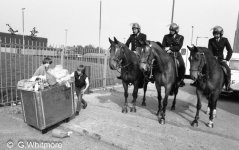
Amazing..as it's 10.17pm..Two mounted police officers have just passed by. The horses have a red light on their tails and a white one to the front. :eek:
 
Just stop oil protesters will be v happy animal rights not so lets try and please everyone
Now theres a challange!!!!
 
I wish the police wouldn't use horses like they do, it must be absolutely terrifying for the beasts to be pelted with stuff, and have to charge into a baying mob as they so often do. Sure they are trained - de-sensitised - to a degree, but only so the riders can control them. Even more the case with Household Cavalry riding them around in central London, it's anachronistic and wrong in my view, just to maintain some dubious ceremonial image.
 
Used to know a recently retired Met mounted copper who first told me where their horses had their female anatomy... And that people generally treated the horses with a lot lore respect than they did the officers on their backs.
 
I am surprised that they still have them considering how much they cost and how little they are used. A LWB Landrover with a water cannon can be parked up between events whereas a horse has a £30k a year jockey and grooms whether it is working or not. On some night shifts I used to drop by the stables and have a cuppa with the night watchman. It is unbelievable how much expense is lavished on that department.

I've been involved in situations when the horses have made a difference, but not many. A dog & handler can do most of what the horses do in public order situations plus a lot more in other capacities.
 
A copper atop a horse has a much higher PoV than even vehicle based officers do (barring HGVs which are of little use in situations where mounted officers are likely to be deployed!) and are far more manoeuvrable too.
 
A copper atop a horse has a much higher PoV than even vehicle based officers do (barring HGVs which are of little use in situations where mounted officers are likely to be deployed!) and are far more manoeuvrable too.
But not as much as a set of drones linked to the Gold/etc commanders wagon.
 
I think that the trick for the police, as any organisation, is knowing when it's time to abandon a tool and when to keep using it.

There's been various TV programmes on the use of horses by police around the world. From these, I gather that they are cost effective. Horse mounted officers are, it's claimed multipurpose, so can combine several duties, which other units would find difficult or require specialised equipment for. In this respect, they are like the dog units.
 
I've been in quite few police stables. The horses are incredibly well cared for and are kept spotlessly clean, but their training is rooted in the century before last - zero understanding of their needs or psychology, they just need to bring themselves up to date, which would involve bringing in outsiders who understand horses, instead of relying on police officers who were trained by police officers, ad Infinium :(

I am surprised that they still have them considering how much they cost and how little they are used. A LWB Landrover with a water cannon can be parked up between events whereas a horse has a £30k a year jockey and grooms whether it is working or not. On some night shifts I used to drop by the stables and have a cuppa with the night watchman. It is unbelievable how much expense is lavished on that department.

I've been involved in situations when the horses have made a difference, but not many. A dog & handler can do most of what the horses do in public order situations plus a lot more in other capacities.
Water cannon are illegal in this country. Ask Boris Johnson, when he was mayor of London he spent millions on them, and of course they were never used.
 
I wish the police wouldn't use horses like they do, it must be absolutely terrifying for the beasts to be pelted with stuff, and have to charge into a baying mob as they so often do. Sure they are trained - de-sensitised - to a degree, but only so the riders can control them. Even more the case with Household Cavalry riding them around in central London, it's anachronistic and wrong in my view, just to maintain some dubious ceremonial image.
I'm with you 100% on that. Coincidently, my wife and I watched a couple of Youtube videos a couple of nights ago about the experiences of the Horse Guardsmen at Horse Guards Parade, Westminster Walk. They do an hour then change. She thinks it's cruel to make the horses stand there for that length of time while strangers want to pat them and idiots want to make fun of the guardsmen.. I agreed with her. I'm also firmly against any sport involving horses. As you'll be aware, Lindsay, they are exceptionally intelligent and sensitive creatures. I really like them. I have a friend who was a civilian driver for the police in Cheltenham and when he was offered overtime at the Cheltenham races he declined the offer because of his opposition to horse racing. Of course, during normal hours he had to go there if directed.
 
I talked o horse cop a couple years ago at an outdoor event. He said for general crowd control there is nothing better. People respect and admire the horses, they spread goodwill and, as mentioned above, they give the officers a great view of crowd. He did say if things start getting dicey they generally pull the horses out.
 
I've been in quite few police stables. The horses are incredibly well cared for and are kept spotlessly clean, but their training is rooted in the century before last - zero understanding of their needs or psychology, they just need to bring themselves up to date, which would involve bringing in outsiders who understand horses, instead of relying on police officers who were trained by police officers, ad Infinium :(


Water cannon are illegal in this country. Ask Boris Johnson, when he was mayor of London he spent millions on them, and of course they were never used.

It was the same with dog training and also can be said about the nepotism of promotion. As for water cannons; it only takes a change of law to be made legal. And there were forces other than London who had some. West Yorkshire had three or four.
 
I'm with you 100% on that. Coincidently, my wife and I watched a couple of Youtube videos a couple of nights ago about the experiences of the Horse Guardsmen at Horse Guards Parade, Westminster Walk. They do an hour then change. She thinks it's cruel to make the horses stand there for that length of time while strangers want to pat them and idiots want to make fun of the guardsmen.. I agreed with her. I'm also firmly against any sport involving horses. As you'll be aware, Lindsay, they are exceptionally intelligent and sensitive creatures. I really like them. I have a friend who was a civilian driver for the police in Cheltenham and when he was offered overtime at the Cheltenham races he declined the offer because of his opposition to horse racing. Of course, during normal hours he had to go there if directed.

The horses chosen for this work aren't the pathetic scared of their own shadows type that you find in some riding stables or in private ownership. Same with police dogs. Those that can't do it don't get selected.

We had a friend who trained horses for three day eventing, show mumping, dressage, point to point and hunting. Anyone remember The Poacher? That was one of his along with Canada's one and only World Championship. The type of horse that you see competing in those top events is a different animal to those we ordinary mortals get to ride.
 
But not as much as a set of drones linked to the Gold/etc commanders wagon.


True but a drone isn't as imposing to those on the ground.
 
It was the same with dog training and also can be said about the nepotism of promotion. As for water cannons; it only takes a change of law to be made legal. And there were forces other than London who had some. West Yorkshire had three or four.
Dog training is something that I know about, and I also used to be involved with a business that supplied specialist equipment to several police forces, as well as to the RAF and the army. The RAF (who supplied trained dogs to C&E) were superb trainers, the army were unbelievably bad, and most of the police forces fell somewhere between the two, the Met was probably better than most but nowhere near the civilian standard.

The general police attitude was that if a dog didn't learn it was useless, get rid of it and start again - zero understanding of dog behaviour, complete inability to recognise that all dogs are individuals and need individual care, individual approaches to training depending on their personality and different rates of learning.

The same comments apply to my other area of knowledge, shooting. The police standards are appalling, in terms of both safety and competence. Basically, they are trained to look menacing and shout at people, which is usually the right way of avoiding a firefight, but if it actually comes to discharging their weapons they simply haven't had anywhere near enough training. When it comes to firearms, the infantry regiments are top of the tree, civilian shooters are generally pretty good and the only thing that the police have going for them is their self-belief.
 
For overall situational awareness for an operational commander, a drone will be better than a horse.
To intimidate/modify behaviour, a armoured horse of 17-18 hands will certainly do the trick. but just because they have been trained and de-sensitised, doesn't take away their instinctual drives as a prey animal, so they will experience great stress in a hostile situation. I don't think it's right to impose that stress on an animal that didn't choose to do the job. All the horses in cavalry regiments around the time of WW1 were desensitised to a degree but were appallingly used and then destroyed for meat to feed the French and Belgians afterwards. I have a real thing about the misuse of animals.
I agree that police horse training and selection will find rather different horses to the average, and pro eventing horses are up there too. But look at the mistreatment dished out by Charlotte DuJardin on her dressage mount, using a lunging whip on its legs to make it do the Spanish walk. Also remember these dressage/event riders use spurs and often Pelham bits, to enforce their will through pain. I once had an olympic rider kicked out of a stables for using two assistants with whips to force a horse through a water jump, when it was literally screaming in fear (making my horse bolt).
I've enjoyed attending race meetings, but I consider steeplechase to be unnecessarily risky sometimes. I prefer, and I think the horses do too, flat and hurdles racing. I honestly think steeplechase is an example of doing something for the expected thrill of an accident/injury - car-crash entertainment if you will.
So maybe I'm a bit mamby pamby about this, but as far as I'm concerned animals need protecting from humans - period.
 
For overall situational awareness for an operational commander, a drone will be better than a horse.
To intimidate/modify behaviour, a armoured horse of 17-18 hands will certainly do the trick. but just because they have been trained and de-sensitised, doesn't take away their instinctual drives as a prey animal, so they will experience great stress in a hostile situation. I don't think it's right to impose that stress on an animal that didn't choose to do the job. All the horses in cavalry regiments around the time of WW1 were desensitised to a degree but were appallingly used and then destroyed for meat to feed the French and Belgians afterwards. I have a real thing about the misuse of animals.
I agree that police horse training and selection will find rather different horses to the average, and pro eventing horses are up there too. But look at the mistreatment dished out by Charlotte DuJardin on her dressage mount, using a lunging whip on its legs to make it do the Spanish walk. Also remember these dressage/event riders use spurs and often Pelham bits, to enforce their will through pain. I once had an olympic rider kicked out of a stables for using two assistants with whips to force a horse through a water jump, when it was literally screaming in fear (making my horse bolt).
I've enjoyed attending race meetings, but I consider steeplechase to be unnecessarily risky sometimes. I prefer, and I think the horses do too, flat and hurdles racing. I honestly think steeplechase is an example of doing something for the expected thrill of an accident/injury - car-crash entertainment if you will.
So maybe I'm a bit mamby pamby about this, but as far as I'm concerned animals need protecting from humans - period.
I feel the same way. I'm involved with a small horse rescue and rehoming charity. I'm a million miles away from being an expert on horses but, over the years, I've seen how damaged they become because of either deliberate cruelty or well-meaning but poor care.

As you say, they are prey animals. They are also herd animals, and when they are in a natural herd situation they gain strength from numbers, even if the number of extra horses is just one, and all members of the herd are alert to dangers and act as lookouts. We keep our horses in small herds of around 6-7, they have enough space to be on their own if they want to be, but have the others for company and protection. They always form hierarchial groups instantly, which gives them extra security, and that's how it should always be done.

But take a horse away from the herd, stick someone on the horse's back, completely restrict its ability to see, move its head, run away etc and it's in a state of constant fear, made worse by being on its own.

The dead giveaway of horse quality of life and rider competence is appearance; if the horse is covered in mud then it's allowed to be a horse, and if the rider looks like a bag of s*** tied up with string then s/he is probably pretty expert. If the horse is beautifully turned out, if the rider is wearing all the gear, and especially spurs, and the horse bridle is very restrictive, then that horse is probably having a very poor life. Riding crops are a good example. Riding crops can be useful for opening gates, but if there are no gates then they have no legitimate purpose:(

The racing industry is probably the worst, they race horses that are too young even to take the weight of a rider, and they keep them completely isolated from each other (to avoid injuries caused by normal horse contact)
 
Last edited:
Dog training is something that I know about, and I also used to be involved with a business that supplied specialist equipment to several police forces, as well as to the RAF and the army. The RAF (who supplied trained dogs to C&E) were superb trainers, the army were unbelievably bad, and most of the police forces fell somewhere between the two, the Met was probably better than most but nowhere near the civilian standard.

The general police attitude was that if a dog didn't learn it was useless, get rid of it and start again - zero understanding of dog behaviour, complete inability to recognise that all dogs are individuals and need individual care, individual approaches to training depending on their personality and different rates of learning.

The same comments apply to my other area of knowledge, shooting. The police standards are appalling, in terms of both safety and competence. Basically, they are trained to look menacing and shout at people, which is usually the right way of avoiding a firefight, but if it actually comes to discharging their weapons they simply haven't had anywhere near enough training. When it comes to firearms, the infantry regiments are top of the tree, civilian shooters are generally pretty good and the only thing that the police have going for them is their self-belief.

The manual of police dog training is designed to get every dog through the course assuming that they start with the right dogs. I would think that the equine side is similar. On the initial dog course there is a lot of wasted time if your dog has a greater ability for learning. Also, in the early days the reward concept is seriously undermined as a result of the dog not being suitiably rewarded because of the handler being required to participate in the training of the other dogs on the course. For the first 7 weeks the dogs remained in kennels when they were paired with a novice handler. That resulted in a serious lack of the bonding required to form a team. I got the impression that in those first 7 weeks the new dogs resented the handlers.

With my second dog I had the opportunity to train him myself prior to starting an initial course. Before my dog had officially been licenced we had won the Criminal Work Shield at our annual open event and came second in our in-force competition. We only actually actively participated in less than 4 weeks of the 14 week initial course. The methods that I used to train Jaf were nothing like those dictated by the manual.

But, the biggest problem is not the initial training. It is the recruitment of the right animals and people. In 2007 during a short spell of light duties brought about by an injury on duty I brought 10 donated dogs and one dog costing £90 into the training school. They all passed out and worked full careers. At that time they had been paying up to three grand each for dogs. They then decided to commence a breeding program that cost £ hundreds of thousands and resulted in less than 10 working police dogs after 4 years. But the Chief Inspector was promoted on the back of its claimed success.
 
The horses used by the Police are one of the few working reasons left for them.

If there was no Police horses would that just mean there are less horses? I think it might.
 
Last edited:
we need to do what a few countries do is a two tier police force with a more military equipped side and a regular side
get rid of horses and start using water cannons
 
My view is that it would be a very good thing if there were far less horses.

According to one of my sources, King Charles has already got rid of many of the ceremonial horses and intends to reduce them to a very small number, which I again think is the right thing to do.

I'm very much on the side of the horses, but my view is that there are far too many, they generally have a very poor life because the vast majority are owned by people who don't care for them properly. Literally anyone can buy a horse, there's no licencing, no space, accommodation or knowledge requirements. Compare that with motor vehicles, which have replaced working horses but which don't throw a hissy fit and do unpredictable things, but which require competence, a driving licence and insurance . . .
 
...Compare that with motor vehicles, which have replaced working horses but which don't throw a hissy fit and do unpredictable things...
Perhaps I've just been unlucky but I've had a few examples contrary to that claim...
  • A month after its MOT test, a car I was driving had the offside front wheel mount come apart and the wheel separate entirely from the car. Luckily, I was driving up a steep hill at the time!
  • I was sent to Coventry, along with nine other people, to pick up a bunch of new cars for our engineers and reps. We set off back to base in convoy. About half an hour into the journey, the car in front of me came to an abrupt halt, the propshaft having literally fallen of the clutch mount! At the end of the day only four of the cars (including mine) made it to head office in fully operational condition.
  • A three month old car had the engine fail dramatically, with one of the end cylinder walls exploding from the block.
  • Another new car, the replacement for the previously mentioned one, was called in for a required "fix" to the front brake mounts, about a month after delivery. I picked it up first thing, set off along the motorway and about ten miles later, both sets of callipers fell off their mounts, more or less simultaneously, at 70MPH.
Those seem like "unpredictable hissy fits" to me. :naughty:
 
Those seem like "unpredictable hissy fits" to me. :naughty:
Fair point, but horses are always unpredictable, any experienced rider can come up with 4 examples from every ride, not from a lifetime of experience:)

Pretty typical is a horse that shies at seeing a plastic bag or a leaf on the ground - it's never seen one before and panics every time:) Good riders will see the "hazard" first and nothing happens, but most riders are far from good, and typically the horses and riders that we see on public roads are the worst of the bunch . . .
 
For anyone who's interested in horses, it's hard to find a better source of info than Lucy Rees.

She has around 1000 acres of wild land in Spain and for many years has had about 30 horses living on it, they are as close to being wild and completely natural horses that can possibly exist, and she is recognised as one of the leading experts.

My youngest daughter, whose degree is in horse behaviour, has spent a long time working with her and with her horses, and they made this video
 
Perhaps I've just been unlucky but I've had a few examples contrary to that claim...
  • A month after its MOT test, a car I was driving had the offside front wheel mount come apart and the wheel separate entirely from the car. Luckily, I was driving up a steep hill at the time!
  • I was sent to Coventry, along with nine other people, to pick up a bunch of new cars for our engineers and reps. We set off back to base in convoy. About half an hour into the journey, the car in front of me came to an abrupt halt, the propshaft having literally fallen of the clutch mount! At the end of the day only four of the cars (including mine) made it to head office in fully operational condition.
  • A three month old car had the engine fail dramatically, with one of the end cylinder walls exploding from the block.
  • Another new car, the replacement for the previously mentioned one, was called in for a required "fix" to the front brake mounts, about a month after delivery. I picked it up first thing, set off along the motorway and about ten miles later, both sets of callipers fell off their mounts, more or less simultaneously, at 70MPH.
Those seem like "unpredictable hissy fits" to me. :naughty:

Austin/Morris/BL or JLR?
 
The common denominator seems to be the SWI...
 
The horses chosen for this work aren't the pathetic scared of their own shadows type that you find in some riding stables or in private ownership. Same with police dogs. Those that can't do it don't get selected.

We had a friend who trained horses for three day eventing, show mumping, dressage, point to point and hunting. Anyone remember The Poacher? That was one of his along with Canada's one and only World Championship. The type of horse that you see competing in those top events is a different animal to those we ordinary mortals get to ride.
I'd ban it all,Clive. How unatural is dressage ?

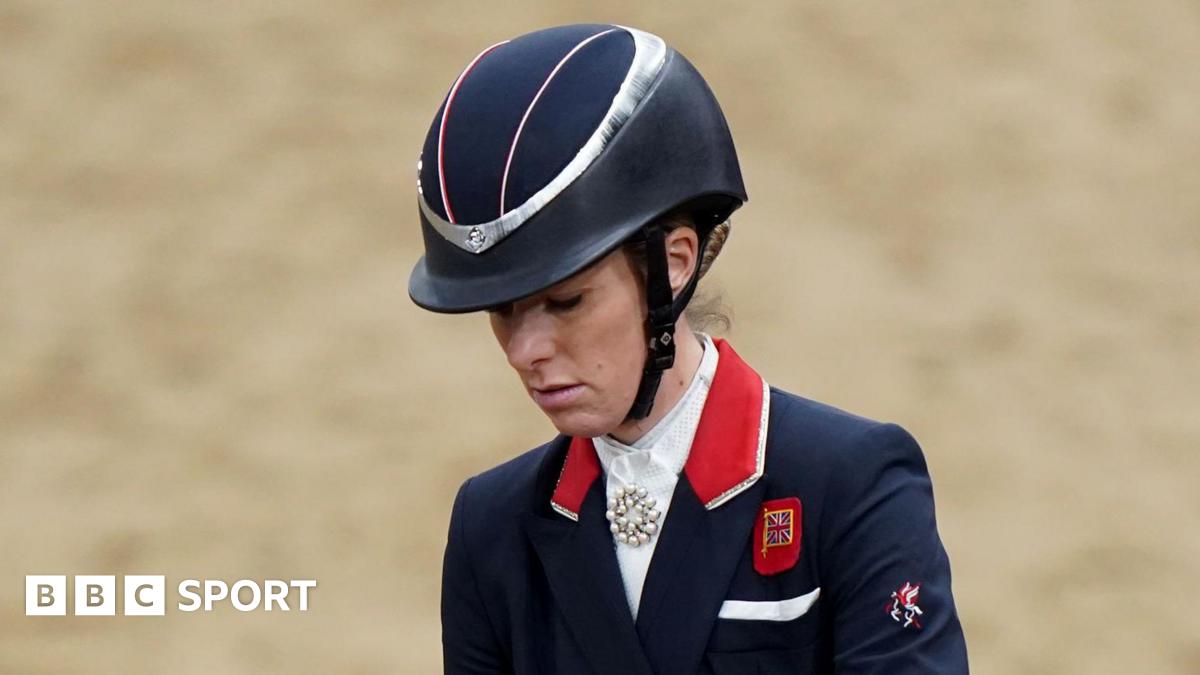
You'll probably recall the incident involving the dressage champion Charlotte Jardine.

Mankind has treated horse appallingly over the centuries taking them into wars.WW1..8million killed WW2. Estimated at 2-3million killed.
 
I'd ban it all,Clive. How unatural is dressage ?

You'll probably recall the incident involving the dressage champion Charlotte Jardine.

Mankind has treated horse appallingly over the centuries taking them into wars.WW1..8million killed WW2. Estimated at 2-3million killed.

Not all horse trainers use cruelty. There is an old 'Out of Town' episode that demonstrates a dancing horse that is obviously loving its routine. Yet that horse had previously been mistreated at a circus and discarded as untrainable.

And where do you stop? Man uses many animal species for work and keeps them as pets. Dog and cat breeds have been designed by man.
 
Dog and cat breeds have been designed by man.
I can't speak for dogs but my guess is that 99%+ of cats are totally un-designed by mummy and daddy cats.

They have. however, evolved subtle powers to control humans without our concious knowledge...

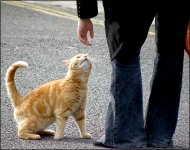
Ginger cat in Swindon SP570uz 4020016.jpg

:naughty: :exit:
 
@Clive K 100% :)

Cruel training methods are usually down to ignorance or economics, or a mixture of both.

Ignorance - a lack of understanding of the instincts, needs and psychology of the animal and belief that a standardised training regime works with all animals.
Economics - it takes far less time, and therefore costs far less, to batter an animal into submission than to encourage it to work with us.

We have a border wallie on our farm, he's a rescue. He is extremely well-bred and has an incredibly strong working instinct and is desperate to please, but his previous owners (a nice farming couple who had no understanding of him at all) simply stuck him in a kennel and spent little or no time with him. They tried to teach him to work sheep but it didn't work, and they eventually sent him away to a sheepdog trainer. He came back from there terrified of sheep, and panicked if they tried to fit a collar and lead. He was also frightened of all men, although he was fine with women.

And, although he was very happy to chase squirrels and rats, he had no interest in chasing a ball.

Pure guesswork, but the indications are that the "trainer" tied him to an experienced dog, which dragged him around chasing sheep, which does work with some dogs but not with others.

A year later and he's a completely different dog, he loves working sheep and is leading a very happy life. He's great. Just two problems remain, and I just can't be bothered to deal with those problems because doing so will cause him stress. He wears a harness because he's fine with a harness and the harness is a good replacement for a collar, and he simply won't go into the house, he has never been inside a house, but that's fine, he has a large kennel and he doesn't need to go indoors. He is however very happy to travel in cars, vans and tractors.

I understand and love dogs. A lifetime ago I competed at championship level in dog obedience, and later I moved to training problem dogs. I don't understand horses at all, but have been told by experts that their training needs are almost identical, my problem is that I can read dog body language very well but can't read horse body language at all, so I can't form a bond with them. The main difference between dogs and horses seems to be that, with a horse, we just need to show it what we want and it then remembers it, but most dogs need far more repetition. Apparently most stallions are similar to dogs in that respect, but stallions are fairly uncommon.

 
I agree with all of that Garry. We used to know a very good horse trainer who pointed out the things to look for. Dog trainers would call some of them pre-cursors, a small change in stance or demeanour that occurs when the animal is considering what to do next, and also the changes that occur in response to a situation that the dog or horse likes or dislikes. Like dogs, the ears are used to read changes of mind set. Also how they position their feet.

My two police dogs were chalk and cheese. They were totally different in character and required totally different training methods. The first one required repetition with a simple possession of the ball reward. The second, I could almost read out what I wanted him to do and he would do it first time just because he wanted to please me.

I wasn't happy with the Manual of Training's method of training dogs to bite. It lead to dogs siezing the arm or sleeve from underneath then putting the brakes on to stop the criminal in an upright position. With my second dog I trained him to run after me from 50 yards away, and sieze a training sleeve held horizontal at shoulder height. I let go of the sleeve when he took it. That made the dog bite high on the arm at full speed and follow through. The training criminals ended up like Superman flying through the air with arm outstretched and 40kg of dog clamped on their upper arm. When we came to do the static knife and gun scenarios he came in full-on at full speed and just wiped them out. On the streets he flattened every one he was sent after. Then released and heeled up at the first command.

Similarly I adapted the send away and re-direct training as the manual's method rarely produced reliable results.
 
Not all horse trainers use cruelty. There is an old 'Out of Town' episode that demonstrates a dancing horse that is obviously loving its routine. Yet that horse had previously been mistreated at a circus and discarded as untrainable.

And where do you stop? Man uses many animal species for work and keeps them as pets. Dog and cat breeds have been designed by man.
Well, I think one place where "you can stop" is horse racing. The friend, I mentioned who, as a civilian, drove the police van to Cheltenham races told me that an insider told him that horses are put down when they could be saved after a fall because if there's a chance they might recover and,of course it's not guaranteed, then the insurance won't pay out. Around 200 horses are killed each year and an unknown number killed in training because they don't make the grade. In the Middle East they have camel racing. I won't outline a whole load more abuses in the horse-racing industry but that death toll is bad enough on its own.

Zoos have a mixed picture because,these days, here in the UK at least, they pay an important role in saving endangered species. This isn't the case in many other countries which is why so many end up here in rehab /rescue centres.I just happen to hear a fact about orcas the other day. In the wild there is no recorded incident of one attacking, let alone killing, a swimmer/diver but plenty when they are held in pools in places like SeaWorld.As of November 28th. last year there have been at least 180 orca deaths in captivity, not including 30 miscarried or still-born calves. SeaWorld holds 18 orcas in its three parks in the United States. At least 44 have died.

On the other hand I don't see a problem with sheep dogs. I watch the trials and ,imo, the dogs clearly enjoy what they're doing. Assistance dogs are fine. Not much to say about the Shire horses used in fields in days gone by and so-called draught horses.

You mentioned cat and dog breeding. Cruelty to be found there too, with some breeds especially those with 'flat-faces'.

It's a mixed bag and both you and I can give examples to support our view and I don't wholly disagree with what you say.
 
Yes, everything about horse racing is cruel, and is an anachronism, I'm very much against over-regulation but IMO it should have been banned years ago, it survives only because of the immense amount of money made from it.

Sheep dogs (Border wallies anyway) are true working dogs, and they love their work. There's an immense amount of training involved when the dogs are at trials standard, but the average border wallie needs very little training because the "want" and the working instinct is so strong - go left, go right, stop, down and move the sheep towards me slowly - basically one dog does the work of a pack of wolves, covering about half a dozen different positions, and the dogs love every minute of both the work and the training.

Sheepdog work is all or nothing - very long days followed by nothing to do, but unlike racing horses, when they aren't working they have a decent life, acting as family dog, guard dog, family member etc. Our own dog doesn't know it, but come lambing very soon, he will be working on next door's farm, there will be a quad bike in front with food on it to lead them and he'll be at the back, separating the pregnant ewes from the rest and controlling their movement, and all that he wants is to hear the magic words "That'll do" at the end, praise and reward:)

But, and this is something that I feel strongly about, working dogs, and especially border collies, are bred for work and usually make very bad pets. Unfortunately, most people buy dogs because of their looks, or high price, and give zero thought to their function.

As for the Kennel Club, I believe that they are indirectly responsible for all the freaks in the dog world, because the winning show dogs are the ones with very exaggerated conformation and body shape, so far removed from their original working purpose that they should never be used as breeding stock and often with zero working capability because of this, but they're the ones that win the prizes.
 
But, and this is something that I feel strongly about, working dogs, and especially border collies, are bred for work and usually make very bad pets.
I agree with that, from personal experience.

When I was eight or nine, my father brought home a border collie, which had been dropped by one of his farmer friends. I don't remember the details, if I ever knew them, but she was a friendly, happy go lucky animal. She was also, it turned out, pretty much untrainable as a domestic pet. After three or four months, if I remember correctly, she was gone. I never found out what happened but, knowing my father, she probably was found a more suitable home.
 
There are vast differences in what people refer to as border collies. The origin of the breed was a working sheepdog 'Old Hemp'. He is the first name in the pedigree. Before a sheepdog litter can be registered with the International Sheepdog Society both parents have to have competed in working trials and gained a level of proficiency. The downside is that in-breeding has caused diseases including PRA and a high level of drive that can lead to pups that don't make the grade as sheepdogs becoming car chasers and other issues.

The Border Collie as defined by the Kennel Club is far removed from that ideal. They just have to conform to breed standards.

In between you have the non registered, often whappy individuals that are not suited to domestic life.
 
Back
Top