Modern Conceptual Photography issues ?

thesmileyone

Suspended / Banned
Messages
158
Name
John
Edit My Images
Yes
I am writing a dissertation and could do with some opinions if you dont mind ?

Looking back to old conceptual photography, as an example, Cindy Shermans work, the concept behind her images was feminism, her images were simple, such as this
media.tumblr.com/tumblr_ku8qnzsWwy1qzs4y4.jpg

Now with the advent of Photoshop people are creating stunning looking images, using blending exposures etc, do you think some of the actual concept is lost ? I keep seeing amazing looking images but cannot fathom the actual concept behind the image. Surely this makes them abstract and therefore not conceptual at all ?

It is my point of view that had Cindy Sherman simply wrote about her feelings towards feminism, her words would be censored or she would have been critiscised...but by using a photograph to get her views across it was alot more effective, as she isnt making a statement but rather the viewer understands the "concept" as a statement against feminimity ?

Many thanks :)
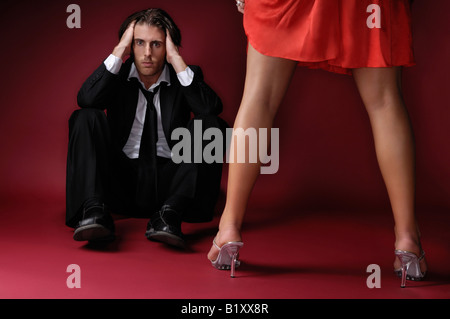
 
To me - and I'd imagine others - the term conceptual refers to stock photography that tries to illustrate a concept ie, 'sexual harrassment'
B1XX8R.jpg

B4E9C6.jpg


Or 'debt'

AT3B2R.jpg

BKTFA7.jpg


So I think you need to be very clear about your terminology.

In response to your actual point, and ignoring whether I believe Sherman was pro or anti feminism, weren't there other writers doing just what you say Sherman would have been censored or criticised for doing? I'd have thought that if you're addressing the effectiveness of Sherman's photographic statements you'd have to give examples of other types of artist who were less effective because of their chosen medium.

The whole photoshop, abstract thing would - to me - be an entire other dissertation about whether these images have as much meaning as traditional photography, low art v high art etc.
 
Hi John

I have read through your post a couple of times and I can see where you are coming from.

Your thoughts about the use of photoshop possibly being responsible for masking the concept behind the image may well be true in some circumstances. However, I really would not necessarily assume that the photographer actually had a concept to start with. This fact becomes very apparent when trawling through photographic forums, including TP.

On the subject of images being abstract and therefore not conceptual at all, then my reaction is “Are you sure about that John?”

I think that ‘fixedimage’ has touched on an interesting point, re “being very clear about terminology”, though, perhaps its more about remembering that things like ‘conceptual’ and ‘abstract’ can be quite subjective.

Anyhow, interesting stuff – Thanks for starting the thread John.

Sam-D
 
Now with the advent of Photoshop people are creating stunning looking images, using blending exposures etc, do you think some of the actual concept is lost ? I keep seeing amazing looking images but cannot fathom the actual concept behind the image. Surely this makes them abstract and therefore not conceptual at all ?

Is the fault with:
  • The technology;
  • The artist; or
  • The viewer?
I can't see how the problem in identifying with the concept can come from the technology, only in the way the artist chooses to apply it and/or the ability of the viewer to understand it - which could be a fault with the visual vocabulary of either the artist or the viewer.

Have you got any specific, modern, conceptual photographers (within a definition that would include Cindy Sherman) that act as an example to your dissertation?
 
Andreas Gursky creates his own images using image manipulation software from prints taken on a film camera. He makes his own reality yet makes it look real. This is conceptual in a way that the concept is what he sees as an ideal or his own reality of the world, yet he isnt adressing an issue (or atleast he hasnt said that he is) yet he does make you think, through his work.

This is an example of how modern technology has changed conceptualism as he wouldnt be able to create the images without it.

Even if he tried painting, it wouldnt look as real as it does in pixel format.
 
Gursky always seemed more of a documentary photographer (tending as you say, to the abstract) than a conceptual artist to me (I'd always figured that his photoshopping was more used to enable his large mosaics to be constructed from a practical point of view).

There's plenty of conceptual photographers who are as direct as Sherman working today - like Gillian Wearing. I'm not certain that Cindy Sherman would have been censored had she written about feminism at that time (there were plenty of others that did) just that with her background as an artist, conceptual self-portrait photography was the best way for her to communicate her message.

I can't really agree with your starting point - it seems a bit of a strawman argument to take photographers who haven't said that they're working conceptually, and then argue that conceptual photography has become obscure on that basis.
 
Digital photography in general has made the genre more accessible but that doesn't actually foster an increase in the instance of genuinely creative people. It just gives an apparant over-abundance in the more common forms of expression. More importantly, perhaps, is the fact that modern marketing needs skew the presented content toward the most consumed, the middle of the bell curve, making it seem as if conceptual work is in retreat. There's probably been an increase in absolute terms simply because there's more people doing photography but unless the media show this it wont actaully be apparent.
 
Back
Top