Misconceptions of Vintage

Ian Grant

Suspended / Banned
Messages
108
Name
Ian Grant
Edit My Images
No
When it comes to photographic equipment there is some overall consensus.

1. Film cameras per see are not Vintage, although of course some are.

Think Beer, all are Ales, but not all Ales are Beers. Beers contain Hops, Ales used a variety of bittering agents, including Hops.

So where is a line drawn, typicall pre 1964 is roughly vintage with 35mm SLR cameras, and around 1972 with lenses and Multi-Coating. But then a 1954 Leica M3 is barely vintage, we can still buy new lenses for them and they still have service support.

Most early Medium Format SLR cameras are unreliable, the Hasselblad 500C was the first reliable camera followed by the Bronica S2a, while old they are not vintage cameras.

A vintage MF SLP camera would be something like a Reflex Korelle, or the post WWII Agiflex copy.

Large format, well vintage is930s and older. But even then a Century 5x4 camera (and similar US camera) can take modern 5x4 DDS. The US standarised their plate (&film) holders in the very early 1900s, here in the UK we had no standar until after WWII, it was the same in Europe. Then we adopted the US standard.

So pre-WW2 British LF cameras are definitely vintage.

Film cameras of various formats are still being made, and there are plenty on the second hand market. Because they are not digital does not make them vintage.


2. Lenses

With 35mm lenses Vintage is generally pre-Multi Coating, prior to that many Wide Angle lenses and almost all Zooms were quite low contrast.

It’s also about early disigns, think 58mm f2 Biotar, 58mm f1.9 Primoplan,55mm 50mm Pancolar, etc, longer FL Triplets Triotar, Triplan etc.

Sticking a film camera lens on a Digital camera does not make it Vintage, particularly if it’s a modern Multi-Coated lens. It’s just a cheap lens solution :D Nothing wrong with that.


3. When is a lens really Vintage

Perhaps when it really is old and gives a Vintage look, uncoated, but even then that’s a personal perspective. Even that varies with design.

Perhaps I’m lucky I have a Dallmeyer Stigmatic II No 5 lens, and have photographs of Alec Strachan, who made it, he worked for Dallmeyer from 1860 to 1910.

Bottom line, no Multi Coated lens is vintage, just because it doesn’t fit a different manufacturers Digital camera.

Ian
 
Last edited:
It’s simple. Anything before I was born is vintage. Anything before I got into photography is retro. Anything more recent than my gear is new.
 
Many auctioneers go with;
>100 years = Antique,
<100 years but older than 30-40 years = Vintage
and retro is at least 20 years old

I think its pretty subjective though depending on what you're talking about.
 
Last edited:
I think Ian is just presenting his own definitions. Other people may have different opnions and I don't set any store by it. And I have no idea what ale or beer has to do with it.

But, it reminds me of a former colleague who was miffed that his 1970's Datsun did not qualify as a classic car in a local show. He was told that it was undeniably vintage, but would never be regarded as classic. :D
 
2. Lenses

With 35mm lenses Vintage is generally pre-Multi Coating, prior to that many Wide Angle lenses and almost all Zooms were quite low contrast.

It’s also about early disigns, think 58mm f2 Biotar, 58mm f1.9 Primoplan,55mm 50mm Pancolar, etc, longer FL Triplets Triotar, Triplan etc.
These are your assertions. But I can't see that the term vintage has such a precise meaning. It's just one of those casual 'flavour' adjectives.

Ryan's post #4 above is about as clear as it gets ...
 
It's all semantics. A definition is fine but it's in the eye of the beholder unless you are an auctioneer.

I understand that the term "vintage" can be defined simply by age, certainly by the trade and organisations including collectors, etc. Whereas Ian is introducing other random criteria including whether the item still can still be serviced by the manufacturer and general reliability.

"Classic" however is as lindsay describes; a personal value sometimes influenced by social and printed media, clubs and associations, etc.
 
These are your assertions. But I can't see that the term vintage has such a precise meaning. It's just one of those casual 'flavour' adjectives.

Ryan's post #4 above is about as clear as it gets ...

No, that's actually not my assertions at all, that's my observations after viewing many YouTube videos, yes it is one of those casual "flavour" adjectives

Ryan's post #4 is very close to my own perspective, maybe because I might be older I see that vintage criteria to be 50-60 years.

That's based on experience, and the response from others seeing images made with various lenses, assuming they were new, despite being between 50-160 years old.

Ian
 
Does 'classic' fit somewhere in between vintage & retro then? :ROFLMAO: :ROFLMAO:
I think it depends on which bats, in which belfries are ring-ding-a-dinging which bells... :tumbleweed:
 
For cars the strict definition of vintage is made before 1931, except as below, but even auctioneers will call newer cars vintage in their descriptions
(Veterans are pre-1904 followed by Edwardians)
Post vintage thoroughbreds, classics, and retro follow depending on the years of your youth !

Cameras were in use before cars but the earliest examples of both can still be used. I hope we can keep it that way
 
For cars the strict definition of vintage is made before 1931, except as below, but even auctioneers will call newer cars vintage in their descriptions
(Veterans are pre-1904 followed by Edwardians)
Post vintage thoroughbreds, classics, and retro follow depending on the years of your youth !

For motorcycles, the Vintage Motor Cycle Club says generously that “it encompasses any motorcycle over 25 years old on an annual rolling basis”


The Sunbeam Club goes with the narrower 1915 to 1931 definition, but my dad was always more active in the VMCC so I am happy with theirs :D
 
Last edited:
No, that's actually not my assertions at all, that's my observations after viewing many YouTube videos, yes it is one of those casual "flavour" adjectives

Ryan's post #4 is very close to my own perspective, maybe because I might be older I see that vintage criteria to be 50-60 years.

That's based on experience, and the response from others seeing images made with various lenses, assuming they were new, despite being between 50-160 years old.

Ian

Ah. So your opinion is based on that irrefutable font of knowledge: youtube

That explains it. :rolleyes:
 
Vintage is anything over 25 years technically but then this can apply very loosely.

Like my Gibson Les Paul is 25 years old now, it's "vintage" but when referred to guitars, people associate vintage to 50's and early 60's guitars.

Cameras....I think of it as manual ones, that's about it.
 
Ah. So your opinion is based on that irrefutable font of knowledge: youtube

That explains it. :rolleyes:

My opinion is not based on any YouTubers, it's very much deeper, based on decades in photography. My actual thoughts are that most of the YouTube videos are obsessive.

Definitions of vintage are quite fluid when it comes to photographic equipment, Since the invention of Dry plates in 1871 by Richard Maddox there have been various step changes in camera and lens development. The first SLR cameras were introduced in the early1900s, a TLR not long after,

Of course the major change is the first 35mm camera the Leica, that forced film companies to greatly improve their emulsions. Ilford's 1935 Fine Grain Panchromatic )FP), & Hypersensitive Panchromatic (HP) were the first of a new generation of high quality films, Ilford still make their successors FP4 & HP5.

A firther step change is the 1936 Kine Exacta, the first 35mm SLR, then the Cintax/Pentaco SLR, and in 1952 the KW Praktina the first full professional SLR system. Unlike the Exacta the Praktina system included motor drives, bulk film backs, and a vast array of lenses from multiple manufacturers.

The next step change was modern Japanese SLRs, the Nikon F system introduced in 1959, the Pentax Spotmatic in 1964, and similar cameras for other Japanese manufacturers.

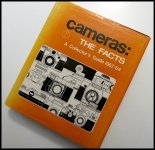
Focal Press published 3 editions of a book "CAMERAS THE FACTS HOW they work WHAT they do HOW they Compare", 1957, 1960, & 1963/4.

Not every camera then available new is in these books, which are essentially 2-4 page précis of different cameras, taken from the small Focal Press camera guides. Comparing these 3 books is interesting because you see the demise of the 120 folding cameras, the collapse of German camera manufacture, and by 1963/4 the beginning of Japanese dominance with rangefinder and SLP camera.

From my perspective from 1963/4 is the modern era of camera manufacture, yes there were improvements and refinements, various auto modes added, I see Vintage as prior to this. Yes sure a 1960s film camera is retro to compare to much later film cameras and DSLRs but still capable of extremely high quality results.

Of course someone younger who has only used digital camera could have a different perspective, but when you see how many young people are buying film cameras and lenses at camera fairs they have different perspectives.

Ian
 
Last edited:
Since the invention of Dry plates in 1971 by Richard Maddox
Cor blimey! That bloke was a genius; dead for 69 years and still inventing stuff!
 
"Cameras: the Facts" is a useful reference for what might be called "The SLR Revolution" but I don't find the line drawings as much fun as a book with photographs of the cameras. My copy is the 1981 reprint...

Cameras the Facts front cover FZ82 P1010842.jpeg
 
Last edited:
From my perspective from 1963/4 is the modern era of camera manufacture, yes there were improvements and refinements, various auto modes added, I see Vintage as prior to this. Yes sure a 1960s film camera is retro to compare to much later film cameras and DSLRs but still capable of extremely high quality results.
You're talking 60+ years in your definition of 'modern' cameras. I personally think that is stretching it a bit.
Maybe the mid 60's was the peak of the film camera technology adoption lifecycle but I would say its a completely separate technological era from digital and worlds away from actual modern digital cameras.
Are 60's cameras modern in terms of photographic film capture technology? Sure, in the same way current mirrorless cameras are modern compared to the first CCD sensors developed in the late 70's. Those early CCD sensors could still be considered vintage in the digital era so I think technological eras that came before the advent of digital could validly be considered vintage.
 
Can we introduce those dancing angels and their amazing performing pin head at this point?

:tumbleweed:
 
"Cameras: the Facts" is a useful reference for what might be called "The SLR Revolution" but I don't find the line drawings as much fun as a book with photographs of the cameras. My copy is the 1981 reprint...

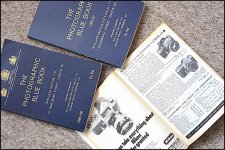
I never came across the reprint. I picked up 2 Blue Books for £1 each at a camera fair, one from the US 1985, the other Hove International 1994-1995. The US book has far more photographs, and higher quality. The original Blue Book was actually the Wallace & Heaton catalogue. 1971-2 expensive 20p.

The other great resource is the British Journal Phorographic Almanac, I have every copy from 1920063, after that it became the BJP Annual. I have a few pre 1920 copies as well.

Ian
 
You're talking 60+ years in your definition of 'modern' cameras. I personally think that is stretching it a bit.
Maybe the mid 60's was the peak of the film camera technology adoption lifecycle but I would say its a completely separate technological era from digital and worlds away from actual modern digital cameras.
Are 60's cameras modern in terms of photographic film capture technology? Sure, in the same way current mirrorless cameras are modern compared to the first CCD sensors developed in the late 70's. Those early CCD sensors could still be considered vintage in the digital era so I think technological eras that came before the advent of digital could validly be considered vintage.

You need to have a knowledge of pre 1963/4 cameras, there really was a massive improvement in terms of quality and handling, reliability, also lens quality.

Film cameras and Digital cameras are different media, I use both. My preference is 5x4 sheet film, sometimes 10x8, and my Rolleiflex TLRs.

Ian
 

Yes, I went into their shop in New Bond Street a couple of times, maybe 1970/1, and it was an amazing store. I went in again after Dixon's bought the company and it had gone downhill.

I didn't realise Wallace & Heaton had taken over or merged with City Sales & Exchange, They were a large retailer 19 pages of adverts in the 1915 BJP Almanac. It seems they had merged by 1954 with 7 stores in London, 3 under the W&H name, 4 City Sales & Exchange.

Ian
 
My opinion is not based on any YouTubers, it's very much deeper, based on decades in photography. My actual thoughts are that most of the YouTube videos are obsessive.

Definitions of vintage are quite fluid when it comes to photographic equipment, Since the invention of Dry plates in 1871 by Richard Maddox there have been various step changes in camera and lens development. The first SLR cameras were introduced in the early1900s, a TLR not long after,

Of course the major change is the first 35mm camera the Leica, that forced film companies to greatly improve their emulsions. Ilford's 1935 Fine Grain Panchromatic )FP), & Hypersensitive Panchromatic (HP) were the first of a new generation of high quality films, Ilford still make their successors FP4 & HP5.

A firther step change is the 1936 Kine Exacta, the first 35mm SLR, then the Cintax/Pentaco SLR, and in 1952 the KW Praktina the first full professional SLR system. Unlike the Exacta the Praktina system included motor drives, bulk film backs, and a vast array of lenses from multiple manufacturers.

The next step change was modern Japanese SLRs, the Nikon F system introduced in 1959, the Pentax Spotmatic in 1964, and similar cameras for other Japanese manufacturers.

Focal Press published 3 editions of a book "CAMERAS THE FACTS HOW they work WHAT they do HOW they Compare", 1957, 1960, & 1963/4.

Not every camera then available new is in these books, which are essentially 2-4 page précis of different cameras, taken from the small Focal Press camera guides. Comparing these 3 books is interesting because you see the demise of the 120 folding cameras, the collapse of German camera manufacture, and by 1963/4 the beginning of Japanese dominance with rangefinder and SLP camera.

From my perspective from 1963/4 is the modern era of camera manufacture, yes there were improvements and refinements, various auto modes added, I see Vintage as prior to this. Yes sure a 1960s film camera is retro to compare to much later film cameras and DSLRs but still capable of extremely high quality results.

Of course someone younger who has only used digital camera could have a different perspective, but when you see how many young people are buying film cameras and lenses at camera fairs they have different perspectives.

Ian

Sorry, but all that is waffle. You said in your post that you had come to the conclusions about what you think is vintage after viewing many Youtube videos. Now you are saying that you have not based your opinion on any Youtube videos. You are contradicting yourself.

Basically you have an opinion on what is vintage and what is not vintage. That is fine. It is your personal opinion. As you are now aware, many disagree with your opinion. However, in creating this thread in the way that you have and then your trying to justify your posting of a photo taken with a vintage lens on a vintage or antique camera on a thread created for modern cameras demonstrates your total lack of understanding other people's valid opinions.
 
You're talking 60+ years in your definition of 'modern' cameras. I personally think that is stretching it a bit.
Maybe the mid 60's was the peak of the film camera technology adoption lifecycle but I would say its a completely separate technological era from digital and worlds away from actual modern digital cameras.
Are 60's cameras modern in terms of photographic film capture technology? Sure, in the same way current mirrorless cameras are modern compared to the first CCD sensors developed in the late 70's. Those early CCD sensors could still be considered vintage in the digital era so I think technological eras that came before the advent of digital could validly be considered vintage.

You need to have a knowledge of pre 1963/4 cameras, there really was a massive improvement in terms of quality and handling, reliability, also lens quality.

Film cameras and Digital cameras are different media, I use both. My preference is 5x4 sheet film, sometimes 10x8, and my Rolleiflex TLRs.
Well you've convinced me, thanks for the education. /s>
 
Anything over 20 years old
It comes from the French
Vingt age anglicised to Vintage
 
Sorry, but all that is waffle. You said in your post that you had come to the conclusions about what you think is vintage after viewing many Youtube videos. Now you are saying that you have not based your opinion on any Youtube videos. You are contradicting yourself.

Basically you have an opinion on what is vintage and what is not vintage. That is fine. It is your personal opinion. As you are now aware, many disagree with your opinion. However, in creating this thread in the way that you have and then your trying to justify your posting of a photo taken with a vintage lens on a vintage or antique camera on a thread created for modern cameras demonstrates your total lack of understanding other people's valid opinions.

I said observations from watching Videos, these were of other people's opinions on vintage lenses. I'm not particularly interested in those lenses I mentioned but they are mostly from pre-1963/4..

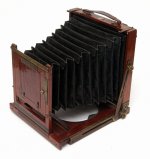
From my point of view "Vintage" is early wood and brass cameras, Quarter plate to 12"x10" early SLRs, 120, Quarter plate, and larger, up to Half plate. That also includes lenses going back to the 1860s.

redfern000sm.jpg


So that greatly colours my opinions of what's vintage or modern.

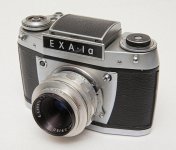
exa1a06sm.jpg

exa1a04sm.jpg

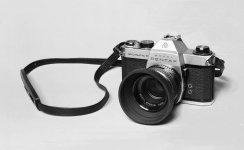
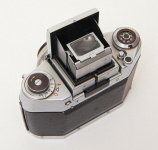
So yes I consider this Exa 1a camera as Vintage.

spotF-sm.jpg

But to me this is "Modern" OK some might sat Retrp.

Ian
 
I said observations from watching Videos, these were of other people's opinions on vintage lenses. I'm not particularly interested in those lenses I mentioned but they are mostly from pre-1963/4..

From my point of view "Vintage" is early wood and brass cameras, Quarter plate to 12"x10" early SLRs, 120, Quarter plate, and larger, up to Half plate. That also includes lenses going back to the 1860s.

View attachment 472784


So that greatly colours my opinions of what's vintage or modern.

View attachment 472781

View attachment 472782

So yes I consider this Exa 1a camera as Vintage.

View attachment 472783

But to me this is "Modern" OK some might sat Retrp.

Ian

Ian, you can twist and turn and waffle all that you want. You are just digging a deeper hole for yourself. But the crux is that you, I nor anybody else has the definitive opinion on what is vintage and what isn't. The difference is that only you thinks that you have and only you tries to impose your views on everybody else.

I'm about to make use of the ignore function. Your opinions have nothing of interest to me. I won't be reading any more of them.
 
Last edited:
All film cameras are vintage. The last being vintage'ish. It was only digital that defined a new age.
 
Back
Top