Mirror Lenses

newyorkaddict

Suspended / Banned
Messages
635
Name
Darren
Edit My Images
Yes
As above, what are the advantages/disadvantages? Why are they so cheap for such big Zooms? Any info would be helpful. Was looking at some on EBAY for shooting Astro stuff with, would they be any good for this or am i wasting my money:thinking:
 
If you're on a budget and intend to shop around for a really long tele lens you may have noticed a quite strange rep of the species - mirror lenses. For photographic usage there're usually 500mm f/8 mirrors but there're also faster versions like 500mm f/5.6 and with extreme focal lengths like 1000mm f/11. Naturally mirror lenses are also widely used for astronomic purposes.

Mirror lenses are comparatively small - e.g. a 500mm f/8 mirror is about as "big" and light-weight as a mid-range standard zoom. The focal length is extremely interesting for wildlife photography and the price is usually hot - very hot. At around 200-400 Euro/$ this is certainly the very cheapest option in this range. So is it crap or really something worth to be considered ?

In order to impress you here's a shot with a Tokina 500mm f/8 mirror lens:
Looks pretty good, doesn't it ? But it tells only part of the story - the shot above was taken under optimal conditions. More on this later.

Let's have a look at the principal design of a mirror lens first. As the name implies these lenses are mainly based on mirrors rather than glass elements. Incoming light gets reflected by a main mirror (located at the back of the lens) towards a small secondary mirror (at the front) which then reflects the light back towards the film via a correction (glass) element. The lack of glass elements (apart from the correction element) is a significant design advantage compared to classic (refractive) lenses - chromatic aberrations (visible as color shadows) are virtually absent. Looking at the illustration below you may notice that the light path gets folded. This is the reason why these lenses offer such a long focal length while keeping a very small length. Dependent on the configuration the main mirror can be pretty large so while quite short most mirrors tend to be rather fat as well. 500/8 mirrors remain pretty compact but e.g. 500/5.6 or 1000/11 mirrors are about as large in diameter as the width of an SLR.


Unfortunately the design results also in some significant disadvantages like

no aperture so it's not possible to control the depth-of-field.
the mirror reflections eat contrast
the overall sharpness is usually quite mediocre

the secondary mirror produces an odd effect donut-like effect on the out-of-focus high-lights. The following picture illustrates this problem.


Taken from www.photozone.de
 
I had one many years ago when into film , think it was a Centon , they are usually MF only and Max F8 , hard to focus from darkly lit viewfinder , lightweight though , the best reports I have seen are for the Sony/Minolta AF models around £500 .
Generally the usual advice is not to expect good IQ from mirror lens I think .
 
Advantages:

Cheap
Light weight compared to conventional lens.
Cheap
Short compared to conventional lens.
Cheap

Disadvantages:

Fixed aperture (typically f/8)
Difficult to focus really accurately except in really bright conditions.
Lower IQ than conventional lens
Characteristic donut shaped out of focus highlights.

Whilst I have little experience of astro work, I really don't think that a cat lens is the answer. I suspect that for any serious work of this kind you would be better advised to get a telescope and adapter to fit your camera to it.

Did I mention that they are cheap?
 
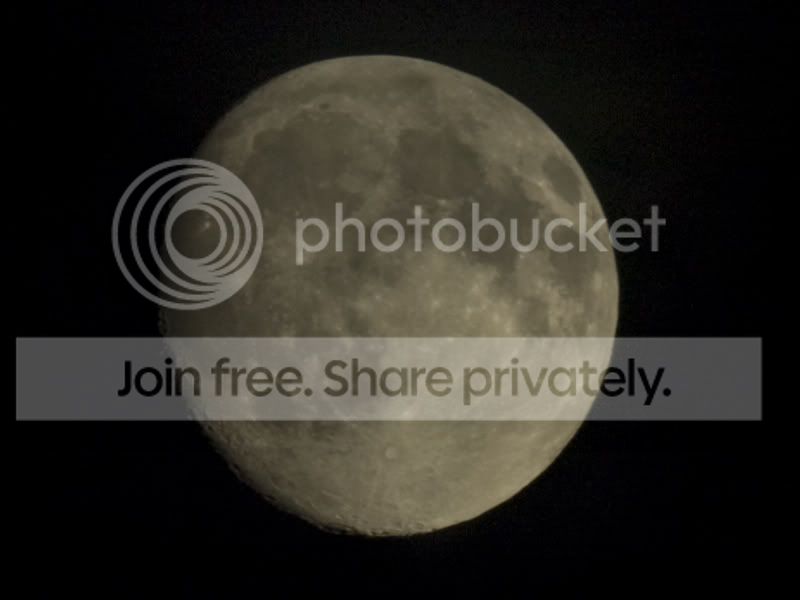
i have a tamron 500mm and havent really used it much yet (had a little play ) the only one i have put on the net was a moon shot, and it is straight from camera (except converting to jpg and cropped - no lightening or sharpening etc at all.)

newmoon.jpg


weather permitting I am taking it to the safari park tomorrow, will post some more at the weekend hopefully
 
It's pretty well all been covered I think but the fixed aperture of f8, or sometimes even f11, means you're struggling in all but the best light for a usable shutter speed. Whilst the price may seem attractive, you'll find that in use it will prove frustrating.
 
Back
Top