Metering for aircraft in flight etc.

Frosticles

Suspended / Banned
Messages
390
Name
Kevin
Edit My Images
Yes
Took my first shots of aircraft on Saturday during Forces Day. In PP I had to apply a lot of shadow rescue in Lightroom 5. I am currently using evaluative metering. Should I really be using spot metering along with spot or centre focus? Camera is a 7d & lens is the 100-400L.

Many thanks, Kevin.
 
I use spot metering for targets like that and also birds in flight
 
Spot just exposes for the subject & ignores the surroundings?
 
Three modes of metering - full frame, centre weighted and spot.

Full frame - average across the entire frame
Centre weighted - across the entire frame, but biased towards a centre circle
Spot - just uses a central circular area, how big or small this is varies between cameras and on some you can adjust its size

Things to be aware of.... colour is light, different colours reflect different amounts of light. Using spot metering and just metering from the colour (or partial colour) of your subject could blow the rest to pieces (thats more of a motorsport type comment)

That being said, against a bright blue sky or white clouds, using anything that hits those areas will under expose the subject.

Use spot for aircraft, but make sure you understand the size of the spot and ensure your target is covered by the spot - which is what I expect you are suffering from - your subject is too small in the viewfinder, so not actually covering the spot. Don't know if you can reduce its size on a 7D?
 
Thank you. I was using evaluative metering (Full) as I usually do but, because of the bright sky, tended to under expose the aircraft which took a lot of recovering in PP. I will have a play with spot & see how it goes. Hopefully I can hit a compromise somewhere.

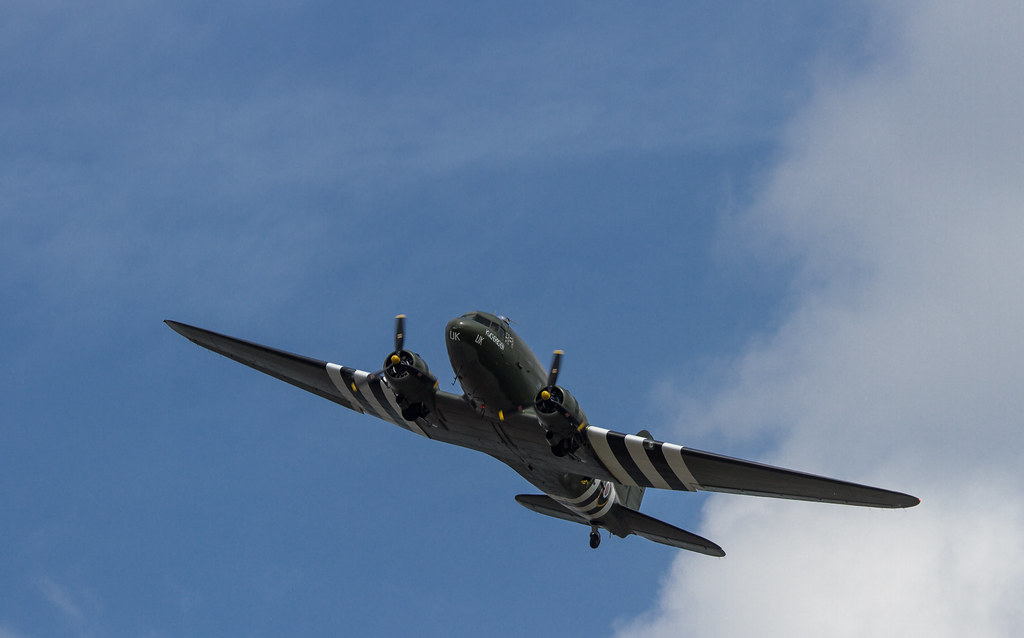
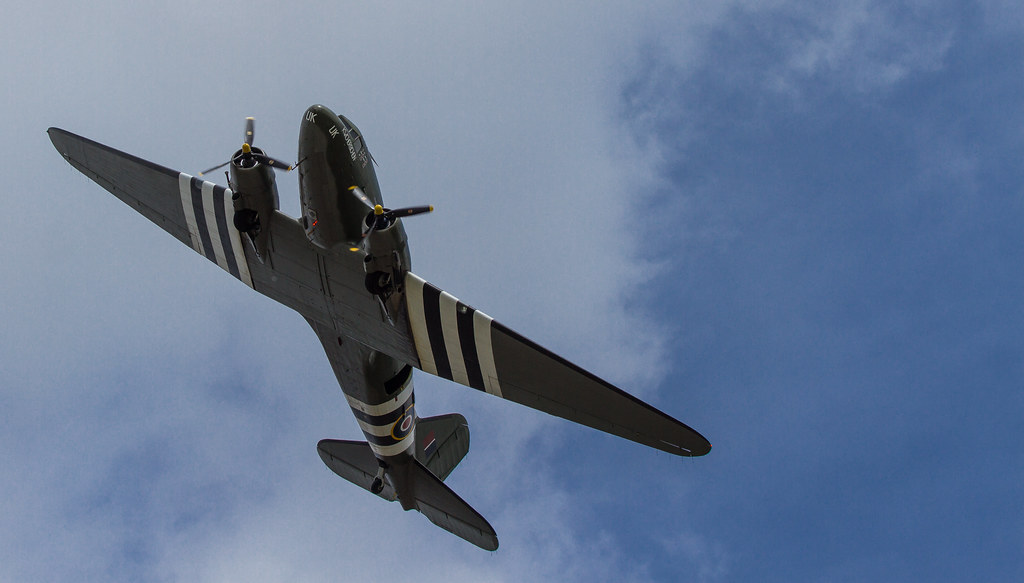
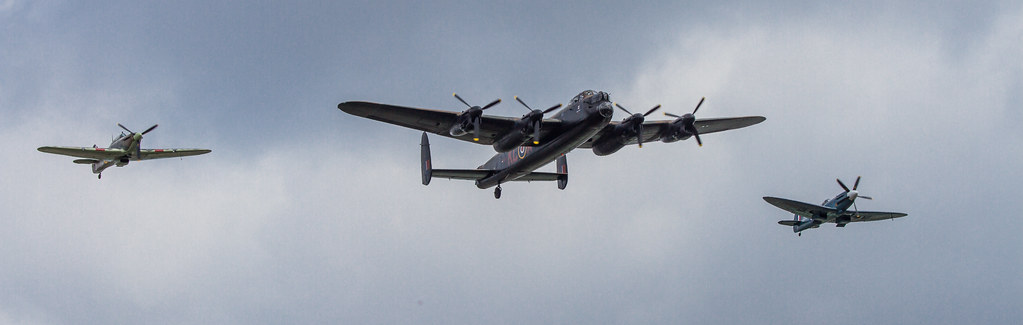
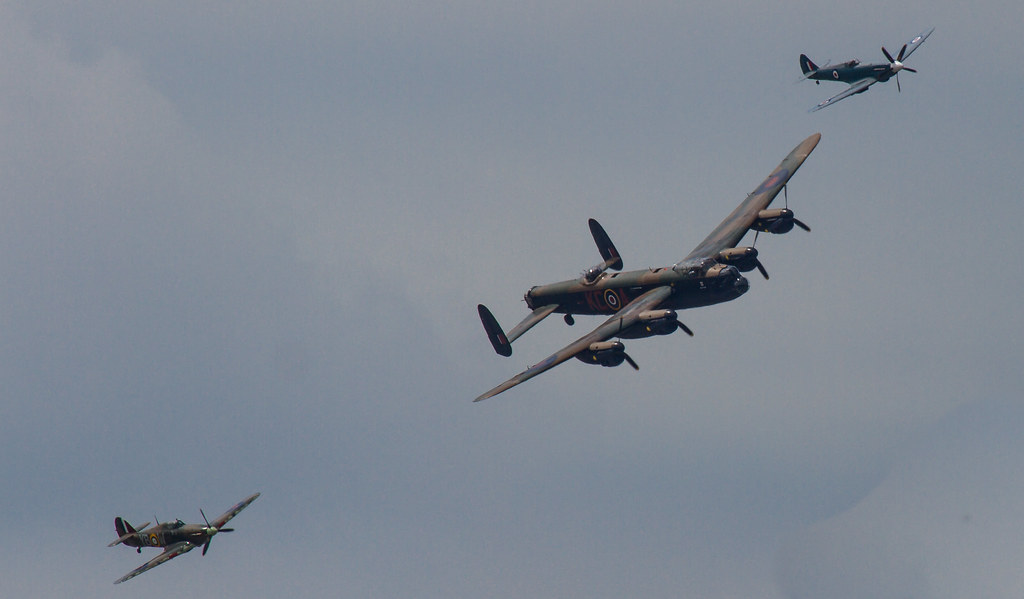
Some of the pics I took on Saturday. Comments more than welcome. :thumbs:


Dakota by kevaruka, on Flickr


Dakota by kevaruka, on Flickr


Lancaster, Spitfire & Hurricane Trio by kevaruka, on Flickr


Lancaster, Spitfire & Hurricane Trio by kevaruka, on Flickr
 
Would it not be easier to just use exposure compensation at the time to lift the images a bit rather than relying on spot metering?
[/newb]
 
I suppose you could, but I'm sure the difference between a bright sky and the aircraft is probably beyond the +/- 3 EV that exp comp gives you - assuming its 3, I can't remember ever pushing that too much.
 
Would it not be easier to just use exposure compensation at the time to lift the images a bit rather than relying on spot metering?
[/newb]

I don't want to blow the sky. :( Do use ETTR sometimes, certainly when it is darker. On a bright day though which is forecast I will have a go with spot & take it from there.
 
I would say that the props need more motion blur. I posted my shots from my first air show last year and attracted just that comment. Try a slower shutter speed
 
I use centre weighted average for aircraft, your shutter speed is much too high for prop stuff.
 
Personally, I don't have an problems with the normal Evaluative metering.
Spot, however causes issues big time.
Airshows are in effect a series of fly pasts, and the biggest bit you see in gernal is the underside of the aircraft. Thats in shadow, so spot meter will do what it says on the tin, but the top side of the aircraft gets blasted out of all recognition.

EV metering will look at both, and give you a reasonable result, although it's always going to be a comprimise.

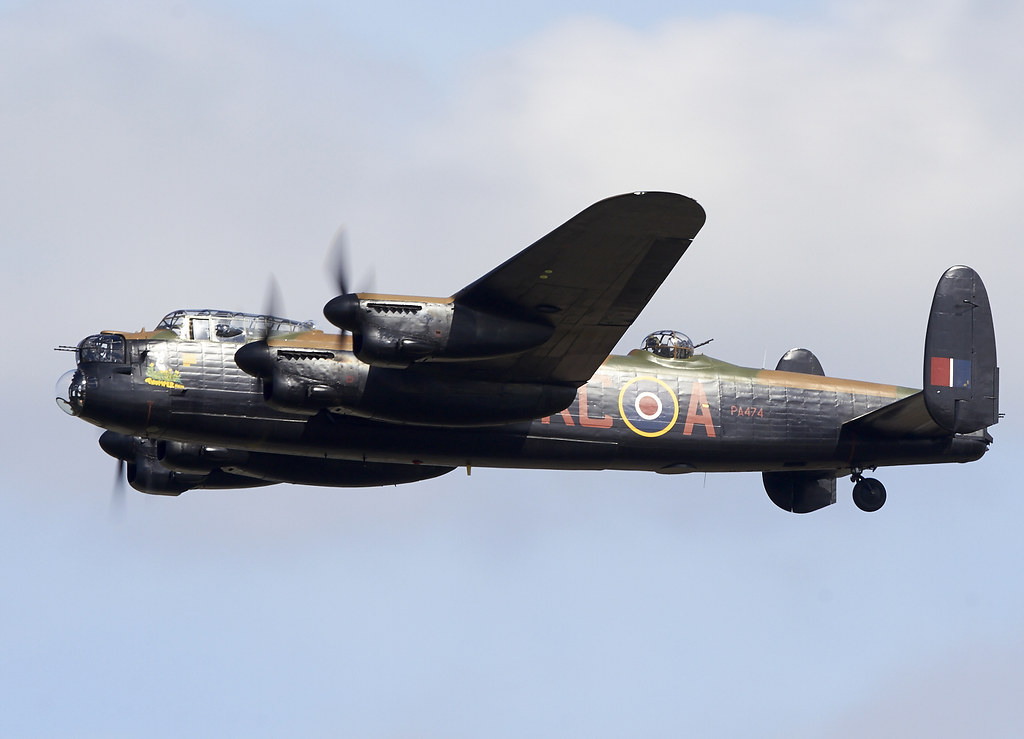
The Lanc is a good example of why spot metering just wont do it. It's black on the underside, but EV metering did worked fine.

8711564690_8dbbe887b7_b.jpg


Obviously, the position of the sun is key though. Although if you're going to an airshow, the Sun only appears as you are leaving!
 
Again a late reply as I'm new to this Forum, but can add something to this thread in case anyone is ever searching for info.

I do a lot of low level photography in the Mach Loop, I've tried most of the metering options and - apart from spot- don't seem top find much difference. When I did try spot I had problems for reasons outlined already. If we get planes that are high I usually dial in up to +2 exp comp depending on whether it's a blue or white sky.

Regards

Alchad
 
even with spot metering,i still prefer to dial in + compensation depending on how strong and which direction the sunlight comes from. without + compensation,most of the shots of aircraft or birds are underexpose.
 
Again a late reply as I'm new to this Forum, but can add something to this thread in case anyone is ever searching for info.

I do a lot of low level photography in the Mach Loop,I've tried most of the metering options and - apart from spot- don't seem top find much difference. When I did try spot I had problems for reasons outlined already. If we get planes that are high I usually dial in up to +2 exp comp depending on whether it's a blue or white sky.

Regards

Alchad

I was taking pictures of planes against the sky yesterday and I agree, that's what worked best for me too: aperture priority, eval or centre weighted metering and experiment with the exp comp to get the plane as correctly exposed as possible without blowing the sky (i.e. chimp for blinkies until you nail it) - e.g. my TP day pic was +1.7EV. As long as the sky isn't blown it can be pulled back in PP (I used the luminance sliders in Lightroom to darken the blues).
 
Last edited:
The light in the sky is very consistent, unless you have clouds on and off. Why don't you just set the camera to manual mode and ensure consistency without worries?

In my case yesterday, nailing the exposure in manual mode and sticking to those settings was my first thought but unfortunately the wonderful Rhyl weather scuppered that plan. :) The clouds were on & off most of the afternoon, light changing quickly and often. It was quite a windy day so the clouds were moving fast.
 
Last edited:
The light in the sky is very consistent, unless you have clouds on and off. Why don't you just set the camera to manual mode and ensure consistency without worries?

Simply because it does not, and cannot work.

A bit of sky on my left might stay consistent, well, for a while, but put a black, then a grey, then a silly coloured aircraft in it, and the exposure for each will vary greatly.

Even if it did work on the one bit of sky, the bits on my right, and in front, will be different again.
 
A bit of sky on my left might stay consistent, well, for a while, but put a black, then a grey, then a silly coloured aircraft in it, and the exposure for each will vary greatly.

If they are in the same light then the exposure will be correct for all of them.


Steve.
 
Incident metering works well

Old techniques of hand held Weston master meter with invercone or expodisc,even a pringles cap corrected with a grey card adjustment.

Having said that, I was glad I shot Shoreham Airshow in RAW as these needed quite a lot of correction. The sky really was a dull grey so perhaps I should have used centre weighted metering :bang:

David
 
Last edited:
If they are in the same light then the exposure will be correct for all of them.


Steve.

Steve hi, have you seen Bernies aircraft shots, I'd suggest he has nailed his technique pretty well and his advise would be worth listening to.
Not seen anything from you (tbh I havent looked either, so dont shoot me down if you're red hot too - busy in work and this is a quick reply)

Matt
 
If they are in the same light then the exposure will be correct for all of them.


Steve.

Worked for me with film for twenty odd years before moving to this silly dy-git-all stuff. Meter the grass in front at the angle your likely to shoot at, and open up a stop and a half, - ish. Hell even used to use MANUAL focus AND a pre-set lens, AND got published. Just shows how wrong we were. :shrug:


And any way, theres no right or wrong exposure, its ALL subjective. :p
 
As has been stated, what I suggested is exactly what you would get if you used an incident light meter reading. It has worked well for many years.

The only difference is that digital's limited dynamic range means you can't get away with over exposure like you can with film.


Steve.
 
Stumpy
The grass trick was something I learned in the days of that fiddly silver nitrate coated stuff, it kind of worked, but I always put that down to wider latitude with film, as Steve points out.
I didn't find it quite as successful with digital, and in any case, it worked in one direction, but not the other, unless you re metered. Thats not quite so easy when several million pounds sterlings worth of Her Majesty's finest aircraft is thundering down the runway at oh my god miles an hour though.
So for compromise, and consistency, evaluative metering is the better way forward for most. I agree there's more accurate ways of doing it, but accuracy is pointless if the subject is 3 miles west of you by the time you've sorted it out.
 
Incident or grey card (grass) metering gives "correct" exposure, but not "what I want." I don't want a silver/white subject to be "white" (blown) and I don't want a dark black/shadowed subject to be "black" (lacking detail). Same is true for manual exposure (set and forget).

I use spot metering and dynamic focus modes w/ subjects that I can get the focus point where I want it. I use CW when I can't; and for cameras w/ slower AF systems/fewer points. Matrix metering is very smart these days and I would not discount using it (but it may be slower, I don't know). All modes may/will require some EC offset. And no mode is going to be ideal in every situation. But I use spot 95% of the time.
 
Back
Top