Location lighting advise for freezing action/fashion stuff.

T5 is misleading always though. Why don't they ever quote the T1? (actual flash duration). For anyone who may not know you need to divide the t5 by 3. This gives the actual speed of a whole flash pop.

e.g. T5. time of 1/1500 sounds great for action, but in fact the actual full flash duration is nearer 1/500 second which is not quick enough. Just another example of companies bending the truth with spec.

How can it be bending the truth? If T5. time is 1/1500 that's not bending the truth - a specification is a specification & its up to the buyer to decide if it's relevant or not :cuckoo:

All manufacturers do this to show their products in the best light, always have and always will.

Paul
 
How can it be bending the truth? If T5. time is 1/1500 that's not bending the truth - a specification is a specification & its up to the buyer to decide if it's relevant or not :cuckoo:

All manufacturers do this to show their products in the best light, always have and always will.

Paul

Because many people do not know the difference and are being sold on a T5 of 3 times (rough average as Garry said it varies) what the actual flash stopping capacity is.

To put it another way, what is the advantage of stating a T5 time over a T1?

Is there an actual use of T5 times in any practical situations?
 
Because many people do not know the difference and are being sold on a T5 of 3 times (rough average as Garry said it varies) what the actual flash stopping capacity is.

To put it another way, what is the advantage of stating a T5 time over a T1?

Is there an actual use of T5 times in any practical situations?

But as Garry also states, it has become the defacto industry standard and as such anyone quoting the t0.1 time will look to have a 'slower' comparable flash duration unless technically knowledgeable - which I'm not I hasten to add.

I've no idea what the flash duration (and at what 't' time was) of my first heads dating from the mid 70's but my second set of heads (first produced in 1981) quote a flash duration at t0.3, but as it isn't at t0.5 I've no idea how they compare to my new heads. Industry standards - that's what we need, no bending the truth then, just ease of comparison :D

Paul
 
T.5 and t.1 times are not bending the truth exactly, but I think it's true to say they are very misleading and most people read t.5 as the action-stopping potential time (as there is no other reason to quote it anyway) when it's actually nowhere near it with studio heads. The t.1 time is more like it, but nobody ever quotes that.

However, if you're used to hot-shoe guns with IGBT cutting off the tail sharply, the quoted flash durations at anything below full power are pretty much dead accurate. What you get is what you get, no more and no less in practical terms - that's the total flash exposure time, just like a shutter speed is.

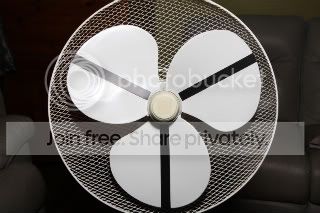
Anyway, I persisted with my second-curtain sync theory mentioned in post #33 above, using an Elinchrom D-Lite studio head this time. The theory works! And you can get the shutter to trim the tail mechanically and get an effectively shorter flash duration, but I'm not sure it's very practical. Here's what I got.

Full shot, static fan, Canon 5D2
IMG_3722-1.jpg


First curtain sync at 1/100sec
IMG_3710-1.jpg


Second curtain sync 1/200sec. Note the darker line of the black tape, and there is also much less of protection wire visible behind the blade on the right.
IMG_3721-1.jpg


While I think that's a useful benefit, note that I used 1/100sec for the first shot to emphasise the tail and bear in mind that you have to use a hack with an optical slave to get second curtain sync with studio flash (on a Canon at least) which is a bit of hassle, and the maximum benefit is at the bottom of the frame. This is at the top of the camera, where the shutter begins its travel downwards to cut off the tail.

It would be interesting to see what difference it would make with a fast-shutter camera like a Canon 1D-series, and with the second-curtain timing optimsed with the Pocket Wizard's variable delay. But I can't see it really catching on :D
 
Last edited:
Guys, my apologies - I'm talking rubbish in the post above. Yes, I know, not for the first time... :D

The difference between the two images is not between first and second curtain sync, it is just the change in shutter speed. Basically, the tail of the flash is so flippin long that it is clipped by the normal action of the shutter at max x-sync speed.

I know this because the Canon system switches out second curtain sync at speeds above 1/25sec! So the sync in both images is regular first curtain. I had an inkling there was summat amiss and checked it out, and have since tested it in a variety of ways - with the regular Canon system, at 1/25sec you can get second curtain, but at 1/30sec and higher it's regular first curtain only regardless of what's set on the gun.

You can go much higher than that with Pocket Wizards, and indeed fine tune things so that it's exactly at the rear end of the second curtain cycle - which would be very interesting to try - but I don't have PWs.

Sorry again :)
 
Last edited:
After reading all the reviews and listening to all the advice give, I'm expecting delivery of a Elinchrom ranger rx speed AS kit.

Problem now being I have lots of s-fit mods... Is there some kind of adapter to mount Bowens mods on the Elinchrom heads? I dont really expect there to be, but if there was a way it would save me some cash.

Any idea's?

Rob.
 
Back
Top